%20png%20copy.avif)

Most B2B SaaS pricing is a guess. It’s anchored to internal costs or a nervous glance at a competitor's website. Both are fundamentally broken models that systematically undervalue technology and leave revenue on the table.
Value-based pricing isn't about finding a number your customers will tolerate. It's about quantifying the economic outcome your product delivers. It anchors your price to your customer's ROI, reframing your fee as an investment, not an expense. This isn't theory; it's the operational discipline required to build a high-margin, defensible business.
Most B2B SaaS pricing is a strategic liability. Founders, especially early on, default to one of two flawed models that frame their product as a commodity, forcing them to compete on features or price instead of impact. This is the blind spot value-based pricing corrects.
These legacy models aren't just financial missteps; they're go-to-market failures. They signal to the market that you don’t fully understand the problem you solve.
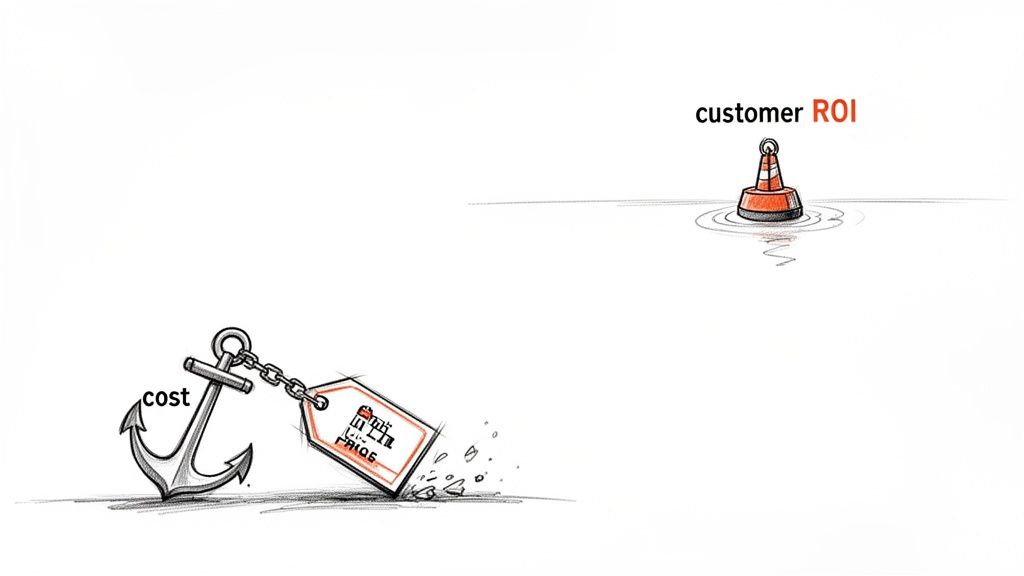
The core problem is pricing from an internal or competitive perspective, not an external, customer-centric one. This leads to two common failure modes:
The fatal flaw in both models is the absence of the customer. Your price becomes a function of your P&L or a competitor’s marketing page—not the financial return your product generates.
When price isn't tied to outcome, it creates friction across your entire go-to-market motion. Sales defends a price tag instead of demonstrating value. Marketing struggles to articulate ROI. Product lacks a clear signal on which features drive economic impact.
This misalignment leads to higher CAC and a leaky revenue bucket. Discounting becomes the primary sales tool, eroding margins and attracting price-sensitive customers. The downstream effects are severe, impacting everything from net revenue retention to your SaaS churn rate benchmarks. Pricing based on costs or competitors is a passive approach in a market that rewards conviction.
Value-based pricing anchors your price directly to the measurable economic value your product creates for your customer. It’s a commercial model based on their P&L, not yours. We’re talking about increased revenue, reduced operational costs, or mitigated business risks.
This forces a mental shift. You stop looking at your own costs or your competitors’ flimsy pricing pages. You become obsessed with your customer's business outcomes. For a B2B SaaS company, this is the only model that aligns your success with theirs. You are no longer selling a tool; you are selling a financial result.
Pricing is not a one-time decision. It is a direct reflection of your go-to-market strategy, shaping how you market, sell, and build your product. An effective model must do three things:
Cost-plus and competitor-based models fail on all three counts. They create adversarial relationships, cap revenue, and turn your product into a commodity.
Value-based pricing is the act of pricing your product based on the money it makes or saves for your customer. Anything else is a guess.
Executing this requires deep customer intimacy. You must be able to articulate not just what your features do, but what they are worth. This is where a rock-solid value proposition becomes the bedrock of your commercial strategy.
When you put the three main pricing models head-to-head, the strategic advantage of value-based pricing becomes undeniable.
The data supports this. Value-based pricing allows founders to charge based on outcomes, often translating to 20-50% higher price points. An OpenView survey found that 39% of SaaS organizations have already made the switch. For early-stage teams, this is critical. When implemented correctly, it targets a churn rate of just 5-7%—a figure cost-based pricers rarely achieve.
Value-based pricing is one of several approaches. You can explore a range of 10 powerful SaaS pricing strategies for a broader view. But for a growth-stage B2B SaaS business, anchoring price to value isn't just a strategy—it's the only one that builds a foundation for sustainable, high-margin growth.
Value is a concept; price is a number. The chasm between the two is where most pricing strategies fail. Founders talk about "value," but rarely can they translate it into a dollar amount a sales team can use in a proposal.
Quantifying value isn't an academic exercise; it's the most critical input for your commercial model. It moves pricing from a subjective guess to an objective, defensible calculation. Without this step, you aren’t doing value-based pricing. You’re just guessing with more confidence.
Most teams think they understand customer value because they run interviews and collect feedback. This is a dangerous trap. Generic discovery calls—asking about pain points or feature requests—are insufficient for pricing.
To put a number on value, you must shift from passive listening to active financial investigation. Your goal isn't to hear what customers want, but to understand what specific business outcomes are worth to them. This requires a different kind of conversation, one focused on process, cost, and consequence.
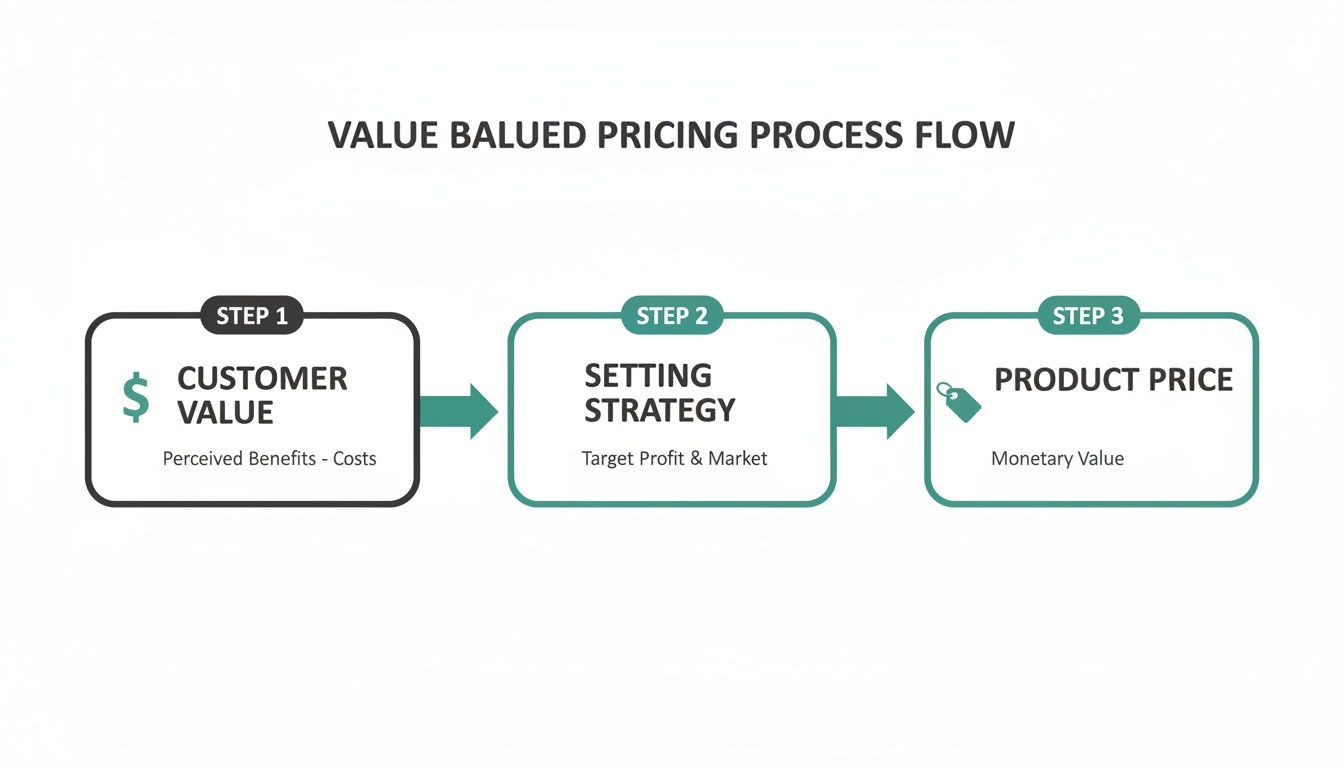
This flowchart illustrates the core logic. A defensible price is an output of value discovery, not an independent decision made in a vacuum.
To get to real numbers, you must dissect your customer's workflow before and after your solution. This means mapping their current state—the slow, expensive, or risky way they operate today—and modeling a future state where your product has eliminated those inefficiencies.
The economic impact you create almost always falls into one of three buckets:
Your job is to build a simple, believable ROI model for each scenario. This model becomes the source of truth for your pricing and the foundation of your sales messaging.
You don't find value by asking, "What would you pay for this?" You find it by asking, "How much is this problem costing you right now?" The answer to the second question dictates the answer to the first.
This isn't a one-off project; it's an ongoing operational discipline.
Conduct Targeted Value Interviews: Forget generic feedback calls. Schedule conversations with your best-fit customers. Focus the entire conversation on the "before" and "after." Ask: "Before our tool, how many people were involved in this process?" or "What was the estimated time your team spent on this task each week?"
Map the Workflow: Whiteboard their entire process. Identify every manual step, painful handoff, and clunky system they used before you. This visual map reveals the exact points of friction your product solves. That's where quantifiable value lives.
Build a Simple ROI Calculator: Create a basic spreadsheet that translates operational improvements into hard dollars. Inputs should be simple variables gathered during a sales call (e.g., number of users, volume of transactions, hours spent). The output is a clear dollar figure representing annual value. This tool is essential for setting your price and arming your sales team. A deep understanding of these drivers is also crucial for improving key customer success metrics.
Validate with Multiple Customers: One conversation is an anecdote. Five reveal a pattern. Your goal is to validate your value hypotheses across a cohort of your ideal customers. When you hear the same quantifiable pain points repeated, you've found a reliable anchor for your pricing.
This disciplined approach transforms "value" from a marketing claim into a hard number. It gives you the confidence to set a price that reflects the economic impact you deliver.
After quantifying value, you must translate that discovery into a pricing structure your customers understand and your sales team can sell.
Many founders treat tiers as feature buckets, leading to generic "good, better, best" models. An effective, value-based structure mirrors your customer's maturity and scales directly with the economic impact you deliver. This isn't just packaging; it's architecting a customer's journey with your product. Each tier should feel like a natural next step, making an upgrade compelling.
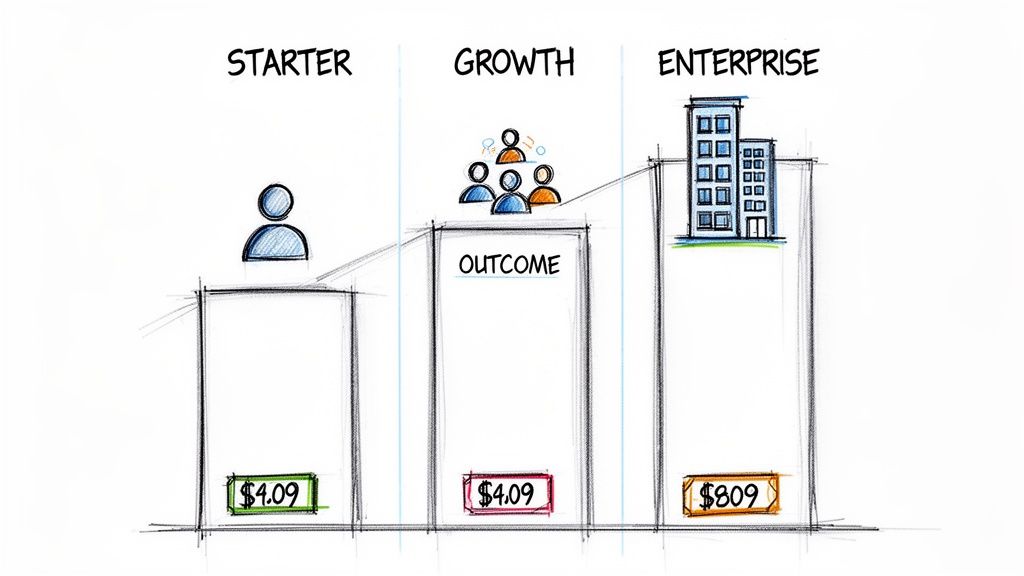
The most important decision here is choosing your value metric. This is the unit your price scales with—per user, per contact, per transaction. A bad value metric creates friction. A great one makes your pricing feel fair and intuitive.
The wrong metric is a tax on growth. Per-user pricing is the default for many tools. But if your product delivers value by automating work and reducing headcount, charging per user punishes your customer for achieving the outcome you promised.
A strong value metric has three characteristics:
Nailing this metric is the first step in building tiers that sell themselves.
Your pricing tiers mirror your customer segmentation. Each tier should be built for a specific Ideal Customer Profile (ICP) or a distinct stage in their growth.
Your pricing page is a product marketing document. Each tier should tell a story to a specific audience. If customers consistently ask which plan to choose, your tier design has failed.
The shift to value-based pricing accelerated post-2010 as SaaS pioneers moved away from rigid models. That move helped shape a market now valued at over $317 billion. Recent data shows 39% of firms now use this strategy. For a startup, this means a tool that saves an enterprise 30% on operational costs can command a premium price.
Healthy benchmarks for companies with strong value alignment show a CLV:CAC ratio of 3:1, churn under 7%, and 15-25% NRR uplifts.
Once you have this segmentation, mapping features to tiers becomes a logical exercise. You stop asking, "What can we hold back?" and start asking, "Which features are only valuable to a customer at this stage?"
A brilliant pricing model is strategically useless if your sales team cannot execute it. This is the most common point of failure. The go-to-market motion grinds to a halt because reps, conditioned to sell on features and price, lack the confidence or tools to sell on business outcomes.
Your pricing strategy lives or dies in the sales conversation. If reps can’t articulate the ROI behind your higher price, they will default to discounting. This undermines the model and signals that your value claims are flimsy. Equipping your sales team is a core requirement.
To sell on value, your reps must stop being product demonstrators and start acting as business consultants. Their job is not to walk a prospect through a feature list; it is to diagnose financial pain and prescribe a solution with a clear, quantifiable return.
This demands a shift in mindset and a new set of sales enablement assets. Generic product one-pagers and feature-heavy decks are now liabilities. Your sales materials must be rebuilt around the customer's P&L.
Your sales team’s primary job is no longer to sell software. It’s to sell a more profitable future for your customer’s business. Your product is the mechanism.
Competitive battlecards need a complete overhaul. Most are useless feature grids that force reps into a point-by-point comparison—a game you will lose against a lower-priced competitor.
A value-based battlecard flips the script. It moves from comparing features to comparing outcomes. It should arm your team to answer: "Why is our solution the more profitable choice, even at a higher price?"
This approach has a massive impact. Companies with value-based models see up to 25% higher win rates. Battlecards built around tangible value—like "Our AI saves you $50,000/year in manual labor"—give sales the ammunition to defend price and close bigger deals.
Data from OpenView shows that 32.5% of B2B leaders use this model. You can find more insights on these outcome-based models from L.E.K. Consulting.
Effective sales enablement is the bridge between your pricing strategy and your revenue reality. For a deeper dive, our guide on sales enablement best practices provides a framework for building a high-performing GTM engine.
Implementing value-based pricing is a high-stakes move. It’s powerful, but it's also unforgiving. It stress-tests your entire go-to-market engine and exposes every weakness. The teams that fail see the warning signs from day one. These are fundamental blunders that cause the entire model to implode, forcing a retreat to the false comfort of cost-plus or competitor-based pricing.
This is your pre-mortem. These are the mistakes that sink the transition.
This is the most common and catastrophic error. A flawed value metric creates immediate friction. It punishes customers for achieving the success your product is supposed to deliver.
Imagine your platform helps companies reduce headcount. If you then charge per seat, you are taxing them for getting value. This backward incentive turns your pricing into an obstacle. Customers limit usage to control costs, killing adoption and expansion revenue. If your reps are constantly justifying why the price scales the way it does, your metric is broken.
The right value metric feels intuitively fair. It scales in lockstep with the primary outcome your customer is buying. Get this wrong, and every other decision is built on a foundation of sand.
Founders fall in love with theoretical ROI calculations that live only in their spreadsheets. They build perfect-world models with no connection to the messy reality of their customers' work.
Value isn’t what you think it is. It’s what your customer perceives and can measure.
When you price based on unproven, aspirational value, your sales team sounds out of touch. The second a prospect pushes back with, “We don’t see how we could get that return,” you’ve lost. You haven't sold them on value—you’ve tried to sell them a fantasy.
A value-based pricing model is a hollow strategy if your sales team isn't trained, equipped, and incentivized to execute it. Most companies drop the ball here. They hand reps a new pricing page and expect them to connect the dots. It never works.
Without new messaging, ROI calculators, and battlecards built to sell outcomes, your reps will default to discounting. The symptoms are obvious:
Pricing isn't a one-time decision. It's a core competency that must be woven into the fabric of your sales motion. Treat it as anything less, and you are setting yourself up for failure.
Let's address the common questions that arise when moving from theory to implementation.
This is a classic chicken-and-egg problem, but it's not a blocker. Early on, you lean heavily on qualitative data. You don't need a massive dataset.
Your first step is to conduct deep, problem-focused interviews with your Ideal Customer Profile (ICP). You need to build a directional hypothesis about their biggest pains and the economic impact of those pains. Ask: "If we could save each of your reps 5 hours a week, what is that worth to the business in real dollars?"
Use those conversations to build a back-of-the-napkin ROI model. Launch with a price based on that hypothesis. Your first handful of customers are your real-world test. Refine as you gather usage data.
This is a positioning challenge, not a pricing one. You must be sharp about articulating your differentiated value.
If your product delivers measurably more value—and it has to—then your sales team must be armed to say, "You're right, we are more expensive. Here’s the specific ROI our customers achieve that makes us the more profitable choice." Your sales materials have to prove it.
Selling on value is a deliberate choice to refuse to compete on price. You are consciously carving out a premium space in the market. If you flinch at the first price comparison, the strategy falls apart.
Pricing isn't "set it and forget it." It is a living reflection of the value you deliver. A good rhythm is a minor review quarterly and a major strategic review annually.
Constant, disciplined attention to pricing is one of the highest-leverage activities a founder can undertake.
At Big Moves Marketing, we help founders move from pricing guesswork to strategic clarity. We work with B2B SaaS leadership to quantify value, build a defensible GTM strategy, and enable teams to sell on outcomes. Find out how we can help at https://www.bigmoves.marketing.
Explore Big Moves Marketing services and resources:




%20-%20white.svg)