%20png%20copy.avif)
Most advice about MVPs is wrong.
Founders hear “build the smallest possible product” and translate that into “ship a stripped-down app fast.” That's how they burn months building software that never had a real buyer, a clear use case, or a viable go-to-market path. The issue isn't speed. The issue is what you're trying to learn.
If you want the blunt answer to what is a minimum viable product, it's this: not a small product, but the smallest credible experiment that tells you whether the business deserves to exist. In B2B SaaS, that usually means testing demand, message, workflow, buyer urgency, and willingness to pay before you commit to code.
That distinction matters because startup failure is often a market problem, not a shipping problem. A widely cited startup research statistic says about 42% of startups fail because there is no market need, and one industry source reports that approximately 72% of startups use an MVP approach (startup survival and MVP adoption data). The method is common. The interpretation is where teams go off the rails.
The most dangerous MVP mistake is treating it like Version 0.1 of the final platform.
That sounds reasonable. It isn't. It pushes founders into roadmap thinking before they've earned the right to have a roadmap. They start debating features, architecture, integrations, and UI polish when the fundamental unanswered question is far simpler: does anyone care enough to change behavior, buy, or engage seriously?
In B2B SaaS, a weak MVP usually looks complex. It has a login, settings page, usage dashboard, and a bunch of half-built workflows. It can be demoed. It can even be launched. But it doesn't answer the only question that matters early on: is there a painful problem tied to a credible buying motion?
A reduced feature set can still be the wrong product for the wrong buyer with the wrong message.
That's why I tell founders to stop asking, “What's the minimum we can build?” and start asking, “What's the minimum evidence we need?” Those are different questions. One leads to code. The other leads to truth.
Most MVPs fail before launch because the team picked a build plan before defining the assumption under test.
A landing page, a manual service, a founder-led workflow, or a prototype can all qualify as MVPs if they produce real learning. A skinny SaaS app is only an MVP if it tests the core risk, not if it just exists.
If you're still framing an MVP as a first release, read Big Moves Marketing's view on the viable minimum product. The distinction is useful because “minimum” by itself creates bad incentives. Teams cut features but keep the same untested business logic.
Here's the unvarnished truth. Early B2B SaaS failure usually isn't caused by an inability to ship. It's caused by weak assumptions hiding inside product confidence.
Common examples:
None of those problems are solved by releasing a smaller app.
An MVP should expose them quickly. If it doesn't, it's not viable in the only sense that matters.
Eric Ries's Lean Startup framing made the term useful because it defined an MVP as the version of a new product that lets a team collect the maximum amount of validated learning about customers with the least effort (Lean Startup definition via Agile Alliance). That's the definition worth keeping.
Everything else is noise.

An MVP is not a roadmap milestone. It's a tool for reducing uncertainty. It helps you decide whether to continue, change direction, or stop before the company sinks time and budget into the wrong thing.
Most founders say they're de-risking the product. Usually they're not. They're de-risking implementation. That matters far less than they think.
The biggest early risks in B2B SaaS are usually these:
If your MVP doesn't target one of those risks directly, it's probably a distraction.
Founders sometimes hear “least effort” and think they're allowed to be sloppy. Wrong. The market won't separate your experiment design from your company. Buyers will judge the experience in front of them.
So the rule is simple. Minimize effort internally. Preserve credibility externally.
That can mean a manual backend, a narrow use case, or a single workflow. It does not mean a broken onboarding flow, vague positioning, or a confusing demo. Your MVP still has to create enough trust for a buyer to reveal real intent.
Practical rule: Your MVP should be cheap in engineering effort, not cheap in customer perception.
For B2B founders trying to make that shift, how B2B SaaS founders should validate a startup idea is the more useful planning lens than another feature-prioritization session.
The point of the experiment is not activity. It's decision quality.
After the MVP, you should be able to say one of three things with conviction:
If your MVP ends with “we need more time” by default, you probably designed it to avoid truth.
Most MVP conversations collapse because founders pick a format too early. They decide they need a prototype, a no-code app, or a stripped-down SaaS product before they've decided what they're trying to validate.
That's backwards.
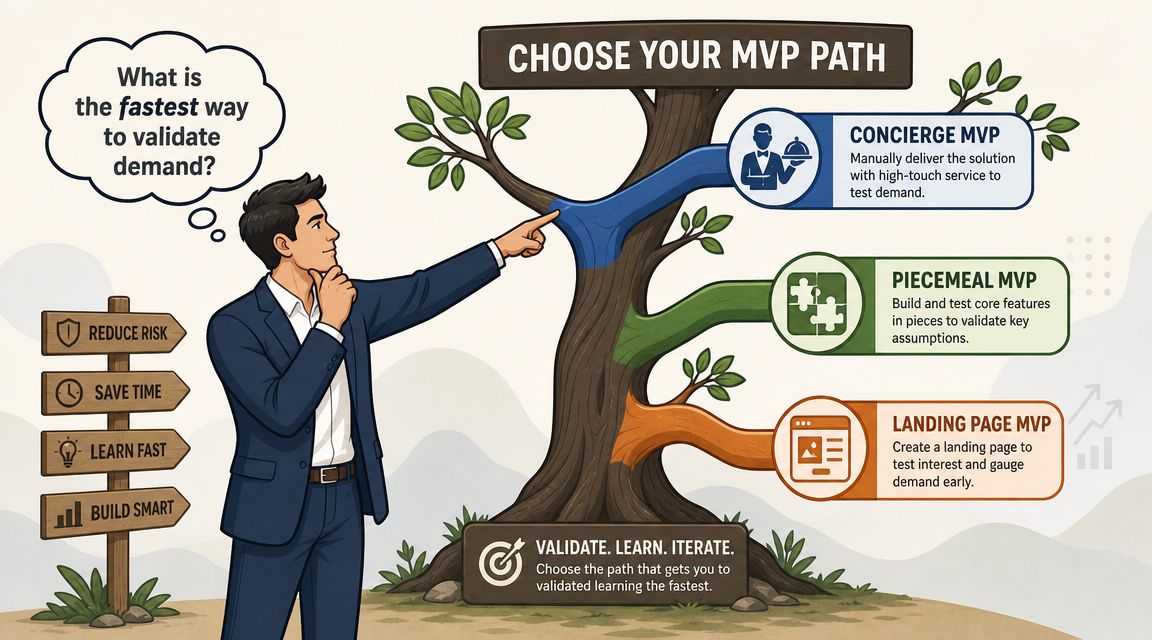
A widely missed point in mainstream MVP thinking is that the first experiment doesn't always need to be a product at all. A smoke test, landing page, concierge service, or prototype may be a better first move because the goal is learning with the least effort, not shipping software (why an MVP may not need to be a product).

Different MVP types answer different questions.
If you want to know whether buyers care, use a demand test. If you want to know whether a workflow can be delivered, use a manual service. If you want to know whether users can complete the core action repeatedly, then a coded product may finally make sense.
Founders typically waste time. They use a software MVP to answer a message question. Or they use a landing page to answer a retention question. Wrong tool, wrong signal.
MVP typeBest used to testGood fit in B2B SaaSWeaknessLanding page MVPWhether the value proposition earns attention and responseNew category positioning, demo-led demand capture, waitlist or call bookingCan overstate demand if traffic quality is poorSmoke testWhether buyers will click, inquire, or attempt to buyPricing page tests, outbound campaigns, category framingInterest is not the same as usageConcierge MVPWhether you can manually deliver the promised outcomeHigh-value workflows, services wrapped as software, founder-led deliveryHard to scale if the workflow has no repeatable structurePiecemeal MVPWhether existing tools can simulate the solutionInternal ops tooling, reporting workflows, integrations, back-office automationCan become duct tape that hides product complexityPrototypeWhether buyers understand and want the interaction modelEnterprise buying, complex platforms, multi-stakeholder demosDoesn't prove sustained behavior on its ownSingle-feature productWhether users repeatedly use one core workflowShopify apps, narrow utilities, self-serve productsToo narrow if the buying decision depends on surrounding context
A few examples make this clearer.
User research matters here because assumptions usually break at the message layer before they break at the feature layer. If you need a cleaner way to test that, how to conduct user research is the right discipline to bring in before another build sprint.
The smartest MVP is often the one your engineering team is least excited to build.
That's because manual experiments are emotionally unsatisfying. They don't feel like product progress. But they often produce the fastest commercial truth.
MVP choice should be driven by buying context, not founder preference.
A lot of teams pick the MVP type that matches their internal strengths. Product-led founders default to code. Sales-led founders default to decks and demos. Both can be wrong. The right choice depends on what a buyer has to believe, who has to believe it, and how much organizational change the product requires.
Expert guidance describes the MVP as an ROI-to-risk optimum, large enough to trigger adoption, satisfaction, and sales, but small enough to avoid bloated scope. The practical implication is simple: prioritize by revenue-weighted customer value, not by the total number of requests (productboard on right-sized MVP thinking).
If you sell into larger accounts, your MVP needs enough fidelity to survive scrutiny.
A CIO or VP Ops won't buy because your prototype is clever. They buy when the workflow feels credible, the implementation path looks manageable, and the business case is legible. In that environment, a clickable prototype paired with founder-led discovery, a narrow pilot, or manual fulfillment often beats a flimsy self-serve app.
Use higher-fidelity MVPs when:
If funding is part of the equation, founders evaluating capital options may find this roundup of Angel investors for UAE MVP development useful. Not because capital fixes validation, but because weak funding choices often pressure teams into premature builds.
Not every product needs a heavy first move.
If the product is narrow, the user is obvious, and the value is immediate, a landing page, smoke test, or single-feature build can work. That's more common in utility products, internal tools, or narrower app ecosystems like Shopify where the install path is shorter and the promised value is easier to grasp quickly.
Use leaner MVPs when:
The key is discipline. Thin doesn't mean random. It means tightly matched to the commercial question.
An MVP without a measurement plan is just founder theater.
In Lean Startup terms, the MVP exists to generate validated learning with the least effort. In practical B2B terms, that means your MVP should be built around one measurable hypothesis, such as conversion from landing page to demo request, activation to first value, or trial-to-paid conversion (single measurable hypothesis guidance from Shortcut).
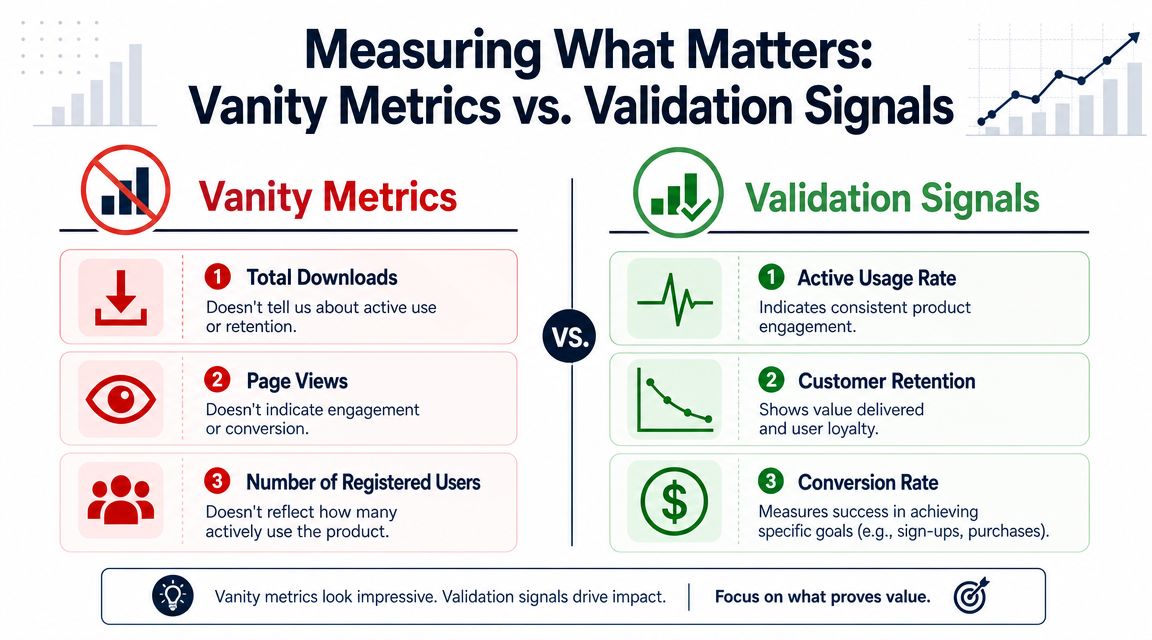
Teams tend to measure what's easy to collect, not what resolves uncertainty.
Page views, impressions, raw signups, demo attendance, and positive comments all create noise. They can be directionally useful, but they don't answer whether the business assumption held. You need a metric that ties directly to the question behind the experiment.
Here's the test. If the metric goes up, can you make a better investment decision? If not, it's vanity.
Don't ask whether people noticed your MVP. Ask whether they took the next costly action.
A short explainer can help teams align on that difference:
The metric should fit the experiment.
A lot of teams also need a forcing function for PMF readiness. This product-market fit checklist is useful because it shifts the conversation from top-of-funnel activity to actual evidence of pull.
Founders love post-hoc interpretation because it protects ego.
Don't do that. Before the MVP goes live, define what would make you kill, pivot, or continue. Decide which behaviors count as proof. Decide which objections are fatal. Decide what non-response means.
If you wait until after launch to interpret results, you'll rationalize almost anything.
Theory is clean. Actual founder behavior isn't.
Most MVP failures follow a few familiar patterns. They don't look dramatic at first. They look like “reasonable next steps.” Then six months disappear.
A founder launches a stripped-down product with broken onboarding, unclear copy, and a workflow that barely works. Buyers bounce. The founder concludes there's no demand.
That conclusion is usually lazy.
The market didn't reject the category. Buyers rejected a low-trust experience that failed to deliver a usable promise. “Minimum” doesn't excuse confusion.
How to sidestep it:
Another founder proves they can deliver the outcome manually. Customers are happy. Early revenue appears. Everyone celebrates.
Then the trap shows up.
The delivery depends on founder judgment, heroic service, and custom work that can't be turned into a repeatable product workflow. The MVP validated demand for a service, not necessarily for software.
If your MVP works only when the founder is in every step, you haven't validated a product. You've validated founder labor.
How to sidestep it:
This one is the most common in product-strong teams.
They spend months building. The launch signal is weak. Instead of accepting the result, they add features, broaden the ICP, revise pricing, and reinterpret feedback until the original hypothesis is unrecognizable. They're not iterating. They're avoiding the verdict.
How to sidestep it:
MVP discipline is mostly emotional discipline. Teams don't fail because they lack frameworks. They fail because they don't want the answer.
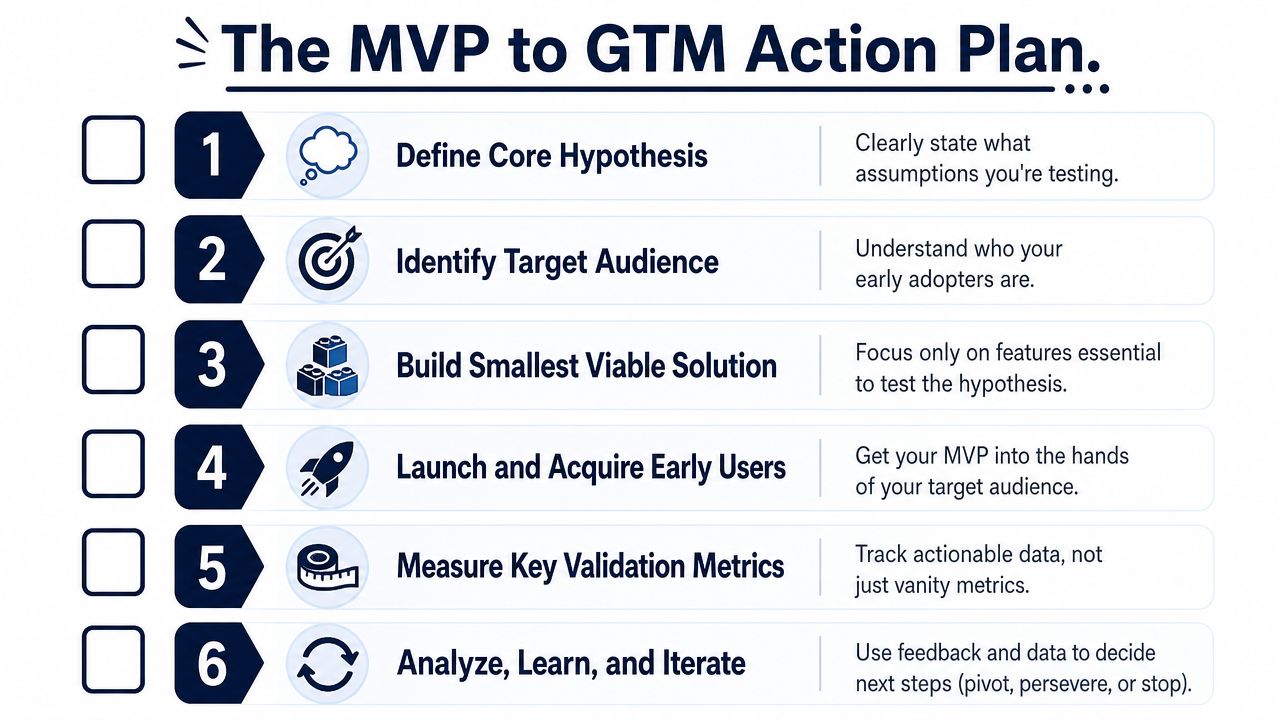
A useful MVP plan should fit on one page. If it doesn't, you're probably planning a product launch, not a validation exercise.
The founder's job is to force clarity before anyone starts building. That means defining the assumption, the audience, the test format, the success signal, and the decision rule. It also means deciding how you'll get the experiment in front of the right people. An MVP with no distribution plan is just a private prototype.
For teams that need a broader tactical complement, this guide to expert tips for building MVPs is a useful companion. Use it after strategy is clear, not before. Sequence matters.
If you need the commercial side of the launch mapped properly, a product launch plan template helps tie the MVP to actual market exposure instead of internal assumptions. Big Moves Marketing also sits in that layer of work as a strategic option when founders need tighter positioning, clearer GTM hypotheses, and a more disciplined validation plan before scaling spend or headcount.
The shortest accurate answer to what is a minimum viable product is this: the minimum test that can tell you whether the business deserves more investment. In B2B SaaS, that often means validating market, message, and monetization before you obsess over product breadth.
Build less. Learn faster. Believe evidence.
If your team is building before it's thinking clearly, Big Moves Marketing can help tighten the positioning, define the GTM hypothesis, and design an MVP that tests the business, not just the software.





%20-%20white.svg)