%20png%20copy.avif)

A successful B2B product launch isn't a one-day event; it's a full-blown campaign that kicks off long before the actual release. A solid product launch plan template is more than just a checklist. It's the strategic framework that gets your entire company aligned and telling the same story. This guide gives you that framework, turning your plan into a real revenue-driver.
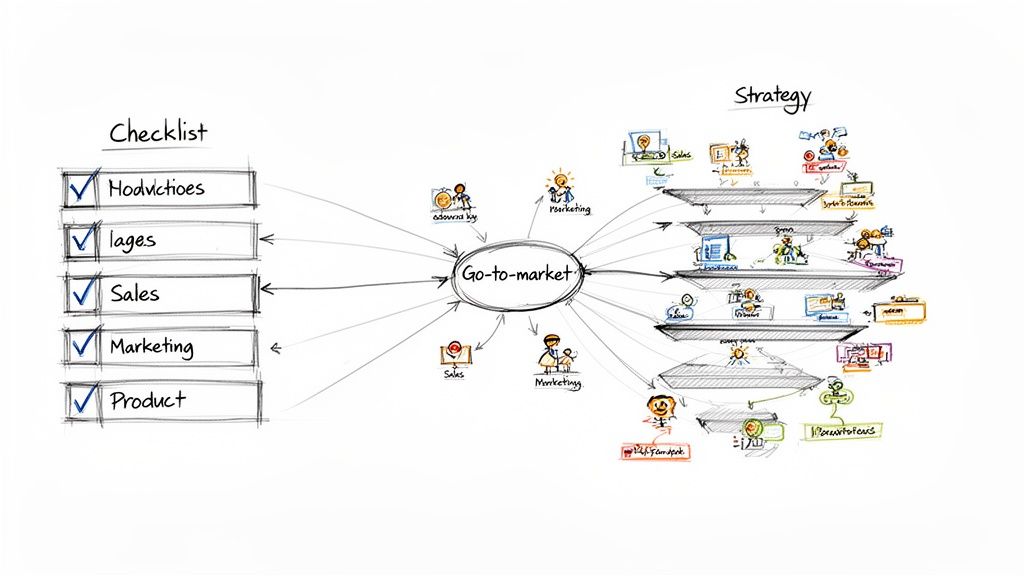
Let's be direct. Most "product launch plans" are just glorified to-do lists. They help you check boxes, but they do almost nothing to create real market impact. After spending over 15 years in the B2B SaaS world, I've seen this approach lead to missed targets and a ton of internal friction more times than I can count.
A strategic plan, however, sets the foundation for a win. It reframes the launch from a collection of disconnected tasks into one cohesive, story-driven campaign. This is how you avoid the classic mistakes that sink otherwise great products—like sales and marketing being completely out of sync, or a message that just doesn't land with your ideal business customer.
The big difference is moving from what you need to do to why it matters. A checklist might say, "Create battlecards." A strategic plan makes sure those battlecards are armed with differentiated messaging your sales team can actually use to close deals.
This shift in thinking is non-negotiable for growth. Product launches are a massive revenue driver for modern B2B companies. In fact, for many organizations, over 25% of total revenue and profits comes directly from new product releases. This stat alone shows why a structured plan is so essential for grabbing market share.
A great launch plan doesn’t just list deliverables; it orchestrates a story. It ensures every team, from product to sales, is telling the same compelling story to the market, creating clarity and building momentum from day one.
Our downloadable template is designed to do just that. It breaks down the launch into distinct, manageable pillars that ensure every aspect of your go-to-market motion is covered.
This structure ensures nothing falls through the cracks and everyone knows their role in making the launch a success.
Ultimately, the goal is to get everyone moving in the same direction. A well-crafted plan acts as the single source of truth, aligning your entire organization around shared goals and a unified vision.
This alignment is the heart of an effective go-to-market motion. A truly successful product launch requires more than a simple checklist; it needs a robust and comprehensive go-to-market strategy.
If you want to go even deeper, check out our guide on building a B2B go-to-market strategy framework at https://www.bigmoves.marketing/blog/go-to-market-strategy-framework-b2b.
In this guide, we give you the downloadable template right upfront, then dive into the actionable strategies that turn that plan into real results.
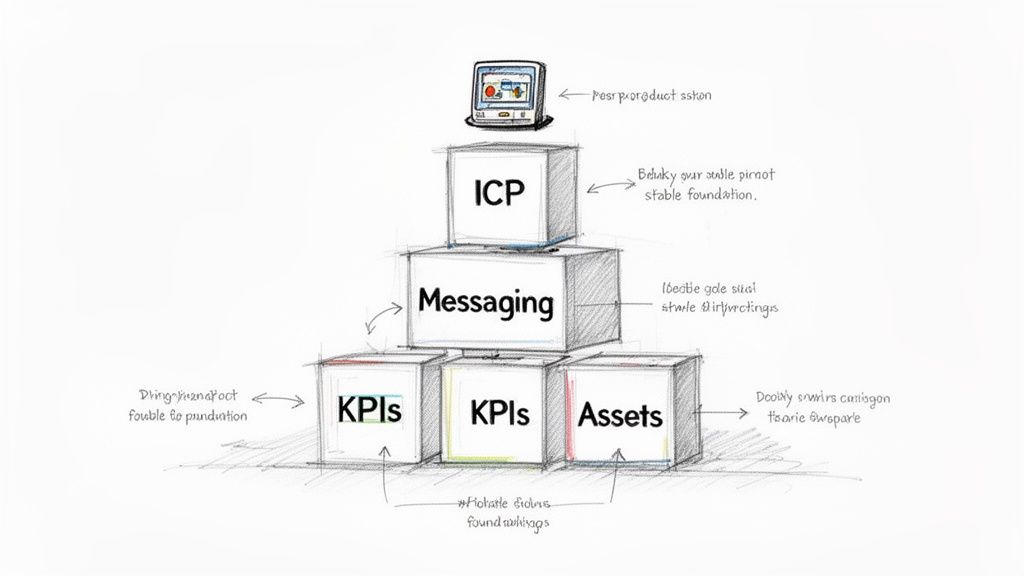
A B2B product launch doesn't just happen on launch day. The real work—the heavy lifting that determines success or failure—starts weeks, sometimes months, in advance. This pre-launch phase is where you build the bedrock for your entire go-to-market strategy. It’s your chance to turn educated guesses into solid convictions about your market, your message, and your team's readiness.
This is why professional launch plans are almost always broken into three stages: pre-launch, launch, and post-launch. It’s an industry standard for a reason. This structure methodically organizes the work across product, engineering, marketing, sales, and support, making sure nothing falls through the cracks.
Before you write a single line of copy or design one sales slide, you need to know exactly who you're selling to. A vague target like "mid-market tech companies" is a surefire recipe for a diluted message that ends up resonating with no one.
What you need is a razor-sharp Ideal Customer Profile (ICP). This goes way beyond basic firmographics like company size or industry. A great ICP for a B2B product gets into the real-world business problems your buyers face, the outcomes they’re responsible for, and the operational headaches that keep them up at night.
A well-defined ICP is critical for a few reasons:
Moving from a general idea to a documented ICP is a non-negotiable first step. If you're looking for a structured way to do this, check out our guide on creating a data-driven https://www.bigmoves.marketing/blog/ideal-customer-profile-template for B2B companies.
Once you have a crystal-clear ICP, it's time to craft a message that actually connects with them. In my experience building pitch decks for over 70 tech companies, the most common mistake I see is leading with features instead of value. Your B2B customers don't buy features; they buy solutions to their problems and a clear path to better business outcomes.
Your messaging needs to translate what your product does into what it means for your customer's business. This is your core value proposition. Keep it simple, direct, and make sure it answers the one question every B2B buyer is silently asking: "Why should my company care?"
From that core proposition, you can build out a full messaging framework:
The goal isn't just to be understood; it's to be undeniable. Your messaging should make the value of your product so clear that choosing a different path feels like a business risk.
Not every product is ready for a full-scale launch on its target date, and hope is not a strategy. You need objective, pre-defined go/no-go criteria to make an informed decision. This process pulls emotion and internal pressure out of the equation, replacing them with data-driven checkpoints.
These criteria need to be agreed upon by all stakeholders—product, engineering, sales, and marketing—long before the pressure is on. This ensures everyone is aligned on what "ready" actually means.
Example Go/No-Go Criteria for a B2B Launch:
As you get these assets ready, using a guide to a killer lead generation landing page template can be a huge help in making sure your marketing materials are effective from day one.
These checkpoints create accountability and prevent a premature launch that could seriously damage your brand's reputation. A short delay to meet these standards is always, always better than launching a product that isn’t truly ready for the market.
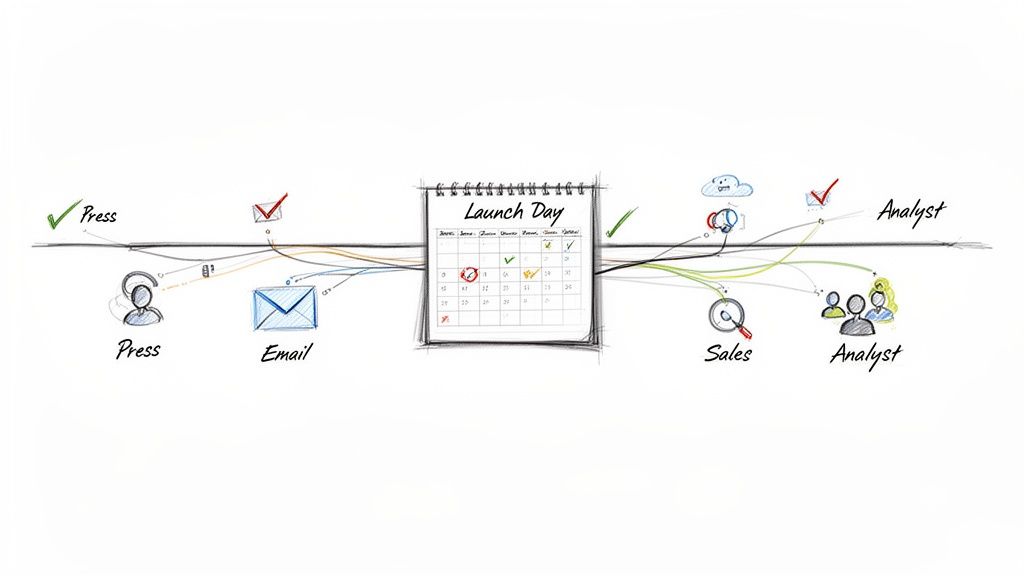
Launch day is when your strategy hits the real world. All the planning, positioning, and late-night prep work from the pre-launch phase finally pays off. This isn't just about pushing a button; it’s a carefully orchestrated performance designed to grab the market's attention and spark immediate interest.
A well-run execution phase is more than a checklist on a timeline. It’s about synchronizing every single go-to-market activity to create one loud, clear, and powerful impact. This is how you manage the controlled chaos of launch week and turn a simple product release into an event people remember.
Your message needs to feel like it's everywhere at once for your target B2B audience. To do that, you have to get your marketing channels working in concert, each one amplifying the others. A disconnected effort, where every channel is off doing its own thing, just muddies the waters and confuses potential business customers.
Think of it like putting on a show. The press release is your opening act, setting the stage for what’s to come. Analyst briefings offer the expert reviews, while your email campaigns are the personal invitations sent to your most important prospects.
Here’s how you can make these channels hum together:
This unified push makes sure that no matter where a prospect stumbles upon your launch, they get the same strong story. For a deeper look at how to structure all this, our guide on building a B2B SaaS marketing plan is a great place to start.
Your sales team is in the trenches, and their confidence on launch day is everything. Firing off an email with a link to the new product page just won’t cut it. They need to be armed and ready to convert all that marketing buzz into actual pipeline.
This means getting them the right tools at exactly the right moment. Your sales enablement assets shouldn't just be informational PDFs; they need to be practical, punchy, and built for real conversations with real business prospects.
A few must-have assets include:
The whole point of launch-day sales enablement is to eliminate any hesitation. When a rep feels like they have all the answers, they can get back to doing what they do best: selling.
The chaos of launch week isn't just external; what's happening inside the company is just as crucial. The entire organization needs to be in sync and ready to react to whatever the market throws at you. A good internal communication plan keeps everyone on the same page.
Something as simple as a dedicated Slack channel can act as a command center for real-time updates. Daily stand-up meetings during that first week help teams flag issues, share early wins, and stay coordinated.
This constant communication is what allows you to be agile. If you start hearing that a certain message isn't landing or a particular feature is getting all the attention, you need to be able to pivot fast. A responsive internal team can adjust the strategy on the fly, making small tweaks that can have a huge impact on your launch's success. It ensures everyone is working together to build momentum and tackle any surprises that pop up.
The launch-day champagne has been popped and the congratulatory Slack messages have slowed to a trickle. Your product is live. It’s a huge milestone, but for experienced B2B teams, this isn't the finish line—it's the starting line for the real race.
That initial flurry of activity is just potential. The post-launch phase is where you turn that potential into sustainable growth. This is your chance to listen with intent, learn from every user interaction, and adapt faster than your competition. The next 90 days are a goldmine of unfiltered feedback and hard data, and your job is to mine it effectively.
Your first month is all about creating a powerful, proactive feedback loop. Your early business adopters are your most critical asset right now. They’re using your product with fresh eyes and are often surprisingly willing to share what they love, what they hate, and what just plain confuses them. You just have to make it easy for them.
Don't just sit back and wait for the feedback to roll in. You have to go get it.
The goal here isn't just to collect bug reports. You're hunting for patterns. Are ten different B2B users getting stuck at the same step in your onboarding? Is one feature you considered minor getting rave reviews? This is the raw material for your first product iterations and marketing message tweaks.
As you roll into your second month, your focus expands from qualitative stories to quantitative data. It's time to see if the KPIs you defined before launch are actually moving. Are people not just signing up, but truly using the product?
This is where you have to look past vanity metrics. A spike in sign-ups is nice, but it doesn't tell you if you have a viable product. You need to dig into user behavior.
Key B2B metrics to obsess over now include:
The goal in this phase is to turn data into a story. If feature adoption is low for a key workflow, that’s not a failure—it’s a signal. It might mean you need better in-app guidance, a clearer value proposition, or an improved user experience.
This is also the perfect time to get serious about optimizing your onboarding. A smooth, guided introduction can be the difference between a user who sticks around for years and one who churns in a week. For some battle-tested ideas, check out our deep dive into customer onboarding best practices.
By the end of the first quarter, you should have a powerful combination of gut-feel from user conversations and hard evidence from your analytics. Now, it’s time to synthesize it all and shape the future. These insights are pure gold for refining your product roadmap and sharpening your go-to-market strategy.
The final, crucial step is to run a post-mortem. This isn't about pointing fingers. It’s a blame-free, collaborative review focused on one thing: getting better for the next launch.
Get the entire cross-functional launch team in a room and ask three simple questions:
Document the answers and, most importantly, turn them into an action plan. This process ensures that every launch—successful or not—becomes a strategic asset. You’re not just shipping products; you're building a repeatable, scalable engine for growth that gets smarter and more effective every single time.
Frameworks are great, but nothing makes a plan click like seeing it in the real world. To take the guesswork out of it, let's walk through a tangible, filled-out example using our product launch plan template. This will bring the whole strategy to life, showing you exactly how to apply the principles we've covered to a fictional B2B SaaS company.
Let's meet "ConnectAI," a new platform designed to help sales teams automate their follow-up sequences with AI-driven insights. They're gearing up to launch a new enterprise-tier module, and this is how they map it all out.
The first thing the ConnectAI team does is pin down the core mission for this launch. This isn't just about shipping a new feature; it's about making a specific, measurable impact on the business and, more importantly, their customers.
Their positioning statement is direct and cuts right to the chase: "For enterprise sales leaders who are losing deals due to inconsistent follow-up, ConnectAI's new module is the only AI-powered platform that analyzes prospect engagement to automate and personalize outreach, ensuring no opportunity is ever missed."
Just like that, anyone reading it knows exactly who it's for, the problem it solves, and what makes it different from everything else out there.
To keep everyone honest and prevent a premature launch, the team establishes some hard-and-fast go/no-go criteria. These aren't suggestions; they're non-negotiable checkpoints that align every department on what "ready" actually looks like.
Their Key Performance Indicators (KPIs) are just as specific. They're focused on real business outcomes, not fluffy vanity metrics. The target is 50 new enterprise trial sign-ups and a 15% feature adoption rate among those new users within the first 30 days.
A launch plan without clear, measurable goals is just a wish list. By defining success upfront with go/no-go criteria and specific KPIs, you create accountability and give your team a clear target to aim for.
The timeline is where all that strategy turns into concrete action. It breaks down the entire launch into manageable phases with clear owners for each task. It's all about making sure nothing falls through the cracks.
Here’s a simplified look at how ConnectAI structures their launch activities in a timeline table.
This condensed timeline from our filled example highlights key deliverables, team ownership, and deadlines, ensuring every team knows its role as launch day approaches.
This kind of table provides a quick, scannable overview that keeps the entire launch team aligned and on schedule.
ConnectAI knows that even the best product won't sell itself. A successful launch depends on an empowered, well-equipped sales team. Their sales enablement materials are practical and built for the real world—think a one-page "mini battlecard" with key talking points, competitive differentiators, and pre-written answers to the most common objections.
Their communications plan is just as targeted. They’ve prepared a sequence of emails for different segments: existing customers, warm leads, and cold prospects. This ensures the message is always relevant to the audience’s relationship with the company. It’s this level of detailed prep that ensures on launch day, everyone is confident, aligned, and ready to execute.
Well-structured templates really can make a huge difference here. For instance, Figma's Product Launch Template has been shown to cut preparation time by 20%, while the integrated plans in Notion can lead to 15% faster iteration on things like onboarding processes. To see how other companies are doing it, you can explore more examples of effective launch plans.
The visual below shows how you can map out the critical first 90 days to keep the energy high after the initial launch buzz fades.
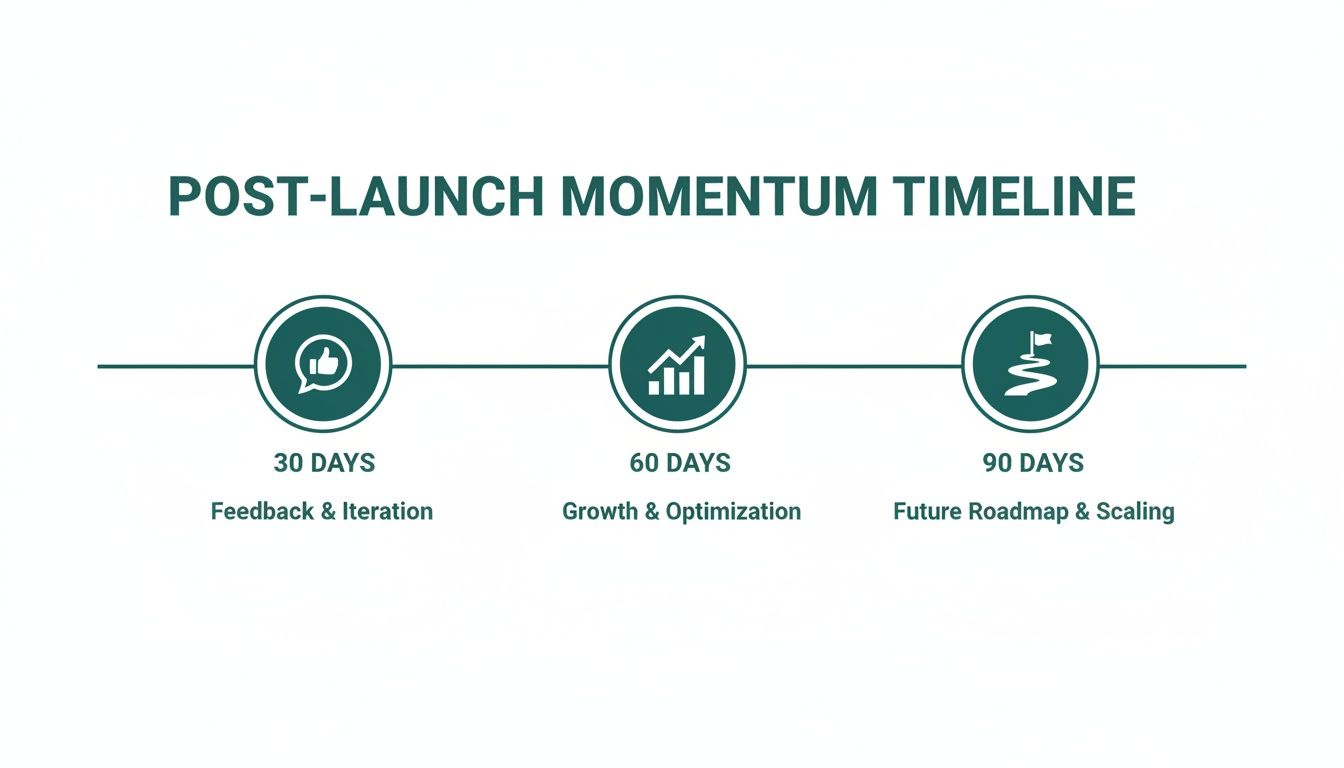
This kind of structured timeline ensures your team stays focused on what matters most post-launch: collecting feedback, driving growth, and making smart decisions for the future roadmap.
Even the best-laid plans run into real-world questions. Once you start applying a framework like this, the "what ifs" and "how do I..." moments are inevitable. That's actually a good thing. It's where experience turns a solid template into a battle-tested process you can rely on again and again.
Let's dig into some of the most common questions I hear from B2B founders and product marketers when they start putting a product launch plan template into practice. The goal here is to get you past the theory and into confident execution.
This one comes up constantly. When your entire company can fit in a single sprinter van, a plan with a dozen different "owners" can feel pretty intimidating.
The secret is to focus on outcomes, not roles. Forget the titles in the spreadsheet. On a small team, one person is often the Head of Product Marketing, Sales Enablement, and Demand Gen all before their first coffee break.
Instead of getting bogged down, ask: what are the absolute, non-negotiable things we need to get right for this launch to have a shot?
Don't try to boil the ocean. A small team wins by being ruthlessly focused and agile. Pinpoint the 20% of launch activities that will drive 80% of the results and ignore the rest.
There’s no magic number here, because the budget question is really a strategy question in disguise. It forces you to get honest about your priorities. Are you placing your bets on paid ads, content, or direct outreach?
For an early-stage B2B SaaS startup, a "lean" launch budget might be close to $0 in cash, focusing entirely on "sweat equity" activities. This is about investing time, not dollars, into things like creating one truly exceptional piece of content, personally engaging in niche online communities, or doing direct outreach to your hand-picked list of ideal business customers.
As you get more funding or traction, you might start layering in paid channels:
Start small, prove what works, and earn the right to spend more. A successful, scrappy launch gives you the data and the confidence to justify a bigger investment next time around. For more ideas, our guide on how to launch a new product offers additional strategies you can apply.
It's so easy to get hooked on vanity metrics in the first 30 days—things like website traffic, social media impressions, or the number of signups. While those numbers aren't totally useless, they don't tell you the most important thing: is your product actually working for businesses?
Instead, zero in on the metrics that signal real engagement and give you an early read on product-market fit.
These are the leading indicators. They tell you if you're pointed in the right direction long before you have enough data to track things like churn or LTV. Get these right, and you'll have the insights you need to iterate your way to sustainable growth.
Ready to stop guessing and start executing? At Big Moves Marketing, I help B2B SaaS and AI startups build and execute the launch strategies that drive real revenue. Let's build your next big move together. Find out more at https://www.bigmoves.marketing.
Explore Big Moves Marketing services and resources:



%20-%20white.svg)