%20png%20copy.avif)

Most advice on market entry is built for companies that ship containers, open offices, or negotiate retail placement. That's not your problem if you run B2B SaaS.
For a software company, market entry usually isn't a geography decision first. It's a decision about which customer segment, vertical, use case, pricing band, and acquisition channel you can win with predictable economics. If you miss that, you end up doing expensive “expansion” before you've proven that anyone in the new market cares enough to buy.
That mistake is common, and it isn't harmless. A 2025 SaaS Metrics Report cited by NMS Consulting notes that 68% of SaaS firms entering new segments fail due to misaligned digital go-to-market, with only 22% leveraging multi-channel experiments effectively (NMS Consulting). That's the issue. Not whether you picked Germany before the UAE, but whether you picked a winnable wedge and a channel mix that can validate demand fast.
Founders love to say they’re “entering a new market” when what they really mean is “we want revenue from somewhere else.” That's too vague to be useful.
In B2B SaaS, the better question is this: what is a market entry strategy if your product is already globally accessible? It's a plan to win a specific new pocket of demand. That might be fintech compliance teams in the UK. It might be mid-market healthcare operators in North America. It might be a move upmarket from self-serve to enterprise.
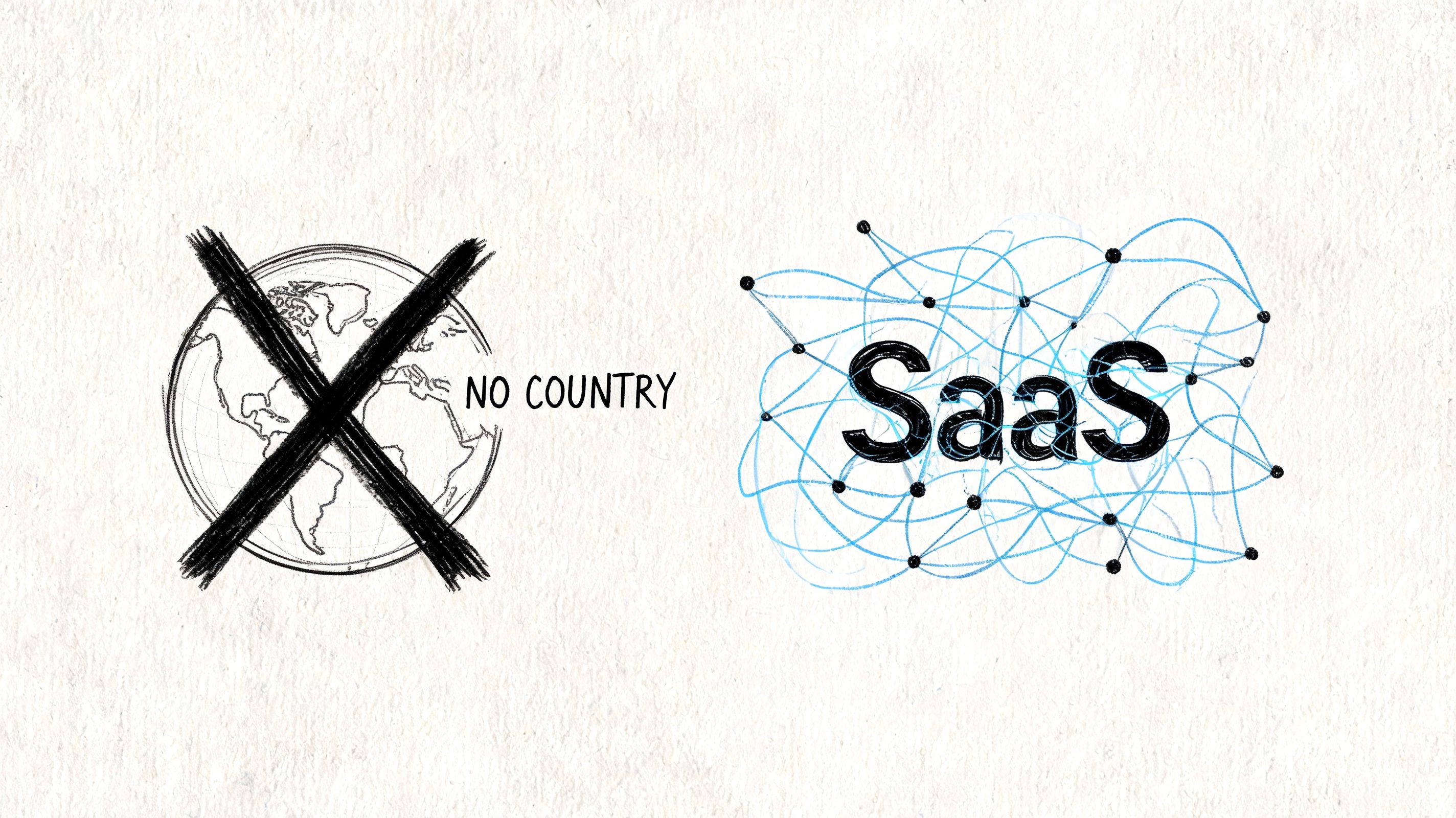
Physical businesses need to solve import rules, distribution, local inventory, and operating entities early. SaaS often doesn't. Your first constraint is usually message-market fit, not customs paperwork.
That’s why most generic advice on strategies for entering new markets feels off for software founders. It overweights entry modes built for physical businesses and underweights the SaaS question: can you generate qualified pipeline from a new segment without burning your team for six months?
Hard truth: If your positioning is muddy in your current market, expansion will amplify the problem, not solve it.
A lot of teams mistake adjacency for opportunity. They see a new country, bigger TAM, or a noisy competitor raise money and assume they should follow. Then they reuse the same homepage, same sales deck, same pricing page, and same outbound language for a completely different buyer.
That isn't a market entry strategy. It's a distribution of confusion.
Think in terms of buying conditions, not borders.
A “market” in B2B SaaS is usually defined by combinations like:
If you need a more disciplined way to choose where to focus, this breakdown of how to identify target markets in B2B is the right starting point.
The mistake isn't expanding. The mistake is treating market entry like a map problem when it's really a fit and distribution problem.
Here's the definition that matters.
A market entry strategy for B2B SaaS is a focused plan to acquire the first meaningful cohort of customers in a new segment, vertical, or region with economics you can repeat. Not random wins. Not founder heroics. A system you can scale without rebuilding the company every quarter.
Research summarized by Growth Factor says that for every successful market entry, approximately four others fail, and around 65% of startups falter due to inadequate strategies (Growth Factor). That’s why vague ambition isn't enough. You need a blueprint.
Most founders spread too early. They pick a category that sounds big, then try to serve every plausible buyer in it. Sales hears one story. Marketing tells another. Product starts shipping edge-case requests. The result is familiar. A little traction, no real momentum.
The better move is a beachhead.
Pick one narrow, defensible wedge where four things are true:
If one of those is missing, your “new market” will eat time and cash.
A real SaaS entry plan needs five parts. Nothing academic. Just the pieces required to make good decisions.
Your ideal customer profile can't be “mid-market companies.” That's useless.
You need specificity around company size, buyer role, trigger event, existing stack, urgency, and internal politics. A market is not attractive because lots of companies exist in it. It’s attractive because a concentrated subset has a painful problem and a fast path to purchase.
Your existing message probably won't travel cleanly.
The product can stay the same while the buying reason changes. A compliance team buys certainty. A revenue leader buys speed. An operations leader buys fewer manual failures. Same platform. Different entry language.
The product is constant. The reason to care changes by segment.
You need a route to first customers. Direct sales, self-serve, partner-assisted, or a pilot-led motion. This choice shapes speed, control, and feedback quality. It also determines how quickly you learn what's broken.
Most SaaS teams often remain superficial. They say “we'll run LinkedIn, content, and outbound” as if channels are a strategy.
They aren't. They’re delivery mechanisms. Your distribution plan should specify which channel validates demand fastest, which channel creates proof, and which channel compounds over time. If you want a sharper operational view, this guide to go-to-market strategy for SaaS is useful because it forces channel choices back into ICP and positioning logic.
Don't enter a market without kill criteria.
You need explicit thresholds for pipeline quality, conversion, sales cycle friction, implementation burden, and retention signals. Otherwise teams keep “testing” long after the evidence says stop.
They assume entry starts at launch. It doesn't.
It starts the moment you decide what not to pursue. Good market entry strategy is mostly disciplined exclusion. You narrow the buyer, narrow the promise, narrow the offer, and narrow the channels until the signal gets clear enough to act on.
That’s what gives you a shot at repeatability.
The worst way to choose a market is by chasing the largest TAM slide in the board deck.
Big markets attract attention because they make strategy look ambitious. They also hide bad judgment. If you can't reach, convert, and retain a dense cluster of buyers, TAM is trivia.
Founders often ask, “How big is the market?” The better question is, “How many accounts can we realistically reach, convince, and onboard with our current team, product, and sales motion?”
That means shifting from top-down fantasy to bottom-up reality.
Use these filters first:
If the market looks huge but every deal requires custom integrations, six stakeholders, and a security review marathon, that's not an opportunity. That's a trap.
In this regard, founders need more discipline.
Leland’s market entry framework recommends assessing attractiveness with break-even analysis, using this formula: required market share for break-even = Fixed Costs / (Average Selling Price × Contribution Margin Ratio) (Leland). The same source notes that average B2B SaaS profit margins range from 20% to 40% in mature markets, and gives this example: with fixed entry costs of $500K, ASP of $50K per year, and contribution margin of 60%, break-even requires about 17% market share in a $100M segment. For most startups, that’s unrealistic.
That example matters because it exposes a common delusion. Founders underestimate how much share they need in a narrow segment to justify entry costs.
A clean decision framework beats founder instinct dressed up as vision.
CriterionDescriptionWeight (1-5)ICP densityConcentration of target accounts with similar pain and buying context5Problem urgencySeverity and immediacy of the use case you solve5Channel accessibilityEase of reaching buyers through channels your team can already operate4Sales complexityExpected friction from procurement, security, legal, and implementation4Competitive whitespacePresence of a clear angle against incumbent positioning4Pricing fitAlignment between customer value perception and your likely pricing power4Expansion potentialAbility to grow from initial use case into broader account adoption3Operational burdenInternal effort needed across product, support, and customer success3
Don't overcomplicate it. Score each candidate market. Compare them side by side. Force trade-offs into the open.
Practical rule: Pick the market where your current strengths matter most, not the one that flatters your ambition.
A lightweight PEST review still matters for SaaS. Economic conditions, regulatory posture, data sensitivity, and buyer conservatism all affect speed to revenue. But keep it practical.
If you're evaluating a region where entity structure, taxation, or operating setup may matter, this breakdown of insights on UAE company formation is a useful example of the operational questions that can sit behind an otherwise attractive market.
For demand selection, though, your first work is still customer clarity. This ideal customer profile template helps force that discipline. Without it, founders keep selecting markets they can't penetrate.
Walk away if any of these are true:
A good market is one you can enter with conviction, not one you can justify in a spreadsheet.
Most traditional market entry models don't matter for software founders. Franchising is irrelevant. Licensing is usually a legal packaging choice, not a go-to-market strategy. Exporting is a physical-goods metaphor with limited value for cloud products.
In practice, there are three viable SaaS market entry models.
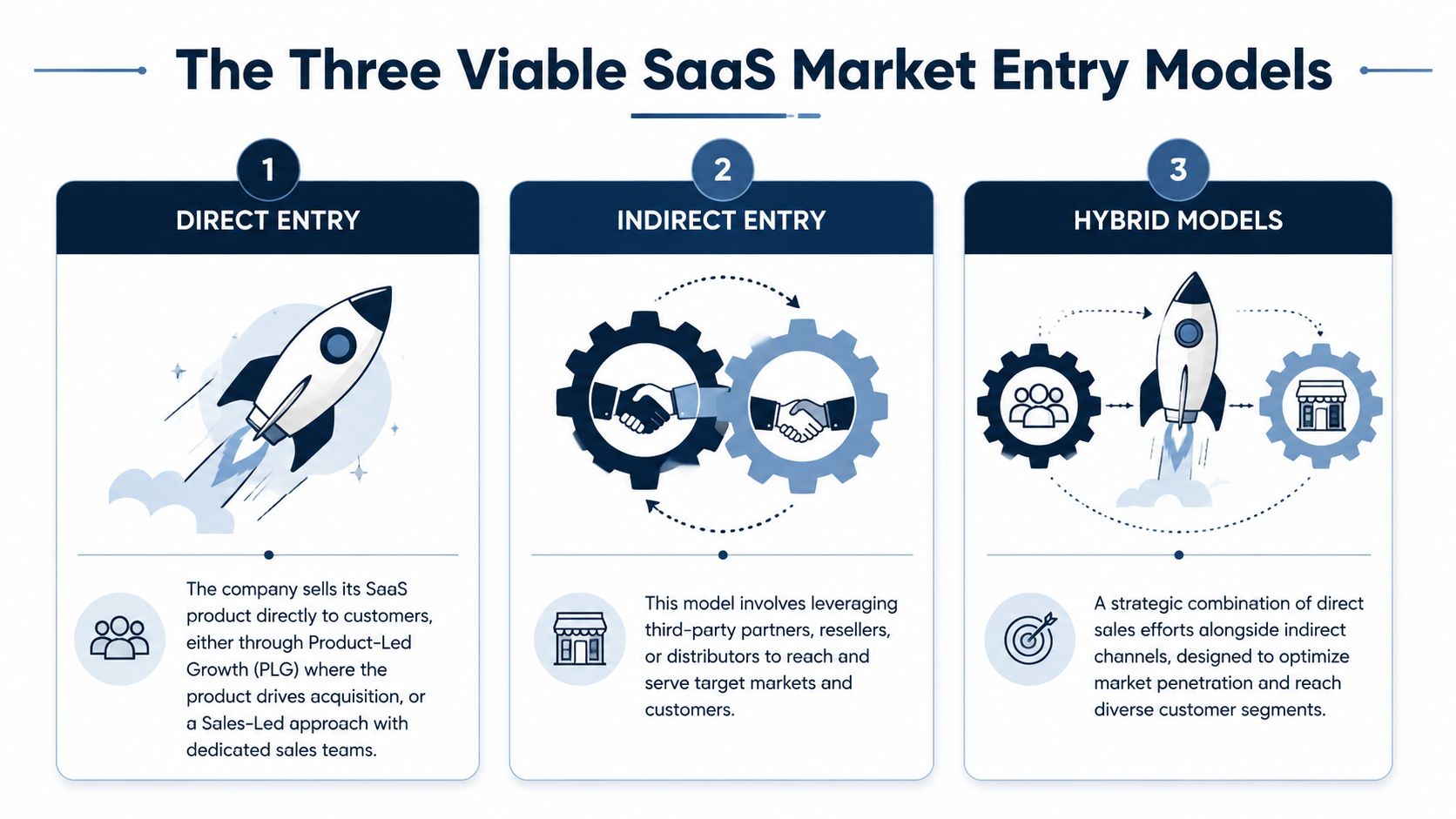
Value Consulting Partners reports that companies that carefully select their market entry strategy based on thorough market analysis achieve a 30% higher success rate. The same source says businesses using joint ventures or partnerships experience up to a 25% increase in market share, and that firms incorporating local partnerships show a 30% higher overall success rate and are 25% more likely to reach profitability within three years (Value Consulting Partners). For SaaS, the lesson isn't “go build a joint venture.” It's simpler. The entry model you pick changes the odds.
Direct entry means you own the customer relationship from first touch to renewal. That can look like PLG, founder-led sales, SDR and AE motion, or an enterprise sales team.
This model is strongest when:
The upside is control. You hear objections directly. You see where deals stall. You learn what language converts. That matters a lot when you're still refining your wedge.
The downside is cost and execution load. Direct entry demands tight positioning, sales rigor, onboarding capacity, and patience. A lot of teams choose it by default without realizing how much GTM competence it assumes.
Indirect entry means a partner helps you reach, sell, implement, or validate the product. In SaaS, that usually means integration partners, consultancies, agencies, resellers, ecosystems, or platform specialists.
This model works when trust is imported from the partner relationship, or when the product only makes sense as part of a broader stack or service layer.
Use it if:
FactorDirect entryIndirect entrySpeed of learningHighMediumControl over messageHighLowerAccess to trustLower at firstHigher if partner is credibleMargin retentionHigherLowerOperational complexityInternalShared with partnerScalability pathStrong if repeatableStrong if partner incentives are aligned
A lot of SaaS teams romanticize partnerships. They shouldn't. Most partner motions fail because the vendor wants distribution while the partner wants revenue, implementation simplicity, and low support burden. If those incentives don't line up, the relationship turns into polite inactivity.
That said, channel can be powerful. It often works best after you already know the message, the use case, and the implementation pattern. Then the partner isn't guessing. They're repeating.
If you're funding expansion and thinking about the kinds of investors who understand SaaS growth dynamics in specific regions, this Gritt.io investor database can be useful context for market-specific capital networks.
And if you're building a partner route seriously, this perspective on channel distribution marketing is worth reading because it treats channel as a strategic design problem, not a sign-up form.
Your first partner should be a force multiplier, not a substitute for having no market thesis.
Hybrid entry is usually the smartest option for growth-stage SaaS.
You run a direct motion to learn fast, while selectively using partners, integrations, communities, or pilots to lower friction. This gives you both signal and reach. More importantly, it prevents the usual failure mode where you outsource learning too early.
A phased version of hybrid looks like this:
Use the model that matches product complexity and company stage.
If you’re early and still clarifying message-market fit, go direct. If the market is trust-heavy and implementation-led, layer in indirect support. If you already have repeatable proof in one segment and want controlled expansion, hybrid is usually the right answer.
Avoid elegance. Pick the model that gets you the best information fastest while protecting economics.
Most market entries fail in execution long before strategy gets a fair test. The usual pattern is predictable. Teams copy the existing website, reuse the same sales deck, run generic outbound, and call it localization.
That doesn't work because new markets buy for different reasons, even when the product is identical.
Your category narrative isn't enough. Buyers don't purchase categories. They purchase relief from a problem that feels urgent in their context.
A finance leader in a mature company may care about control and auditability. A head of growth may care about speed and visibility. A founder may care about replacing chaos with a process the team can trust. Same product. Different buying trigger.
Use this sequence:
A weak positioning layer makes every channel look worse than it is.
Founders often treat pricing like brand signaling. That's backwards in a new market.
Your first goal is to learn how the segment values the problem, how procurement reacts, and where packaging creates friction. You are not trying to win an internal debate about whether your product is “premium.”
Practical pricing rules:
If you're rebuilding monetization logic at the same time as market entry, this guide on how to price a SaaS product gives a more useful framing than feature-tier guesswork.
Sell the change in business condition. Features only matter after the buyer believes the change is worth paying for.
Founders burn time by launching too many channels at once. They confuse activity with coverage.
A better sequence looks like this:
Founder-led outreach, tightly targeted LinkedIn prospecting, small paid search tests around high-intent terms, and direct customer interviews give fast feedback. These channels are messy, but they surface the truth quickly.
Once you know what converts, translate it into site pages, case proof, comparison content, sales enablement, and email sequences. At this point, Webflow pages, sharper vertical landing pages, and structured proof assets start doing real work.
SEO, paid media expansion, partner enablement, and broader outbound should come after you understand what the market believes and why it buys.
You don't need a giant launch plan. You need a disciplined operating rhythm:
PillarCore questionEarly sign of strengthPositioningDoes the target buyer immediately understand why this matters?Better response quality and cleaner discovery callsPricingDoes the offer feel proportional to the problem solved?Lower friction in commercial conversationsDistributionAre we reaching buyers in places where intent already exists?More qualified meetings from fewer channels
Execution isn't about volume. It's about reducing ambiguity until the path to repeatability is obvious.
A new market should be run like an experiment with consequences. Not a hope-filled launch.
Too many teams judge market entry on vanity signals. Website traffic, impressions, meeting count, demo volume. Those can all rise while the entry is failing unnoticed.

You need metrics that tell you whether the market is responding before revenue data arrives.
Good leading indicators include:
These signals tell you whether the market is structurally viable for your current product and GTM model.
The lagging set is less exciting, but it matters more.
Focus on:
MetricWhat it tells youCAC paybackWhether acquisition cost fits the segment’s economicsRetention qualityWhether initial wins were real or just good sellingExpansion behaviorWhether the product can grow inside the accountROI by channelWhich acquisition paths deserve more budgetMarket share progressWhether you're actually building a position, not just collecting isolated logos
If these lagging outcomes don't improve after messaging and process iterations, the issue usually isn't campaign execution. It's that the market thesis was wrong.
If buyers need a lot of education before they understand the problem, you don't have a channel problem. You have an entry problem.
This happens when the product technically works but doesn't fit the buyer’s workflow, urgency, or internal buying logic.
Mitigation is brutal honesty. Review lost deals. Look at support burden. Listen for repeated objections. If the same friction appears across accounts, stop forcing the segment.
A lot of teams blame the market when the issue is they chose channels that don't match buyer behavior. Enterprise buyers often won't discover a category-critical platform the same way SMB operators do.
Mitigation means testing channels in sequence, not all at once. Keep the learning loop tight.
To sharpen the team’s thinking on operating discipline, this short video is useful:
This is common once you start winning visible deals. Incumbents drop price, tighten contracts, or copy your language.
Mitigation is to avoid fighting on generic claims. Anchor the sale around a problem incumbents are structurally weak at solving. Faster implementation. Better workflow fit. Cleaner analytics. Stronger service layer. Pick an edge they can't neutralize with one discount approval.
Every market entry should begin with three pre-agreed decisions:
Without that discipline, teams keep feeding weak markets because no one wants to admit the thesis was wrong.
If you want a clean answer to what is a market entry strategy, it’s this. A time-boxed plan to prove you can win repeatable customers in a new segment without betting the company on assumptions.
Run the first ninety days like a controlled campaign.
Start with research that can change your decision, not research that decorates it.
Interview target buyers. Audit competitors. Pull apart pricing pages, review sites, category pages, LinkedIn ads, and sales language. Map the buying committee. Identify the trigger event that makes the problem active. Decide which wedge has the highest urgency and the lowest sales friction.
Your output at this stage should be concrete:
Launch the minimum viable go-to-market motion.
Build only what you need. A focused landing page. A tight outbound sequence. A short sales deck. A demo path customized for the new segment. One or two proof assets that reduce buyer skepticism.
Then run direct tests. Talk to prospects. Watch where they lean in and where they disengage. Rewrite fast. You're trying to learn what makes a qualified buyer move, not impress the market with a polished launch.
Measure hard. Cut what isn't working. Double down on what is.
Look at call quality, objection patterns, deal progression, pricing friction, and onboarding strain. If the signal is strong, invest in better assets, broader channel support, and a more repeatable sales process. If the signal is mixed, narrow further. If it's weak, stop.
That last part matters. Founders lose more money from dragged-out bad entries than from decisive exits.
A strong market entry strategy is narrow, testable, and ruthless about evidence. That’s how software companies expand without losing focus.
If you're a B2B SaaS founder or GTM leader trying to enter a new segment, reposition in a crowded category, or build a sharper growth plan, Big Moves Marketing helps teams get clear on message, market, and execution. The work is built for companies that don't need more activity. They need better decisions, a tighter story, and a go-to-market motion that can prove itself quickly.
Explore Big Moves Marketing services and resources:




%20-%20white.svg)