%20png%20copy.avif)

Most founders treat pricing as a set-it-and-forget-it task—a number pulled from a spreadsheet or, worse, copied from a competitor. This is a critical, and surprisingly common, strategic error.
Pricing isn't a line item. It's the most potent and underutilized growth lever you have. It signals your position in the market, defines the customers you attract, and dictates your growth ceiling.
Get it wrong, and you build systemic drag into the business. You'll fight high churn, attract low-value customers who drain support resources, and create constant friction in your sales cycle. The entire go-to-market motion will feel like it's running in mud.
In my experience advising B2B SaaS companies, two flawed models consistently trap founders:
Your pricing strategy must be a growth engine, not a liability. It's essential to understand the downsides of legacy models like the problem with per-user CRM pricing. Pricing is a core component of your go-to-market strategy, inextricably linked to your broader marketing mix.
Pricing isn't about covering costs. It's about capturing a fair portion of the economic value you create for a specific customer. If the value you deliver is immense but your price is low, you are leaving growth capital on the table.
This strategic mindset is no longer optional. The market is dynamic, and your pricing has to be as well. Recent research shows that three-quarters of US software companies adjusted their pricing last year.
This shift isn’t random. It’s a direct response to the need to align price with actual value delivered, especially as new AI features demand a complete rethink of traditional subscription structures. As many as 60% of US providers now use hybrid or usage-based approaches—a clear signal that static, one-size-fits-all pricing is obsolete.
The first step is to reframe pricing from a simple number to a core strategic function. Stop asking, "What can we charge?" and start asking, "What value are we creating, and how can our pricing model reflect and scale with that value?"
Before you open a spreadsheet, you must answer a fundamental question: what are you actually charging for?
This is your value metric. It’s the unit of consumption that scales directly with the value a customer receives from your product. Get this wrong, and you build a fundamental drag into your entire growth engine. Your pricing won't scale with customer success.
Is it per user? Per gigabyte? Per API call? Per contact? This isn't a trivial choice. It is the axis on which your entire customer relationship turns. A 10,000-employee enterprise with only five active users of your tool should not pay the same as a 50-person startup where everyone lives in your product daily. If they do, your value metric is broken.
So many founders fall into the same old pricing traps, usually because they picked the wrong model or value metric right from the start.

The lesson here is critical. Pricing based on your costs or what your competitors are doing is playing defense. Your pricing needs to be an offensive weapon—a core part of your growth strategy that’s tied directly to your customers’ success.
Most B2B SaaS products lean toward one of a few core models. The default "per-user" model is often the path of least resistance, but it's rarely the most strategic choice. Each model comes with its own set of advantages and hidden risks.
The table below breaks down the strategic implications of these common models, helping you see beyond the surface-level simplicity and understand the long-term impact on your sales, revenue, and customer relationships.
| Pricing Model | Best For | Primary Advantage | Hidden Risk |
|---|---|---|---|
| Per-User | Simple tools with uniform individual value (e.g., design software) | Easy for anyone to understand and forecast. | It punishes adoption. Customers turn into gatekeepers to control costs, which strangles expansion and internal advocacy. |
| Tiered | Products with a clear maturity path for customers (e.g., marketing automation) | Creates a natural upgrade path as customer needs grow more sophisticated. | You can easily create confusing feature walls that frustrate users and overcomplicate the sales process. |
| Usage-Based | Infrastructure or API-first products (e.g., Twilio, Snowflake) | The purest form of value alignment. Your revenue grows directly with your customer's success. | Can create budget anxiety for customers if their usage is unpredictable, leading to hesitation. |
Choosing a model isn't just about picking what's easiest. It's a strategic decision that shapes how your customers interact with your product and how your revenue scales over time. Think hard about which model best reflects the value you deliver and aligns with your long-term growth ambitions.
The market is clearly shifting toward models that reflect delivered value. The use of usage-based models for AI features, for instance, has skyrocketed from 37% to 69%, while obsolete license-maintenance models have plummeted. This isn’t a coincidence. With the global SaaS market projected to grow from $317.55B in 2024 to $1,228.87B by 2032, your pricing has to match that velocity, not hold it back.
Your value metric is the heart of your pricing strategy. It dictates your ability to capture a fair share of the value you create. To land on the right one, you must get out of the boardroom and into the data.
A great value metric achieves three things simultaneously: it's easy for the customer to understand, it aligns with the value they get from the product, and it grows as their usage and success grow.
Analyze how your best customers are using your product. What specific activity correlates most strongly with them achieving their goals? Is it the number of projects they manage? The volume of data they process? The number of workflows they automate? That’s your starting point.
A strong value metric should also naturally increase a customer's lifetime value over time. Understanding the mechanics behind a SaaS Customer Lifetime Value (CLV) calculation is crucial here, because it forces you to think about long-term growth, not just the initial sale.
The goal is to create a pricing structure where your success is a direct byproduct of your customers' success. This entire philosophy is built on a simple principle, which you can read about in our deep dive on how to define value-based-pricing.
Choosing the right model and metric isn't a one-time decision. It’s a hypothesis you'll need to test and refine constantly. But if you start with a metric that aligns with customer value—not your internal costs or a competitor's broken strategy—you're already ahead of 90% of the market.
Let's be direct: asking a customer, "What would you pay for this?" is the fastest way to get a useless answer. Nobody gives you an honest number that helps your business. They give you a number that helps theirs.
Yet, you must understand their willingness to pay. This is where most founders get it wrong. They either ask directly and get bad data, or they skip this step entirely, glance at a competitor's pricing page, and guess. Both are recipes for leaving significant revenue on the table.
The goal is to build a defensible price range anchored in the economic value you create for a specific customer profile. It’s about triangulating a price point through indirect analysis, not flawed, direct questions. Here’s how I guide SaaS companies to a data-backed price without ever asking that question.
Reframe your prospect interviews and demos. Stop talking about cost and start digging for value. Your job is to map your features to their specific, quantified pain points.
Forget asking about their budget. That’s a dead end. Instead, ask questions that force them to put a number on their problem:
The moment a prospect says they waste 20 hours a week on a task your product automates, you’ve found your value anchor. You are not selling software; you are selling them back 20 hours of productive time, every week. Your price must simply be a fraction of that captured value.
Formal conjoint analysis can be overkill for an early-stage team, but its underlying principle is powerful: force trade-offs.
Instead of asking prospects to price hypothetical packages, ask them to choose between them.
For example, present two options during a demo:
Then ask, "Putting the exact price aside for a moment, which of these two packages feels more aligned with your team's immediate needs?"
Their choice—and more importantly, their reasoning—tells you exactly which features they see as premium and what kind of price jump feels reasonable for that added value.
A prospect’s hesitation is data. If they consistently balk at the jump from a $500 to an $850 package, your price ceiling is probably closer to the lower end. If they don't even blink, you have room to push higher.
This method provides a much richer understanding of value perception than a simple number ever could. If you want to dive deeper into structuring these kinds of valuable user conversations, we have a complete guide on how to conduct user research that shows you how to get past surface-level feedback.
Glancing at a competitor's pricing page to copy their numbers is a rookie mistake. But analyzing their page to deconstruct their strategy? That’s a pro move.
Ignore their dollar amounts for a minute and break down the structure:
This analysis gives you a map of the market's expectations. You can then choose to either play by those rules or strategically break them. For instance, if every competitor bundles basic reporting in their starter plan, but you know your reporting provides 10x more insight, you have a solid justification for making it a premium, paid add-on.
This triangulation—mapping their pain to value, forcing packaging trade-offs, and deconstructing competitor positioning—gives you a defensible price range. It replaces guesswork with a structured process that roots your price in the only thing that actually matters: your customer's perception of value.
Your pricing tiers are a silent sales tool, working 24/7 to either guide prospects to a purchase or send them away in confusion. Too many founders get this wrong. They build overwhelming feature-comparison grids that look like an airline cockpit, forcing potential customers to book a demo just to figure out what they’re buying.
A well-designed tier structure tells a story. It meets a customer where they are today and lays out a clear, compelling path for them to grow with you. This isn’t about stuffing features into “Good, Better, Best” buckets. It’s about defining the psychological fences between each plan.

Your tiers should act as a mirror, reflecting your customer's own growth journey. Simply throwing more features at higher price points is a tactical error. Each plan needs to solve the core problems of a specific customer segment at a specific stage of development.
The "Starter" or "Launch" Tier: This is for your smallest, newest customers. It has one job: get them to successfully adopt the core workflow of your product. Strip it down to the absolute essentials needed to solve one primary job-to-be-done. Anything else is noise that creates friction.
The "Growth" or "Business" Tier: This is your bread and butter—the plan you want most of your customers to choose. It’s built for teams that have mastered the core workflow and now need more power, collaboration tools, and efficiency at scale. This is where you introduce features that help them expand their usage.
The "Enterprise" or "Scale" Tier: This is for your largest, most sophisticated customers. The value drivers here are almost never about more features. They're about security, compliance, control, and dedicated support. Think SSO, audit logs, dedicated account management, and advanced governance controls.
When you align tiers to maturity, you create a natural upgrade path. A customer doesn’t jump to the next plan for one more feature; they upgrade because their business has fundamentally outgrown the philosophy of their current plan.
The difference between a brilliant tier structure and a mediocre one is the "fences" you build. A fence is a single, critical capability that creates a clear dividing line between one tier and the next. It’s the one thing that makes a customer realize, "Okay, we need to upgrade."
Stop creating endless checklists of minor features. Your tiers should pivot on 2-3 major "fences" that align with a customer's growing sophistication. A customer at scale doesn't upgrade for more templates; they upgrade for SSO and API access.
A marketing automation platform, for instance, might use the number of contacts as its value metric, but the real fence between its "Growth" and "Enterprise" tiers is the availability of multi-touch attribution or custom object support. These aren't just minor add-ons; they represent a fundamental shift in how a modern marketing team operates.
This is also where you should make strategic, regular price adjustments. Recent data shows that companies with three or four packages raised their cheapest tier by 10% in the past year, with price increases of 0-20% being the norm for 67% of firms. Major players like Salesforce, Slack, and Microsoft do this all the time to reflect added value. You can see how leading SaaS companies are shifting their pricing by reviewing the latest industry pricing benchmarks.
A classic and effective tactic is using a "decoy" plan. The decoy's purpose isn't to be sold; it exists to make your preferred plan look like a much better deal by comparison.
Let's say you have three tiers:
In this scenario, the "Pro" plan is often the decoy. The jump from Basic to Pro for just one feature (reporting) feels steep. But the leap from Pro to Business for API access and priority support for only $30 more feels like an obvious choice. This framing anchors the buyer's perception of value and nudges them toward the tier you actually want them on.
Ultimately, your pricing page should make the decision for the prospect. It needs to be so obvious which plan is right for them that they feel confident clicking "buy" without talking to a salesperson. If it creates confusion, you don’t just have a design problem—you have a growth problem.
Your pricing strategy is an academic exercise until a sales rep has to defend it in a negotiation. It's a slide deck, not a growth lever, until it meets the reality of the market.
All your carefully crafted, value-based tiers mean nothing if your team immediately offers a 30% discount at the first sign of pushback. How you operationalize your pricing—how it lives and breathes in your sales process—is what determines whether it drives growth or creates friction.
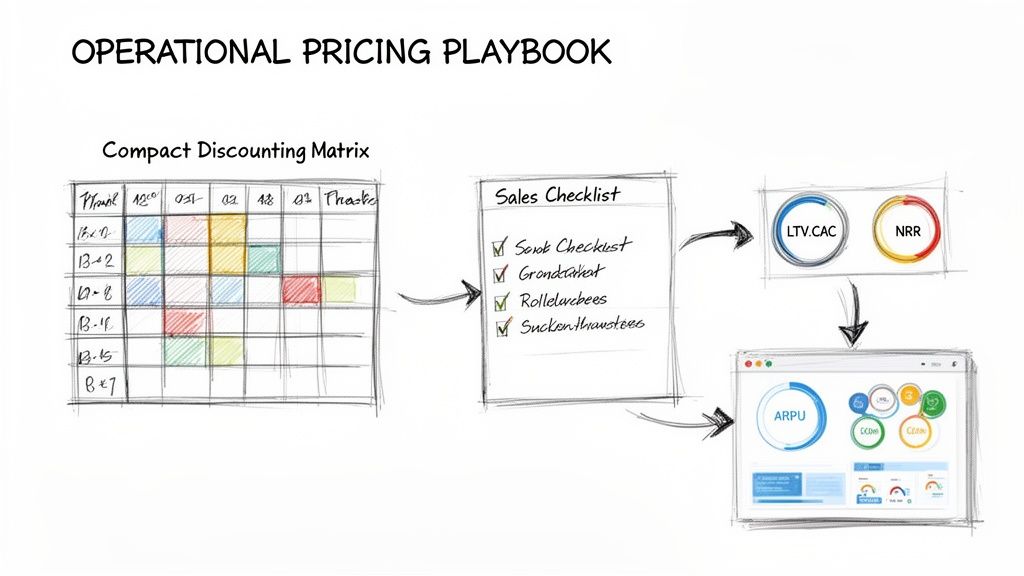
Sales reps need autonomy, but autonomy without guardrails erodes your margins. The constant "Can I get approval for this discount?" dance kills sales velocity and signals a lack of confidence to the buyer.
The solution is a discounting matrix. This isn't a suggestion; it's the rulebook. It defines the exact level of discount a rep is empowered to offer based on specific, value-adding criteria.
A matrix gives reps clear swim lanes. They know what they can do on their own and when they must escalate. It speeds up deals and protects your average selling price. For this to really click, you need lock-step aligning sales and marketing around shared revenue goals.
Stop letting your sales team negotiate from a position of weakness. A discounting matrix transforms discounting from a reactive concession into a strategic tool to shape deal terms in your favor.
The debate between transparent, public pricing and the dreaded "Contact Us for a Quote" is a false choice. You probably need both. The real question is where you draw the line.
Public pricing, now used by 45% of SaaS companies, is a massive engine for product-led growth and SEO. Done right, it can generate an SEO ROI of over 700% for B2B SaaS. It qualifies prospects for you and greases the wheels for your SMB and mid-market segments.
Enterprise quotes are for complexity. When a deal involves custom integrations, intense security reviews, and MSA negotiations, a public price tag is irrelevant. That deal needs a solution architect, not a checkout page. With the North American SaaS market projected to hit $211.7B by 2026, having a disciplined enterprise motion is non-negotiable.
Your pricing page should serve both motions. Display your clear, self-serve tiers for the lower end of your market, but have a prominent "Contact Sales" path for your enterprise ICP. The bottom tiers generate leads; the top tier generates pipeline.
Sooner or later, you will raise your prices. How you communicate this change will determine whether you successfully increase your ARPU or trigger a wave of churn.
Justify, Don't Apologize. Frame the price increase around all the value you've added since they became a customer. You're not asking for more money for the same thing; you're adjusting the price to reflect a better product. List the major features and improvements you've shipped.
Give Ample Notice. Ambushing customers destroys trust. Give existing customers at least 60-90 days' notice. This gives them time to adjust their budgets and shows respect for their planning process.
Offer a "Loyalty" Lock-in. For your best customers, give them a chance to renew for another year at their current rate before the new pricing takes effect. This pulls revenue forward, rewards loyalty, and turns a potential negative into a powerful retention event.
Whatever you do, don't grandfather customers indefinitely. A legacy customer paying a fraction of what new customers pay eventually becomes an unprofitable drag on your support resources. Your goal is to migrate everyone to the new structure over a reasonable timeframe. A healthy pricing strategy requires discipline and a commitment to capturing the value you continuously create.
Theory is clean. Execution is messy. Once you have a pricing model and tiered structure, the real work begins. I’ve seen it time and again—a pricing strategy lives or dies in the day-to-day decisions.
Founders consistently get stuck on the same set of practical questions. These aren't academic debates; they are real-world blockers that stall growth if not addressed. Let's get into the most common ones I hear.
You have to treat your pricing like a core product feature. It needs constant iteration, not a "set it and forget it" approach. Your pricing can't be static when the market itself is always in motion.
As a rule of thumb, a full strategic review should happen annually. But you need to be monitoring its performance every quarter. Certain events should trigger an immediate, off-cycle review.
In a market evolving this quickly, waiting longer than 12 months is a serious risk. Stagnant pricing signals a stagnant product.
This one comes up a lot, and the answer depends entirely on your go-to-market motion. There's no single right answer here, only a strategic trade-off.
If you're running a product-led growth (PLG) or self-serve model, public pricing is non-negotiable. It’s a critical part of creating a frictionless buying journey and it qualifies visitors for you automatically. Hiding your prices kills your PLG engine before it even gets started.
For purely enterprise-focused, high-touch sales motions, withholding pricing can force a conversation. Just be aware of the cost: you’re creating friction and might get disqualified early on when buyers are doing their own independent research.
A hybrid approach is often the most effective path. Display pricing for your lower-tier packages to capture SMB and mid-market interest, which also provides solid SEO benefits. Then, use a "Contact Us" for the enterprise tier that requires custom configuration and quoting.
This strategy gives you the best of both worlds. You get the inbound lead flow and qualification from your public pricing page while keeping control over complex, high-value deals.
Communication and justification are everything. A price increase is a moment of truth for your customer relationships, and you need to handle it with care.
First, never apologize for raising your price. Frame it as a direct reflection of the added value you're delivering. A perfect time to announce the change is right after a major product enhancement or feature release, as it immediately links the cost to a tangible benefit.
Give your existing customers plenty of notice—at least 60 to 90 days is standard. This shows respect for their budgeting cycles. Most importantly, you have to clearly articulate the "why" behind the change. Connect the price increase to specific improvements you’ve made that help them hit their goals.
A great tactic for your most valued customers is to offer them the option to renew early and lock in their current rate for another 12 months. This is a fantastic way to mitigate churn risk, pull revenue forward, and reward loyalty. You can find more direct insights into the strategy of many top B2B SaaS companies here.
The market is rapidly adopting more flexible models. Gartner predicts that by 2027, 70% of the top 200 software vendors will offer consumption-based pricing options, a trend supercharged by the AI SaaS market's explosive growth. As you can discover from these SaaS statistics, your pricing must evolve to keep pace.
At Big Moves Marketing, I partner with B2B SaaS founders to build and execute go-to-market strategies that drive revenue. If you need clarity on your positioning, messaging, and pricing to win more deals, let's talk. Learn more at https://www.bigmoves.marketing.
Explore Big Moves Marketing services and resources:




%20-%20white.svg)