%20png%20copy.avif)

Most B2B SaaS founders build their growth model on two pillars: direct sales or product-led growth. Right there, they create a massive strategic blind spot.
There's a third pillar, one often dismissed as too complex or a distraction for later. It’s channel distribution marketing—a deliberate strategy for recruiting an army of partners to win customers you cannot reach on your own. This isn't about low-value affiliate links. It's about building an ecosystem of resellers, integrators, and consultants who already have the trust of your ideal accounts.
Founders misdiagnose channel partnerships. They see them as a high-cost experiment or a distraction from the core business. In reality, a well-executed channel strategy is one of the most effective hedges against skyrocketing customer acquisition costs (CAC) and market saturation. It is a core component of a capital-efficient, defensible growth engine.
Your direct sales team is expensive. Your product-led motion eventually hits a ceiling. Relying only on those two channels leaves you vulnerable. Channel distribution opens a third, highly scalable path to revenue by accessing new pockets of the market through partners who already own the customer relationship. To ignore this is to willingly cap your own growth.
A common mistake is viewing partners as a cheap sales team. They are not. They are a distribution channel with their own P&L, motivations, and priorities. Your success depends on understanding and aligning with their business model, not just yours.
To grasp the strategic implications, you must compare the unit economics of a direct sales motion versus a channel-led one. They are fundamentally different business models, each with its own cost structure, scalability, and risk profile.
The trade-offs are significant. With direct sales, you have high costs and high control. With channel distribution, you trade control for dramatically improved scalability and capital efficiency. One isn't inherently better; they are complementary levers for growth.
Most B2B SaaS leadership teams are trapped in a two-dimensional GTM mindset. They spend all their time optimizing direct sales funnels or tweaking PLG loops, completely missing the leverage that exists outside their own four walls. Channel distribution isn't an "add-on" for when you're "big enough"—it is a strategic decision that should be on the table as soon as you have a repeatable sales process.
First, ensure your core model is solid. Our guide on https://www.bigmoves.marketing/blog/b-2-b-saas-go-to-market-strategy covers getting the foundation right.
The momentum is undeniable. The global Channel Market was valued at $12 billion in 2023 and is forecasted to double to $24 billion by 2030, fueled by an 8.50% CAGR. This growth proves that relying on partners is no longer a tactical move; it's becoming a core driver of exponential growth.
This guide reframes channel distribution from a side experiment to an essential part of your go-to-market machine. It's worth optimizing your go-to-market strategy to ensure your entire approach is sound. We’ll break down what actually works, what fails, and how to build a program that produces real pipeline, not just partner logos for your website.
Many founders get channel partnerships wrong from the start. They treat recruitment like a numbers game—sign up as many partners as possible and see what sticks. This is a recipe for failure.
Partnering isn't a numbers game; it's a strategic alignment problem. The single most common—and expensive—mistake I see is picking the wrong type of partner for your product.
Vague labels like "reseller" or "affiliate" are useless. They don't tell you anything about the partner's business model or what motivates them to sell. The truth is, your product's complexity, its average contract value (ACV), and the length of its sales cycle dictate which partners can even succeed. Get this alignment wrong, and you'll burn a year and significant capital chasing partners who are fundamentally incapable of moving your solution.
This decision tree gives a high-level look at the initial choice between building a direct sales team versus going with channel partners.

While this visual simplifies that first big Go-to-Market decision, the next choice is more critical once you’ve committed to a channel strategy: picking the right partner archetype.
Let's be clear: Referral partners are lead sources, not sales engines. Their job is to identify potential buyers in their network, make a warm introduction to your sales team, and then step away. They don't run demos, they don't negotiate contracts, and they don't close deals.
Think of these partners as an extension of your marketing team, not your sales team. They are often consultants, boutique agencies, or industry influencers who have earned the trust of your ideal customer. They monetize their access and credibility, not their ability to sell software.
Resellers and Value-Added Resellers (VARs) are built to handle the entire transaction. They take ownership of the sales cycle, from prospecting and quoting to closing and even implementation. They are a true extension of your sales force.
This is where founders stumble. They try to hand a complex, enterprise-grade product to a transactional reseller. It never works. A reseller’s team is compensated for volume, not for a six-month consultative sale. They will fail, and you’ll blame the channel instead of your poor partner selection. If your product needs deep expertise, a VAR who can layer on services or integrations is a better fit, but the core transactional nature of their business remains. Our guide to the B2B channel mix can help you map this out.
This is the deepest form of partnership. Strategic and integration partners embed your technology directly into their own core product or service. Your solution isn't just an optional add-on; it becomes a critical component of the value they deliver to their customers.
These partnerships are about co-creating value, not just reselling a product. The game is about deep technical integration and a joint go-to-market plan. The sales cycle is long, but the resulting deals are often large, incredibly sticky, and much harder for competitors to displace.
Choosing the right partner isn't about finding someone willing to sign an agreement. It's about meticulously matching your product's economic and operational reality to a partner's inherent business model. Anything else is a fast track to wasting time and burning capital.
A "Become a Partner" page on your website isn't a channel program. It's a sign of wishful thinking. A real program is a product, and your partners are its first and most important customers. If you can't sell them on the value of partnering with you, they will never sell your product to anyone else.
Most founders make the same predictable mistake. They throw together a few PDFs, create a generic email alias, and think they've built a channel. They haven’t. What they've created is a liability—a program that generates partner logos but zero revenue, all while burning through time and credibility.
Your channel program is not a marketing campaign. It is an operational function of the business, as critical as your direct sales motion. It requires a clear blueprint, dedicated resources, and unwavering executive commitment to survive its first year.
Building a channel that produces predictable revenue means treating it like any other product launch. You must define the value proposition, the structure, and the rules of the game that govern the relationship. Without these, you're building on sand.
Here are the absolute essentials:
A Clear Partner Value Proposition: This is the most critical piece. You must be able to answer, "What is the economic incentive for the partner?" It’s never about "our great tech." It’s about how they make money. Can they build high-margin services around your product? Does your solution pull through sales of their core offerings? Is the referral fee or margin substantial enough to justify their sales team's attention over other products in their portfolio?
A Tiered Structure: All partners are not created equal. A tiered system (e.g., Silver, Gold, Platinum) is essential for rewarding performance and incentivizing partners to invest more in the relationship. Higher tiers should unlock better margins, more marketing development funds (MDF), dedicated support, and early access to your product roadmap. This creates a clear path for partners to grow with you.
A Commercial Framework: This is your rulebook. It must codify deal registration to prevent channel conflict, define your revenue share or discount structures, and establish the rules of engagement between your direct sales team and your partners. There can be no room for interpretation when a large deal is on the line.
Theory is cheap. Execution is where channel programs live or die. Once the framework is in place, your focus must shift entirely to enabling and protecting your partners.
The first hurdle is channel conflict. It’s inevitable. Your direct sales team will see partners as a threat to their territory and compensation. You must get in front of this. While rules of engagement are your primary defense, you also need compensation plans that make your direct reps "channel-neutral" or even reward them for helping on partner-sourced deals. If you don't, your own team will sabotage the program.
Next is sales enablement. Your partners are not your employees. They will not absorb knowledge about your product through osmosis. You must provide a baseline set of assets:
This is the bare minimum. Assuming partners will "figure it out" is a common and fatal mistake. For more on this topic, read our insights on effective B2B channel marketing.
Finally, you need a solid Partner Agreement. This isn't just a legal formality; it's the commercial and operational contract that solidifies everything. It should clearly outline tier requirements, commission structures, the deal registration process, termination clauses, and support SLAs. A weak or ambiguous agreement is an open invitation for disputes that will poison your channel ecosystem.
Building a channel program that drives revenue is a deliberate, methodical process. It's about constructing a business model that makes it profitable for other companies to sell your product. Anything less is a collection of logos on a webpage.
Trying to manage a channel program on spreadsheets is a guarantee of failure. It might feel manageable with your first two partners, but by the fifth, it becomes a chaotic mess of missed opportunities, untracked leads, and frustrated partners. As you scale, technology isn't a luxury; it's a necessity for management, measurement, and enablement.
A channel tech stack is designed to solve the specific operational bottlenecks that kill early-stage programs. This isn't about buying fancy software. It's about systematizing the partner experience to make them more effective and your program more predictable. Without it, you’re asking partners to succeed through sheer force of will—a strategy that never works.
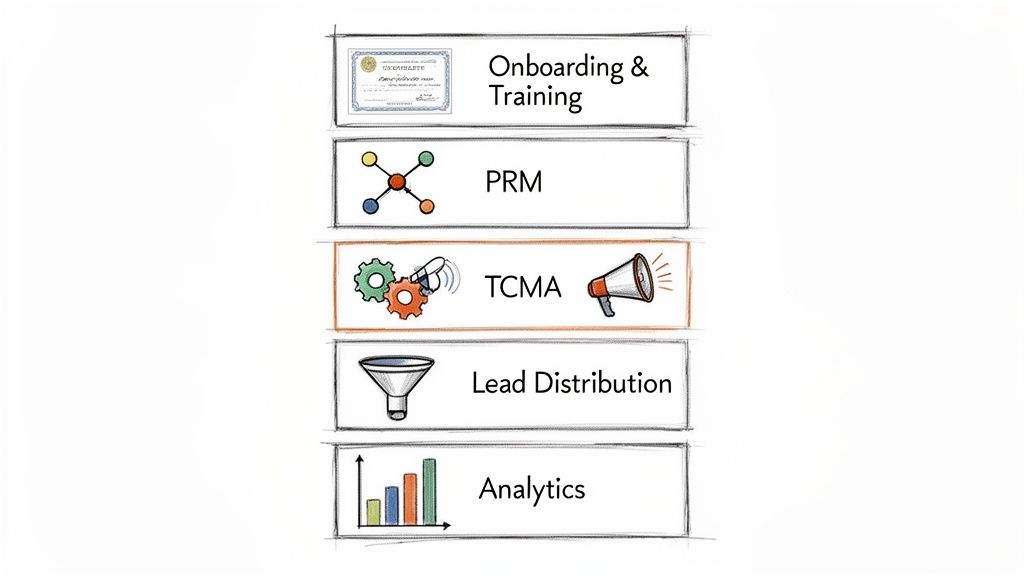
The central nervous system of any serious channel program is a Partner Relationship Management (PRM) platform. Think of it as a CRM, but built specifically for managing your partners, not your end-customers. A PRM becomes the single source of truth for your entire channel ecosystem.
Its core functions are designed to eliminate the manual work that cripples channel managers:
While a PRM manages the relationship with your partners, Through-Channel Marketing Automation (TCMA) software empowers them to market for you. A TCMA platform allows you to create marketing campaigns and content that your partners can easily co-brand and execute.
A TCMA system is a force multiplier. It turns passive resellers into active demand-generation engines by giving them ready-made campaigns they can deploy with a few clicks. This is how you scale your marketing voice far beyond your own team.
These platforms are becoming critical, especially for startups looking to expand efficiently. The through-channel marketing software market is expected to grow at a CAGR of 29.4% through 2026, with small and mid-sized businesses leading the charge. These tools are key for low-cost customer acquisition, which is why North America's market share is projected to climb to $1,800.1 million by 2026.
The real question isn't if you need a channel tech stack, but when. The signal is clear: you invest when the pain of managing your program manually becomes greater than the cost of the software. For most SaaS companies, this tipping point occurs between 5 and 10 active partners.
The ROI justification for a revenue leader is straightforward. It’s not about features; it’s about driving tangible business outcomes:
A well-implemented tech stack professionalizes your program, signaling to partners that you are serious about their success. It’s a critical investment in transforming your channel from an experiment into a predictable revenue engine. Choosing the right marketing automation is a key step, and you can learn more about selecting B2B marketing automation platforms in our dedicated guide.
Vanity metrics destroy channel programs. I’ve seen it dozens of times: founders get seduced by the number of signed partners, treating it as a sign of progress. It’s not. A roster of 50 partner logos is meaningless if they generate zero pipeline and consume your channel manager’s time.
The only way to hold your channel investment accountable to revenue is to shift the conversation entirely. You must stop asking, "Are our partners busy?" and start asking, "Are our partners productive and profitable?" This requires a disciplined approach to measurement, separating the predictors of future success from the results of past efforts.

Leading indicators are your forward-looking metrics. They measure a partner's engagement and capability, telling you if your program is building the momentum that will eventually convert into revenue. In the first 12-18 months of your program, these are the numbers to be obsessed with.
Think of them as the vital signs of your channel's health. Your most critical leading indicators include:
These metrics are your early warning system. If these numbers trend down, revenue will inevitably follow.
Lagging indicators measure historical results. They are the ultimate proof of your program's success, but they are, by definition, slow to materialize. Obsessing over these numbers too early is a classic mistake that causes leaders to abandon promising channel programs before they mature.
These are the key lagging indicators you’ll track over the long haul:
A common failure pattern is demanding significant partner-sourced revenue within the first six months. A channel program is not a direct response campaign; it is a long-term strategic investment. Success in year one is defined by strong leading indicators, not lagging ones.
Building an effective channel program requires patience and the right analytical model. To grasp the broader financial metrics involved, learn more about how to measure marketing ROI in our detailed guide.
A clear scorecard that separates leading from lagging indicators provides the discipline needed to diagnose issues, allocate resources, and prove the program’s value long before revenue becomes a major line item on your P&L.
Building a channel distribution program is a minefield of expensive, predictable mistakes. The siren song of scalable growth often makes founders deaf to the hum of operational discipline. This leads to burned capital, wasted time, and a torched reputation in the market.
Most of these failures aren't novel; they are recurring nightmares born from the same flawed assumptions. Think of this section as a pre-mortem—a checklist of hard-won lessons from programs that collapsed under their own weight. Understanding these failure modes is the first step to building a channel program that survives its first year.
The fastest way to kill a channel program is with a poorly designed commercial model. If partners can't see a clear, compelling path to profit, they simply won't invest their time. Founders often make the fatal mistake of assuming their product's "greatness" is incentive enough. It never is.
A partner’s sales rep cares about one thing: "How does this help me hit my quota?" If your margin is lower than a competing product in their portfolio, you will lose that battle every time.
Your program must be designed around the partner's P&L, not just your own. A 20% margin is meaningless if the sales cycle is twice as long as their average deal. You have to ensure the effort-to-reward ratio is overwhelmingly in their favor, or your program will be dead on arrival.
The second deadliest mistake is thinking you can hand over a partner agreement and watch the pipeline roll in. This is an abdication of responsibility. Partners are not your employees; they won't absorb product knowledge through osmosis. Expecting them to create their own pitch decks and battle cards is a recipe for disaster.
This is especially true for complex B2B SaaS sales. The high-touch, trust-based interactions required for these deals are a huge part of why the direct selling market is expected to surge to $407.80 billion by 2033. You must arm your partners with sales enablement materials that are at least as good as what your internal team uses. You can read the full research about direct selling market trends to see how critical this model is becoming.
Without explicit rules of engagement, you will pit your direct sales team against your channel partners. This creates immediate distrust and starves your program of the internal collaboration it needs to survive. If a direct rep sees a partner as a threat to their commission check, they will actively sabotage them.
To get ahead of this, you need crystal-clear rules:
A channel program without unwavering executive sponsorship is a slow-motion train wreck. It will be the first budget to get cut and the last to get resources. This isn't just about a line item in the budget. It’s about having the strategic focus and political capital to navigate internal resistance and fund the program through its first 12-18 months—the typical timeframe before it shows significant, lagging revenue.
If leadership treats the channel as a side project, so will the rest of the company. It’s that simple.
Here are direct, unfiltered answers to the questions I hear most often from B2B SaaS founders and revenue leaders weighing a channel strategy.
The answer has nothing to do with your revenue and everything to do with your go-to-market maturity. You should only consider a channel program after you have a repeatable direct sales motion, a crystal-clear Ideal Customer Profile (ICP), and undeniable product-market fit.
Partners cannot sell a product you can't sell yourself. It’s that simple. Launching a channel program too soon forces your first partners to do your market discovery for you—a near-certain path to failure and burned relationships.
The rule is simple: You must prove you can sell it before asking anyone else to. A channel is a scaling mechanism for a proven GTM motion, not a substitute for one.
Channel conflict is inevitable. The goal isn't to prevent it, but to manage it proactively. The key is establishing crystal-clear "Rules of Engagement" before you sign your first partner. This document is non-negotiable and your single source of truth for preventing ambiguity.
Your rules must define:
Without these guardrails, your internal sales team will see partners as competition, and your program will be dead on arrival.
Expecting a channel to be a major revenue driver in its first year is a setup for failure. It’s the single most common reason leadership pulls the plug on a promising program too early.
The first 12-18 months are about building the foundation, not hitting massive revenue targets. Success in year one isn't measured by closed-won revenue; it’s measured by partner activation and pipeline momentum.
Here’s what a realistic Year 1 scorecard looks like:
Your only goal in the first year is to prove the model works. You need to refine your process and gather data to justify more investment in year two. Anything more is wishful thinking.
At Big Moves Marketing, we help B2B SaaS founders and leadership teams build the strategic clarity needed to avoid these costly mistakes. If you need to build a go-to-market motion that drives defensible revenue, let's talk. Learn more about how we partner with companies like yours at https://www.bigmoves.marketing.
Explore Big Moves Marketing services and resources:




%20-%20white.svg)