%20png%20copy.avif)
Most advice about startup consulting companies is built on the wrong question.
Founders ask, “Who’s the best consultant?” That’s usually a sign they haven’t diagnosed the actual problem. They want relief, not clarity. So they hire someone to “fix growth,” “tighten messaging,” or “build pipeline,” even though those are categories, not diagnoses.
That’s why so many consulting engagements produce polished documents and weak outcomes. The consultant isn’t always the problem. The buying logic is.
If you’re a B2B SaaS founder, the decision isn’t who to hire first. It’s how to define the problem tightly enough that outside expertise has a chance to matter.
Most consulting engagements fail before the kickoff call.
They fail when the founder decides to outsource confusion. “We need growth help” usually means, “We don’t agree internally on what’s broken, and we hope an outsider can absorb the ambiguity.” That’s not a brief. It’s a transfer of unresolved leadership work.
There’s another layer founders ignore. Around 80% of new consulting companies fold within their first two years, according to a write-up citing the US Bureau of Labor Statistics on the high failure rate of consulting startups. That matters because when you hire a consultant, you’re not just buying expertise. You’re taking on the business risk, operating discipline, and incentives of that firm too.
A founder sees stalled demos, messy sales calls, low win rates, or a website that isn’t converting. Then they compress all of that into one lazy sentence: “We need a consultant.”
What they often need is one of three things:
Those are not the same purchase.
A vague problem statement is an invitation for a vague engagement.
If you want a useful external partner, start with your own accountability. Define the commercial issue, where it shows up, and what evidence you already have. If you can’t do that, you’re not ready to hire. You’re ready to think.
That’s also why good consulting services for startups should create clarity before they promise delivery. If someone is eager to sell execution before they’ve tightened the problem, be careful. They may be optimizing for billable work, not outcomes.
Founders usually hire a consultant too late and define the problem too loosely.
The pattern is predictable. Pipeline feels soft, sales says lead quality is down, marketing wants more budget, product says activation is the issue. A startup consulting company then gets hired against a symptom instead of a diagnosis, and the engagement turns into expensive guesswork.
That is a founder mistake first.
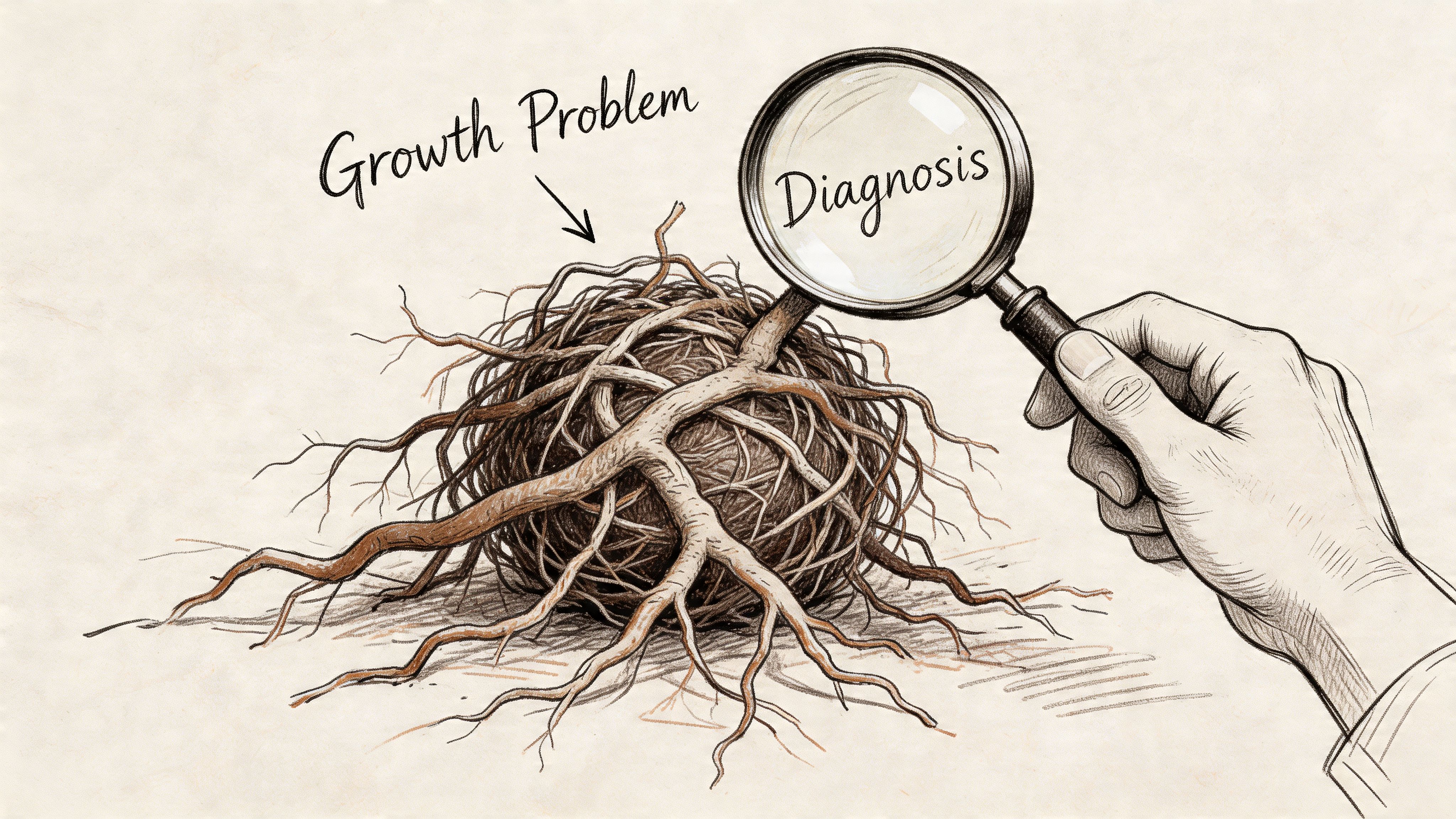
Start at the point where revenue motion breaks. Name the first visible failure, not the downstream complaint.
Use questions like these:
Where does the breakdown appear first
Is it low response from outbound, weak demo conversion, long sales cycles, poor expansion, or churn right after onboarding?
Which team sees it most clearly
Sales hears objections. CS sees expectation gaps. Product sees activation friction. Marketing sees message mismatch. Founders hear all of it and often overreact to the noisiest input.
What changed
New ICP. New pricing. New category language. More competition. A shift from founder-led sales to AE-led sales. Traffic up, intent down.
A symptom is only useful if you can connect it to the system creating it.
| Symptom | Likely underlying issue |
|---|---|
| Plenty of demos, weak close rate | Messaging creates curiosity but not buying urgency |
| Good first calls, bad second calls | Discovery is weak or the economic buyer isn’t engaged |
| Paid traffic lands, pipeline doesn’t move | Offer and page narrative don’t match buyer intent |
| Sales says leads are bad | ICP definition is too broad or qualification criteria are loose |
| Churn after early wins | Promise sold in GTM doesn’t match product reality |
Actual user research matters at this stage. If your diagnosis comes from internal opinion alone, you will hire the wrong help and brief them badly. A strong user research process for SaaS teams gives you buyer language, buying criteria, and friction points you can use.
One practical tell. If three people on your team describe the growth problem three different ways, you do not have a channel problem yet. You have a clarity problem.
That distinction matters in every market, including ecommerce. A founder who hires an ecommerce growth agency before figuring out whether the issue is offer, conversion path, or retention is buying activity, not progress.
Write a one-page brief. If it needs a deck to explain the problem, the thinking is still muddy.
Include:
The business context
Stage, sales motion, target segment, and the specific revenue motion under pressure.
The symptom
One clear statement. Example: enterprise demos are happening, but buyers do not progress after technical validation.
Your current hypothesis
Weak differentiation. Legal and security risk handled too late. A champion who cannot sell internally.
Known constraints
Small team, no PMM, long implementation cycle, founder still leading sales, weak CRM hygiene.
A short explainer can help your team align before any external conversation:
A consultant should pressure-test this brief, not invent it for you. If you skip the diagnosis, you outsource the thinking, and the consultant will usually optimize for the kind of work they sell. That is how founders end up with channel tactics for a positioning problem, new messaging for a product gap, or a stack of recommendations nobody can execute.
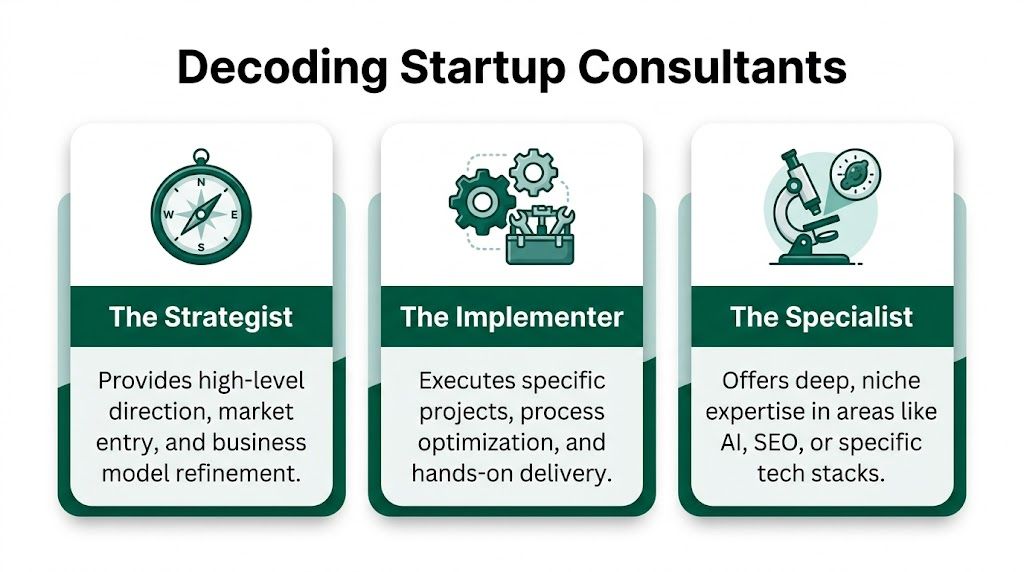
The market is crowded because “consultant” hides very different kinds of work.
That’s part of the confusion. Founders hire a specialist when they need strategy, or they hire a strategist when they need somebody to run the function for a while.
The market itself has moved toward depth. The consulting space includes specialists like Ryan with $687 million in funding and Acuity Knowledge Partners with $600 million, as noted in this consulting startup market overview. That’s a signal. Specialist, data-driven firms are taking share from broad, generic operators.
Hire a strategist when the company has motion but not coherence.
This is the right choice when:
A strategist should reduce ambiguity. They should help you choose. If they mainly produce options, they’re being too safe.
This is the person or firm you bring in when the strategy is good enough and execution is the bottleneck.
You know the ICP. You know the offer. You know the motion. What you lack is throughput, project ownership, or operational discipline.
That might look like:
This category often gets confused with strategy because founders are tired. But fatigue is not strategy debt. It’s execution debt.
A specialist is for narrow, high-skill work. SEO, technical content, RevOps cleanup, pricing research, paid acquisition, analyst relations, partner motion, AI workflow design.
If you’re in commerce or adjacent SaaS, this breakdown is similar to how teams evaluate an ecommerce growth agency. The useful question isn’t “are they smart?” It’s “are they built for this exact growth constraint?”
Precision beats reputation. A known name with the wrong lens is still the wrong hire.
There’s also a fourth shape in practice, even if people don’t label it cleanly. The interim leader. Fractional CMO, fractional CRO, fractional VP Marketing. That’s not advisory alone. That’s someone taking responsibility for decisions, cadence, and team alignment. If that’s your need, treat it as leadership capacity, not consulting. A fractional CMO model fits when the problem is sustained decision-making, not a one-off recommendation.
Founders often run consultant selection like a beauty contest. The winner is usually the firm with the cleanest deck, the biggest client logos, and the smoothest story.
That is a bad buying process.
You are not hiring for polish. You are hiring for judgment under uncertainty, the ability to challenge your assumptions, and the discipline to say, "this is not a marketing problem" when your team wants a marketing answer.
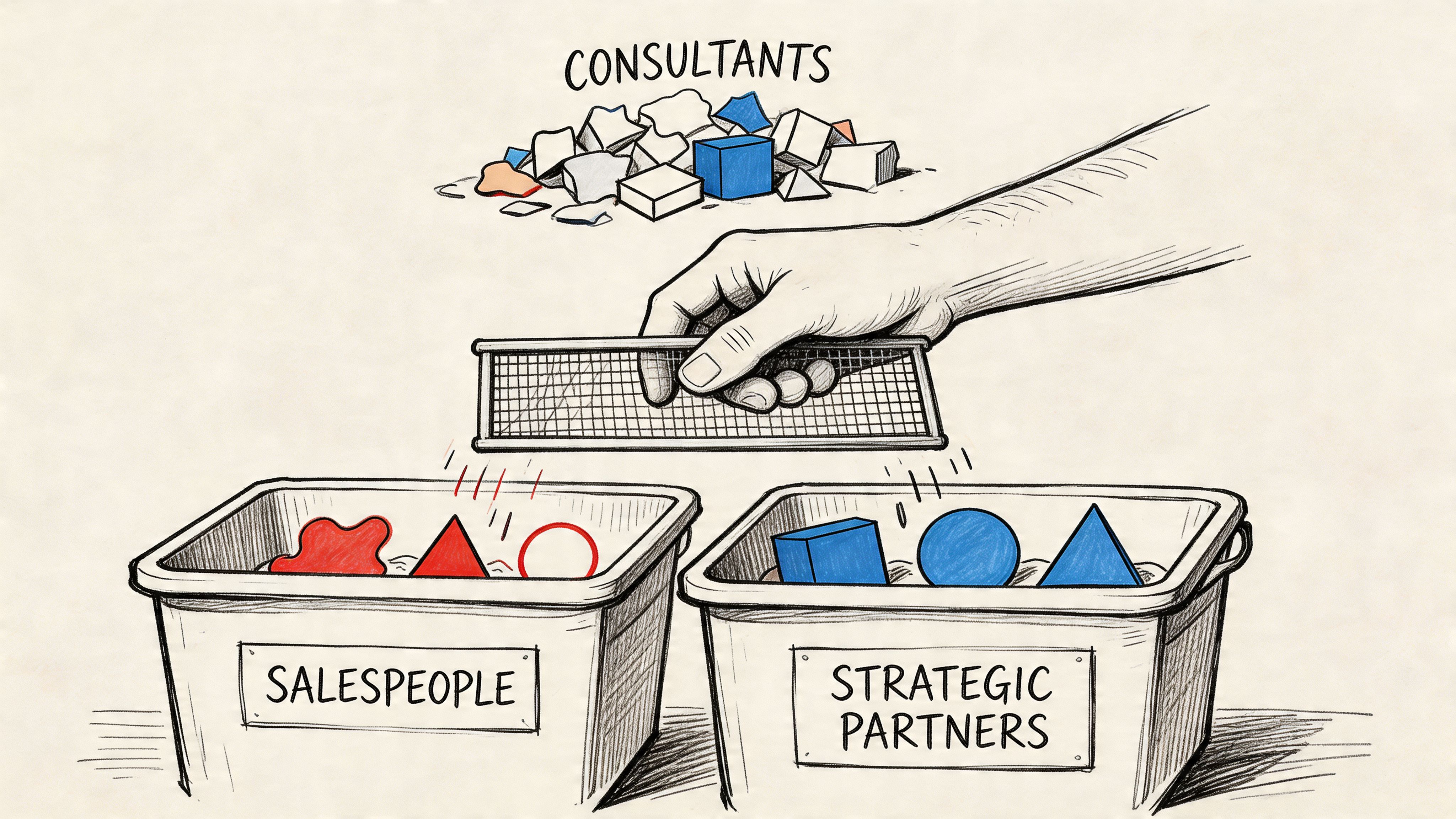
A useful vetting conversation should create friction. If every answer sounds polished, you are probably hearing sales training, not actual diagnosis.
Ask questions like:
Tell me about an engagement that failed. What did you get wrong at the start?
Serious consultants can name their misses, explain why they happened, and show how they changed their approach.
If you had to challenge our current plan in the first two weeks, where would you look first?
You need an independent operator, not a highly paid validator.
What evidence would make you call this a product-market fit issue instead of a marketing issue?
The distinction is critical. Founders waste months hiring for acquisition when the core problem is weak demand, poor retention, or a sales motion the market does not want.
What would you need from me and my team for this to work?
Good consultants are explicit about client-side failure modes. Slow feedback, fuzzy ownership, missing data, and founder interference kill engagements fast.
How do you handle a founder who wants speed before clarity?
The right answer includes pushback. If they promise instant momentum without tightening the diagnosis, expect a lot of activity and very little progress.
Weak consultants hide behind language that sounds strategic but says nothing. "We drive alignment." "We optimize funnels." "We bring best practices." None of that helps you decide whether they can solve your problem.
Watch for these patterns:
They force every problem into the same method
One workshop. One audit. One roadmap. Different company, same answer.
They claim broad expertise with no clear edge
If they pitch strategy, execution, hiring, messaging, paid media, pricing, RevOps, and sales enablement with equal confidence, they are selling coverage, not depth.
They refuse to make trade-offs
Good advisors can tell you what they would cut, delay, or ignore. That is where judgment shows up.
They talk around accountability
If success depends on vague alignment, shared energy, or better collaboration, press harder. Ask what should change, who owns it, and how you will know it worked.
A capable agency for B2B marketing should sound like a clear thinker, not a polished presenter. End the call with one standard. Are you clearer on the problem, the likely bottleneck, and the next decision? If not, do not hire them.
A bad scope can waste a good consultant.
Founders sabotage themselves. They buy an open-ended retainer because it feels flexible. In practice, it often creates soft accountability, vague deliverables, and endless interpretation.
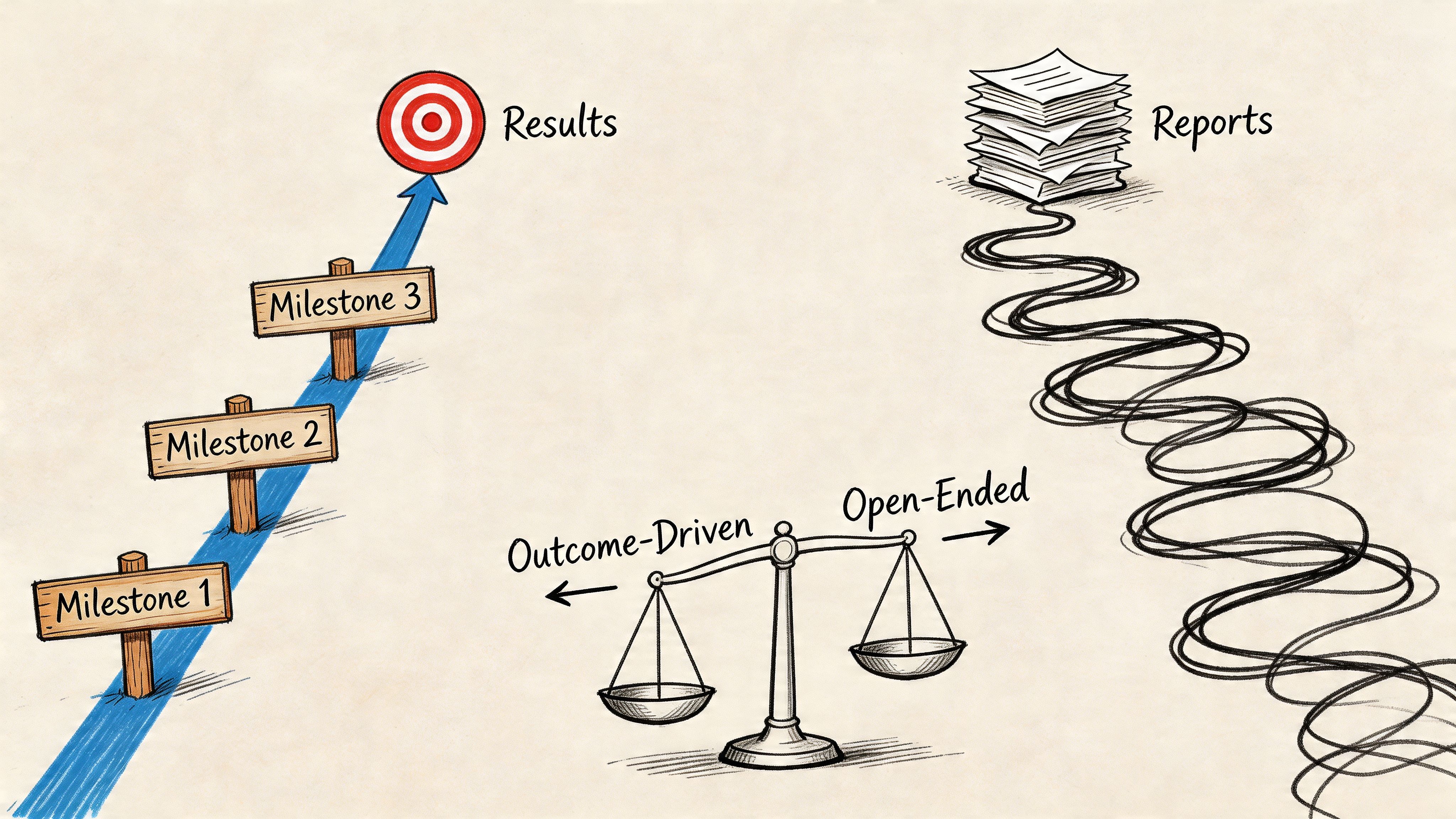
Start with a defined problem, a defined hypothesis, and a defined review point.
Not “help us grow.” Use something like this instead:
We believe our demo-to-opportunity drop is driven by weak positioning for the enterprise buyer. This engagement will test and refine the narrative, website path, and sales story for that segment, then measure whether buyer progression improves.
That structure forces everyone to think.
It also protects your team from dependency. Research discussed by McKinsey notes that founders in underserved communities often feel scaling is “out of reach” because they lack mentors and repeatable systems, which is why consulting that builds internal capability matters. That lesson applies broadly, not just in one founder segment. If the consultant leaves and your team is no smarter, the engagement was incomplete.
A useful scope has five parts:
The business problem
One sentence. Concrete. Commercial.
The operating hypothesis
What you believe is causing it.
The intervention
Messaging work, buyer interviews, sales narrative, offer redesign, funnel audit, leadership support.
The decision point
Continue, expand, pause, or hand off internally.
The transfer requirement
Docs, messaging assets, team training, call reviews, or process changes that stay after the consultant exits.
Some firms are built around this model. For example, CMO as a service can make sense when you need structured guidance plus leadership continuity, but it should still run against a sharp mandate, not an endless stream of meetings.
Don’t pay for motion. Pay for clearer decisions, tighter execution, and capability your team retains.
The right consultant doesn’t hand you a pre-drawn route.
They reflect the truth about your company more clearly than your internal dynamics allow. Where the message is weak. Where the ICP is bloated. Where sales is compensating for strategy gaps. Where the founder is still the bottleneck.
That’s why the useful frame isn’t “which startup consulting companies are best.” It’s “what kind of external thinking will make our next decision better?”
A consultant is a force multiplier for a founder who’s willing to be precise, uncomfortable, and accountable. They’re useless to a founder who wants outsourcing disguised as strategy.
Use them to sharpen judgment. Use them to compress learning. Use them to build a stronger internal system.
But keep ownership where it belongs. With you.
If your B2B SaaS team needs help diagnosing a positioning, messaging, or go-to-market problem before spending money on the wrong growth motion, Big Moves Marketing works as a strategic growth partner for founders and revenue leaders who want clarity, a tight scope, and execution built around real commercial constraints.
Explore Big Moves Marketing services and resources:





%20-%20white.svg)