%20png%20copy.avif)

For B2B SaaS founders, the default move after a seed or Series A round is to hire a full-time CMO. I’ve seen this pattern repeatedly, and it’s almost always a costly mistake.
The role you actually need isn't about managing a large team or deploying a seven-figure budget. It’s about achieving strategic clarity and building a repeatable go-to-market engine. This requires a different kind of leader: a fractional chief marketing officer.
The pattern is predictable. A B2B SaaS company hits a milestone—usually post-seed or around Series A—and the board starts asking about the "marketing leader." The founder, who’s been juggling founder-led sales and inconsistent marketing output, agrees it’s time to hire a "real" CMO.
This is a trap.
You don't need a full-time, C-suite executive yet. What you need is strategic clarity and a validated GTM motion. The person who excels at managing a $10M budget and a 50-person team is almost never the same person who can roll up their sleeves and architect a growth engine from scratch.
This thinking leads founders into two expensive failure modes:
Both scenarios are expensive learning experiences. You burn through capital, time, and team morale. The problem isn't the person; it's the role. You've hired for a job that doesn't exist at your company’s stage.
The core mistake is framing the problem as "filling a seat" instead of "acquiring a capability." Early-stage companies need access to C-level strategic thinking without the full-time C-level cost and operational drag.
This is precisely the gap a fractional chief marketing officer is designed to fill. They provide the strategic horsepower to build the engine—a task that must happen long before you need a full-time driver to operate it at scale.
To put this in perspective, here's a direct comparison of what engaging each type of leader looks like in an early-stage B2B SaaS company.
| Factor | Full-Time CMO | Fractional Chief Marketing Officer |
|---|---|---|
| Financial Commitment | $350k-$500k+ total compensation (salary, bonus, equity). Significant burn before proving value. | $7k-$20k per month retainer. Flexible engagement, tied directly to strategic milestones. |
| Primary Focus | Team building, budget management, long-range planning, board-level communication. | Architecting the initial GTM strategy, building foundational systems, hands-on execution, mentoring junior staff. |
| Core Skillset | Leadership at scale, managing managers, navigating large organizations, deploying large budgets. | 0-to-1 GTM playbook development, pattern recognition from multiple early-stage builds, player-coach execution. |
| Typical Failure Mode | Too strategic, disconnected from hands-on work. Builds plans but not pipeline. High cost, slow impact. | Engagement ends before systems are fully embedded; potential for knowledge transfer gaps if not managed well. |
| Time to Impact | 6-9 months to ramp, learn the business, hire a team, and begin executing. | 30-60 days to diagnose, build the initial strategic plan, and start executing foundational projects. |
| Best Fit For | Scale-ups ($20M+ ARR) with proven product-market fit and a team to manage. | Early-stage (Seed to Series B) needing strategic direction and a repeatable growth model without the full-time cost. |
This comparison makes it clear: hiring a full-time CMO too early is a profound misalignment of resources, timeline, and required skills.
The market has caught on to this inefficiency. The need for flexible, high-impact strategic leadership has fueled growth in the fractional model, a trend accelerated by the instability of the full-time role. With the average startup CMO tenure at just 18-24 months and a staggering 42% of hires considered unsuccessful within 18 months, the fractional model offers a more stable and effective alternative.
Instead of gambling on a single, high-stakes hire, you engage a leader who has built the 0-to-1 marketing function many times before. They are not there to build a permanent team under them. They are there to build your initial GTM foundation, install the right operating systems, and mentor your existing team.
As we cover in our guide on how to build your B2B marketing team structure, the goal is to have them build the engine, prove it works, and prepare your company for the full-time leader you’ll actually need in 12-18 months.
A fractional chief marketing officer is not a consultant, an agency, or a senior manager you rent by the hour. Their value comes from executing three specific, high-leverage jobs that most early-stage B2B SaaS companies either ignore or get catastrophically wrong.
Founders aren't buying advice; they're buying strategic capacity and execution velocity, focused on these distinct outcomes. Getting this wrong leads to misaligned expectations and burned cash.
This is the classic fork in the road for a founder. One path leads to burnout, while the other sets the stage for sustainable growth.

The diagram above lays out the founder's dilemma. It shows why bringing in a fractional CMO to build a solid foundation first is almost always the more strategic move, compared to the common mistake of a premature—and expensive—full-time hire.
The first and most critical job is to design and validate the company's core go-to-market strategy. This is not about running random campaigns. It’s about building an interconnected system where every part works together to create a predictable pipeline.
A real fractional CMO won't start by asking about your ad budget. They start by diagnosing the foundations of your business.
Here’s what that architectural work looks like:
This work prevents the most common startup failure: a flurry of disconnected activities that generates noise but no signal.
A strategy without a system is a slide deck. The second job is to build the operational infrastructure that makes marketing scalable, repeatable, and measurable. This separates a seasoned leader from a mere strategist.
They install the processes and tech you need to run a modern marketing function, ensuring that motion creates momentum. It's the difference between ad-hoc campaigns and a durable growth machine.
A fractional CMO’s primary deliverable is not a campaign; it's a system. They are paid to build the machine, not just turn the crank. That system should be built to outlast their engagement.
Key pieces of this operating system include:
Our guide on creating a strategic marketing plan template provides a solid framework for how to document this system.
Finally, a fractional CMO’s job is to multiply the impact of your existing team and, most importantly, you—the founder. They are not another individual contributor; they are a leader who elevates the entire marketing function.
This is the most overlooked part of the role. A great fractional CMO transfers knowledge, installs discipline, and builds capability within your organization. This allows you to finally step back from being the default head of marketing.
This function shows up in two main ways:
An engagement is successful when the fractional CMO has effectively worked themselves out of a job, leaving behind a stronger team and a functioning system ready for a full-time leader to inherit.
When founders discuss fractional CMOs, the conversation often gets stuck on cost savings. This misses the point entirely.
The real value isn’t what you save on a full-time salary. It’s the opportunity cost you avoid and the revenue you accelerate.
A great fractional CMO doesn't just trim your budget. They stop you from burning months—or years—on the wrong channels, using weak messaging that tanks conversions, and running a misaligned marketing and sales engine.

This is about real financial impact. Data shows companies that bring in fractional CMOs see significantly higher revenue growth rates compared to organizations without that specialized leadership. This improvement comes directly from having an expert who knows how to create market velocity. You can explore the performance metrics that fractional CMOs deliver to see how this is done.
To get a true read on the ROI, founders must look past a simple salary comparison. You need to model how strategic expertise impacts core business metrics.
Here’s a framework for calculating the real return:
The question isn't, "Can we afford a fractional CMO?" The real question is, "Can we afford another six months of unfocused marketing, a botched product launch, or a flat pipeline?"
Let's make this concrete. Assume your average contract value (ACV) is $30k. A fractional chief marketing officer engagement costs $10k per month.
Here are two scenarios:
This simplified model doesn't even touch on the long-term value of the assets created, like a documented positioning framework or a reporting dashboard. When you're looking at the return, consider how robust competitive intelligence will inform better decisions and maximize these outcomes.
The ROI of a fractional CMO isn't measured in the expense line they replace. It’s measured in the revenue growth curve they accelerate. For a deep dive into tracking these outcomes, check out our guide on how to measure marketing ROI for B2B SaaS.
One of the most common and costly mistakes founders make is confusing a marketing agency with a fractional CMO. They both offer marketing resources, but their fundamental purpose is different.
An agency is hired to execute tasks. A fractional CMO is hired to own outcomes.
This isn’t semantics; it’s the entire game. Understanding this difference will determine whether you make the right hire.
An agency is accountable for delivering on a pre-defined list of activities. Did they publish the four blog posts? Did they launch the ad campaigns? Their job is to check the boxes you give them.
A fractional chief marketing officer, however, is accountable for a business outcome. Their job isn't to "run PPC campaigns"—it's to "fix our broken lead funnel" or "build a pipeline that supports our next funding round." The specific tactics are just tools to achieve that outcome.
An agency rents you a team of specialists to execute a known playbook. A fractional CMO provides the strategic ownership to figure out which playbook to run in the first place.
If your strategy is flawed, an agency will diligently execute it straight into the ground. A great fractional CMO’s primary responsibility is to ensure the strategy is right from the start.
Agencies operate within a tightly defined scope of work. They are an external vendor managing a specific channel or project, often with little visibility into your sales process, product roadmap, or broader business strategy.
A fractional CMO integrates directly into your leadership team. They are a part-time executive, not an outside vendor. Their scope is intentionally broad and strategic, covering the entire go-to-market function.
This integration is key. A fractional CMO has the authority and context to challenge product assumptions, work with the head of sales to fix a broken lead handoff, or push the CEO to sharpen the company’s core positioning. An agency cannot do that. If you're exploring when a vendor model might be the right call, understanding the nuances of hiring a specialized agency for B2B marketing can provide more clarity.
So, which do you need? The choice boils down to what you already know.
Hire an agency when: You have a proven, repeatable marketing tactic that you simply need to scale. You know that LinkedIn ads targeting VPs of Engineering with a specific case study convert profitably. You don't need a strategist; you need more hands to run the machine you’ve already designed.
Engage a fractional CMO when: You don’t know which tactics will work because the underlying strategy is missing or broken. Your funnel is leaking, your messaging isn't landing, or you're launching into an undefined market. You need a leader to architect the machine before you can hire people to run it.
Using an agency for a job that demands a fractional CMO leads to endless, costly cycles of "testing" without a coherent strategic framework. It’s like asking a construction crew to design the skyscraper. The result is always a monumental waste of time and money.
Of all the places a fractional CMO engagement can go wrong, the initial setup is the most common point of failure. A vague, open-ended agreement isn't a partnership; it's a recipe for misaligned expectations and wasted cash.
You have to define the relationship with the same rigor you'd apply to a critical hire. How you structure the pricing, time commitment, and deliverables is just as critical as who you choose.
Engagements typically fall into one of two buckets, depending on the problem you need to solve.
Monthly Retainer: The workhorse model. You pay a fixed monthly fee for a predictable time commitment and scope. It’s the right structure when you need a leader to build your foundational GTM strategy, diagnose what's broken, and oversee the first few quarters of execution.
Project-Based Fee: The "special forces" option. It's best for a single, well-defined mission with a clear finish line, like a new product launch, a complete positioning overhaul, or building a sales enablement toolkit from scratch. The fee is tied to delivering the project, not the hours it takes.
Occasionally, an engagement might kick off with a small, paid discovery project—a "diagnostic" phase—before committing to a longer-term retainer.
The structure you choose sets the tone for accountability. A retainer is about owning a function and its outcomes over time. A project is about delivering a specific, high-value strategic asset.
What does this actually cost?
It varies based on the CMO's track record and the required scope, but the numbers are not a total mystery. Most experienced fractional CMOs work on a monthly retainer, with effective hourly rates between $150 and $500. The time commitment can range from 5 to 35 hours a week. Some propose value-based pricing, tying compensation to hitting a target like a 20% lift in revenue within six months. You can see how different fractional CMO compensation models are used in practice to get a better sense of the landscape.
For a typical early-stage B2B SaaS company, expect a commitment of 10-20 hours per week. This is the sweet spot, providing enough time for strategic depth and hands-on work without the six-figure price tag of a full-time executive.
That time is usually split across three core areas:
This is the most important part of the agreement. Get crystal clear on what will be delivered.
If a candidate talks vaguely about "strategic guidance," that's a red flag. You're paying for tangible assets that become part of your company’s operating system.
A great fractional CMO doesn't just give you a checklist; they build the machine. Here’s what you should expect:
These are not just documents. They are the foundational pillars of a marketing function that can scale.
Hiring the right fractional chief marketing officer is a high-stakes decision. The market is flooded with generalists who’ve slapped the "fractional CMO" title on their LinkedIn profiles but lack the strategic depth your startup needs.
You’re not hiring a consultant to give advice from the sidelines; you’re bringing a senior leader into the trenches to architect your growth engine. This demands a vetting process that cuts through the noise and tests for genuine B2B SaaS pattern recognition.
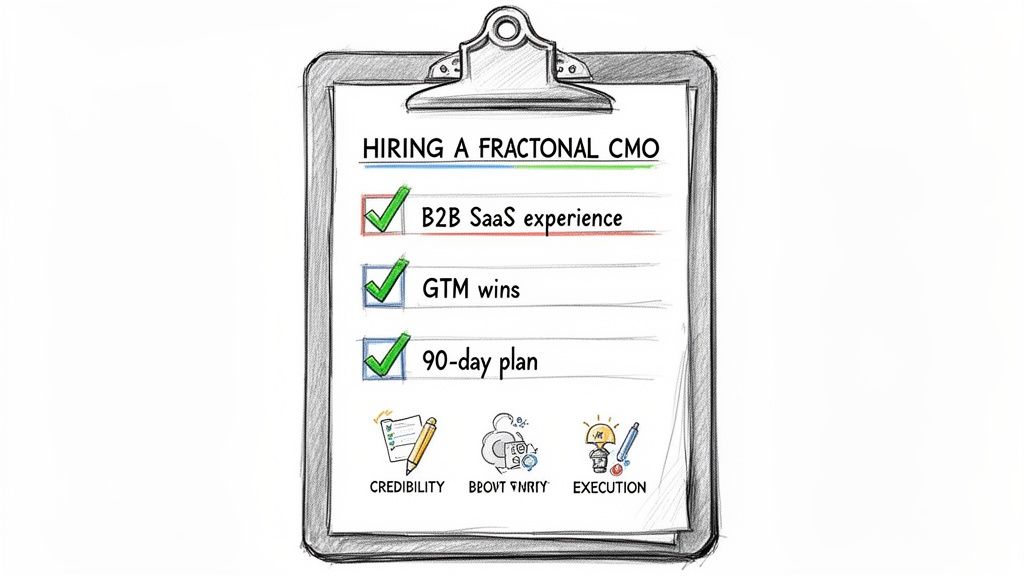
Before you schedule an interview, screen for a specific kind of experience. A background in D2C or generic B2B services does not translate to the physics of SaaS growth.
Direct B2B SaaS Experience: Have they spent significant time with companies at your exact stage (pre-PMF, Seed, or Series A-C)? Do they have deep experience with your specific GTM model, whether PLG, sales-led, or a hybrid? Success at a Fortune 500 doesn't mean they can build from scratch.
Proven 0-to-1 GTM Builds: Look for concrete proof they’ve built a marketing function from the ground up. They should be able to walk you through specific examples of architecting positioning, establishing the first demand channels, and building reporting that ties marketing spend to revenue.
Player-Coach Mentality: Their track record must show a blend of high-level strategy and hands-on execution. If a candidate only talks about managing big teams or six-figure budgets, they are the wrong fit. You need someone who can devise the strategy and roll up their sleeves to build the first campaigns.
Once their background is confirmed, the interviews must reveal how a candidate thinks and operates. Ditch hypothetical questions. The only way to know if they can do the job is to give them a piece of the job to do.
The goal is to simulate the real work. Our insights on hiring a B2B marketing consultant offer a broader perspective on vetting strategic partners.
The most revealing interview is a working session, not a Q&A. Give a candidate a real, anonymized business challenge. Their ability to diagnose the root cause and outline a logical plan of action is more valuable than any resume.
To filter out the pretenders, pressure-test their thinking. The following questions are designed to move beyond surface-level answers and reveal their depth.
| Question Category | Sample Question | What to Look For |
|---|---|---|
| Diagnostic Acumen | "Here's our current funnel data and our top 3 business goals for the year. What's the first thing you would dig into? What do you suspect is broken?" | Can they see past vanity metrics? A great candidate will ask clarifying questions about your ICP, sales cycle, and value prop. They’ll form a clear hypothesis, not just recite best practices. |
| Strategic Trade-offs | "We believe our top two growth opportunities are expanding into a new industry vertical and launching a PLG motion. We only have the resources for one. How would you decide?" | A structured framework for making decisions under constraints. They should talk about validating assumptions, calculating TAM, and estimating resource costs—not just picking the more exciting option. |
| First 90-Day Plan | "Assuming you start next week, walk me through the specific, tangible outcomes you would deliver by the end of your first 90 days. What assets would exist?" | Specificity is everything. Vague promises like "improved brand awareness" are red flags. Look for concrete deliverables like "a documented messaging framework" or "a live lead-to-revenue dashboard." |
| Failure Analysis | "Tell me about a GTM strategy you built that failed. Why did it fail, and what did you learn about your own assumptions?" | Look for genuine ownership and deep reflection. The best leaders are candid about their mistakes and can clearly articulate the first-principles lesson they learned, not just blame external factors. |
This process isn't about reviewing credentials; it’s about finding a leader with the proven ability to build the revenue engine your startup needs to scale.
When I talk with B2B SaaS founders, the same direct questions about the fractional CMO model always come up. Here are the unfiltered answers.
The sweet spot is right after your seed round and heading into Series A. This is the critical window where you have early signs of product-market fit—a handful of happy customers, low churn—but no repeatable engine to find more of them.
At this stage, you need high-level strategy to define your growth model, but you cannot justify a $400k+ C-level salary. A fractional CMO is built for this exact gap. They architect the foundation before you need a full-time leader to scale it.
Hiring earlier is a waste of money; you don't have enough market signal. Hiring later means you’ve likely burned significant capital on random acts of marketing.
A high-impact engagement almost always falls between 6 and 12 months. This timeline is the minimum viable period to diagnose the business, build the strategy, and see it through the first phase of implementation and validation.
The first 90 days are for diagnosis and strategy. The next two quarters are for execution—building systems, running initial campaigns, and seeing the first pipeline results.
A great fractional CMO’s goal is not to create a permanent dependency. Their job is to work diligently to make their own role obsolete by building a self-sufficient marketing function and helping you hire their full-time replacement when the time is right.
Anything less than six months is a consulting project, not a foundational build. Anything longer than 18 months without a clear off-ramp starts to feel less like a catalyst and more like a crutch.
Yes, but their role is leadership and mentorship, not day-to-day task management. This is a crucial distinction. A true fractional CMO multiplies the impact of your junior team by giving them a strategic framework, upskilling them, and installing disciplined processes.
They are not there to be a project manager for your content calendar. They are the architect of the system your team operates within. They define the "what" and the "why," which empowers your team to own the "how."
The market for fractional execs has gotten noisy. You must be aggressive about filtering out consultants who have never built anything from scratch.
Keep an eye out for these red flags:
Real experts have pattern recognition from seeing dozens of other SaaS companies through this exact stage. They diagnose your business with precision; they don't just sell you a pre-packaged bundle of services.
At Big Moves Marketing, I partner with B2B SaaS and AI founders to build the positioning, sales tools, and go-to-market strategies that drive adoption and revenue. If you need to translate your product's potential into a powerful market launch, let's connect. Learn more at https://www.bigmoves.marketing.
Explore Big Moves Marketing services and resources:



%20-%20white.svg)