%20png%20copy.avif)
Most early-stage founders operate under a dangerous assumption: that sales lead generation is a numbers game where more activity guarantees more pipeline. This misunderstanding of go-to-market mechanics is why so many B2B SaaS companies burn capital on a flood of low-intent MQLs while their sales teams starve for real opportunities.
The goal is not a busy funnel. It is a predictable stream of revenue from accounts that perfectly match your Ideal Customer Profile (ICP).
If your sales team complains about lead quality and your customer acquisition cost (CAC) is spiraling, you don’t have a top-of-funnel problem. You have a systemic failure. The common advice to ‘just do more’—more cold emails, more content, more ads—ignores the root cause: a fundamental disconnect between your product, your ICP's acute pain, and your go-to-market motion.
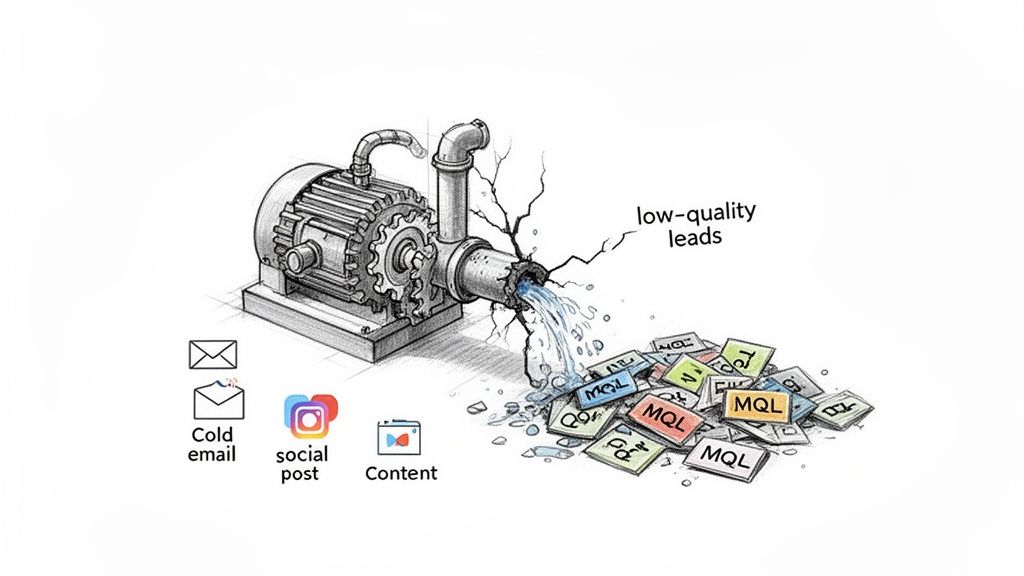
You’re likely running playbooks designed for scaled companies with established brand equity. This approach fills your pipeline with low-quality leads your AEs cannot close, eroding trust between marketing and sales.
For an early-stage B2B SaaS company, the Marketing Qualified Lead (MQL) is almost always a vanity metric that creates structural conflict. It rewards marketing for volume, not value. Marketing hits its quota, but sales is left with a list of contacts who downloaded a whitepaper and have zero purchase intent.
This broken model is standard practice. The average B2B SaaS website converts around 2.3% of visitors into leads. The MQL-to-SQL conversion rate is a dismal 13%, meaning nearly 9 out of 10 "leads" are a waste of resources.
Top-performing companies see lead conversion rates over 10% because they engineer their GTM for precision, not volume.
The primary mistake is treating sales lead generation as an activity quota. The objective is pipeline creation. Success isn't measured by emails sent, but by qualified meetings booked with your ICP.
Instead of chasing MQLs, you must shift focus to identifying and engaging high-fit accounts. This requires a different mindset. Stop thinking like a marketer running campaigns and start thinking like a founder solving a critical business problem for a specific type of company.
This strategic shift demands several changes:
This isn’t about minor adjustments. It’s about rebuilding your entire lead generation engine around a new principle: creating a system that generates sales opportunities, not just fleeting interest. For more on this, the insights from the goldmineai blog offer useful frameworks.
Most sales lead generation efforts are dead on arrival. They fail long before the first cold email is sent because the founder has a fuzzy, aspirational idea of who they’re selling to. This isn't a theoretical exercise. It's the strategic foundation of your entire go-to-market machine.
A weak foundation guarantees wasted motion. Your team burns capital chasing accounts that will never close. Your messaging sounds generic. Your sales cycle drags on because prospects feel no burning need to act now.
The antidote is unapologetic clarity. You need an ironclad Ideal Customer Profile and positioning that cuts through market noise.
Most teams stop at a shallow list of firmographics: company size, industry, geography. This is useless. It tells you who a company is, not whether they have the acute, expensive pain your product solves. A real ICP digs into the operational and psychological reality of your best-fit customers. Your ICP isn't a company. It's a specific person inside that company, grappling with problems that have measurable business consequences.
You must identify:
The most powerful ICPs are defined by pain, not personas. When you can articulate your customer's problem better than they can, you earn authority. This is the starting point for all effective sales lead generation.
With this deep intelligence, you can craft positioning that acts as a filter. It should actively attract the right prospects and repel the wrong ones. Your positioning is not a list of features; it's a clear promise of a specific business outcome.
Effective positioning answers the only question a prospect cares about: "Why should I choose you over doing nothing or choosing a competitor?"
Conduct surgical customer interviews with your best customers. These conversations are for intelligence extraction, not compliments. The goal is to uncover the exact language they use to describe their problems and the value they realized.
With this raw material, you build a value proposition that is a statement of tangible results. It moves from a weak, feature-based pitch ("We have an AI-powered analytics dashboard") to a powerful, outcome-based promise ("We help Series B fintechs cut customer onboarding time in half, reducing compliance risk and churn").
This foundation of ICP and positioning dictates every subsequent move. It determines which channels to own, what to write in your outreach, and what content will capture high-intent demand. Without it, your sales lead generation efforts are just expensive guesswork.
Stop throwing random tactics at the wall. Too many founders burn through capital with an 'all-of-the-above' approach to sales lead generation. Your channel strategy must be a direct consequence of your ICP and market position. The goal isn't to be everywhere; it's to find the few channels that give you maximum leverage right now.
Choosing the right channel is about matching your company's maturity with the most efficient way to reach your ideal customers.
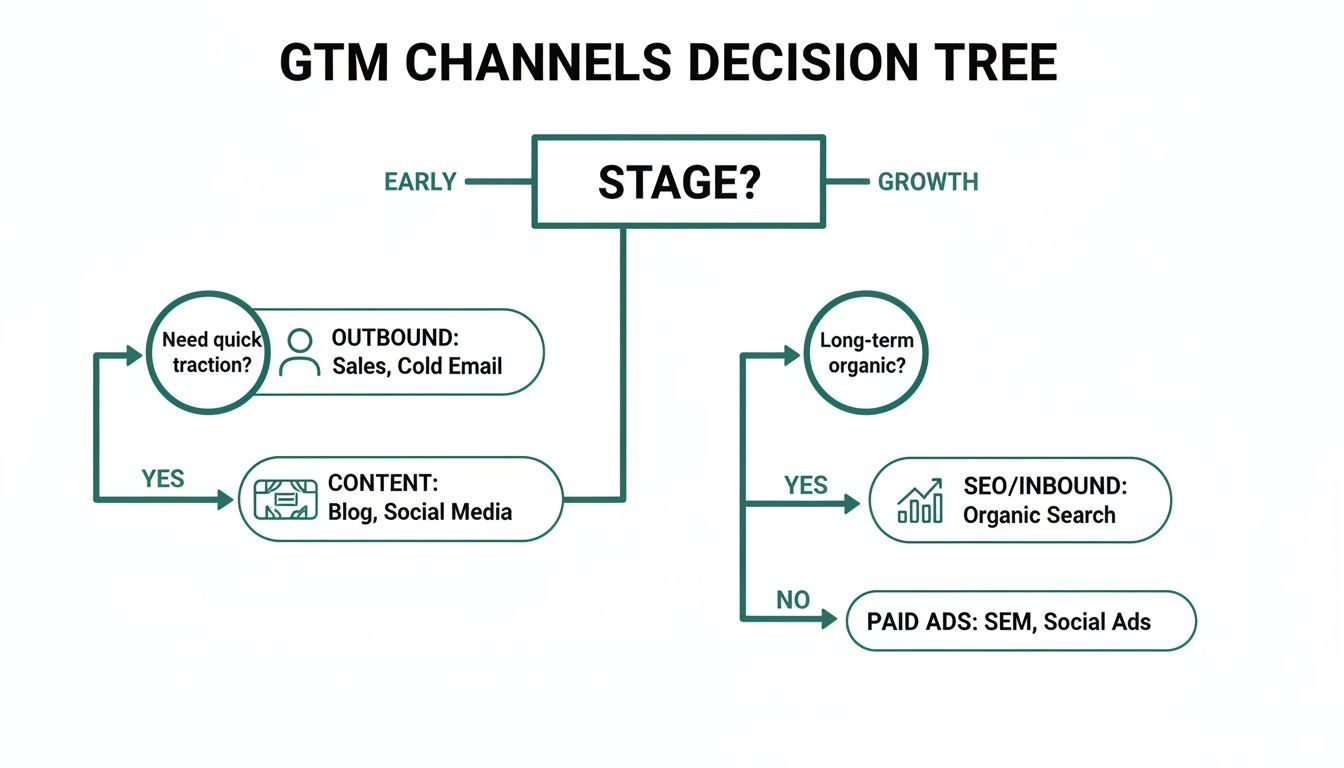
The sequence is clear: early-stage companies must validate their market with targeted outbound. Only then can growth-stage companies layer in scalable inbound channels. This builds on a solid understanding of a modern SaaS go-to-market strategy playbook.
In the early days, before product-market fit, only one channel matters: founder-led outbound.
No one understands the customer's pain, the product's vision, or the value proposition's nuances better than the founding team. This isn't about hiring SDRs to blast generic templates. It’s about surgical, high-empathy outreach conducted by founders to learn, validate, and land your first 10-20 design partners or paying customers.
This phase has three critical jobs:
I’ve watched startups fail because they tried to skip this step. They hired a VP of Sales or outsourced lead generation too early, only to scale a message that didn't work for an audience that didn't care. Founder-led sales is the crucible where your GTM strategy is forged.
Once your messaging is validated and you have a repeatable sales process, you can begin layering in other channels. This is where many teams err, jumping straight to SEO or paid ads without foundational proof.
A well-planned GTM motion requires careful channel selection.
| Channel | Primary Goal | Best For (Stage) | Common Failure Point |
|---|---|---|---|
| Founder-Led Outbound | Market Validation & Initial Revenue | Pre-Seed / Seed | Prematurely delegating to non-founders. |
| Content & SEO | Building Authority & Capturing Demand | Seed / Series A | Focusing on vanity traffic instead of high-intent keywords. |
| Paid Social (LinkedIn) | Targeted Lead Generation | Seed / Series A | Running ads with unvalidated messaging and a broad ICP. |
| Partnerships | Scaling Reach & Credibility | Series A and beyond | Seeking partners before having a valuable customer base to offer. |
The sequence is what makes or breaks your growth engine.
SEO and Content: This is a mid-to-long-term investment. Start by targeting high commercial intent, bottom-of-funnel keywords. Your first articles should target prospects actively looking for solutions like yours.
Paid Channels: Platforms like LinkedIn are powerful for B2B when used with precision. 89% of B2B marketers use it for lead generation, and it drives an estimated 80% of B2B leads from social media because four out of five members influence business decisions. Use paid social to get your validated messaging directly in front of your ICP.
Partnerships: This channel becomes relevant once you have an established product and a customer base that provides value to another company's audience. Do not rush it.
The sequence is critical. Outbound validates. Inbound scales. Attempting to scale before validation is the most common and costly mistake in sales lead generation.
Each of these channels serves a distinct purpose. Mastering this sequence is key to building a capital-efficient growth machine. To go deeper on the pros and cons, check out our guide on B2B marketing channels.
Strategy is a document until you turn it into pipeline. This is where most B2B SaaS teams fail—they have a plan but cannot translate it into meetings. Your sales lead generation efforts live or die by the quality of your execution. It’s about focusing on signal, not noise.
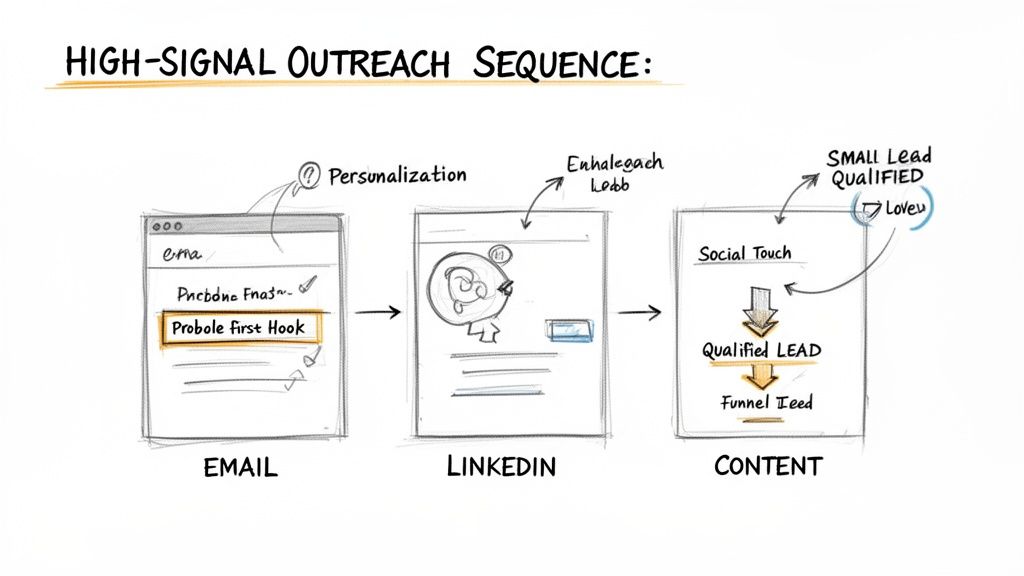
The bar for cold outreach is higher than ever. Generic templates are instantly deleted. Senior decision-makers care about their problems, not your features. Your outreach must prove you understand their world.
Successful outbound is built on two pillars: hyper-personalization and problem-centric messaging.
{{first_name}}. It’s referencing a recent company milestone, quoting them from a podcast, or pointing to a role they’re hiring for that indicates a pain you solve. It proves you did the work.This reframes the entire dynamic. You are no longer a vendor begging for 15 minutes. You are a peer initiating a strategic conversation.
Your first email has one job: earn a reply by being so relevant and insightful that it cannot be ignored. The entire message should prove you understand their specific context.
A solid sequence is not just email. Weave in strategic touches on LinkedIn—a thoughtful comment on a post or a connection request that references your email. This multi-channel approach reinforces relevance without being intrusive.
Most B2B blogs are content graveyards filled with top-of-funnel articles that attract browsers, not buyers. This is a colossal waste of resources. The purpose of your inbound is to create assets that attract prospects actively searching for a solution to a problem your product solves. We call this pain-point SEO.
Prioritize content based on buying intent.
This strategy transforms your blog from a cost center into a lead-generation machine. Quality and relevance always win over volume. For a deeper dive into turning interest into meetings, explore our guide on mastering B2B appointment setting.
A response is not a sales opportunity. This is where most lead generation systems break. Marketing celebrates a "lead," but sales sees only a name on a spreadsheet—no context, no intent, and no chance of closing.
This friction is a process problem, not a people problem. It stems from a failure to define what a truly qualified lead looks like and how that intelligence is transferred from marketing to sales. Fixing this gap is the single most impactful action you can take to turn marketing activity into predictable pipeline.
The classic BANT framework—Budget, Authority, Need, Timing—is obsolete for modern B2B SaaS. It was designed for slow, linear sales cycles. Today, by the time you can definitively confirm BANT, your prospect has likely already made a decision.
A better model focuses on observable behaviors that signal intent. Stop asking if they have a budget; observe whether their actions prove they are trying to solve the problem.
Qualify leads based on two dimensions:
A lead is only qualified when they are both problem-aware and solution-seeking. Anything less is just a name. Passing it to sales erodes trust and wastes time. Your goal is not to hand off MQLs, but to deliver genuinely qualified opportunities.
When marketing passes an opportunity to an Account Executive (AE), it cannot be a simple notification. The AE requires a complete intelligence briefing to ensure the first call is a productive conversation, not a clumsy rediscovery session. A clear Service Level Agreement (SLA) is non-negotiable.
Marketing must provide a specific set of data points for every qualified lead.
This intelligence transforms the first sales call. Instead of "So... what are you looking for?" the AE can open with, "I saw you downloaded our guide on SOC 2 compliance. Many fintechs we work with struggle with that as they scale. Is that a priority for you?" The difference is night and day.
To get this right, you need a shared, unbreakable definition of a Sales Qualified Lead (SQL). Learn more by reading our guide on how to qualify B2B leads. This alignment is the core of an efficient sales lead generation engine.
You cannot fix what you do not measure. Most early-stage founders measure the wrong things—website traffic, social followers, even raw MQL counts. These vanity metrics feel good but reveal nothing about the health of your sales lead generation engine or its impact on revenue. A spike in traffic is worthless if none of the visitors fit your ICP.
Cut through the noise. The only metrics that matter are those that draw a straight line from your activities to pipeline and revenue. They show you where the friction is in your go-to-market motion so you can make decisive changes.
To build a predictable revenue engine, shift your focus from top-of-funnel activity to middle-of-funnel conversion and velocity. Forget sprawling dashboards. A founder or revenue leader needs only a few key indicators.
Here are the key performance indicators that reveal the truth about your pipeline's health.
Key metrics to track the health and efficiency of your B2B SaaS sales pipeline, moving beyond vanity metrics to focus on revenue impact.
| Metric | What It Measures | Healthy Benchmark (Early-Stage SaaS) | What a Poor Result Indicates |
|---|---|---|---|
| Lead-to-Opportunity Rate | The percentage of leads that sales accepts and converts into a legitimate sales opportunity. The ultimate test of lead quality. | 10-15% for inbound leads; 3-5% for outbound leads. | Your ICP targeting is off, messaging isn't resonating, or your lead qualification criteria are too loose. |
| Sales Cycle Length | The average time from first meeting to a closed-won deal. | 30-90 days for most SMB/Mid-Market deals. | A long or lengthening cycle suggests a weak value proposition or lack of urgency in your messaging. |
| Customer Acquisition Cost (CAC) | The total sales and marketing cost to acquire a new customer, analyzed by channel. | Should be recoverable within 6-12 months of customer revenue. | A rising CAC without a corresponding increase in deal size signals a major efficiency problem in your GTM engine. |
| Pipeline Velocity | The speed at which opportunities move through your pipeline and become revenue. Formula: (Opportunities x Deal Size x Win Rate) / Sales Cycle. | Aim for consistent quarter-over-quarter growth. A 20%+ increase is strong. | Slow or declining velocity is a massive red flag. It shows that even if you have deals, they aren't closing fast enough to sustain growth. |
These metrics move you from tracking activity to diagnosing system health. They connect what you do to what you earn.
Your dashboard's purpose isn't to report on past activity; it's to diagnose system health. If a metric is off, it should immediately point to the part of the engine that's broken.
These KPIs are diagnostic tools. A low Lead-to-Opportunity Rate is a symptom. It forces hard questions: Is marketing targeting the wrong companies? Is the handoff process broken?
A healthy pipeline isn’t about volume. It’s about the quality, velocity, and predictability of the opportunities moving through it.
Focusing on these essential metrics is how you graduate from guessing to knowing. Learn more about connecting these to broader strategy by reviewing our guide on essential SaaS marketing metrics. This approach allows a founder to see the health of their entire growth motion and make the hard decisions needed to build a revenue machine that works.
Explore Big Moves Marketing services and resources:

%20-%20white.svg)