%20png%20copy.avif)
Your sales conversion rate is a single number that tells a complex and often misleading story. For a B2B SaaS leader, the standard definition—the percentage of leads that become customers—is dangerously incomplete. It hides the critical nuance between a good number and a healthy business.
The metric itself is a symptom, not a cause. Obsessing over it is a common but critical mistake.
Most founders I advise are fixated on their sales conversion rate. They track it, report on it, and use it as the primary yardstick for sales team performance. This is a strategic error. The rate is a lagging indicator, a reflection of your entire go-to-market engine's health, not a direct lever you can pull.
I've seen this pattern play out across dozens of early and growth-stage SaaS companies: leadership's fixation on the number itself leads to flawed, short-sighted decisions.
A "good" rate can easily mask a dangerously small pipeline. A "bad" rate might signal an ambitious new GTM motion that needs refinement, not abandonment. This metric isn't a simple performance score; it’s a direct output of your ICP definition, your positioning, and the clarity of your pitch deck.
Chasing generic industry benchmarks is a common and distracting trap. While some data shows the average cross-channel conversion rate is 2.9%, with professional services peaking at 4.6%, these figures are almost meaningless for a specialized SaaS product with a long sales cycle and high ACV.
Comparing your highly-considered B2B software sale to these broad averages is a flawed approach that distracts from the real issues. You can explore more of this data on conversion rates by industry at Ruler Analytics, but don't get lost in the numbers.
The problem is that this metric encourages the wrong questions. Instead of asking, "How do we increase our conversion rate?" leaders should be asking much deeper, more diagnostic questions:
The goal isn’t to hit an arbitrary percentage. It’s to diagnose the health of your revenue engine. A falling conversion rate is often the first signal of a mismatch between your product, your market, and your message.
Blaming the sales team is the easiest, and usually the most incorrect, conclusion. Across my work with founders, a declining sales conversion rate is almost always a signal that something further upstream is broken. It could be a shift in the market you haven't adapted to, a new competitor neutralizing your key differentiator, or simply that your messaging has grown stale.
The number is the starting point for diagnosis, not the final grade. The real work is to look past the rate and dissect the inputs that created it. That is where you find leverage.
Chasing generic sales conversion rate benchmarks is one of the fastest ways to derail a B2B SaaS strategy. It’s a classic mistake. You end up comparing your high-consideration, six-figure deal cycle to an e-commerce checkout flow.
This creates noise, misdirects your team, and inevitably leads to finger-pointing when you don't hit some meaningless "industry average."
The hard truth is that the only benchmarks that actually matter are internal and deeply context-aware. Your sales conversion rate is a direct reflection of your business model, not some universal constant.
So, what’s a “good” conversion rate? The answer is always, "It depends." A 9% conversion rate on cold outreach for a $100k ACV product is a home run. A 25% rate on warm referrals for a $5k ACV product could mean you are underperforming. The number itself means nothing without context.
Here’s what really drives your rate:
This chart gives a high-level glimpse of how conversion rates can differ across channels, but it only scratches the surface.
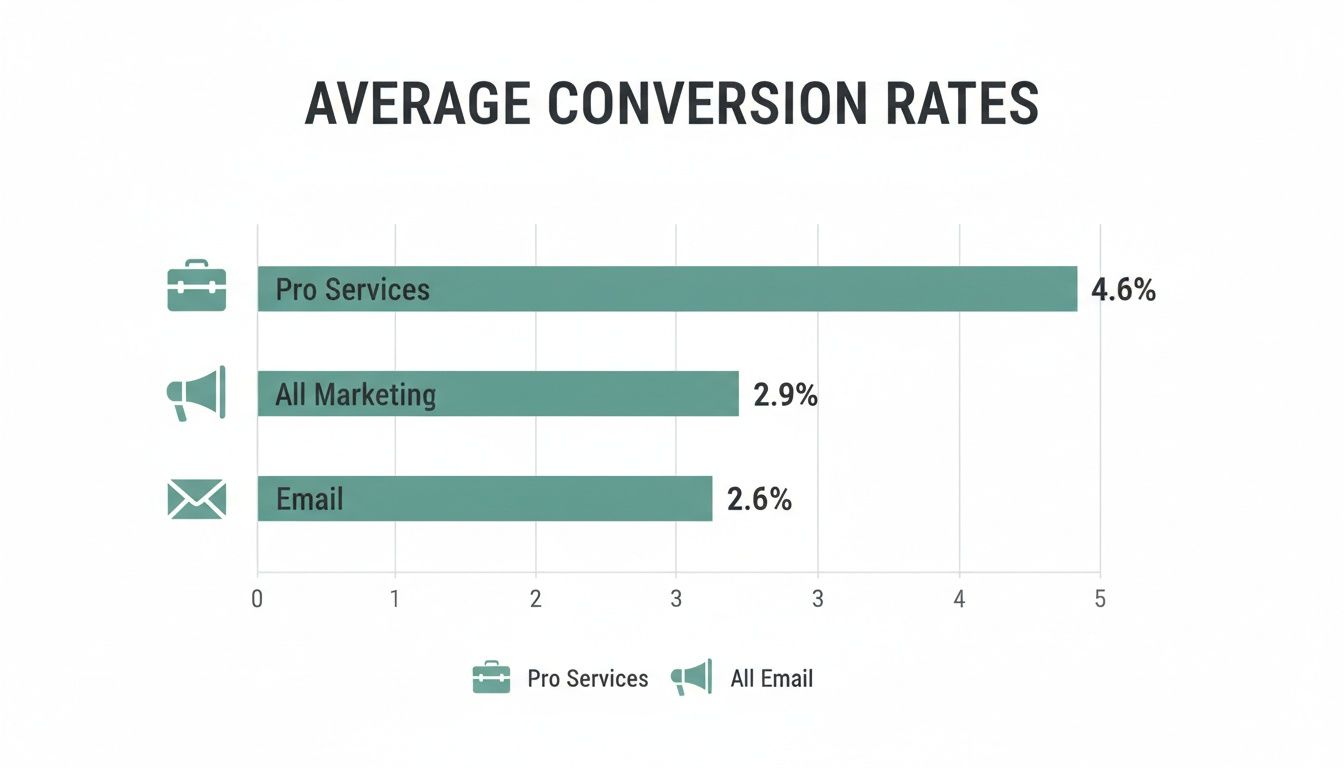
It’s no surprise that higher-touch channels convert better. This just reinforces how critical it is to get specific with your analysis.
Let's ground this in reality. General industry averages are often pulled from a mix of B2C and low-ACV B2B data, which is irrelevant to a founder selling a high-consideration SaaS product. The table below contrasts these generic numbers with the segmented reality of B2B tech sales.
This is the level of nuance required. A single, blended rate hides the truth. Your real performance is a mosaic of these different channels and deal types. You need to see each piece clearly to make smart decisions.
Instead of looking outward at irrelevant averages, your goal is to build an intelligent internal diagnostic system. It starts with segmenting your funnel performance.
Start tracking and benchmarking your sales conversion rate by these core segments:
This segmented view changes the conversation. You stop asking, "Is our conversion rate good?" and start asking, "Where is our GTM engine strongest, and where is it leaking?" It transforms a vanity metric into a powerful diagnostic tool.
This is how you discover where your positioning resonates and where it falls flat. If your sales conversion rate for outbound enterprise leads is near zero, the problem isn't your outbound team—it’s your messaging, your ICP targeting, or the value prop itself.
As you move beyond superficial metrics, understanding your LTV to CAC ratio becomes the ultimate measure of a healthy business.
Building this internal diagnostic system is foundational. It provides the clarity needed to make sharp decisions and stop wasting motion. For a deeper dive on this, see our guide on the SaaS marketing metrics that truly matter.
A low sales conversion rate is a system alert, not the root problem. Chasing the number itself is a reactive, low-leverage activity. In my experience across dozens of B2B SaaS companies, the real issue is almost always a breakdown in one of three core go-to-market pillars.
These are the areas where high-performing revenue engines are built and where struggling ones leak value.
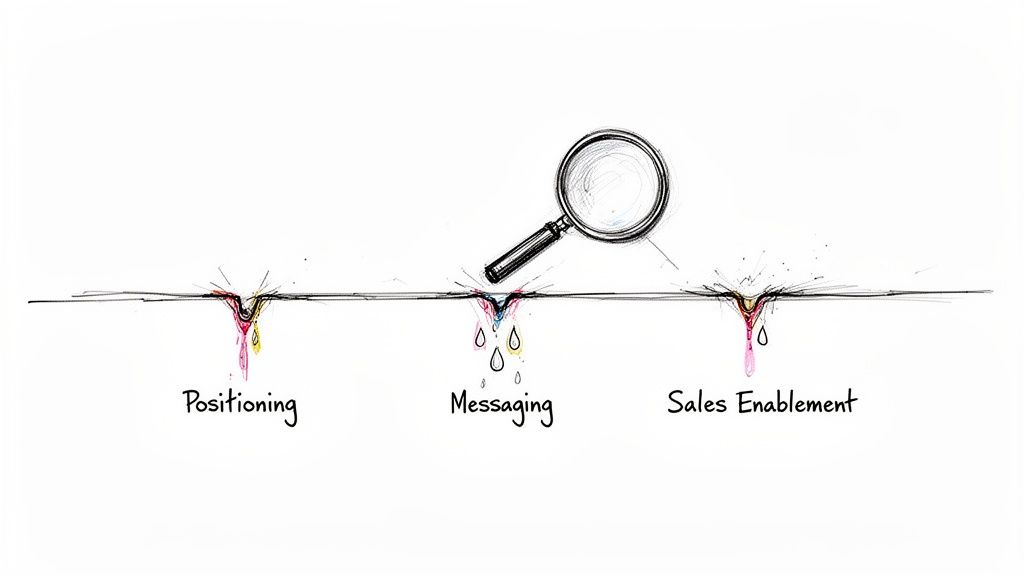
When your sales conversion rate falters, you don’t have a sales problem. You have a diagnostic challenge. Stop looking at the sales team and start interrogating these upstream dependencies.
Weak positioning is the most common and destructive cause of a poor sales conversion rate. It forces your sales team to work heroically on every call just to establish basic relevance.
Symptoms of a positioning failure are easy to spot:
If your prospects can't easily articulate why you are the only viable solution for their specific problem, you don't have a conversion problem. You have a positioning crisis.
This isn't an abstract branding exercise. It's the foundation of your GTM motion. Without a sharp position, your sales team is selling on hard mode, trying to create value from scratch in every conversation.
The second critical failure point is messaging. Many early-stage SaaS companies build messaging that resonates brilliantly with the product's daily user but completely fails to connect with the economic buyer—the person who signs the check.
Your AE might have a fantastic discovery call with a manager who loves the feature set. But when that manager tries to sell the solution internally to their CFO or VP, the argument falls apart.
Why? Because the messaging was built around operational benefits, not strategic impact.
If your AEs can’t arm their champions with a compelling business case, the deal will stall the moment it needs budget approval. To diagnose this, audit your call recordings and pitch decks. Are you speaking the language of efficiency, or are you speaking the language of revenue, cost, and risk? If you are looking to refine this approach, our guide on how to improve sales conversion rate offers deeper strategies.
Finally, look at sales enablement. This isn't about providing more content; it's about providing the right assets that build conviction and dismantle objections.
I’ve seen Series B companies with beautiful websites send their AEs into six-figure deals armed with a 40-slide, feature-heavy deck that looks like a technical manual.
A sales enablement audit should be ruthless. Ask:
If your reps are creating their own materials out of necessity, your enablement strategy has failed. You're not providing them with the calibrated tools required to execute your GTM strategy. This friction directly translates into a lower sales conversion rate.
The number isn't the problem; it's the signal. The real work is to look at these three pillars—Positioning, Messaging, and Enablement—and honestly assess where the breakdown is occurring. That is the only path to sustained improvement.
If you're looking for a clever script or a tactic to improve your sales conversion rate, you’re looking in the wrong place. Those might deliver a temporary bump, but they don't create lasting change.
Sustained improvement comes from systematic, upstream work. The founders and leaders who successfully move the needle don't obsess over the rate itself. They focus on making their entire go-to-market motion more coherent.
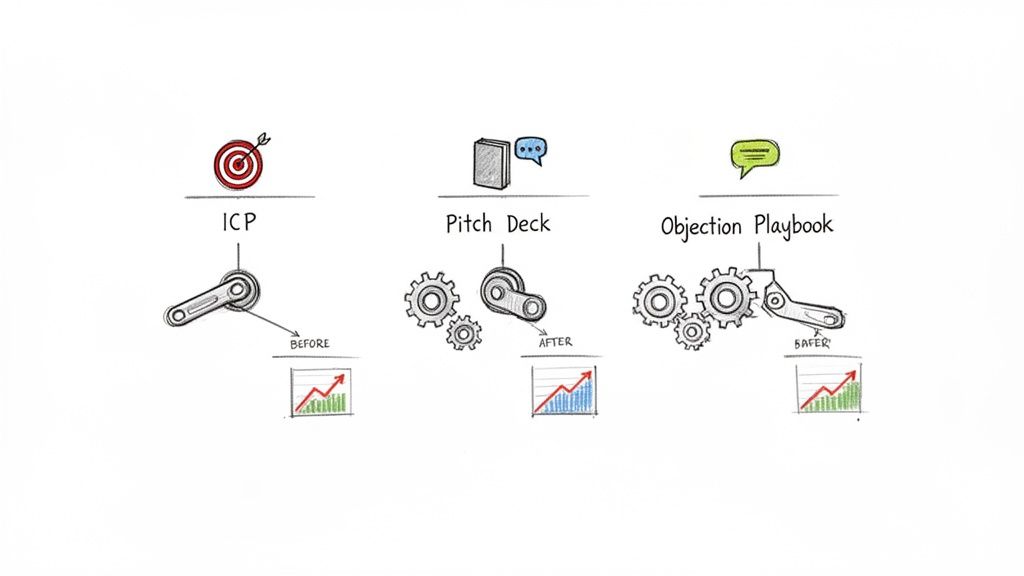
When the system is aligned, your sales conversion rate naturally improves as a byproduct. There are three pillars where this work delivers the highest return.
The single most powerful lever for improving your sales conversion rate is to narrow your focus. This terrifies most teams. They think a wider net catches more fish, but in B2B SaaS, a wider net means your sales team burns cycles on prospects who will never buy.
The goal is to define and dominate a "right-to-win" segment—a niche where your value is so obvious and the pain is so acute that you become the only logical choice. This isn't just demographics; it's psychographics, tech stacks, and business pain.
Case Example: I worked with a Series A vertical SaaS platform whose demo-to-close rate was a dismal 14%. They sold to a broad category of "professional services firms." Digging into their closed-won deals, a pattern emerged: over 60% of their best customers—highest ACV, fastest close times—were all using the same legacy on-premise system that was being sunsetted.
We immediately refocused their GTM motion on this sub-segment.
The result? Their sales conversion rate for new opportunities shot up to 26% in two quarters. They didn't sell harder; they sold smarter.
Your pitch deck is not a one-size-fits-all document. Handing your reps a single, monolithic deck and expecting them to win is strategic malpractice. A B2B deal involves a diverse buying committee, and each person cares about different outcomes.
A modular deck is a library of slides and narrative components that your AEs can assemble to speak directly to a specific audience.
Case Example: I worked with a data infrastructure company whose AEs kept losing deals late in the cycle. Their pitch was brilliant for data scientists but lost the budget holders. We built a dedicated "CFO Module" that translated technical advantages into a clear business case.
This armed their champions to sell effectively internally. Their conversion rate from the "Final Presentation" to "Closed-Won" stage jumped from 40% to over 70%. They were finally speaking the language of the person signing the check.
Objections are not failures; they are signposts. They show you exactly where a gap exists in your messaging or a perceived risk in the prospect's mind. Most sales teams handle them inconsistently. High-performing teams treat objection handling as a system.
This means creating a living playbook—often in a shared document—that contains:
A strong objection-handling system turns tribal knowledge into a scalable asset. It ensures every rep is equipped with the strongest arguments, not just the ones they've discovered on their own.
This system dramatically speeds up ramp time for new hires and ensures your message is consistent. When your team can confidently dismantle the top five objections they face, your sales conversion rate has no choice but to improve.
To identify and implement effective changes, dive into proven strategies like these conversion rate optimization best practices that can impact your outcomes. These levers—Positioning, Pitch Decks, and Objection Handling—are not quick fixes. They are the foundational work required to build a predictable revenue engine.
Trying to fix your sales conversion rate in isolation is a fool’s errand. I’ve seen countless founders fall into this trap. It’s like trying to make your car faster by jamming your finger against the speedometer needle—the gauge might move, but the car isn’t actually accelerating.
Your sales conversion rate is an output. It’s a signal from a much more complex system: your entire go-to-market engine.
Sustainable improvements never come from tweaking tactics at the bottom of the funnel. They come from treating your GTM motion as a single, interconnected machine. Your positioning, messaging, demand generation, and sales enablement are all cogs in this engine. When one is misaligned, the entire system sputters, and a poor sales conversion rate is the sound it makes.
When you change one part of this system, you must adjust the others. If you refine your ICP, your demand gen targeting must reflect that change instantly. If you sharpen your core messaging, that new language has to flow directly into sales training and pitch decks. Anything less creates internal friction and confuses the market.
This is a fundamental reframing for every founder and revenue leader. Stop treating your sales conversion rate as a target. Start seeing it for what it is: a continuous feedback loop on the health of your GTM.
Treat your conversion rate not as a goal, but as a real-time diagnostic. It tells you whether your GTM engine is a coherent machine or a collection of disconnected parts.
A dip in your conversion rate isn't a sales failure; it's feedback that your positioning might be off. A stall in sales cycle velocity isn't an AE problem; it's feedback that your messaging isn't connecting with the economic buyer. This is how you shift from fighting fires to proactively building a high-performance system.
This is also why chasing generic benchmarks is so distracting. Sure, global eCommerce conversion rates might average 2.58%, but B2B SaaS often sits lower, around 1.8%, because of longer, complex buying cycles. Some data shows that in mature markets like the UK, rates can climb to 4.10%, which proves that a coherent, trusted message gets rewarded. But these numbers are noise if your system is broken.
You can browse these 2026 conversion benchmarks from Dynamic Yield to see the variance for yourself, but the real work is always internal.
The true objective isn’t to hit some arbitrary percentage pulled from a report. The goal is to build a coherent machine that predictably finds the right prospects and systematically turns them into high-value customers.
This is the strategic work we do with founders—moving beyond checklists to build integrated systems for scalable, defensible growth. It's about making sure every part of your go-to-market motion works in concert, turning strategic clarity into revenue. When your system is sound, the sales conversion rate takes care of itself. For more on this, see our guide to building a cohesive go-to-market strategy for SaaS.
Theory is one thing. Execution is another. As a founder or revenue leader, you’re not looking at spreadsheets; you’re wrestling with the real-world consequences of your sales numbers. Here are straight answers to the most common questions I get about sales conversion rates.
This is the wrong question. Chasing a universal "good" rate means you're focused on external validation, not internal diagnosis.
A truly good rate is one that improves quarter-over-quarter within your most valuable customer segments. Everything depends on your ACV, sales cycle, and lead source.
For example, a 3% conversion rate is phenomenal if you're closing $150k ACV deals from a cold outbound motion. In contrast, a 20% rate from warm partner referrals for a $10k ACV product could be a sign of a leaky process.
The only productive way to think about your sales conversion rate is to stop chasing generic averages. Your job is to establish and improve your own internal benchmarks, segmented by channel and deal profile. That's how you build a predictable revenue engine.
Almost never. A sudden drop is far more likely a symptom of a GTM problem, not a people problem. Firing reps is a reactive, expensive mistake that ignores the data.
Before you consider performance management, audit what’s happening upstream.
A declining sales conversion rate is a diagnostic tool. It points you toward a strategic gap—usually in marketing, product alignment, or your overall GTM strategy. Dig deeper into how you can improve your sales team's performance by fixing the system, not just blaming the players.
Anyone who promises immediate results from big strategic changes is selling snake oil.
For a B2B SaaS company with a 3-9 month sales cycle, expect a meaningful lift in your closed-won rate after a 6-12 month lag. That’s the reality of fundamental changes like repositioning your product or overhauling your core messaging.
Tactical fixes might provide a quick bump. A new email sequence could boost meeting bookings temporarily. But those are small wins.
Real, durable improvements to your GTM system require patience. You need to be tracking leading indicators—like sales cycle velocity and pipeline quality. These metrics tell you if your strategic shifts are working long before the final closed-won rate ticks up. Be patient and trust the process.
At Big Moves Marketing, we partner with B2B SaaS founders to build the clarity and strategic alignment needed for scalable growth. If you’re ready to move beyond chasing metrics and start building a coherent GTM system, let's talk. Learn more about how we can help at https://www.bigmoves.marketing.
Explore Big Moves Marketing services and resources:
June 26, 2026



%20-%20white.svg)