%20png%20copy.avif)

A go-to-market strategy for SaaS isn't a launch plan. It's the operating system for your entire revenue function—the connective tissue between product, market, and revenue model that generates repeatable wins with high-value customers.
Too many founders treat GTM as a tactical checklist. This approach guarantees stalled growth the moment initial launch excitement fades. It's a costly, predictable error.
The single most expensive mistake B2B SaaS founders make is confusing their go-to-market strategy with a product launch.
A launch is an event—a press release, a Product Hunt feature, a burst of social media. A GTM strategy is a durable system designed to generate predictable revenue, month after month.
This confusion is the root cause of immense waste. I’ve seen it play out repeatedly in Series A to C companies: capital gets torched on marketing campaigns with zero connection to sales outcomes, teams operate from different playbooks, and a painful growth plateau hits the second the launch-day hype evaporates.

When GTM is reduced to a launch, leadership focuses on the wrong inputs and measures the wrong outputs. The obsession shifts to tactical execution without the strategic foundation required to sustain it.
This creates distinct, painful failure points across the business:
A launch creates a spike. A go-to-market strategy creates a slope. Your job is to build the slope, not just chase the spike.
The goal of your go-to-market strategy saas isn't to "get the word out." It is to build the connective tissue between your product, your market, and your revenue model. It forces hard decisions upfront, ensuring every dollar and every hour spent on execution is a high-leverage investment.
While a strong product launch plan is a critical component, a comprehensive GTM strategy is a foundational document.
Before you burn another dollar on marketing or hire another salesperson, you must have absolute clarity on the fundamental components of this revenue engine. This isn't abstract theory; it's about building a machine that reliably turns prospects into profitable, long-term customers.
The following sections break down how to build that machine, piece by piece.
Nothing burns through capital faster in an early-stage B2B SaaS company than an imprecise Ideal Customer Profile. It’s the original sin that leads to almost every other go-to-market failure: wasted ad spend, demoralized sales teams, abysmal efficiency, and a product roadmap that chases ghosts.
Most teams think they have an ICP. What they really have is a loose persona—a vague sketch of an industry and a job title. That’s not a strategy; it’s a guess. A real ICP is a brutally specific, multi-layered definition of the companies that get maximum value from your product and that you can sell to without lighting money on fire.
The core mistake is treating the ICP as a marketing exercise. It’s not. It’s a strategic constraint for the entire business, designed to enforce discipline.

A useful ICP goes far beyond firmographics like company size or industry. It must identify attributes that signal a deal is not just possible, but probable. Without that depth, your GTM team is flying blind. Marketing targets everyone, and sales wastes months on prospects who were never going to buy.
Your profile needs to be sharp enough to answer three make-or-break questions for any account:
An ICP is a filter, not a bucket. Its most important job is to tell your team who not to sell to. This is the operational discipline that builds a capital-efficient go to market strategy saas companies need to survive.
A battle-tested ICP isn't built on one dimension. You must layer different data types to create a complete picture. The goal is to define your "beachhead" market—the narrow, defensible segment you can dominate before expanding.
Your analysis has to include:
Assembling this data isn't a one-off project. It requires interviewing your best (and worst) customers, digging through your CRM for patterns in won vs. lost deals, and training your sales team to ask qualifying questions that go far beyond BANT. For a more structured approach, our guide on crafting a precise ideal customer profile breaks it down.
Your ICP is the central nervous system of your entire go to market strategy saas plan. When it's clear and ruthlessly enforced, the engine works. Marketing knows who to target, sales knows who to prioritize, and product knows whose feedback matters. Get this wrong, and you might as well set your capital on fire.
Let’s be direct: your product’s features are not its value. This is the single biggest reason B2B SaaS messaging fails. Founders and product teams get so wrapped up in what they’ve built—the elegant code, the complex architecture, the long list of capabilities—that they completely miss the point.
Your buyers don’t care about your ‘AI-powered’ engine. They care about solving a painful, expensive business problem. Until you can translate your features into tangible business outcomes, your messaging is just noise.
Good positioning isn't about landing a clever tagline. It’s about making a clear, defensible claim to a specific piece of market territory. From there, you build a messaging hierarchy that proves you own it.
The default setting for most SaaS companies is to talk about themselves. Look at their websites—it’s a laundry list of what the product does. This is feature-speak, and it’s a conversation killer.
Effective messaging flips the script. It focuses relentlessly on what the customer gets. This requires discipline. You have to map every single capability back to a concrete result for your Ideal Customer Profile.
For every feature you're tempted to highlight, force an answer to three questions:
This exercise is your antidote to internal jargon. It’s the difference between saying, "We offer predictive analytics," and saying, "We identify your top 10% of at-risk accounts so you can prevent churn and protect $2M in ARR." One is a feature; the other is a solution to a multi-million dollar problem.
Great positioning isn’t a single statement. It's a structured framework that gives your entire GTM team the right words for the right audience, from a C-suite pitch to a technical demo.
Think of it as the raw material for every landing page, sales deck, and cold email.
Your messaging fails the moment a prospect has to connect your product's features to their business problems. Your job is to do that work for them, explicitly and relentlessly.
This discipline is more critical than ever, with every company slapping an "AI-powered" sticker on their product. The buzzword is officially meaningless. The companies winning with AI aren't just using the tech; they're connecting its capabilities to specific GTM motions. High-performing AI adopters are hitting 56% trial-to-win conversion rates, far surpassing the industry average of 32%. Why? Not because of the AI itself, but because it enables hyper-personalized outbound and a more efficient funnel. You can get more GTM insights from the full state of GTM in 2025 report.
Your positioning is the foundation for your entire go-to-market strategy. It’s not a job for the marketing team; it's the strategic narrative for the company. For a detailed guide on building this structure, use our brand messaging framework. Get this right, and you create clarity. Get it wrong, and you create confusion—the most expensive mistake a startup can make.
Let's cut through the noise. The "Product-Led vs. Sales-Led" debate is a false choice, a distraction that has founders trying to cram other companies' playbooks into businesses that look nothing like their own. The real question isn't what's trendy; it's what your product, your pricing, and your customer demand.
Think of your sales motion as the operating system for your revenue engine. Picking the wrong one is like trying to run enterprise software on a cheap smartphone—the hardware can't support the task. This is one of the most common and costly mistakes SaaS founders make.
You don't choose your sales motion based on preference. It's dictated by the physics of your business. Get this wrong, and you'll either burn cash funding a sales team that can't close deals profitably, or you'll overwhelm your support team with self-serve users who were never going to convert.
It boils down to three things:
Choosing a sales motion isn't about your aspirations; it's about aligning with the fundamental laws of your business. You can't defy the gravity of your ACV.
Product-Led Growth (PLG) has taken over SaaS for a reason, but it only works when the conditions are right. According to ChartMogul's SaaS Go-To-Market Report, top PLG companies are hitting 1,000 subscribers in just 11 months and slashing their customer acquisition costs by 25-60%. It’s incredibly powerful when users can self-onboard and see value immediately, but that magic is typically confined to lower price points.
This decision tree helps visualize how your messaging needs to adapt. It's about shifting the conversation from what your product does to what your product achieves for the customer.
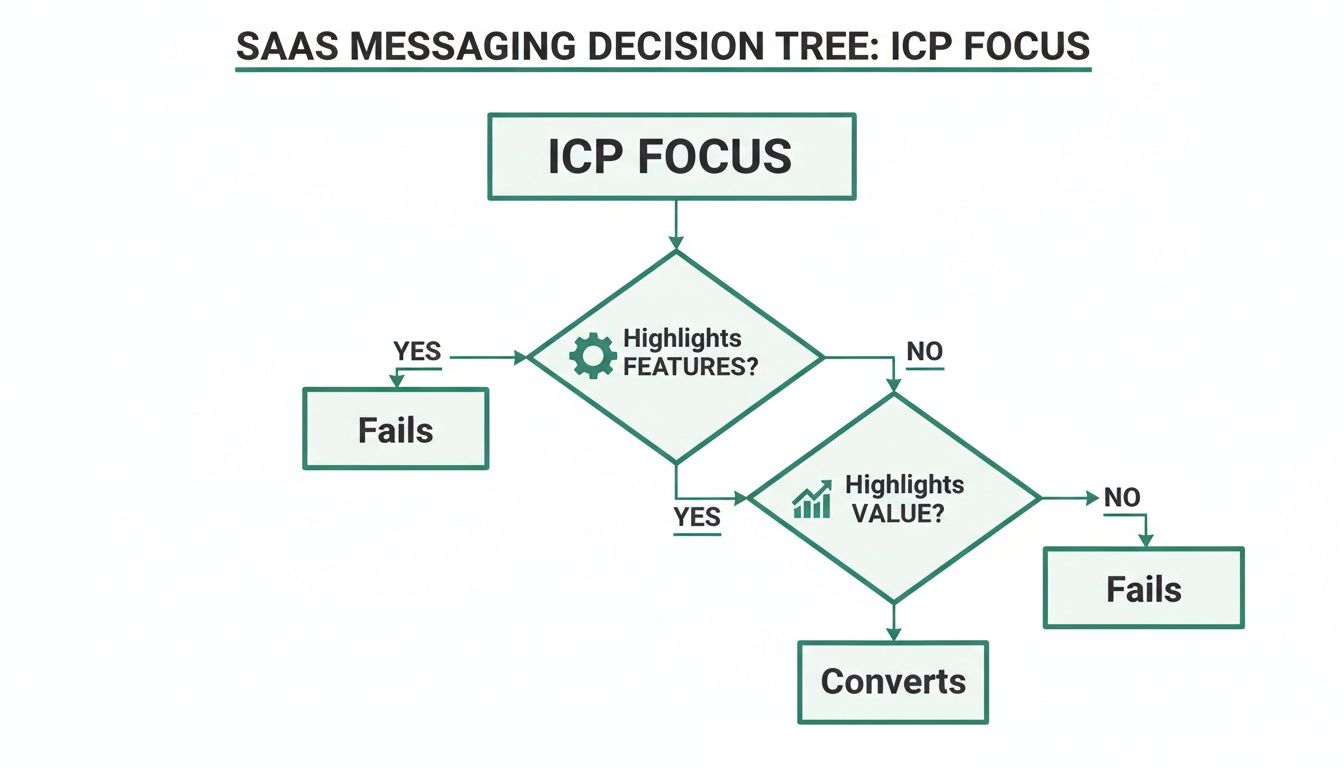
Talking about features puts the burden on the buyer to connect the dots. A value-led conversation does that work for them, linking your solution directly to their business goals. That’s what drives conversion.
Here's a breakdown of the models. Remember—it's a spectrum, not a set of rigid boxes.
Product-Led Growth (PLG): This isn't just a "freemium" plan. It's a GTM strategy where the product itself drives acquisition, conversion, and expansion. It thrives in high-volume, low-ACV environments where time-to-value is almost instant. Think Calendly or Slack—the product truly sells itself.
Sales-Led Growth: The traditional approach, necessary for complex, high-ACV solutions sold to entire organizations. Here, the sales team's job is crucial. They navigate complicated buying committees, build a business case, and manage a deal cycle that can span months. Think Workday or Salesforce. A consultative, human-led sale is non-negotiable.
Hybrid Models: This is where most successful B2B SaaS companies are landing. You use a PLG motion to create a massive top-of-funnel, letting users explore on their own. Once they show signs of enterprise potential—like multiple users from the same corporate domain—a sales team engages to orchestrate a larger expansion deal. It's the best of both worlds, but it demands tight alignment between product, marketing, and sales.
The table below offers a simple framework to diagnose which motion your business naturally favors.
Use this as a starting point, not a definitive rulebook. Your reality will have nuances. The goal is to honestly assess where you are today.
Your job is to diagnose which motion your business is built for, not to force a model that doesn't fit. For a deeper look at structuring your team, see our guide on building an effective sales playbook template. Getting this right saves a world of pain and wasted resources.
I've seen it happen more times than I can count: a founder celebrates top-line ARR growth while completely missing that their business model is fundamentally broken. Vanity metrics are the silent killers of SaaS startups, creating a false sense of security right before the floor gives out.
You cannot build a durable revenue engine if you’re measuring the wrong things.
A solid go-to-market strategy demands an unflinching look at reality. That means moving beyond surface-level numbers to focus on the handful of metrics that signal the health and efficiency of your growth motion. These numbers tell you when to pour gas on the fire and when to hit the brakes to fix a critical leak.
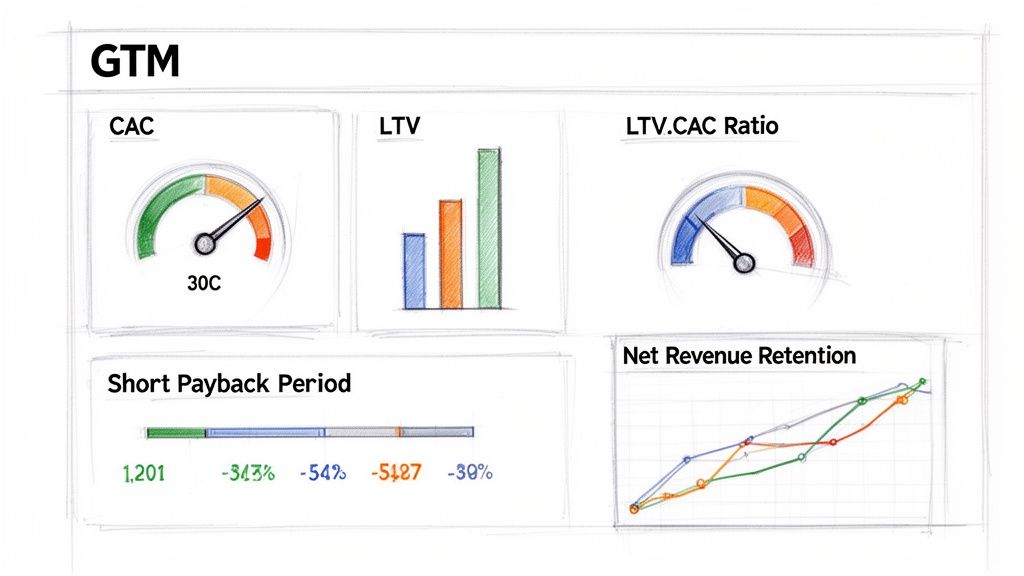
Your GTM dashboard shouldn’t be a sprawling mess of every trackable metric. It needs to be a concise tool highlighting the relationships between your core operational drivers. For B2B SaaS, it all boils down to five essential components.
Your LTV:CAC ratio is the clearest signal you have. A ratio below 3:1 isn't a suggestion to optimize—it's a blaring alarm that your current go-to-market strategy is unsustainable. Scaling with poor unit economics just accelerates your path to zero.
These metrics are diagnostic tools. Their meaning shifts depending on your company's stage, sales motion, and market. A long CAC payback period might signal an inefficient sales process. Persistently low NRR could point to a leaky product or a failure to drive adoption after the sale.
The numbers tell a story that directly informs your next move. It's no surprise that companies meticulously tracking these metrics are growing 20-30% faster than their peers. Top-quartile companies in the $25M-$100M ARR range are achieving an impressive 93% year-to-date ARR growth. To ensure your GTM strategy is driving the right outcomes, you must focus on the SaaS financial metrics that truly matter.
Your GTM dashboard is the scoreboard for your revenue engine. It provides the clarity needed to make disciplined, capital-efficient decisions and avoid the catastrophic mistake of scaling a broken model. For a comprehensive look at the marketing-specific KPIs that feed into this, check our guide on essential SaaS marketing metrics.
Executing a go-to-market strategy comes down to a series of tough, nuanced decisions. There are no silver bullets, only trade-offs.
These are the questions I hear most often from leadership teams building a real revenue engine.
This is a question of capital efficiency. Your goal isn't to find the biggest market; it's to find the market you can win the fastest with the resources you have right now. Many teams get this wrong by chasing a massive Total Addressable Market (TAM) before they've earned the right to.
Layer three filters over your options:
The overlap is your beachhead market. It might feel small, but dominating it gives you the cash, case studies, and confidence to expand from a position of strength.
Your first market isn't your forever market. It's the one that gives you the highest probability of near-term revenue and momentum. Win there first, then expand.
This tension never goes away. The trick is to stop seeing them as separate objectives. Your short-term revenue activities should be the building blocks of your long-term strategy, not a distraction from it.
In practice, this means every short-term "win" must also contribute to a larger strategic asset.
Your day-to-day execution must feed your long-term intelligence loop. If your daily activities aren't making you smarter about your market, your GTM strategy is just a static document.
Founders almost always hire for these roles too early. They expect a new hire to solve what is, in reality, a strategy problem. A salesperson can't fix a broken value proposition, and a marketer can't create demand for a product nobody understands.
The right time to hire is when a process is proven but capacity-constrained.
Hiring before these proof points exist is an expensive way to learn that your strategy is flawed.
Treat your GTM strategy as a living system, not a one-time project. It requires two cadences: a constant pulse check and a periodic deep dive.
Failing to do this is how you get blindsided by a market shift that makes your entire playbook obsolete.
Building a powerful B2B SaaS revenue engine takes clarity, discipline, and an unflinching focus on what truly drives growth. If you need a strategic partner to help you nail your positioning, messaging, and go-to-market execution, let's connect. At Big Moves Marketing, we help founders build the leverage they need to win their market.
Explore Big Moves Marketing services and resources:

%20-%20white.svg)