The most popular advice about product positioning and messaging is to simplify your story. That's useful only after you've made the hard choices. A shorter explanation of an undecided market position is still an undecided market position.
For B2B SaaS leaders, the job isn't writing a homepage that sounds sharper. It's giving a buying group an argument they can agree on, defend internally, and carry through procurement. Treat positioning as a pipeline asset, not a copywriting assignment. Otherwise, you'll keep polishing the pitch while deals stall for reasons your messaging never addresses.
Product positioning is the market choice: the category you claim, the buyer you serve first, the alternative you displace, and the reason you win. Product messaging expresses that choice in words a buyer can repeat without you in the room. Brand messaging sits above both, carrying your company's voice, point of view, and story across audiences.
Positioning, messaging and brand messaging compared
| Layer | Question it answers | Owner | Changes when |
|---|---|---|---|
| Product positioning | Which category, which buyer, which alternative, why us | Founder and product leader | Category, target buyer or competitive set shifts |
| Product messaging | How do we say our position in words buyers repeat | Marketing with sales input | Proof, phrasing or channel needs change |
| Brand messaging | What voice and point of view do we carry everywhere | Founder and brand owner | Company story or audience scope changes |
The distinction matters because each decision requires different evidence. A founder can't delegate the choice of target market to a copywriter, and marketing shouldn't reopen the company's category every time an email underperforms.
For concrete reference points, SubmitMySaas's positioning examples for SaaS founders provide a useful way to examine market choices before debating language.
If your category or first buyer changes, your positioning changes. If your proof or phrasing changes, you're adjusting messaging. A new tone of voice doesn't resolve either decision.
Consider a developer product sold through self-service adoption and enterprise contracts. Describing it as a developer utility attracts an individual user; describing it as an infrastructure control platform invites a different evaluation. That's not a headline test. It changes who evaluates the product, which alternatives matter, and what sales must prove.
The failure pattern is straightforward: teams rewrite homepage copy every quarter without deciding the category. Sales describes a platform, product describes a tool, and paid campaigns promise an outcome neither explains.
Practical rule: Don't approve new copy until leadership can name the market choice underneath it.
This week, write your positioning on one page. Then ask two people in sales and one in product to name the category and main alternative without looking at notes. Disagreement means you need a strategic decision, not another writing session.
Deals stall when only one person in the buying group agrees with you. Run positioning in this order and assign an owner, or consensus never forms: buyer research, competitive mapping, buying-group roles, value propositions, messaging pillars. At Big Moves Marketing, positioning strategy and the messaging framework get defined after buyer understanding, because pillars without evidence collapse in a group evaluation.
Stop debating copy until each layer clears its gate. Vague ownership produces vague claims.
Set the position before buyers lock their preferences. B2B buyers compare notes internally and arrive with vendors already favored, so category association has to happen early. Waiting until an active deal to persuade the group hands the advantage to whoever got there first.
The development process also needs validation gates, not just approved documents.
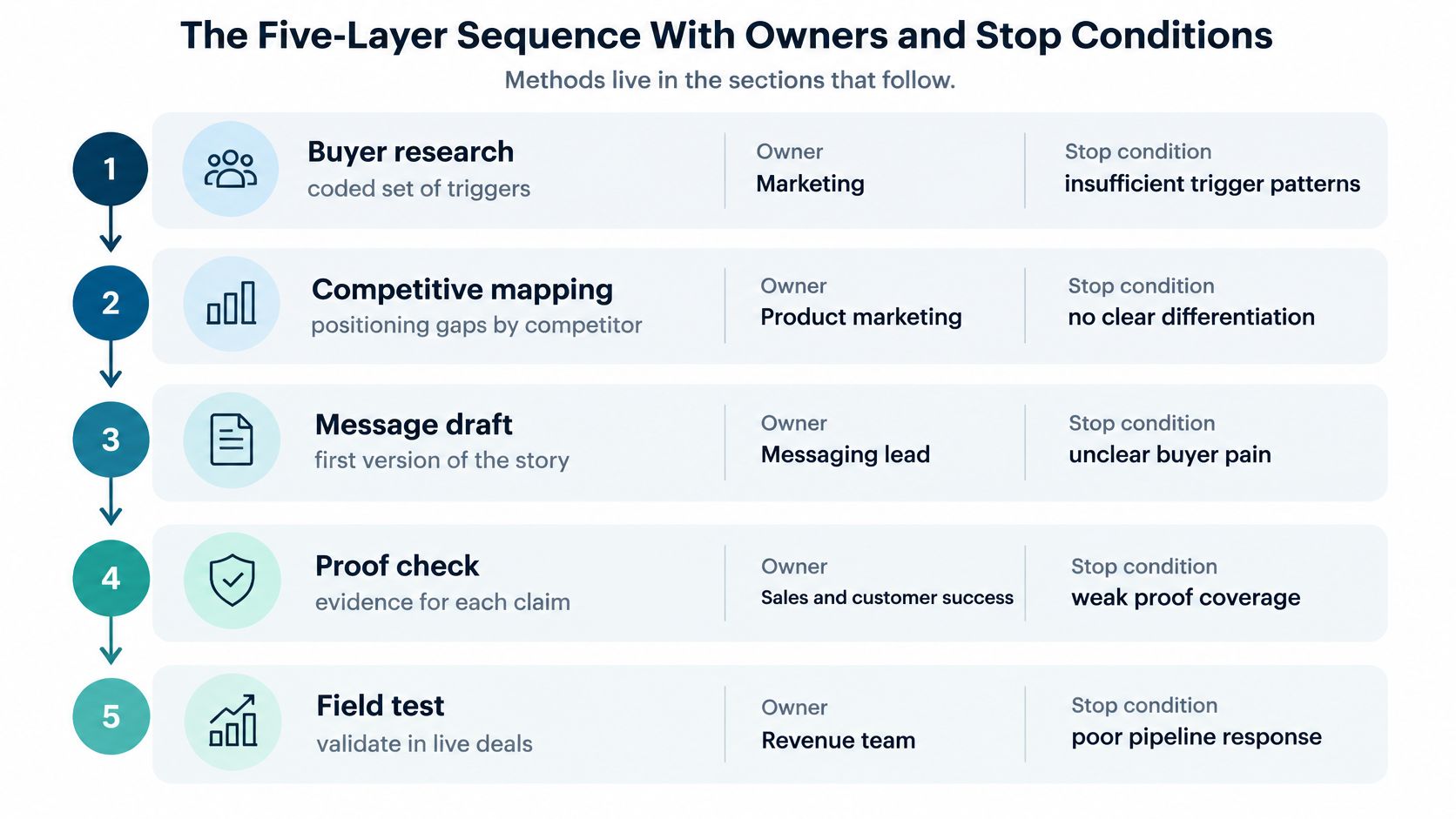
Jumping from a founder brief directly to pillars skips the evidence that makes a claim defensible in procurement, security review, and finance sign-off. Founders: reject any pillar that sales cannot connect to a stalled deal it would have saved.
Weak positioning rarely starts with bad writing. It starts with a draft written before anyone mapped what the buying group must agree on to release budget. Fix that order. Evidence first, claims second.
Start with buyers' problems, pains, and desires, not your feature inventory. Vaibhav runs this step as buyer understanding before positioning strategy and a messaging framework get defined, because that starting point determines which claims deserve pipeline attention.
Time-box a minimum viable research sprint to two weeks. You need to explain purchase decisions, not describe the entire market.
Pull the last 12 to 20 won and lost deal calls and transcripts. Split them by outcome and keep comparable segments together. A persuasive enterprise win must not dictate messaging for a self-service buyer with different constraints.
Code the conversations. Record the trigger event, the problem in the buyer's language, the alternative considered, and the criterion that decided the outcome. This separates a persistent frustration from the event that made someone fund a solution.
Map the roles in the last five deals. Record each participant's first question and decision authority. The first question tells you what that role must resolve before it will support consensus.
Build the competitive grid. For every alternative, capture its headline claim, target buyer, proof, and the gap nobody claims. Include spreadsheets, internal builds, and doing nothing. Buyers do not restrict their options to your software category.
Mark buyer-confirmed white space. Select gaps that match problems buyers named without prompting. An unused phrase is not an opportunity unless buyers care about the underlying difference.
Structure that comparison with the competitive analysis framework. For a larger public-page collection workflow, Context.dev's public web data API for developers is a relevant resource to evaluate. Collecting competitor claims never proves buyers believe them. The working session that matters puts buyer language next to competitive evidence and forces a choice about which gap you can defend in a live deal.

B2B buyers now expect strong self-service tools when choosing a vendor. Your findings belong on the website, not just in a sales briefing.
Make the purchase trigger recognizable. Explain the relevant use case, implementation conditions, alternatives, and evidence. A buyer should not need a discovery call to learn whether your product handles their operating environment.
In Gartner's survey of 632 B2B buyers conducted in August and September 2024, 61% preferred an overall rep-free buying experience, while 73% actively avoided suppliers sending irrelevant outreach. Publish for that behavior.
Do not respond by removing sellers from complex evaluations. Give buyers enough independent clarity to make seller involvement useful. Research is complete when a new interview surfaces no new trigger, alternative, or decision criterion. Narrow an incompatible sample before you declare completion.
Stop writing personas as demographics. Write them as votes you need to win. A champion with enthusiasm and no finance-ready argument loses the deal in the last meeting.
Enterprise purchases involve five to eleven stakeholders across about five business functions. Map decision roles. Never assume the user controls the purchase.
| Decision role | What they evaluate | Evidence to prepare |
|---|---|---|
| End users | Workflow time saved | Task-level before-and-after demonstration |
| Economic buyer | Strategic impact | Connection to the funded business priority |
| IT | Security and integration effort | Architecture, controls, and deployment requirements |
| Procurement | Commercial comparability | Scope, terms, obligations, and comparable costs |
| Finance | Payback against switching cost | Benefit assumptions, migration cost, and sensitivity |
Hold one position across all five rows. Change the proof for each role, not the promised outcome. Otherwise your champion carries a workflow story into a finance review and gets rejected on switching cost.
The risk is measurable. 74% of buying teams experienced unhealthy conflict in Gartner's survey of 632 B2B buyers, content for the buying group increased consensus by 20%, while content for individuals reduced it by 59%, and teams reaching consensus were 2.5 times more likely to report a high-quality deal. Analysts at Ipsos identify internal consensus as the largest purchase barrier, cited by 77% of respondents.
The following are illustrative example rewrites of generic SaaS claims, built to show how one outcome translates across roles. Say you sell close-management software. The shared outcome is a shorter month-end close through automated reconciliation.
For the user, state how exception routing removes manual matching work, then show it with a workflow demonstration and measured task time. For the CFO, state how the same reconciliation mechanism shortens the close without added headcount, then support it with a documented baseline and implementation costs. Same position. Different reason to approve it.
Your champion doesn't need more enthusiasm. They need an argument their colleagues can approve.
Use this formula to force specificity:
For the role experiencing the trigger, the product delivers a named, measurable outcome, unlike the existing alternative, through a specific mechanism, demonstrated by concrete evidence.
Pitch the change first. 60% of B2B buyers considered a sales-oriented pitch a turnoff in Sopro's 2025 B2B buyer research. Lead with the buyer's problem, not your feature list.
Our guidance on using buyer personas in B2B marketing and sales shows how to organize those role differences without splitting the story. At the sentence level, advice to write product descriptions that persuade shoppers helps tighten the wording, but a SaaS committee also demands commercial and technical justification.
A value proposition passes only when its reader can repeat it accurately to a colleague who never saw the pitch. Test every line that way before you publish it.
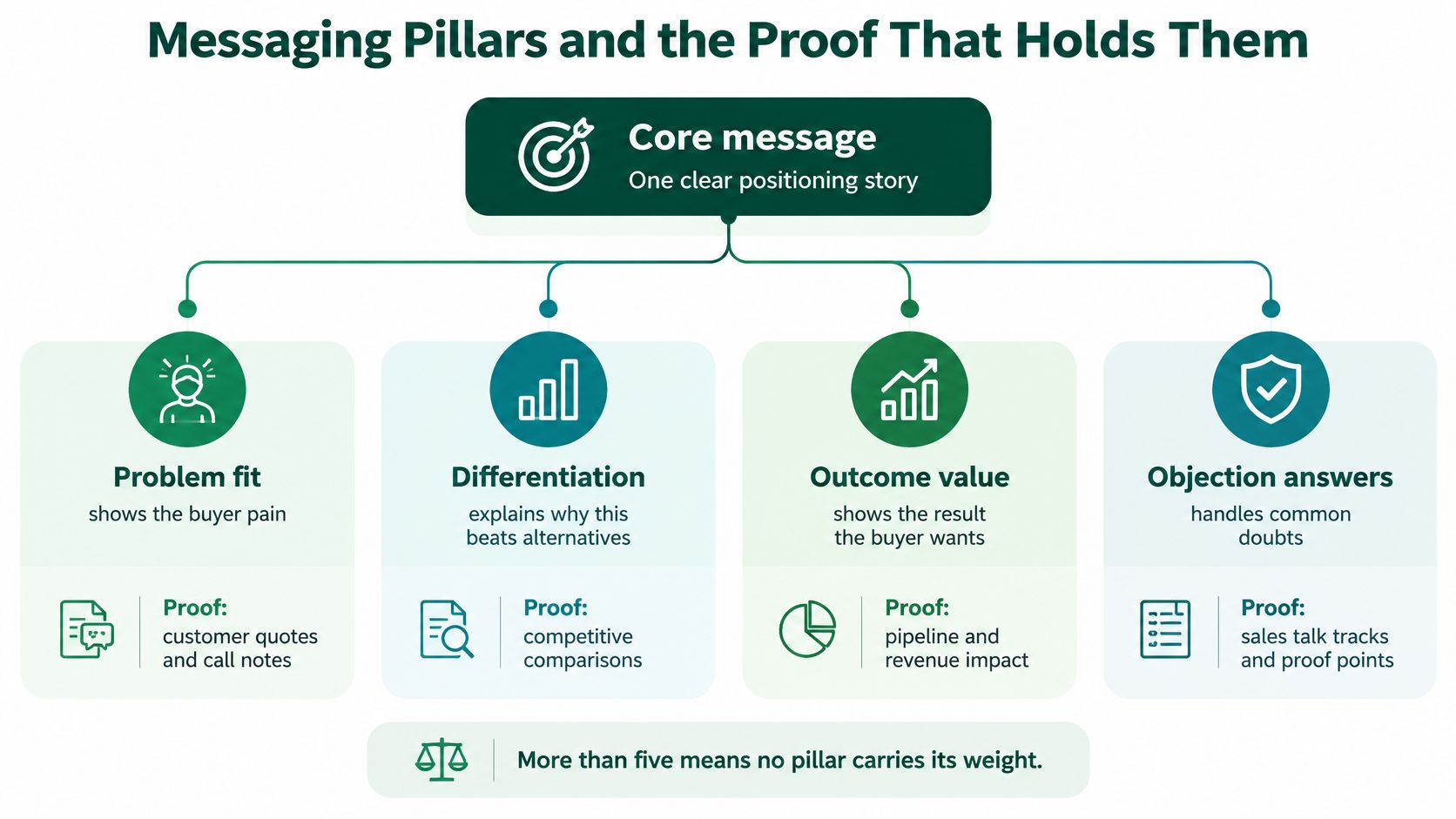
Build one central position and three to five messaging pillars. Each pillar needs supporting evidence and answers to the objections it creates. More than five means you haven't prioritized what the buyer should remember.
A pillar isn't a topic such as innovation or customer success. It's a claim about an outcome and the mechanism that produces it for a specific buyer.
Messaging pillar template
| Element | What to write | Test it must pass |
|---|---|---|
| Pillar claim | One sentence naming the outcome and the mechanism | Could a competitor say this unchanged? If yes, cut it |
| Supporting statement | Two sentences on why the claim holds for this buyer | Does it name a condition specific to this buyer? |
| Proof point | Customer metric, benchmark, integration or implementation detail | Can a buyer verify it in one call? |
| Objection response | The most likely pushback and the evidence that answers it | Does sales use the same wording? |
| Stakeholder line | The pillar translated for one buying role | Does this line reinforce the same claim? |
| Hero headline | The pillar claim compressed to under twelve words | Would a buyer repeat it to a colleague? |
Start with the pillar claim. Name the buyer, outcome, and mechanism explicitly. Faster reporting isn't differentiated; consolidating subsidiary billing records to reduce finance teams' reconciliation work describes something a buyer can investigate.
The supporting statement establishes fit. Explain the operating condition that makes your mechanism valuable, such as separate billing entities or fragmented customer records. Don't spend it restating the headline with more adjectives.
The proof point makes the claim inspectable. Record the evidence owner, measurement conditions, and limitations. Use customer testimonial templates to capture the problem, change, and context, rather than collecting praise that proves nothing specific.
The objection response should address the price of achieving the outcome. If buyers worry about migration effort, answer with migration requirements and implementation evidence, not another benefit.
The stakeholder line translates the claim into a role's decision language. The hero headline compresses it for attention. Neither gets permission to promise a different result.
This hierarchy keeps the core argument visible while separating the evidence buyers need to inspect.
G2's buyer research reports that 51% of B2B software buyers start research with an AI chatbot, up from 29% a year earlier, and 71% use chatbots somewhere in the buying process.
Don't expect a comparison system to infer your differentiation from creative language. Write the buyer, outcome, and mechanism in the claim itself. Add explicit fit conditions, limitations, and evidence so a summary can preserve the distinction.
Homepage copy, sales decks, enablement notes, and nurture emails should draw from the same approved claims. Use that wording on third-party profiles, review sites, and partner pages too. Adapt the surrounding explanation to the channel, not the underlying promise.
Evidence standard: A pillar without proof is an opinion. Keep it in the deck only as a labelled hypothesis.
Generic copy doesn't fail because it lacks personality. It fails because a buyer can't use it to choose. All-in-one and enterprise-grade sound reassuring until someone asks what they mean in practice.
The following rewrites illustrate common SaaS claims, not verified customer results. Every figure is an illustrative placeholder, not a benchmark. Replace the numbers and capability claims with your own measured customer evidence before publishing.
Generic claims and illustrative rewrites
| Generic claim | Specific rewrite | What changed |
|---|---|---|
| All-in-one platform for modern teams | Cuts month-end close time for finance teams running multi-entity billing | Names the buyer, the outcome and the mechanism |
| AI-powered analytics for growing businesses | Flags churn risk 30 days before renewal for account teams | Adds a decision window a buyer can act on |
| Seamless integrations with your stack | Syncs with Salesforce and NetSuite without custom middleware | Names the systems and the cost avoided |
| Enterprise-grade security | Security questionnaires answered in one day with the audit report on request | Gives the IT evaluator a document to check |
| Save time for your team | Cuts weekly forecast preparation from six hours to ninety minutes | Replaces an adjective with a measured change |
These rewrites are stronger directions, not automatically finished pillars. The close-time claim still needs the actual mechanism, such as automated reconciliation. The churn claim needs an explanation of what signals identify risk and whether the account team has enough time to intervene.
The Salesforce and NetSuite claim gives a technical evaluator something concrete to verify. The security rewrite replaces a vague assurance with a response commitment and an inspectable document, but it doesn't replace evidence of the controls themselves.
The forecast example makes the change measurable. It still needs a named buyer, workflow conditions, and evidence that the improvement holds outside a curated demonstration.
That's the benefit of precise language: you discover what you don't yet know. Vague copy lets the team avoid those questions.
Take the three leading headlines on your homepage. Rewrite each to identify the buyer, observable change, and delivery mechanism, then mark the evidence supporting every promise.
Count how many claims a competitor could publish unchanged. For each interchangeable claim, decide whether the problem is weak wording or an undifferentiated offer. Use the distinction between features and benefits to connect a capability to a buyer's operating change without inventing an outcome.
Specific claims exclude buyers. That's the trade-off, and it's useful. A finance product built for multi-entity complexity shouldn't attract every team that wants simpler bookkeeping.
Don't broaden a defensible claim merely because someone outside the target segment doesn't recognize themselves. Broadening the audience also broadens the proof burden.
Messaging metrics tied to pipeline
| Metric | Signal it gives | Read a weak result as |
|---|---|---|
| Stage 2 to Stage 3 conversion | Share of qualified deals that advance after discovery | The claim fails in buyer conversations |
| Win rate by primary pillar | Win rate on deals where one pillar led the conversation | The proof is weak, not the category |
| Message consistency audit | Share of pages, decks and call notes using the same pillar wording | Buyers will notice mismatches before sellers do |
| Time from first meeting to shortlist | Days from first call to shortlist inclusion | The category claim is not landing early |
| Sales cycle length for three or more stakeholders | Days to close in multi-role deals | Consensus proof for finance and IT is missing |
| Repeated category search and direct traffic | Buyers repeating the category name in search or direct visits | The category claim is not being adopted |
Use these readings as diagnostic hypotheses, not causal verdicts. Segment by buyer fit, deal source, and sales motion before attributing a weak result to messaging.
Review the evidence in your CRM alongside the claims buyers encountered.

Connect this discipline to measuring marketing ROI, rather than celebrating attention that never becomes an evaluable opportunity. Search and direct traffic are supporting signals, not proof that positioning caused a purchase.
Use the video alongside your operating review, not as a substitute for deal-level evidence.
Our deliverables include a positioning statement, hero headlines, value messaging pillars, and a product messaging framework. Judge those assets by whether buyers can evaluate, agree, and advance, not by whether leadership likes the wording.
Big Moves Marketing helps B2B SaaS leaders connect audience research and competitive mapping to a clear position and reusable messaging framework. Bring your homepage, recent deal evidence, and the objections that keep resurfacing to Big Moves Marketing, and start by identifying the buying decision your current message leaves unresolved.