%20png%20copy.avif)
A competitive analysis framework is your system for spotting, gathering, and making sense of what rival companies are up to. But let's be clear: this isn't about creating a one-off report. It’s about building an operational tool that helps your product, marketing, and sales teams make smarter strategic decisions.
When done right, this systematic approach ensures your findings are consistent, actually usable, and tied directly to what you’re trying to achieve as a business.
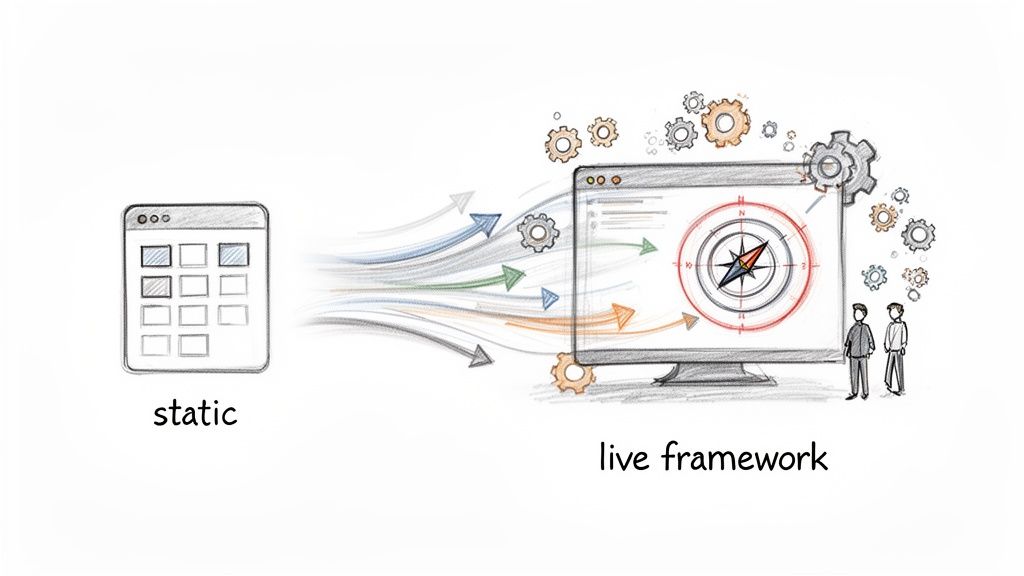
Let's be honest. For way too many B2B SaaS and tech startups, "rival analysis" is a spreadsheet. It gets created, shared around, and then promptly forgotten in a shared drive, gathering digital dust. This old 'set it and forget it' method is a recipe for getting blindsided.
The goal here is to build a living, breathing competitive analysis framework. Think of it less like a document and more like a central intelligence hub that fuels your entire organization. It should inform your go-to-market strategy, sharpen your sales battle cards, and guide your product roadmap. This isn't just about gathering data; it's about creating a decision-making engine.
A static analysis tells you where your rivals were. A dynamic framework tells you where they're going. In my experience advising over 70 tech firms, the companies that consistently win are the ones that build a system to anticipate market moves, not just react to them.
This approach is absolutely vital for a few key reasons:
A well-built framework moves beyond simple feature comparisons to uncover deep strategic insights. It answers the questions that truly matter: Where should we play, and how can we win?
The real power of this kind of system is its ability to connect seemingly random dots.
For instance, a rival's new job posting for "enterprise sales directors" isn't just a personnel change. It's a clear signal they're trying to move upmarket. Seeing them sponsor a niche industry podcast? That reveals a new target audience they're testing. These aren't just isolated data points; they are pieces of a strategic puzzle.
By integrating these signals into a continuous process, you build a much richer, more accurate picture of the market. This transforms your analysis from a tedious task into an engine for growth. The insights you generate become the bedrock for smarter decisions—a point we dig into when exploring how to properly use B2B marketing analytics for growth. It’s about creating a clear view for your entire team, showing them exactly how to outmaneuver the other players in your space.
Before you start digging into other companies' websites, you need a plan. A solid competitive analysis framework isn't just about collecting a mountain of data; it's about collecting the right data, the kind that leads to smarter decisions. Without a blueprint, you’ll end up with a spreadsheet full of trivia, not actionable insights.
Think of it this way: your first step is to define the arena. Who are you really up against? It’s a classic mistake to only keep tabs on the companies that look and feel just like you. The market is more complicated than that, and your customers are weighing options you might not even have on your radar.
To get the full picture, you need to track a few different types of players:
Here’s where a lot of companies get it wrong: they stop at the product. Comparing feature lists is important, but it's only half the story. A company's go-to-market strategy—how they market, how they sell, what their customer experience is really like—is just as crucial as their software's bells and whistles.
You need to understand how they win deals, not just what they sell. This is where you uncover their actual positioning and, more importantly, their weaknesses.
For instance, when you're building out sales battlecards, discovering that a rival has a notoriously clunky and painful onboarding process is pure gold. That’s a powerful piece of intel you’ll never find on their pricing page. It comes from digging into the real customer journey. If you’re just getting started with this process, there's a great article on how to conduct competitor analysis that breaks down the initial steps.
A 360-degree view means analyzing the complete business, not just its product. Your framework must account for their marketing messages, sales process, and customer sentiment to be truly effective.
To build that complete picture, you need a plan for what data to collect and where to find it. This quick reference guide outlines the essential data points you need for a comprehensive market view. Think of it as your reconnaissance mission checklist—it ensures nothing important slips through the cracks.
By systematically gathering this intelligence from various sources, you start to piece together a complete, multi-dimensional profile of each key player in your market.
With a clear blueprint in hand, you’re ready to move beyond just collecting data and start turning it into a strategic weapon. Every piece of information you gather should be viewed through the lens of your own business goals.
And remember, all of this analysis is only as powerful as its relevance to your target customer. The insights you find about a company's flaws are only useful if those flaws are things your ideal buyers actually care about. To make sure you're focused on what matters, take a look at our guide on building an ideal customer profile template. When you combine a deep understanding of your customer with a structured plan for intelligence gathering, you've built a foundation strong enough to drive real growth.
Okay, you’ve gathered a mountain of data. Now what? Raw data is just noise. The real magic happens when you apply a strategic lens—a framework that turns that noise into a clear signal, guiding your decisions and sparking your next big move. This is the part where you go from just collecting information to actually interpreting it.
The right model really depends on what you're trying to figure out. Are you trying to get a 30,000-foot view of the entire market? Or are you gearing up for a head-to-head sales battle? Different questions demand different tools.
A good way to start is by classifying your rivals. It helps you figure out where to focus your energy. Not every company deserves the same level of scrutiny.
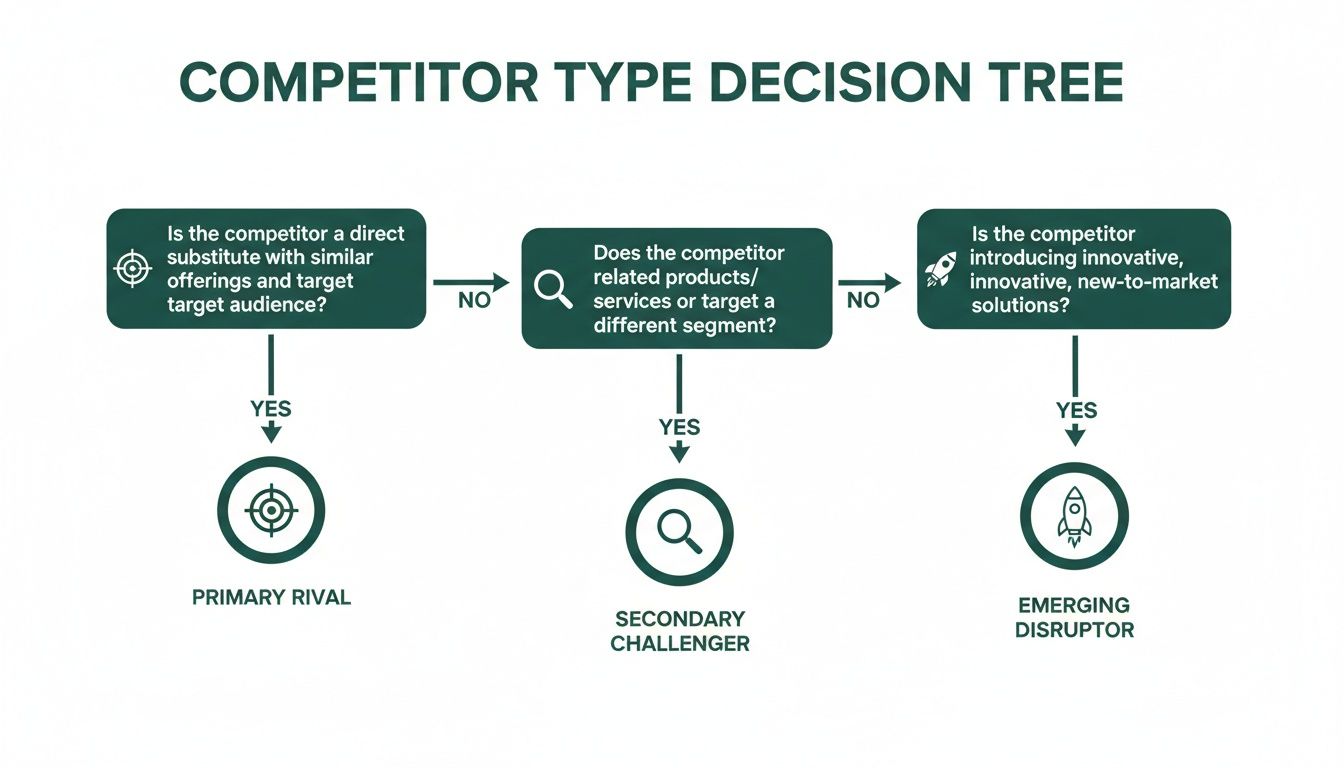
This simple sorting hat guides your analysis, helping you decide which frameworks to apply most rigorously. Now, let’s dig into three proven models that I’ve seen work wonders in the B2B tech world.
To really understand the big picture, you have to look beyond simple feature-for-feature showdowns. This is where Porter's Five Forces comes in. It's a classic for a reason—it forces you to assess the fundamental structure and profitability of your industry by looking at pressures from all angles, not just the company you keep running into in deals.
Developed way back in 1979 by Michael Porter, this model is still a cornerstone of strategy. In fact, roughly 40% of firms globally still use it to gauge how attractive their industry is. It’s not just an academic exercise; for B2B SaaS companies, the proof is in the results. One study showed firms using Porter's achieve 28% better market positioning.
Here’s how you can adapt the five forces for a B2B SaaS reality:
Think of this model as your early warning system. It helps you spot shifts in market power before they smash into your revenue, giving you precious time to adapt your strategy.
Ah, the SWOT analysis (Strengths, Weaknesses, Opportunities, Threats). It's probably the most misused tool in the strategy toolkit. Too often, it ends up as a dusty PowerPoint slide with bullet points that go absolutely nowhere.
The secret to making it powerful for B2B tech is to translate every single insight into a sales talking point, a marketing angle, or a concrete action for your go-to-market teams.
For example, don't just list a weakness like "clunky user interface." Reframe it into a narrative your sales team can use to counter a company known for simplicity. It becomes: "We’ve seen some tools prioritize a simplified UI at the expense of powerful, enterprise-grade features. Our platform is built for complex workflows, which is why our customers can..." See the difference?
Here’s a practical way to structure your B2B SWOT to force action:
By linking every point to a tangible asset or action, your SWOT transforms from a static document into a dynamic blueprint for winning deals and grabbing market share.
Finally, you need a way to see where you really stand in the eyes of your customers. A Feature and Positioning Matrix is a fantastic tool for this. It's a simple grid that plots you and your rivals against the two axes that matter most to your ideal customer profile.
The real art here is in choosing the right axes. Ditch the generic labels like "Price" vs. "Features." They tell you almost nothing. Instead, get specific about the value your customers are looking for. For a project management tool, you might plot "Ease of Use for Non-Technical Teams" vs. "Power for Complex Enterprise Workflows."
Suddenly, the market view comes into focus. You can instantly see where the market is crowded and, more importantly, where the wide-open spaces are. It shows you if you’re positioned as a commodity or if you occupy a unique, defensible spot. For any B2B SaaS company, this exercise is absolutely critical for carving out a profitable niche.
If you want to build one yourself, check out our simple guide on creating a positioning map template to get started.
Using this matrix helps you answer the most critical question of all: in the mind of the customer, where do we stand? The answer will shape your product roadmap, sharpen your marketing message, and give your sales team the clarity they need to win.
All that analysis is just an academic exercise if you don't do something with it. A folder full of SWOT charts and feature matrices isn't going to close a single deal. The real power of a competitive analysis framework gets unlocked when you turn your findings into actual assets that your sales and marketing teams can use.
This is where your intelligence becomes a weapon.
The goal is pretty simple: make your analysis a living, breathing part of every customer conversation. Every data point you've gathered should be sharpened into a talking point, a confident rebuttal, or a compelling value statement that helps your team win.
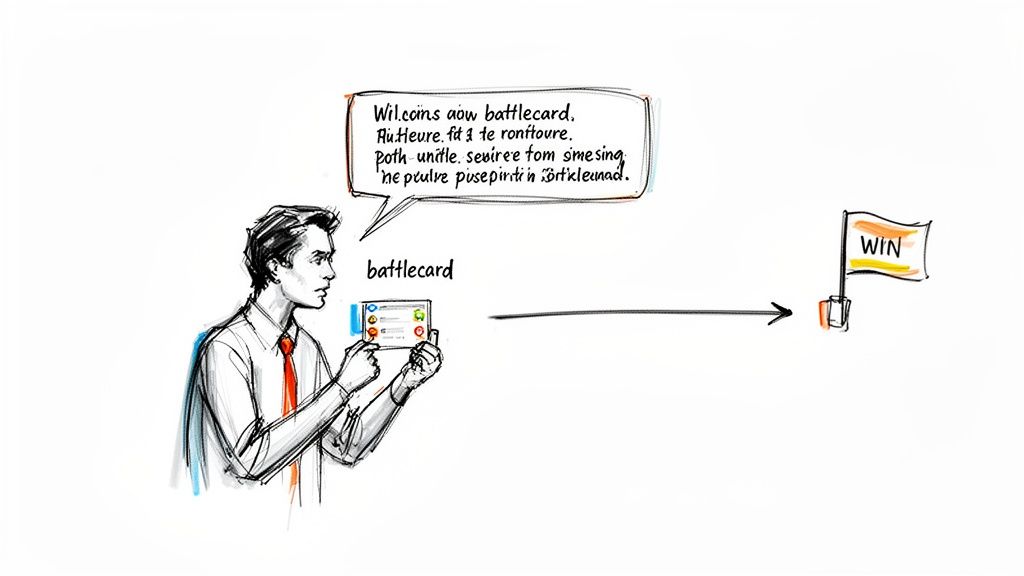
Turning raw data into practical sales tools is a deliberate process. You can't just hand a salesperson a spreadsheet and expect them to magically craft a winning narrative. It's on you to build the bridge from insight to application.
This means creating specific, easy-to-digest materials that reps can pull up in the heat of a call or while drafting a follow-up email. You’re arming them with the exact language and evidence they need to outmaneuver rivals.
Here are the core assets you should be creating:
The best sales enablement materials don't just state facts; they tell a story. They frame your rival's weaknesses not as simple product gaps, but as direct risks to the customer's success.
For example, let's say your SWOT analysis reveals a company has terrible customer support, with an average ticket response time of 48 hours. That insight is the raw material. The actionable sales asset is the talking point you build for a battlecard.
It might look something like this: "When you're facing a critical issue, waiting two days for help isn't an option. Our dedicated support, with a 2-hour average response time, ensures your team is never left stranded." See how that reframes a simple data point into a compelling, risk-averse argument?
Battlecards are easily the most impactful output of a solid competitive analysis framework. They are the front-line tool your sales team will lean on every single day. A great battlecard is concise, scannable, and brutally honest about where you win and where you lose.
A common mistake is cramming way too much information onto a battlecard. Your reps don't have time to read a novel during a live call. You need to zero in on the most critical information that can actually sway a deal.
Your battlecard should include these key sections:
To get a head start, you can explore our detailed guide and downloadable competitive battlecard template. It provides a proven layout for organizing all your insights.
While battlecards are for offense, objection-handling guides are your defense. Your analysis should uncover the claims rivals make about you. Your guide must equip your team to defuse those points with confidence and facts.
Start by listing the top five objections or false claims you hear about your product in relation to a specific rival. For each one, craft a simple, two-part response: Acknowledge and Reframe. First, you acknowledge the prospect's concern, then you reframe the conversation around a bigger point of value where you excel.
This same intelligence also sharpens your overall market positioning. The insights you gather should directly inform your website copy, ad campaigns, and sales decks. If your analysis shows a rival is cleaning up with small businesses but struggles with enterprise clients, you can confidently double down on your enterprise-grade security and scalability messaging.
When you're translating your analysis into these strategies, don't forget to look at external market signals. For example, analyzing lists of top B2B investors in France can reveal which companies are well-capitalized and poised for aggressive expansion. This signals a future threat you need to start positioning against now, enriching your framework and preparing your team for what's coming next.
Your market doesn't sit still, so your analysis can't either. The most brilliant competitive analysis framework becomes a liability the moment it’s out of date. To get real value, you have to create a system to keep your insights fresh. This is the final, crucial step to building a true intelligence engine, not just a static report.
This isn’t about redoing the entire thing from scratch every month. That’s a massive waste of time. It’s about establishing a rhythm—a practical cadence for updates that ensures your framework remains a reliable source of truth for your product, marketing, and sales strategies.
The goal here is to build a proactive intelligence muscle. You want your team to see shifts coming, not get caught scrambling to react after the fact.
One of the first questions I always get is, "How often should we update this?" The answer isn't a single number; it's a tiered approach. Not every piece of data needs the same level of attention.
I’ve found that a rhythm of quarterly check-ins and an annual deep dive works best. This approach balances the need for timely information with the reality that most B2B startup teams are already stretched thin.
Here’s what that looks like in practice:
This two-speed rhythm ensures you're always operating with current data without creating an overwhelming amount of work.
The quarterly review is all about speed and focus. You're looking for tactical shifts that could signal a change in a company's strategy. This isn't a deep, soul-searching exercise; it's a focused intelligence sweep.
Set aside a couple of hours each quarter to run through this list for your top-tier rivals:
For this process to actually stick, it can't be one person's side project. Intelligence gathering needs to be a shared responsibility, woven into your team's existing workflows.
A framework only stays evergreen when people are actively tending to it. Assigning clear ownership transforms the process from a theoretical exercise into a practical, ongoing business function.
A simple way to distribute the load is to assign specific rivals to different team members. For instance, have a product marketer track one company's product updates, while a sales lead keeps tabs on another's pricing. Then, make sure all findings are centralized in a shared dashboard or document.
Even better, use technology to do the heavy lifting. Set up alerts and automated tools to flag strategic shifts for you:
By creating this system, you ensure your competitive analysis framework evolves alongside your market. It becomes a living document and a powerful strategic asset, guiding your decisions and keeping you one step ahead. These insights also directly inform your strategic planning, ensuring your product development aligns with market realities. To see how this intel can shape your long-term strategy, explore our guide on using a Now-Next-Later roadmap to accelerate B2B growth.
Even the best analysis framework will spark a few questions. That's a good thing—it means you're thinking critically. Your market is always shifting, and the way you track it needs to keep up.
Here are some straight answers to the questions I hear most often from B2B founders and marketing leaders.
This is a big one. For B2B SaaS, I recommend a full, deep-dive review of your entire framework once a year. This is your chance to step back, re-evaluate the whole market, and maybe even swap out some of the other companies you're tracking.
But some parts need a much quicker pulse check.
You absolutely have to monitor key go-to-market elements every quarter. This means keeping a close eye on your rivals' pricing changes, major feature releases, and any significant shifts in their marketing messages. An easy way to stay on top of this is to set up alerts for their press releases and blog updates. This hybrid approach—annual deep dive, quarterly pulse check—ensures you're never blindsided by a major strategic move.
Easy. Focusing 90% of their effort on product feature comparisons.
It’s a classic trap. While features obviously matter, a real framework dissects the entire go-to-market engine. Too many startups get stuck in a feature-for-feature spreadsheet and completely fail to analyze a company's positioning, sales process, or customer support reputation.
Winning isn't just about having one more feature; it's about out-marketing, out-positioning, and out-selling them in the mind of your ideal buyer. An overemphasis on product alone leaves you blind to these critical battlegrounds.
Think about it this way: a rival might have a slightly slicker feature, but you hear through the grapevine that their sales cycle is notoriously long and complex. That’s a massive weakness you can exploit in your messaging, but you'd never uncover it by just reading their product docs.
If you don't have a dedicated analyst on staff, the whole process can feel daunting. The key is to be ruthless with your priorities and spread the work around. Trying to analyze twenty companies at once is just a recipe for burnout and useless, shallow insights.
Instead, take a more manageable approach:
For lean teams, consistency beats complexity every time. A simple framework that actually gets updated is infinitely more valuable than a comprehensive one that just gathers dust. A disciplined process like this ensures your team is always working from current, relevant market intelligence, turning your analysis into a continuous source of strategic advantage.
At Big Moves Marketing, I help B2B SaaS and AI startups build the positioning, sales tools, and launch strategies that drive real revenue. If you're ready to turn market insights into winning deals, let's connect. Find out how I can help your company at https://www.bigmoves.marketing.
Explore Big Moves Marketing services and resources:




%20-%20white.svg)