%20png%20copy.avif)
For a B2B SaaS startup, every minute and every lead counts. The old way of manually tracking prospects, sending one-off emails, and guessing which leads are ready to buy is a recipe for slow growth and missed opportunities. It's a system that simply can't scale. Marketing automation isn't just about sending emails faster; it's a strategic framework for scaling your outreach, personalizing every interaction, and building a predictable revenue pipeline that frees your team to focus on high-impact activities.
This guide cuts through the noise to deliver 10 essential marketing automation best practices specifically designed for the unique challenges of B2B SaaS. Forget generic advice; these are actionable strategies to build, implement, and optimize a system that fuels real, sustainable growth. We will cover everything from foundational lead scoring and targeted email workflows to advanced account-based marketing (ABM) and multi-channel orchestration. Each point is crafted to be a blueprint you can implement immediately. To truly grasp the potential, explore concrete Google Ads automation examples that demonstrate how to scale lead generation and maximize ROAS.
By the end of this article, you will have a clear, step-by-step understanding of how to transform your marketing from a series of manual tasks into a powerful, data-driven growth engine. Let’s dive in and start building.
Imagine speaking directly to each business prospect, addressing their specific pain points and industry challenges. This is the power of segmentation, one of the most foundational marketing automation best practices. Instead of broadcasting one generic message to your entire list, you divide your audience into smaller, more focused groups based on shared business characteristics.
This approach transforms your marketing from a monologue into a meaningful dialogue. By understanding who you're talking to, you can deliver content that truly resonates, demonstrating that you understand their unique business world. This builds trust and positions your SaaS solution not just as a tool, but as the perfect answer to their specific problems.
For a B2B SaaS startup, segmentation can feel overwhelming, but it doesn't have to be. The key is to start small and build from there.
Key Insight: Personalization goes beyond using a
[First Name]tag. True personalization is about delivering the right message, through the right channel, at the exact moment it becomes relevant to the recipient's journey.
Start by defining 3-5 core segments that align with your ideal customer profiles. For a deeper dive into creating these foundational profiles, explore how to use buyer personas to accelerate your B2B marketing and sales. As you gather more data, you can create dynamic segments that automatically update, ensuring your marketing stays brilliantly relevant.
Imagine your sales team knowing exactly which leads to call first, armed with the certainty that they're speaking to someone genuinely interested and ready to engage. This is the operational clarity that lead scoring provides. It’s a methodical process for ranking prospects based on their value to your business, allowing you to prioritize your efforts and focus on conversations that matter.
This system transforms your funnel from a crowded room into an organized queue. Instead of treating every lead as equal, you assign points for specific attributes and behaviors, creating a clear hierarchy of interest and fit. This ensures your most valuable resources—your sales team's time—are spent on prospects with the highest probability of becoming customers, accelerating your sales cycle and boosting efficiency.
For a growing B2B SaaS company, a well-defined lead scoring model is a critical bridge between your marketing and sales departments. It provides an objective, data-driven way to hand off leads.
Key Insight: A lead scoring model is not a "set it and forget it" tool. It's a living system that must be refined. Regularly review your model with sales to ensure the leads being prioritized are genuinely converting, and adjust scoring criteria quarterly based on performance data.
Start by mapping the key attributes of your best customers and the common actions they took before signing up. Platforms like HubSpot and Marketo provide powerful frameworks, but the intelligence comes from your unique understanding of what signals a high-quality lead for your specific SaaS product. This practice turns marketing automation into a powerful revenue-generation engine.
Imagine a system that works tirelessly to guide your leads from initial curiosity to becoming paying customers, all without you lifting a finger. This is the core of automated email workflows and drip campaigns, a cornerstone of effective B2B marketing automation. Instead of sending sporadic, one-off emails, you build intelligent sequences that deliver the right information at the right time, triggered by user actions.
This proactive approach turns your email list from a passive audience into an engaged community. By delivering a series of helpful, relevant messages, you systematically build trust and demonstrate your SaaS product's value. It’s about creating a consistent, nurturing experience that guides prospects through their decision-making process, ensuring no lead ever goes cold.
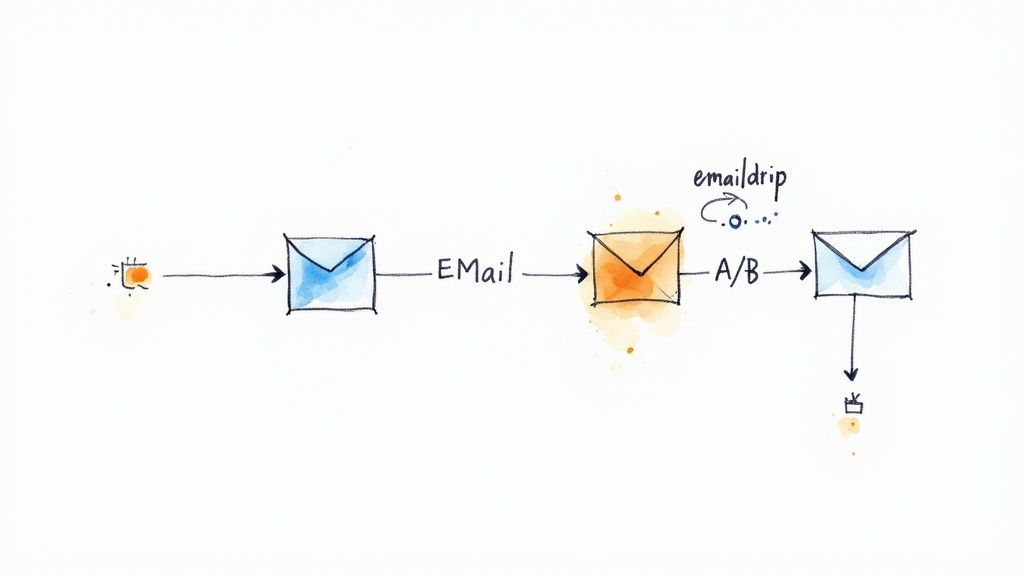
Building your first workflow can feel complex, but the secret is to map the journey before you build the automation. Start with a clear goal for each sequence.
Key Insight: A great workflow doesn't just sell; it educates and helps. Your goal is to be the most valuable resource for your prospect as they solve their problem, making your solution the obvious choice when they are ready to buy.
Start by defining the most critical journey, like your free trial onboarding. For more advanced strategies to improve your email results, explore these B2B email marketing best practices to boost your ROI. As you master the basics, you can build more complex workflows that adapt based on how users interact with your emails.
Imagine your marketing reacting instantly to a prospect's needs, delivering the perfect message the moment they show interest. This is the core of event-based marketing, a key component of modern marketing automation best practices. Instead of relying on static campaigns, you create automated workflows that activate based on specific user actions, or triggers.
This dynamic approach ensures your communication is always timely and contextually relevant. When a user visits your pricing page, downloads a whitepaper, or starts a free trial, these events trigger a pre-defined sequence. This transforms your marketing from a scheduled broadcast into a real-time, personalized conversation that guides users seamlessly through their journey.
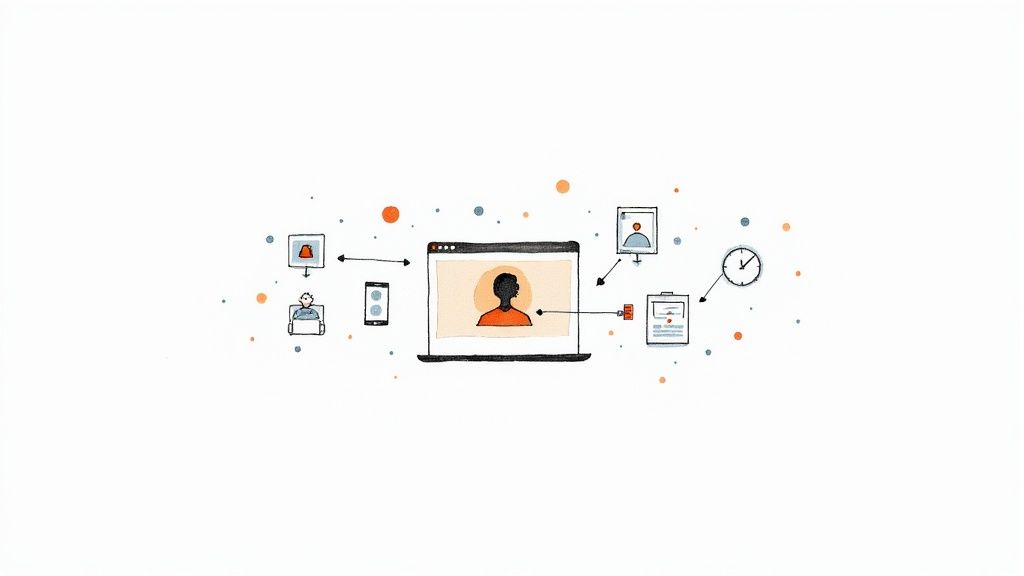
For a B2B SaaS startup, behavioral triggers can turn passive website visitors into active leads and engaged users into loyal customers. The key is to map critical user actions to high-value marketing responses.
Key Insight: The power of behavioral triggers lies in their immediacy and relevance. You are responding directly to a user's demonstrated interest, which dramatically increases the likelihood of engagement and conversion compared to a generic, time-based email blast.
Start by identifying the top 3-5 "money-making" events in your customer journey. These are the actions that most strongly correlate with conversion, like requesting a demo, starting a trial, or visiting the pricing page. Build your first trigger-based workflows around these high-impact moments.
Imagine your sales and marketing teams operating from a single, unified source of truth, where every prospect interaction is visible and every action is synchronized. This is the reality of integrating your marketing automation platform with your Customer Relationship Management (CRM) system. By connecting these two platforms, you break down the silos that often cause friction and lost opportunities.
This connection creates a seamless flow of data, ensuring that marketing's valuable insights on lead behavior are passed directly to sales, and sales' updates on deal progress are fed back to marketing. For a B2B SaaS startup, this alignment is critical. It transforms the lead handoff process from a potential chasm into a smooth, intelligent transition, accelerating the entire revenue cycle.
Connecting your marketing and sales stacks can seem complex, but focusing on a structured approach makes it manageable and highly impactful. The goal is to create a bidirectional data highway that empowers both teams.
Key Insight: A successful integration isn't just about connecting software; it's about aligning processes and people. It ensures that marketing isn't just generating leads, but actively contributing to revenue in a way that sales can immediately act upon.
Start by defining the exact criteria for a lead handoff and the essential data points each team requires. For a more detailed guide on selecting and preparing your central system, you can learn more about how to choose the right B2B CRM for your business. A well-planned integration is a cornerstone of scalable growth and one of the most vital marketing automation best practices.
Instead of casting a wide net and hoping to catch a few qualified leads, imagine treating your most valuable potential customers like VIPs. That's the core of Account-Based Marketing (ABM), a hyper-focused strategy where marketing and sales teams collaborate to turn specific, high-value accounts into customers. It flips the traditional marketing funnel on its head.
This strategic approach is a game-changer for B2B SaaS, especially for those with a high-value product. By concentrating your resources on accounts with the highest revenue potential, you create deeply personalized buying experiences. Marketing automation is the engine that powers this precision, enabling you to orchestrate multi-channel, multi-touchpoint campaigns at scale for your target list.
For a startup, an ABM strategy can seem resource-intensive, but automation makes it achievable. The focus is on quality of engagement over quantity of leads.
Key Insight: ABM isn't just a marketing campaign; it's a fundamental shift in go-to-market strategy. Success depends on tight alignment between marketing and sales, who must work as one unified revenue team to surround and engage target accounts.
By integrating ABM into your workflow, you align your efforts directly with revenue goals. To explore this powerful strategy further, learn how to maximize ROI with Account-Based Marketing. This approach makes your marketing automation not just efficient, but exceptionally effective.
Your automation workflows are powerful engines, but their fuel comes from one critical source: your landing pages and forms. These are the digital gateways where interest becomes action, where an anonymous visitor transforms into a known lead. Treating them as an afterthought is one of the most common mistakes in marketing automation; optimizing them is one of the most impactful marketing automation best practices.

This process is about creating a frictionless, compelling experience that encourages visitors to share their information. A well-optimized page reassures a prospect that the value they will receive (an ebook, a demo, a webinar seat) is worth the data they provide. It’s the handshake that initiates the automated conversation.
For a B2B SaaS startup, every conversion counts. Your goal is to remove every possible barrier between a visitor's intent and their conversion.
Key Insight: A landing page isn't a brochure; it's a conversation with a single goal. Remove all navigation menus, social media links, and other distractions. The only path forward for the user should be completing the form.
Start by auditing your highest-traffic landing pages. Tools like Unbounce and Leadpages offer templates built on conversion principles, providing a strong foundation. From there, commit to A/B testing one element at a time, whether it's the headline, the CTA button color, or the number of form fields, to continuously improve your results.
Launching automated workflows is only the beginning. The true power of your automation engine is unlocked when you treat it not as a "set it and forget it" tool, but as a living system that can be continuously refined. This is where data-driven optimization becomes one of the most critical marketing automation best practices.
Instead of guessing what works, you can use hard data to see exactly which emails drive demos, which workflows generate the most qualified leads, and where prospects are dropping off. This process transforms your marketing from a series of isolated campaigns into a highly-tuned growth machine, where every action is measured, analyzed, and improved upon for maximum impact.
For a B2B SaaS startup, every marketing dollar and every minute of your team's time counts. A commitment to analytics ensures you’re investing resources where they will generate the highest return.
Key Insight: Data is not just for reporting past performance; it's a roadmap for the future. Use your analytics to form hypotheses ("We believe changing the email subject line will increase open rates by 15%") and then run A/B tests to validate them.
Start by building a simple dashboard in your automation tool or a dedicated platform like Databox that tracks 3-5 of your most important KPIs. To build a robust framework for measurement, explore these essential strategies for B2B marketing analytics and their role in driving growth. This focused approach makes data actionable, not overwhelming.
Automation without a plan is just organized chaos. A centralized marketing calendar transforms your strategy from a series of disjointed actions into a cohesive, high-impact program. It's the command center for all your marketing activities, ensuring every automated workflow, email sequence, and social post works together toward a common goal.
This strategic oversight prevents campaign overlap, aligns your marketing and sales teams, and provides a clear roadmap for what's coming next. For a B2B SaaS startup, where every resource counts, a well-managed calendar means you’re not just doing marketing; you’re orchestrating it with purpose and precision, maximizing the impact of every touchpoint.
Building an effective marketing calendar is about creating a single source of truth for your entire team. Tools like Asana, CoSchedule, or HubSpot's built-in campaign planners are excellent for this, but even a detailed shared spreadsheet can work.
Key Insight: A marketing calendar isn't just a scheduling tool; it's a strategic document. It forces you to think about the why behind every campaign and ensures your marketing automation efforts are directly tied to tangible business objectives.
Start by color-coding campaigns by type (e.g., lead generation, product update, brand awareness) to get a clear visual overview. Share it widely and make it a central part of your weekly team meetings. This practice is a cornerstone of effective marketing automation, turning your strategy into a visible, manageable, and highly effective plan of action.
Imagine your brand’s message reaching a prospect not just in their inbox, but also via a timely SMS notification about a webinar, or a personalized in-app message when they log into your trial. This is the essence of multi-channel automation, a crucial practice that moves beyond a single point of contact. It coordinates your marketing efforts across various platforms to create a cohesive and persistent brand presence.
This approach acknowledges that your B2B buyers don't operate in a single channel. They might discover you on LinkedIn, subscribe to your newsletter, and then interact with your sales team through a chat bot. Omnichannel automation ensures the conversation is seamless, picking up where it left off on each platform. This consistency builds a powerful, unified customer experience that makes your brand feel omnipresent and deeply integrated into their professional world.
Expanding beyond email requires a strategic approach, not just adding more channels for the sake of it. The goal is to meet your audience where they are most receptive.
Key Insight: Multi-channel is about being present on multiple platforms. Omnichannel is about ensuring the user's experience is unified and consistent across all of them. True marketing automation best practices strive for an omnichannel reality.
Begin by mapping your customer journey and identifying the most impactful touchpoints for adding a new channel. As you expand, tools like HubSpot's Marketing Hub can provide a single view of the customer, consolidating interactions from email, social media, and your website into one timeline. This unified data is the bedrock of a truly effective omnichannel strategy.
You’ve explored the ten pillars of modern B2B SaaS marketing automation, from granular audience segmentation to sophisticated omnichannel campaigns. We’ve moved beyond the abstract and into the practical, detailing how to implement dynamic lead scoring, build event-triggered workflows, and seamlessly integrate your CRM to create a single source of truth. The journey through these marketing automation best practices isn’t about just flipping a switch; it's about architecting a smarter, more responsive growth engine for your startup.
The path forward can seem daunting. The temptation is to try and implement everything at once, building a complex web of triggers, workflows, and integrations from day one. Resist this urge. True mastery begins with focus and iteration. The power of automation isn't just in its ability to execute tasks; it's in its capacity to learn, adapt, and scale with precision.
Let's distill the core principles we've covered into your immediate next steps. The goal is to transform this knowledge into measurable progress.
The most effective automation feels less like a machine and more like a thoughtful, helpful guide. It anticipates needs, provides clarity, and builds trust at scale, freeing your team to focus on the high-touch, strategic relationships that close deals.
Embracing these concepts is the first step. The next is building a solid operational foundation. This involves selecting the right tools, defining your processes, and setting up the core integrations that will make your system work. For a deeper dive into the comprehensive steps involved in setting up your automation framework, consider this practical guide on implementing marketing automation which breaks down the process into manageable stages.
Ultimately, adopting these marketing automation best practices is about creating a system that delivers the right message to the right person at the perfect moment. It's about turning cold leads into qualified opportunities and new customers into lifelong advocates, all while your team sleeps. This isn't just about efficiency; it's about building a sustainable, scalable go-to-market motion that becomes a core pillar of your company's success. Your next move is to take one of these practices, make it your own, and put it into action today.
Ready to translate these best practices into a powerful go-to-market strategy? At Big Moves Marketing, we specialize in building the positioning, messaging, and launch plans that B2B SaaS and AI startups need to drive adoption and scale effectively. Let’s make your next move your best one.
Explore Big Moves Marketing services and resources:


%20-%20white.svg)