%20png%20copy.avif)
Most B2B SaaS founders define sales enablement as a digital filing cabinet—a shared folder where pitch decks and case studies gather dust. This isn't just a semantic error; it's a strategic liability that injects friction into your go-to-market motion and quietly suffocates deals. The definition itself is the root of the problem.
The typical approach is reactive and fragmented. Marketing produces assets in a vacuum, sales reps might glance at them once, and leadership wonders why revenue feels so unpredictable. This broken model treats enablement as a simple handoff, not what it must be: the core operating system for your entire GTM strategy.
It’s a system designed for failure. I’ve seen this pattern repeat across dozens of Series A and B startups. They invest heavily in product and demand generation but neglect the connective tissue that translates product value into closed-won revenue. The outcome is always the same.
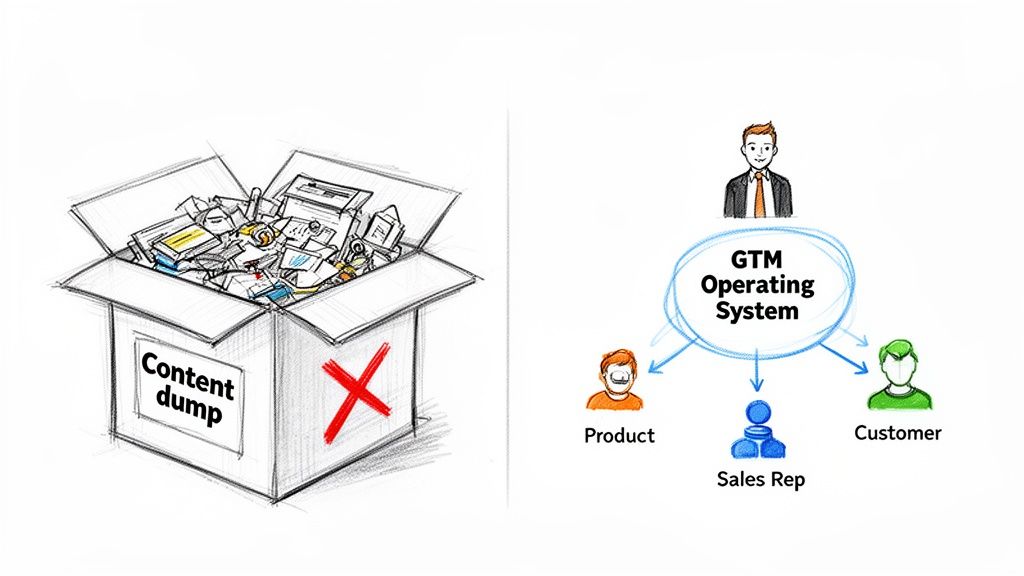
A functional sales enablement definition is the continuous process of equipping your entire revenue team to win consistently. It isn't a function that just creates assets; it’s a system that integrates intelligence from across the business—connecting product insights, marketing messaging, and on-the-ground reality from sales into a single, cohesive motion.
This reframe moves you from random acts of support to a structured engine for growth. The consequences of sticking with the old "content library" definition are severe and predictable:
This is especially damaging in the founder-led sales phase, where every conversation is a goldmine of feedback for refining messaging and product-market fit. A weak enablement process ensures those critical insights evaporate.
The real liability isn't a lack of content. It's the absence of a system that ensures the right message is delivered by a prepared rep to the right buyer at precisely the right moment.
Since enablement is tied to the sales environment, understanding what B2B sales entails is a prerequisite. The goal isn't just to make more things. It's to build a feedback loop that makes your entire GTM engine smarter with every customer interaction.
Thinking of enablement as a system clarifies roles. Marketing’s job isn't to "create content"; it's to synthesize market and product truths into usable tools. Sales doesn't just "consume" assets; they provide the critical feedback that sharpens the message. For a deeper look at a critical asset, see our guide on the sales deck template.
Stop building a content repository. Start building a revenue engine.
Most B2B SaaS startups get sales enablement wrong, and it costs them deals. They treat it as a function—a person or team tasked with producing sales decks. This is a critical error in thinking that guarantees wasted effort and minimal impact.
Sales enablement is the strategic and ongoing process of equipping your revenue team with the content, training, coaching, and technology they need to have effective conversations at every stage of the buyer's journey.
This definition is precise. It shifts the focus from outputs (making another one-pager) to outcomes (winning more deals). It anchors everything to the quality of the conversation between your team and a potential customer.
Think of proper sales enablement as your go-to-market logistics operation. A military doesn’t hand soldiers weapons and hope for the best. It runs a sophisticated logistics engine to deliver the right intelligence, assets, and skills to the right units at the exact moment they’re needed.
That’s what a real sales enablement process does. It’s not about building a massive library of content nobody can find. It’s ensuring an AE facing a technical question from a CTO has the right security one-pager at their fingertips. It’s making sure a new BDR has been coached on handling the "we already use a competitor" objection before they ever make a call.
In a high-stakes B2B sales cycle, victory isn't determined by who has the most assets, but by who can deploy the right intelligence at the critical moment. Enablement is the system that ensures you win those moments.
This strategic view elevates enablement from a support task to a core driver of GTM efficiency. It's why adoption is accelerating. Five years ago, only 32% of companies had a dedicated enablement function. By 2026, that is projected to reach 76%. The reason is simple: companies with formal enablement programs see 49% higher win rates on forecasted deals, a statistic confirmed by research from platforms like Sift Hub.
A true enablement process is built on four interconnected pillars. Treat them as separate tasks, and the structure collapses. This table breaks down what each pillar means and why it fails without a unified strategy.
When founders grasp this process-oriented definition, the conversation shifts. They stop asking for "another deck" and start building the systems that create repeatable revenue. For a deeper dive, see our guide on sales enablement best practices. This operational discipline is the difference between a sales team that works hard and one that consistently wins.
An effective sales enablement program is not built by throwing assets at your sales team. It's an integrated system where every part supports the others, all designed to translate strategy into frontline results. Most startups fail here—they treat content, training, and tech as separate projects owned by different teams.
This siloed approach guarantees waste. Marketing produces content that sales reps ignore, training is forgotten a week later, and expensive software becomes little more than a Dropbox folder. Real enablement synchronizes these pieces into a single GTM engine.
There's a clear hierarchy. It starts with strategic process. That process dictates the right content, which is brought to life through ongoing training, all amplified by a well-chosen tech stack.
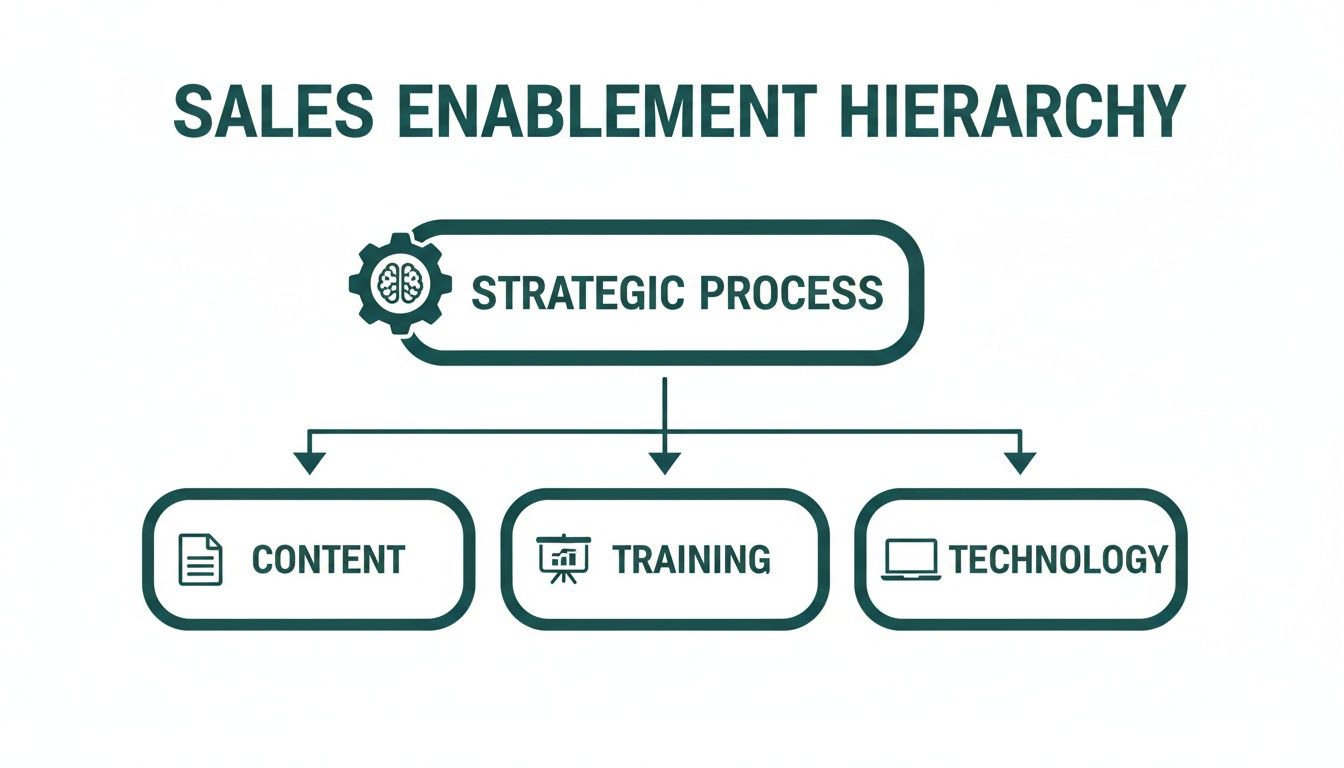
Strategy is the foundation. It drives the tactical work, not the other way around.
The most common mistake with enablement content is treating it like a library. The goal isn’t to build a massive repository of everything a rep might need. The goal is to deliver the exact asset they need, at the exact moment they need it.
This requires a mental shift from a "content dump" to a system of just-in-time assets. It means creating fewer generic pitch decks and more surgical tools mapped to specific sales scenarios.
The test for any piece of content is simple: Does it help a rep move a specific deal forward with a specific buyer facing a specific challenge? If not, it’s noise.
Most B2B SaaS training is a one-and-done event—a product launch webinar or an annual sales kickoff. This model is broken. It ignores how adults learn and how quickly information is forgotten. Effective training isn't an event; it's a continuous rhythm of coaching.
The objective must be to change behavior, not just transfer information.
One-off training sessions build temporary awareness. Continuous, scenario-based coaching builds durable skill. Founders must stop investing in the former and start building a culture of the latter.
This means running role-plays of real deal scenarios, conducting live call reviews, and holding workshops that focus on a single skill, like discovery or negotiation. The focus is always on application, not just acquisition.
Your enablement tech stack shouldn’t be a random collection of tools. It must be a cohesive system designed to get insights to your sales team and track their effectiveness. A critical piece is often equipping reps with the right tools, like the best deal management software, to organize their workflows.
The right stack makes it effortless for a rep to find the exact battlecard or case study inside their existing workflow (like their CRM). It also provides analytics on what content is being used and which assets correlate with wins, finally closing the feedback loop.
Most sales enablement measurement is a waste of time. Founders track busywork—assets created, training sessions held—and mistake motion for progress.
These are vanity metrics. They report on what your team is doing, not what they are achieving.
This creates a dangerous blind spot. You invest resources into what you think is a support system for sales, but you have no way to prove it’s moving the only needle that matters: revenue. The goal isn't to track effort. It's to connect every enablement action directly to a business outcome.
A smart measurement framework tracks two types of metrics to see the full picture.
The critical part: your leading indicators must influence your lagging indicators. If content adoption (leading) goes up but your win rate (lagging) stays flat, the content isn't effective.
To draw a straight line from an enablement activity to revenue, you must build a causal chain. Here are the five core metrics that bridge the gap.
1. Content Adoption & Engagement
This is your first signal. Are reps using the assets you create? Low adoption means one of two things: the content is irrelevant, or reps can't find it. Both are critical failures.
2. Training Certification & Skill Application
Don't track attendance. Test for comprehension and, more importantly, observe real-world application. Use call recording software to see if reps are actually using the new messaging from the training you just ran.
3. Sales Cycle Length
Effective enablement removes friction from the sales process. If your assets and training help reps navigate deals more effectively, your average sales cycle should shorten. If it's not, find out why.
4. Win Rates
This is one of the purest measures of sales effectiveness. Get specific. After rolling out a new competitive battlecard for Rival X, track your win rate in head-to-head deals against them over the next quarter. That's your ROI.
5. Quota Attainment
Ultimately, enablement exists to help more reps hit their number consistently. A rising percentage of your team at or above quota is a powerful indicator that your program is working.
It's easy to get distracted by metrics that feel productive but don't correlate to business success. Use this table to gut-check your reporting.
Focusing on the "Metrics That Matter" column is what separates a world-class enablement function from a glorified content library. It's the difference between being a cost center and a strategic growth driver.
Vanity metrics make you feel productive. Revenue metrics make you profitable. Founders must have the discipline to ignore the former and focus obsessively on the latter.
The data confirms this. Mature enablement functions produce undeniable financial results. Companies with well-developed programs see reps closing deals 32% more effectively against quota. Shifting to skills-based models can shorten sales cycles by 22% and achieve 49% higher win rates on forecasted deals. You can explore more data on how mature enablement directly impacts revenue on SharpSell.ai.
Adopting this hierarchy of metrics finally allows you to answer, "What is the ROI of this work?" with hard data. For more strategies, see our guide on how to improve sales team performance.
Knowing what sales enablement is and executing it are entirely different. I've seen dozens of post-PMF startups tackle this. They rarely fail from a lack of effort. They fail by walking straight into a few predictable, high-impact traps that derail their go-to-market motion.
These aren't minor slip-ups. They are strategic blunders that burn cash, confuse your team, and grind your pipeline to a halt.
This is the most common and destructive mistake. It starts with good intentions. Marketing, confident they know the buyer, produces a new set of battlecards. They announce them in a company-wide email and move on.
Two months later, analytics show zero views. Sales reps say, "Oh, yeah, I think I saw that email. Haven't needed it."
This happens because the content was built on assumptions, not the messy reality of sales conversations. Marketing didn't listen to discovery calls. They didn't hear the exact phrasing of a prospect's biggest objection. They built perfect assets for a theoretical buyer, not the real one your AEs are fighting to close.
The Fix: Make collaboration mandatory. No sales asset gets created until the responsible marketing or product marketing lead has sat in on at least three relevant sales calls. The process must be sales-led, with reps articulating friction points before a single slide is designed.
The second killer mistake is treating enablement training as a one-time event. You have a new feature launch, so you schedule a 60-minute webinar. You explain the messaging and expect every rep to become an expert.
It never works. A week later, they’re still using the old pitch. Why? Because information dumps don't build skill. Expecting a rep to master a new value proposition after one meeting is managerial negligence.
The Fix: Ditch one-off events and build a rhythm of continuous coaching. That initial launch training is just the start. Follow it with mandatory role-play sessions. Use a call recording tool like Gong or Chorus to review how the new positioning is landing in real conversations and provide targeted feedback.
The final mistake is a one-way street where information only flows from leadership down to the sales team. We build the strategy, create the assets, deliver the training, and expect reps to execute without question.
This approach ignores the most valuable source of market intelligence your company has: your frontline sales team. They are the ones hearing which competitors are really showing up. They know which features prospects actually care about and which parts of your messaging fall flat.
A sales team not actively feeding insights back to marketing and product is a massive, wasted intelligence asset. Enablement fails when it's a monologue, not a dialogue.
The Fix: Build a formal channel to capture insights from the front lines. Systematize it. This could be a dedicated Slack channel (#voice-of-the-customer), a required CRM field for deal-lost reasons, or a bi-weekly call between sales and product leaders. This feedback must be a consistent input for your entire GTM strategy.
For a founder at an early-stage company, a “sales enablement program” sounds heavy and expensive. It isn't. You don't need to hire a team or buy software. You need to build a minimum viable system that gives your reps immediate leverage.
This is about finding the few critical friction points killing your deals right now and fixing them. A Minimum Viable Enablement (MVE) playbook can be built in days, not quarters, by focusing ruthlessly on impact.
Your first move is an intelligence mission. Do not start by creating content. Interview your AEs and SDRs one-on-one.
Ask three direct questions:
Listen for patterns. When three reps tell you they get stuck on security questions or consistently lose to the same rival, you’ve found your starting point. This is a diagnostic to find the biggest source of drag in your sales motion.
Next, map your sales process from first contact to close. For each stage (Discovery, Demo, Proposal), pinpoint the single most important question your rep has to answer to move the deal forward.
This isn’t about your features; it’s about the buyer’s psychology. In a demo, the critical question might be, “How does this solve my operational bottleneck?” At the proposal stage, it’s, “Why is this worth the price?”
This map will instantly reveal where your messaging is weakest and which assets you need most urgently.
Resist the urge to build an entire content library. Choose a maximum of two assets that will have the biggest, most immediate impact on closing deals.
The highest-leverage assets to start with are often:
For a head start, use our guide on building a sales playbook template as a foundation.
Finally, an asset is useless until you train on it and get feedback. Put a recurring 30-minute meeting on the calendar every two weeks.
Use this time for one thing: role-playing with the new assets. Gather direct, unfiltered feedback from your reps on what’s landing and what’s falling flat. This simple rhythm turns your GTM from a static process into an adaptive, intelligent system that wins.
Even with a plan, founders and revenue leaders have sharp questions about how this works on the ground. These are the most common, high-stakes questions I get, with answers from years in the trenches.
This is the wrong question. You are already doing sales enablement from day one—it's just messy, inconsistent, and probably led by a founder who is stretched too thin.
The real question is: at what point does the pain of your informal enablement (inconsistent pitches, slow rep ramp time, deals dying for unclear reasons) become more expensive than the cost of building a system?
For most SaaS startups, that breaking point is the 5th to 10th sales hire. This is when the founder can no longer personally onboard every new rep. The lack of a repeatable process becomes a bottleneck to growth, making it the perfect time to build your first real enablement playbook.
Before you have a dedicated Head of Enablement, ownership is a tag team between the founder/CEO and your first marketing hire (who is functionally a product marketer). The founder holds the vision and the unfiltered customer stories; the marketer’s job is to capture that insight and turn it into assets the rest of the team can use.
In the early days, enablement isn't a job title; it's a core go-to-market function. The CEO provides the 'what' (the core message that's closing deals). Product Marketing provides the 'how' (the battlecards and training that let others close deals with it).
Once your sales team grows past 15-20 reps, you can consider a dedicated hire. When you do, have them report to a revenue-focused function like Product Marketing or RevOps—not general marketing. They must be as close to the pipeline as possible.
This is a critical distinction that too many leaders get wrong. Blurring these functions leads to chaos.
Think of it like a race car team:
Sales Operations focuses on the efficiency of the machine. They are the mechanics. They own the CRM, forecasting, territory carving, and compensation plans. Their world is about making the sales process as smooth, fast, and measurable as possible.
Sales Enablement focuses on the effectiveness of the driver. They are the driver coaches. They own the messaging, content, training, and coaching that makes sellers better in every conversation. Their goal is to improve the quality of every at-bat and increase win rates.
Sales Ops gives your team a faster car. Sales Enablement teaches them how to drive it better. You need both to win, but they solve two very different problems.
At Big Moves Marketing, we partner with B2B SaaS founders to build the positioning, messaging, and go-to-market systems that create leverage and drive predictable revenue. If you're ready to move beyond random acts of marketing and build a true growth engine, let's connect at https://www.bigmoves.marketing.
Explore Big Moves Marketing services and resources:


%20-%20white.svg)