%20png%20copy.avif)
Most advice about the minimum viable product MVP is wrong in the way that matters.
Founders hear “build the smallest version of the product,” then translate that into “ship something half-baked, call it an MVP, and hope the market forgives the gaps.” That's not disciplined product strategy. It's usually a slow, expensive way to learn that nobody wanted the thing, nobody understood it, or nobody could buy it through the motion you designed.
The question isn't what features to cut. It's what is the cheapest experiment that can validate the core assumption behind the business.
That distinction changes everything. It changes whether you should write code at all. It changes whether your first milestone belongs to engineering or to founder-led sales. And it changes whether your “MVP” is actually a product, a landing page, a manual service, or a thin workflow held together with spreadsheets and careful onboarding.
Most B2B startups don't fail at MVP because they built too little. They fail because they built the wrong thing for the wrong learning objective.
They call a feature-thin product an MVP, push it into market, get weak engagement, and conclude demand isn't there. Often demand was never what they tested. They tested a poor onboarding flow, vague positioning, incomplete workflow coverage, or a buyer experience that made adoption feel risky.
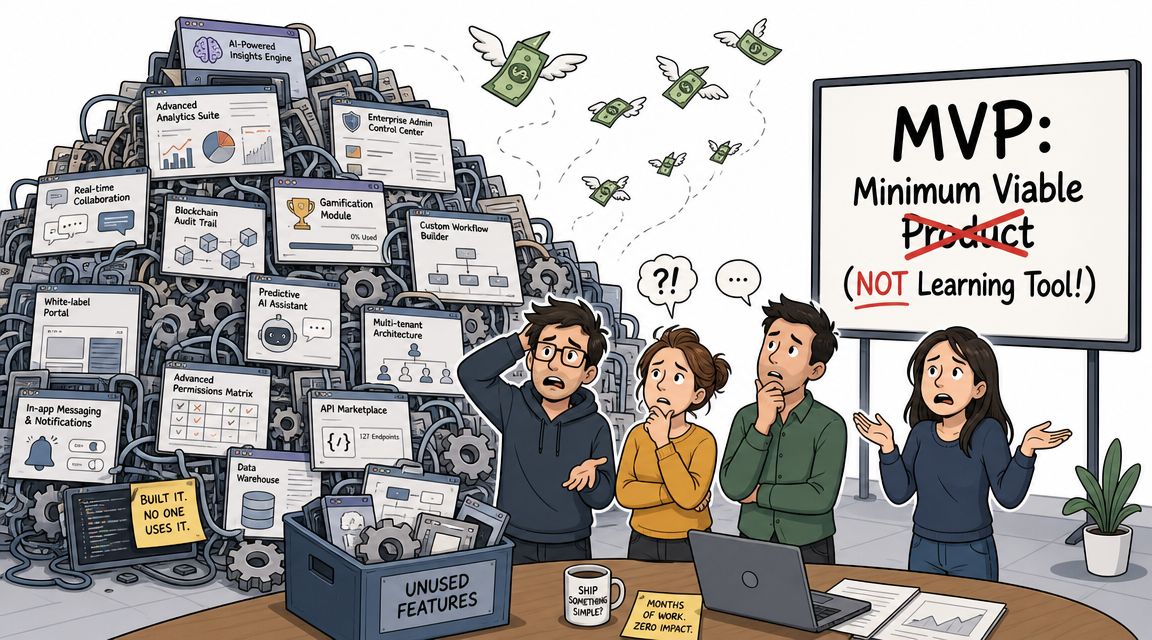
The expensive mistake is treating MVP as a development shortcut instead of a business experiment. If the only question your team asks is “what can we ship fastest,” you're already framing it poorly. The better question is “what do we need to learn before full investment becomes rational?”
That's why I prefer the framing in Big Moves Marketing's take on the viable minimum product. Viability comes before volume. A stripped-down product that can't create real buyer behavior isn't a smart MVP. It's just cheap software.
B2B SaaS doesn't behave like a consumer app. Your early customer isn't casually trying a tool for fun. They're evaluating operational risk, stakeholder fit, workflow disruption, security concerns, and whether your team looks credible enough to trust.
A weak first release doesn't just reduce delight. It contaminates the test.
Practical rule: If the thing you shipped can't produce credible learning about willingness to adopt, pay, or onboard, it wasn't an MVP. It was noise.
That's why the core discipline of an MVP is not “minimum features.” It's minimum investment for maximum validated learning. The build is secondary. The learning objective is the job.
A founder needs cleaner language here, because bad vocabulary creates bad decisions.
The modern concept matters because it gave teams a way to treat early product work as structured learning. Eric Ries popularized the modern minimum viable product concept in The Lean Startup (2011), defining it as “that version of a new product” used to collect the “maximum amount of validated learning” with the “least effort,” a framing captured by Agile Alliance's glossary on the minimum viable product.
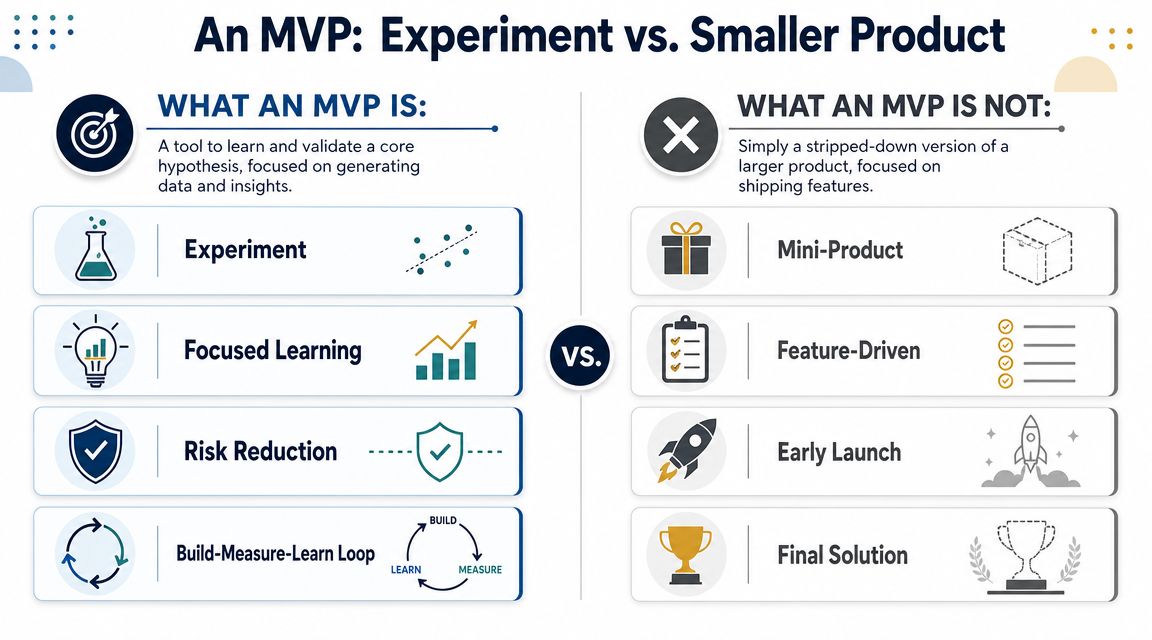
That definition kills the lazy interpretation.
An MVP is not “version one.”
It is not “the ugly first release.”
It is not “whatever engineering can finish by the end of the quarter.”
It is an experiment designed to force reality into the room.
If your team wants to know whether operations leaders will trust automated reporting, your MVP should test trust and workflow completion. If you want to know whether a sales team will pay for pipeline forecasting, your MVP should test buying intent and usage around that specific job. Anything else is distraction.
Here's the practical distinction that matters.
ToolWhat it answersWho it's forWhen to use itPOCCan this technically work?Internal team, technical stakeholdersWhen feasibility is uncertainPrototypeWill users understand the flow or interface?Users, stakeholders, design reviewsWhen usability or workflow is unclearMVPWill buyers adopt and pay under real conditions?Real customersWhen you need market validationMLPCan this create strong early user love and word of mouth?Early enthusiastic usersWhen the category is crowded or experience is a key differentiator
The common founder error is using an MVP when a prototype would've answered the question faster. If the unknown is interaction design, don't build production software yet. If the unknown is whether anyone will pay, a clickable prototype alone won't settle it.
Use the right tool for the right uncertainty.
Founders get in trouble when they try to use one artifact to answer every question at once.
That's how you end up overbuilding. You bake in technical ambition, UI polish, stakeholder appeasement, and GTM hopes into one release. Then nobody knows what the result means.
Most reasons founders give for building an MVP are weak.
“We need something to show investors.”
“We need a launch milestone.”
“We should get the product team moving.”
Those aren't strategic reasons. They're internal comfort.
For a B2B SaaS company, there are really only two valid reasons to build an MVP.
An MVP should be treated as a risk-reduction experiment. Build only the minimum feature set that can validate the core market assumption, because the main technical value is learning whether users will adopt and pay before you invest in fuller implementation, as explained by 3Pillar Global's view of MVPs as risk-reduction experiments.
That means you are testing things like:
If your MVP doesn't answer at least one of those questions, stop calling it market validation.
The second reason is less discussed and more important than is commonly understood. You need to validate whether you can sell, position, onboard, and expand the product.
A lot of B2B startups don't have a product problem. They have a motion problem. The wrong buyer is hearing the pitch. The category framing is muddy. The onboarding requires too much internal setup. Procurement friction appears too early. Founder-led sales works, but the handoff to a broader team falls apart.
That's why validating the idea and validating the motion have to happen together. If you need a sharper way to think about that, start with a rigorous approach to startup idea validation.
Here's the filter I use with founders:
A B2B MVP exists to remove uncertainty that could damage the business. Everything else is theater.
The best MVP often isn't software.
That's the part engineers hate and good founders eventually learn. If the cheapest way to validate the assumption is a landing page, a manual service, or a spreadsheet-driven backend, start there. Don't write code because code feels like progress.
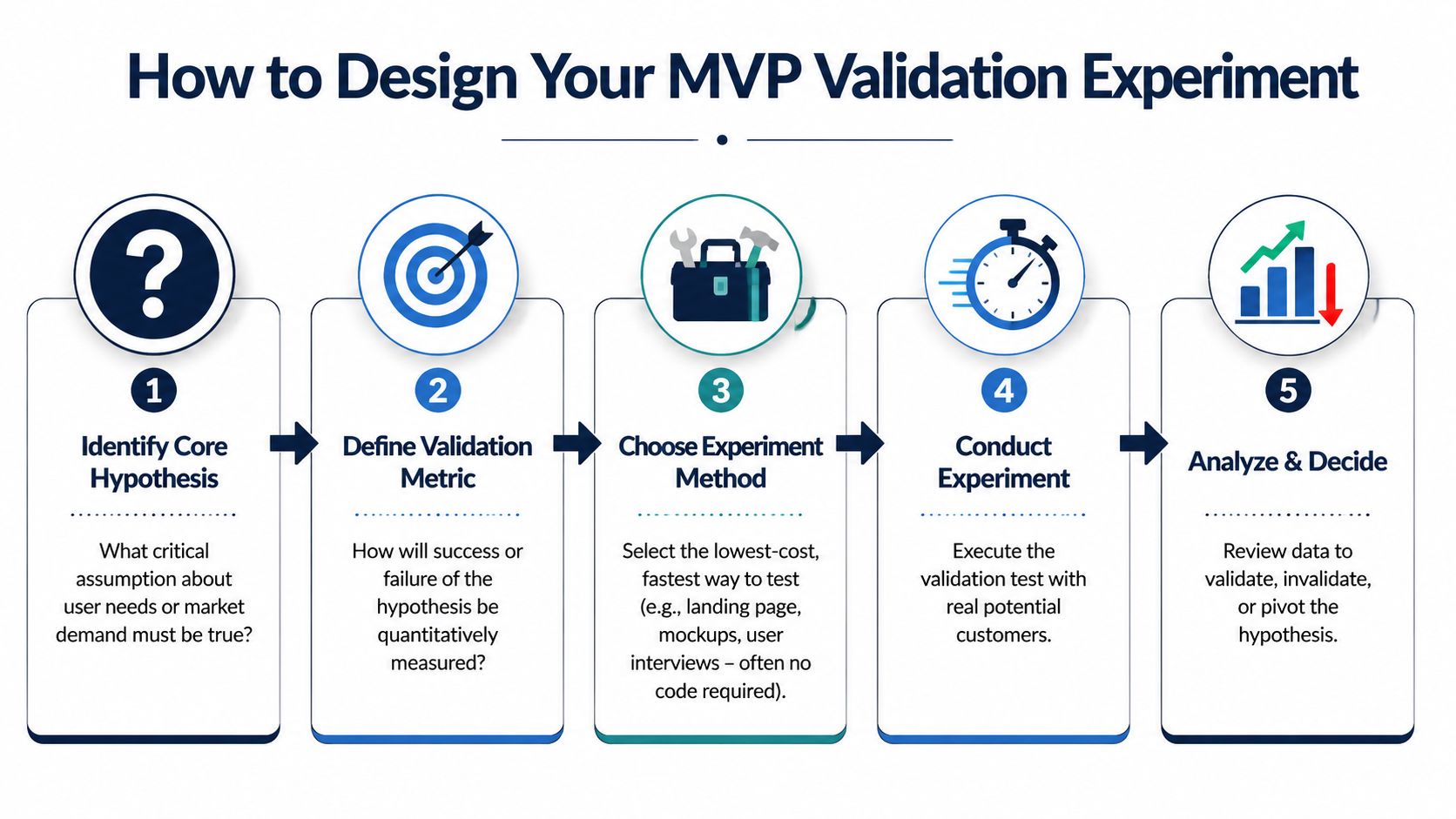
You are not testing “the product.” You are testing the riskiest assumption behind it.
Usually that assumption sounds like one of these:
Write the assumption in plain language. If you can't state it in one sentence, your experiment design is already fuzzy.
A useful prompt is this: What must be true for this company to work?
Founders often waste money. They jump straight to a built product when a lighter test would've answered the question.
A few examples:
Amplitude's explanation of MVPs makes this point clearly in its discussion of landing pages, prototypes, and manual-service MVPs. The right question isn't “what can we code minimally?” It's “which experiment is cheapest and most informative?”
If a spreadsheet plus disciplined onboarding can answer the question, building software first is usually ego masquerading as strategy.
For the qualitative side of that work, good user research matters because founder interpretation is often the biggest source of bias.
Most MVP teams fail here. They launch with vague hope and then rationalize whatever happens.
Define the success condition in advance. Not vanity. Not “some people seemed interested.” A concrete decision rule.
For example, your decision rule might be based on whether prospects agree to a pilot, whether users complete the core workflow, whether buyers commit to a paid trial structure, or whether onboarding can happen without founder heroics. Keep it specific to the assumption.
Use a short scorecard like this:
QuestionWhat you define before launchHypothesisWhat exactly must be trueAudienceWhich specific ICP and buyerActionWhat real behavior counts as validationThresholdWhat result means continue, revise, or stopTime boxHow long you'll run the test
A clean experiment beats a bigger product.
Here's a useful walkthrough before you keep reading:
A technically sound MVP scope is usually built around one primary user journey and a deliberately constrained feature set, because every extra feature increases engineering complexity, QA surface area, and time to feedback without improving hypothesis validation, as Red Thread Innovations explains in its MVP checklist for scoping around one user journey.
That principle is brutal and useful.
Don't build admin settings, broad permissions, reporting layers, and secondary workflows because “customers will expect them.” Build the happy path that proves the job can be done.
A product without a testable go-to-market motion isn't an MVP. It's an internal project.
Most MVP content stops at release. That's exactly where B2B reality starts. You're not validating software in isolation. You're validating whether the company can explain the problem, reach the right people, get meetings, convert trust, onboard customers, and learn from the first wave of usage.
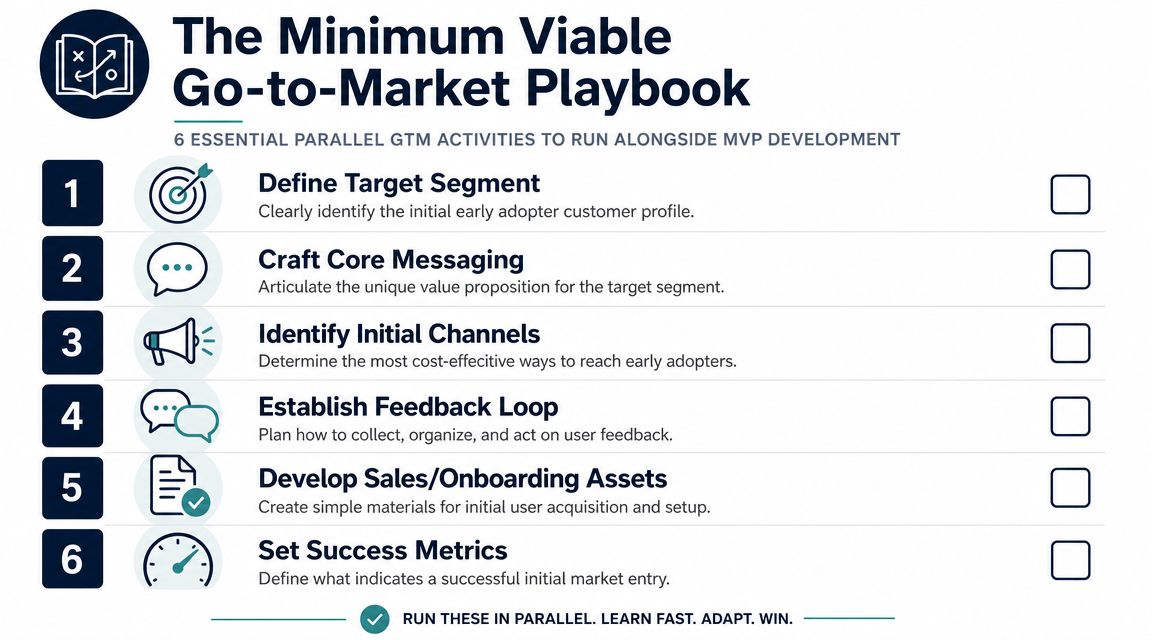
Founders should have a minimum viable GTM stack before the first serious outreach.
That means:
If you need a broader strategic model around that, this guide to B2B SaaS go-to-market strategy is a useful companion because product validation without GTM clarity creates false negatives.
The early motion should be narrow and direct.
For most B2B startups, that means hand-picked outreach to a specific segment, founder-led calls, and a clear ask. Don't hide behind “marketing” yet. You need direct signal from buyers.
A simple operating rhythm works well:
GTM elementMinimum viable versionTarget segmentOne narrow ICP with a visible pain patternOutbound motionTargeted LinkedIn or email outreach from founderSales callProblem diagnosis first, product secondPilot offerTime-bound, outcome-oriented, tightly scopedFeedback loopStructured notes after every conversation
A practical support asset here is a detailed launch planning checklist. Not because checklists are magical, but because early teams forget operational basics when all attention goes to the build.
Founders often collect the wrong feedback. They ask what features people want. Buyers are usually happy to answer. That doesn't mean those features matter.
The useful questions are sharper:
Early customer calls should extract buying logic, not product wish lists.
This is also where the “MVP shouldn't be a product at all” idea becomes strategically powerful. Guidance around MVPs explicitly allows landing pages, prototypes, and fully manual services behind the scenes. Ultimately, the question is which experiment teaches you the most, not which release makes the roadmap look active.
Your first customers are not there to validate engineering alone.
They are validating:
If those inputs aren't captured alongside product usage, the team learns half the lesson and builds the wrong second version.
For teams that need structured support across message, website, and channel testing, Big Moves Marketing operates as a fractional CMO and B2B growth partner rather than a campaign vendor. That matters at this stage because the problem is usually strategic alignment, not channel volume.
A failed MVP usually isn't a product failure. It's a diagnosis failure.
Teams build something, launch it, get mixed signals, then keep shipping because stopping feels worse than admitting the experiment was poorly designed. That burns time and muddies the roadmap.
Atlassian notes that MVPs are designed to launch quickly, gather real user feedback, and reduce risk before teams invest heavily in full development, while NetSuite adds that an MVP contains only the unique core features essential to the product's value proposition so teams can validate the idea earlier. Atlassian's overview of the minimum viable product and risk reduction is useful here because it puts the goal where it belongs. On risk, not vanity.
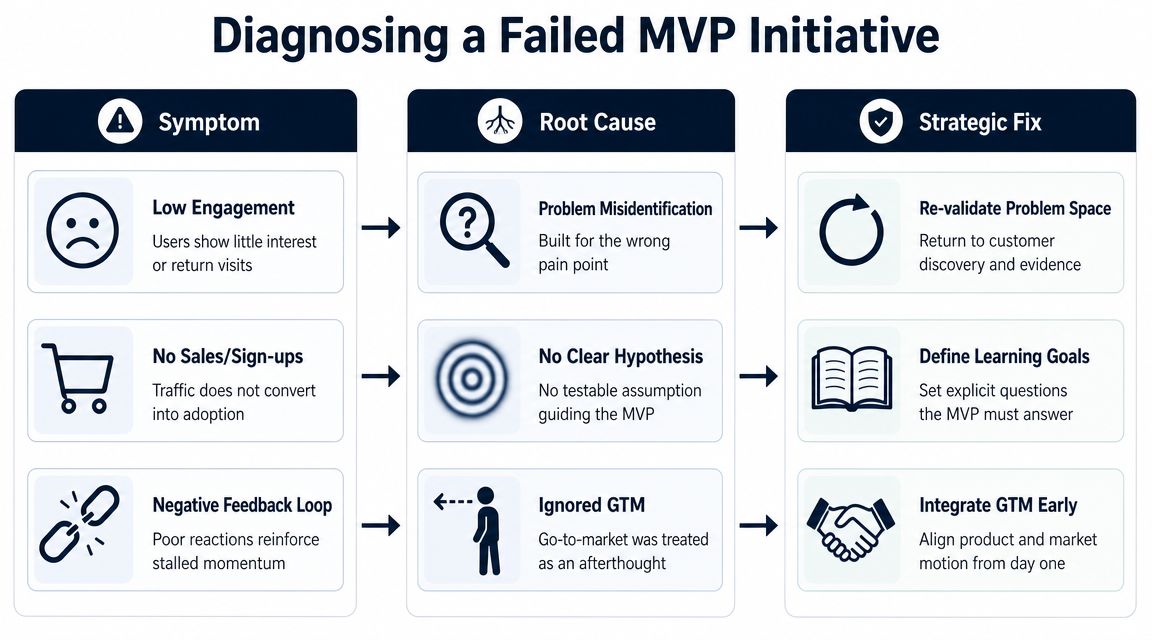
SymptomRoot causeStrategic fixProspects say it's interesting but don't moveYou tested curiosity, not urgencyRework the offer around a painful operational problemUsers sign up but don't complete the workflowThe core job isn't clear or the path is brokenStrip the experience to one valuable outcomeMeetings happen but pilots stallThe buyer case isn't strong enough internallyBuild sharper positioning and proof for one stakeholder group
A product-market fit checklist helps. Not as a ceremonial template. As a forcing function to separate demand issues from delivery issues.
This is a classic trap. Founders hear feature requests and assume validation is happening.
It often means the opposite. The market is helping you imagine a better product because the current value proposition isn't strong enough to purchase.
Feature feedback without buying behavior is often consultation, not demand.
The fix is to stop expanding scope and go back to the core commercial question. What exact outcome is worth paying for right now, with the current buyer, in the current workflow?
This happens when the MVP had no explicit hypothesis, no real success criteria, and no structured feedback loop.
The team confuses motion with learning. Engineering ships. Sales improvises. Product takes notes. Nothing ties back to a decision.
Use this simpler lens:
That is the sharper mental model. A minimum viable product MVP is not the smallest version of your grand vision. It is the smallest credible test of whether the business deserves further investment.
If you're trying to decide whether your next MVP should be product, prototype, concierge service, or a GTM experiment, Big Moves Marketing helps B2B SaaS founders make that call with clearer positioning, tighter validation logic, and a go-to-market plan that produces learning.





%20-%20white.svg)