%20png%20copy.avif)
Most advice about the minimum viable product is wrong for B2B SaaS.
It treats the MVP like a stripped-down software release. Build fewer features. Ship faster. Collect feedback. That sounds disciplined, but it's incomplete in the one place that matters. Buyers don't purchase feature lists. They buy a credible solution from a vendor they trust, with messaging they understand, pricing they can justify, and a path to adoption that doesn't create career risk.
That's why so many technically sound MVPs fail. The product may work, but the commercial system around it doesn't. The team never really tested whether the market understood the offer, whether the ICP cared enough to engage, or whether sales could turn curiosity into pipeline. They validated code and skipped commerce.
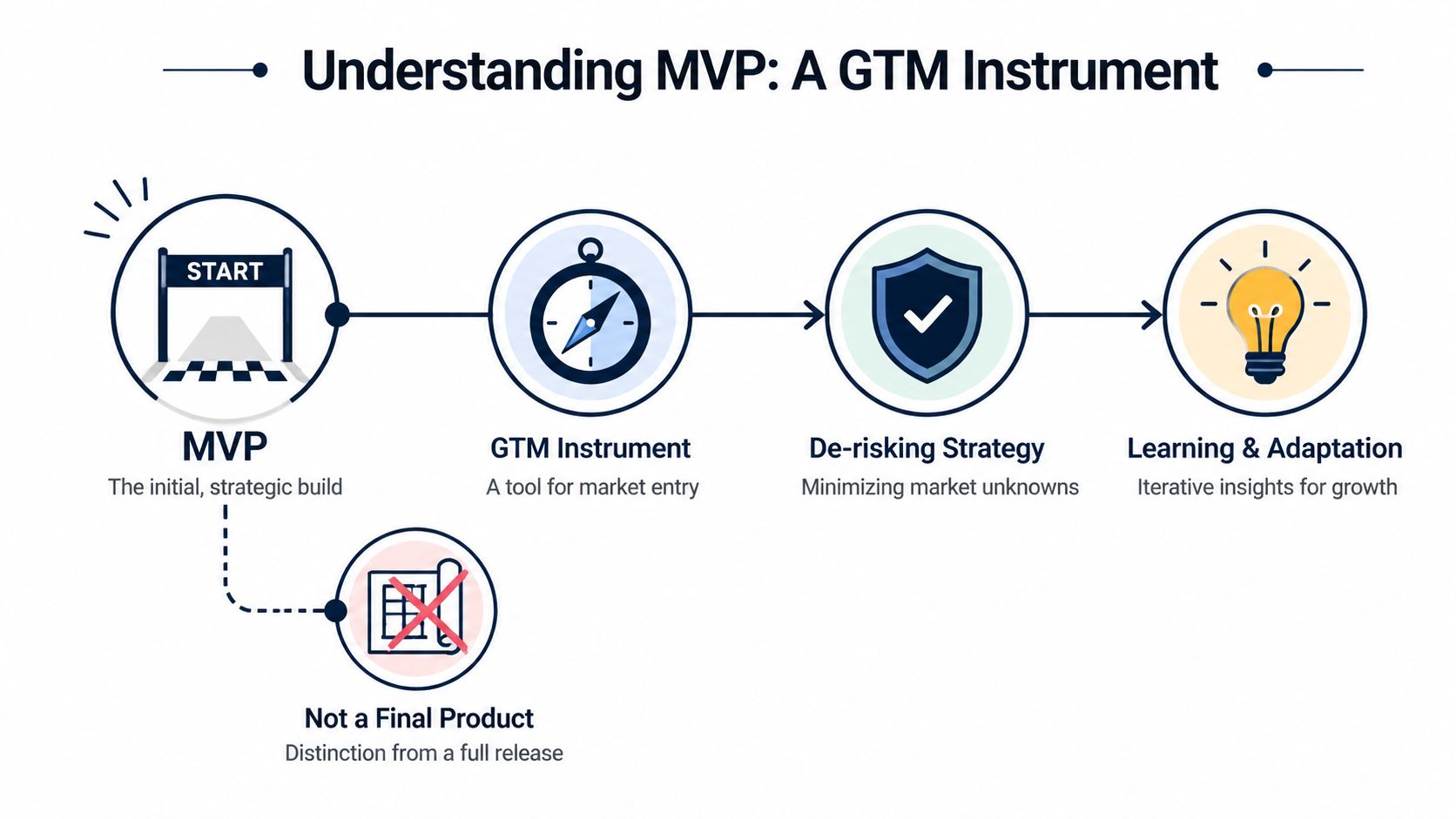
A better framing is simple. Your MVP isn't your first product release. It's your first go-to-market validation instrument.
Founders love the phrase minimum viable product because it sounds disciplined. In B2B SaaS, it often becomes an excuse to ship something buyers would never take seriously.
Here’s the mistake. Teams treat viability like a feature threshold. They ask, “What is the smallest thing we can build?” The better question is, “What is the smallest thing a real buyer will trust enough to discuss, trial, and pay for?” Those are different standards, and confusing them wastes quarters.
CB Insights has long reported that startups frequently fail because they build something the market does not want. That should change how you define an MVP. The job is not to prove your team can ship. The job is to prove the market will move.
A founder tells me they have an MVP. I do not ask how many features shipped. I ask what happened in the market.
Can your ICP understand the value in one sentence?
Can you get a first call without hiding behind a long demo?
Will a buyer give you budget, data access, or internal support?
Can someone besides the founder sell the story clearly?
If those signals are missing, you do not have a viable product. You have a build artifact.
Practical rule: If your MVP cannot test positioning, pricing, and sales motion, it is too narrow to reduce business risk.
That is the dirty secret. Many early products fail for commercial reasons long before they fail for product reasons. The product may function. The offer still falls apart.
A stripped-down release can still be the wrong MVP if it avoids the hard questions. Buyers do not reward minimalism. They reward relevance, credibility, and clarity.
In B2B, that can mean your MVP needs enough workflow fit, enough trust markers, and enough operational readiness to make a pilot feel safe. Sometimes that includes integrations. Sometimes it includes admin controls. Sometimes it includes nothing more than a sharp point of view and a pricing model that proves you understand the budget owner.
Founders miss this because product work feels concrete. Market proof feels messy. But messy is where truth lives. If you want an MVP that gets you closer to revenue instead of closer to burnout, use it to test whether the market is pulling your offer toward product-market fit.
The minimum viable product should be designed to answer one question. Can this company win this market with this message, this buyer, and this buying motion?
That's a go-to-market question, not a product question.
Most founders optimize an MVP for internal comfort. They want a product that feels real to the team. So they invest in architecture, polish, broad functionality, and edge cases. That work is emotionally satisfying because it looks like progress and feels hard.
The market doesn't care.
The market rewards a different set of proofs. Can you get the attention of the right buyer? Can you explain the problem in language they already use? Can you create enough trust for a pilot? Can you ask for money without apologizing? Those are the questions that shape whether an early product has a future.
Generic MVP advice breaks down fast in B2B because categories have different credibility thresholds. An enterprise B2B tool may need compliance or SSO to be believable, while a PLG tool may not. Your MVP scope should match category-specific viability thresholds, not a generic minimalist rule (reference).
That changes how you allocate resources.
You shouldn't ask, "What is the fewest set of features we can ship?"
You should ask, "What is the smallest offer that lets the right buyer take us seriously?"
Sometimes the answer is a workflow with one killer use case. Sometimes it's a service wrapper around manual work. Sometimes it's a landing page, pricing page, and guided demo before the product is fully built. The form matters less than the learning objective.
A strong MVP in B2B usually tests commercial assumptions in this order:
That sequence is why a serious go-to-market strategy for B2B SaaS should shape the MVP, not follow it. Product teams often treat GTM as packaging layered on top of a built thing. In reality, GTM tells you what the product must prove to be credible.
The MVP is a test rig for the business model. Code is only one component.
If your MVP isn't helping you de-risk reach, resonance, conversion, and buyer trust, you're building the wrong thing.
Founders pick MVP types the way product teams pick frameworks. Based on familiarity, not on the commercial question that needs an answer.
That is a mistake.
Your MVP format should match the sales motion you are trying to prove. If you need executive buy-in, procurement tolerance, and workflow credibility, a stripped-down app will not teach you much. If you need to know whether users activate without a sales call, a white-glove pilot will hide the actual problem.
Use the MVP to test buying behavior, not engineering discipline.
| MVP Type | Best For (GTM Model) | Primary Goal | B2B Example |
|---|---|---|---|
| Concierge MVP | Sales-led enterprise | Validate buying process, workflow fit, and willingness to commit time | Founder manually delivers reporting or compliance workflow for a handful of design partners |
| Wizard of Oz MVP | Mid-market sales-assisted | Test whether buyers value the outcome before you automate delivery | Buyer sees an automated dashboard, but the team assembles outputs manually |
| Single-feature MVP | PLG or product-led assist | Validate activation around one urgent job-to-be-done | Shopify app with one clear use case such as post-purchase upsell or review capture |
| Demo-first MVP | New category or unclear demand | Test positioning, pricing, and sales traction before full build | Recorded walkthrough, pricing page, and founder calls used to secure pilot interest |
A concierge MVP makes sense when the key risk sits inside the deal, not inside the interface. Enterprise buyers do not purchase a feature. They purchase confidence that your team understands the problem, can fit the current process, and will not create operational pain after rollout.
That means manual delivery is often the right starting point.
You should use concierge when implementation questions, stakeholder alignment, and buyer trust are bigger obstacles than product mechanics. It also forces you to hear the language buyers use in calls, procurement reviews, and internal handoffs. That information shapes messaging, onboarding, and packaging far better than another sprint of feature work.
Some B2B products sell best when the prospect experiences the output before you invest in the engine behind it. That is where a Wizard of Oz MVP earns its keep.
The prospect sees a polished result. Your team does the hard work manually behind the scenes. You learn whether the promised outcome is compelling enough to trigger a pilot, budget discussion, or expansion conversation.
This approach is useful if automation is expensive and the value proposition is still fuzzy. It also helps when you are weighing build vs buy decisions for early product infrastructure. Do not build custom systems to support a promise the market has not accepted.
A single-feature MVP is effective in PLG or hybrid motions where the buyer, user, and activation path are already fairly obvious. The question is simple. Will the user reach value fast enough to come back?
If your audience definition is still sloppy, this format will mislead you. A focused product cannot fix a weak ICP or vague demand. Before you commit to a narrow feature test, make sure the leads entering the funnel are the right people. Orbit AI's qualified lead guide is a useful reference if your team is still confusing raw interest with actual pipeline potential.
Founders avoid demo-first MVPs because they want something real to ship. Buyers do not care about your need to feel productive. They care whether the problem is clear, the outcome is believable, and the price feels justified.
A demo-first MVP is the right choice when your biggest unknown is market resonance. You can test narrative, pricing, objections, and meeting conversion with a recorded walkthrough, a sharp pricing page, and live founder selling. If nobody books the second call, asks implementation questions, or pushes on commercial terms, more code will not save you.
Pick the MVP type that exposes the hardest revenue risk first.
The wrong MVP does not just waste build time. It gives you false confidence.
Founders ruin MVP validation by tracking product activity without tying it to revenue behavior.
What matters is simple. Will the right buyer engage, will they keep using it, and will a deal move forward without heroic selling?
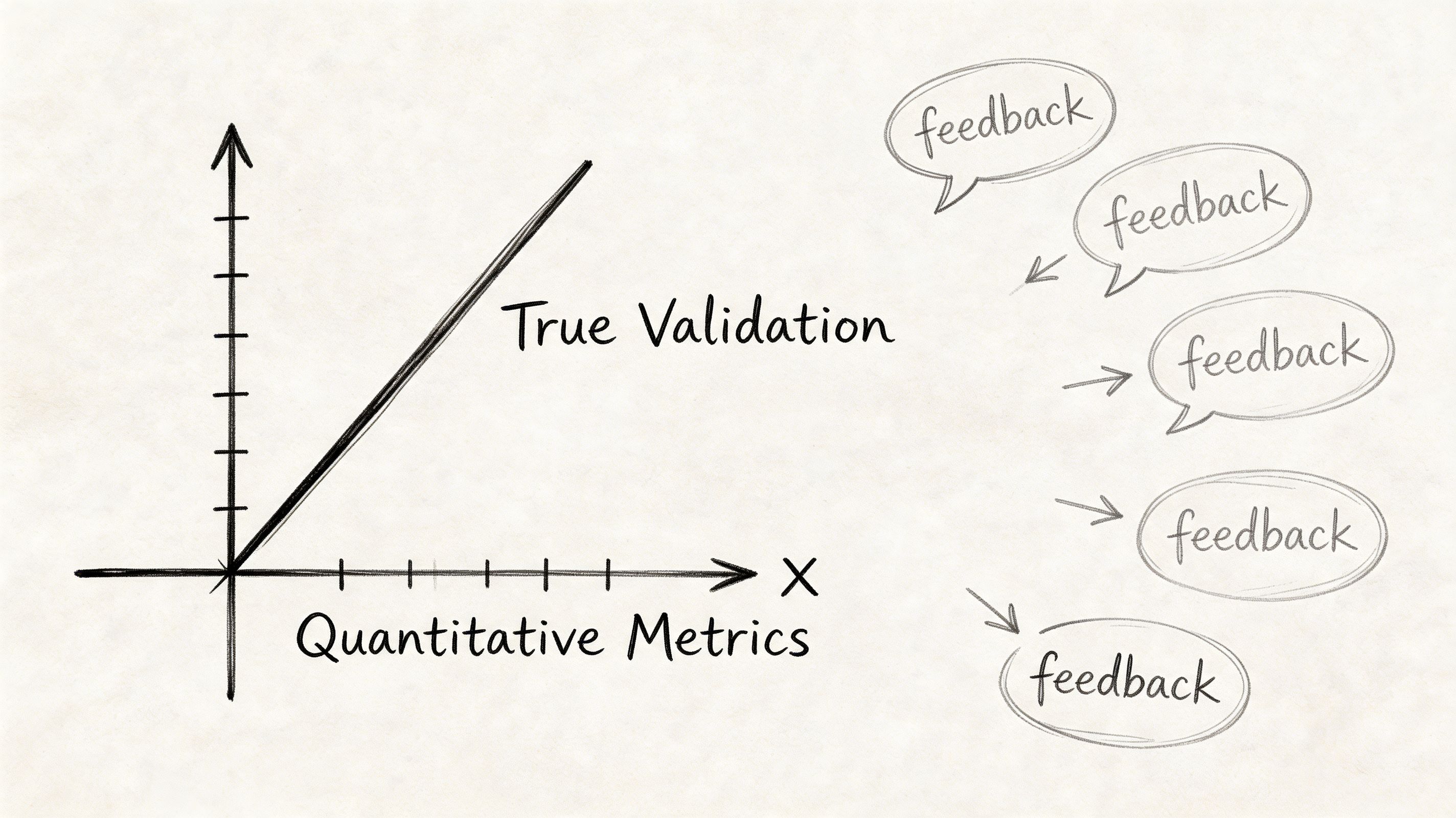
An MVP in B2B SaaS is a go-to-market test before it is a product milestone. Your metrics should reflect that. Usage matters only when it supports a sales motion, a pricing model, and a repeatable path to acquisition.
Start with qualified demand. If the people entering the funnel cannot buy, your usage data is contaminated from day one. Teams that still struggle to define real pipeline potential should tighten their ICP and lead criteria first. Orbit AI's qualified lead guide is a useful reference.
Then measure activation. Define one event that proves a prospect reached first value. Keep it narrow and observable. In a B2B workflow product, that could be connecting a data source, completing a core task, or inviting a second teammate.
Retention comes next. Early drop-off tells you the problem is not painful enough, the onboarding is weak, or the promise in the sales process does not match the product experience. All three are go-to-market problems as much as product problems.
Then look at sales progression. Buyers who see value behave differently. They ask about implementation, procurement, security review, stakeholder buy-in, and pricing. That movement is stronger evidence than positive comments in a call recap.
Finally, test the payback path. You do not need polished unit economics at MVP stage. You do need a believable route to acquiring customers without burning cash on every deal.
Good MVP measurement answers one commercial question. Should you invest in this motion, or stop pretending the market is clearer than it is?
Track five things. Ignore the rest until these are clear.
This is the scorecard that matters. It tells you whether the MVP can become a business, not whether a few users found it interesting.
Customer interviews are useful when they sharpen positioning, expose buying friction, or explain why a deal stalled. They are useless when they become a pile of flattering quotes with no operational value.
Ask questions that reveal commercial truth:
Those answers show whether your obstacle is urgency, trust, pricing, internal approval, or a weak story. This is the primary function of an MVP. It should validate marketability, not just usability.
A useful primer on this discipline is how B2B SaaS founders should validate a startup idea. Teams usually do not fail because they lacked feedback. They fail because they never defined what evidence would justify more spend, more hiring, or more product work.
A short walkthrough can help anchor the point:
Ignore applause metrics. Waitlist size, vague beta praise, demo compliments, and internal excitement do not validate a business.
Real validation shows up in repeated usage, buying urgency, stakeholder involvement, and willingness to discuss price. If those signals are missing, the MVP is not working as a go-to-market instrument. It is just generating polite interest.
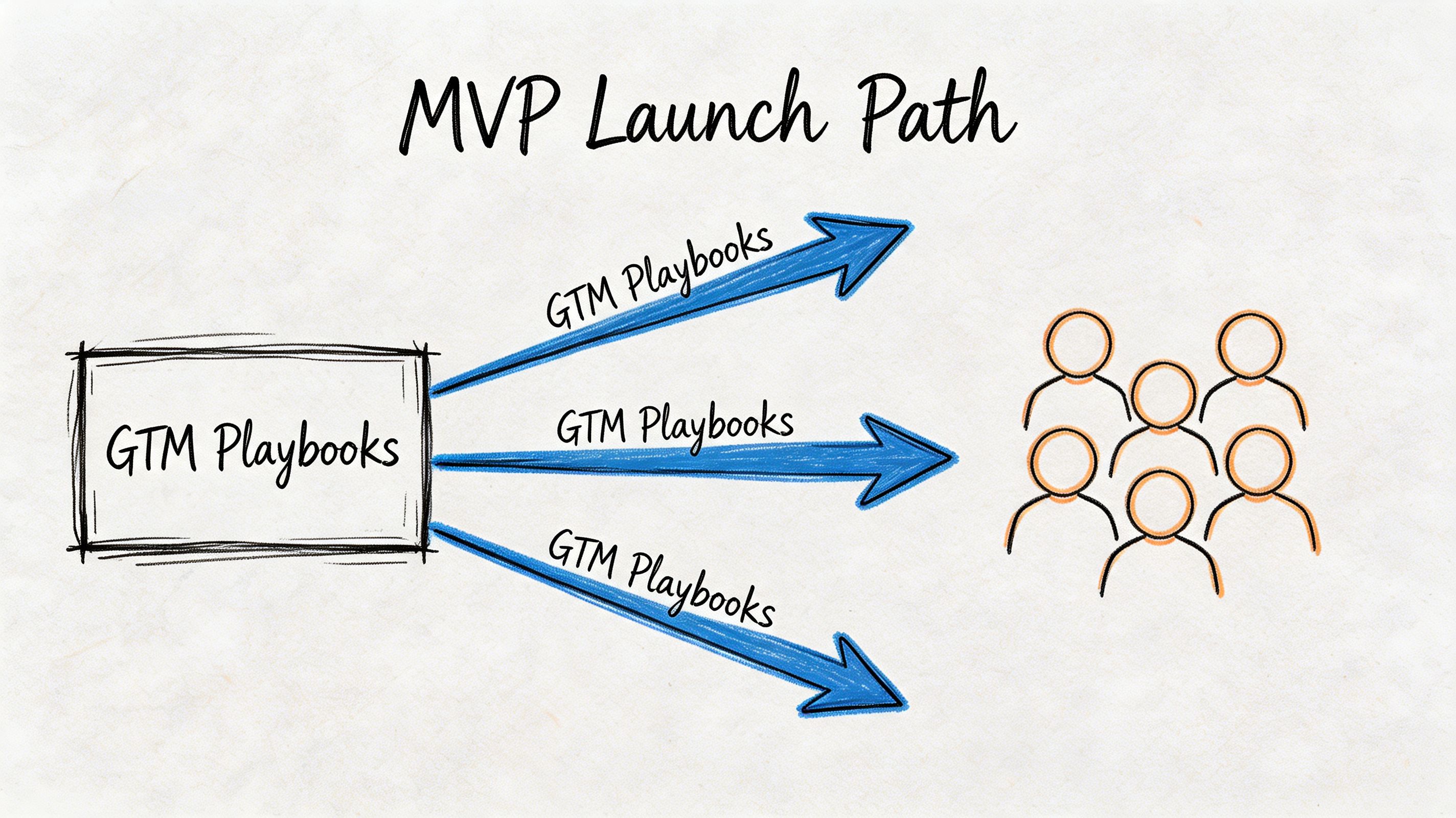
Founders do not lose MVP launches because version one is too small. They lose because nobody built a serious path to customers.
An MVP launch is a sales test with product attached. Treat it that way. Your job is to learn which motion gets meetings, which message gets traction, and which buyer will spend political capital to move a deal forward.
Use this play when the sale depends on trust, workflow change, or internal buy-in.
Recruit a small group of ideal accounts yourself. Do not hide behind a signup form and call it validation. Put a specific pilot in front of them with a timeline, a use case, and a clear success target. If the account will not commit time, data, or stakeholder access, the opportunity is weaker than it looks.
What this play should answer:
This play takes more founder time. It also gives you the highest quality signal in sales-led B2B.
Use this play when the product story is still forming and you need to test whether the market cares enough to act.
Build a short demo around the outcome, not the feature tour. Show the problem, show the changed workflow, then ask for something that reflects buying intent. "Request a pilot" beats "join the waitlist." "Book a fit call" beats "learn more."
A weak CTA hides weak demand. A strong CTA exposes it fast.
This approach works well before full implementation because it pressure-tests your positioning in the open. If buyers will not respond to the promise, the product spec is not your real problem. Your message is. For founders comparing formats, these minimum viable product examples for different launch scenarios are useful reference points.
Early B2B software should usually start here.
Build a tight list of target accounts. Write direct outreach around one painful problem, one clear outcome, and one reason to talk now. Skip the polished deck. Skip the long nurture flow. Get into live conversations and listen for the objections that repeat.
Track the signals that matter:
Founders resist outbound because it feels manual. Good. Manual is exactly what you need at MVP stage. It forces you to hear the market in plain language before you waste months building for a buyer who will never buy.
Founders love MVP success stories for the wrong reason. They treat them as product stories. They are market test stories.
Dropbox is useful because the team tested demand before building a painful backend. The early demo video sold the outcome, not the architecture, and it drew a wave of interest from people who wanted the problem solved, as reported by TechCrunch's coverage of Dropbox's early traction. That is the lesson. An MVP should prove a buyer will care enough to act.
Buffer made the same commercial move. The early test centered on pricing and intent. Visitors saw the offer, clicked into plans, and only then learned the product was not ready yet. That gave the founders evidence about willingness to pay before they spent months expanding functionality.
B2B founders should copy the logic, not the format.
A security workflow startup may need a concierge pilot because the fundamental question is whether a buyer will trust you with a live process. A vertical AI tool may need a demo-first MVP because the sale depends on whether the promised output sounds credible in a buying call. A self-serve SaaS product may need one narrow workflow and clear pricing because activation and upgrade behavior answer the GTM question fast. If you want more patterns by use case, this roundup of minimum viable product examples for different launch scenarios is worth reviewing.
The right question is always commercial. What has to happen for a real buyer to move?
That is why teams building a digital product MVP often get stuck. They define scope well enough for engineering, then fail to define what sales evidence they need. This guide to building a digital product MVP is useful for scoping the product side, but founders still need to decide what market proof counts before they start.
Feature requests feel like progress because they sound specific. Often they are noise.
A request matters when it is tied to revenue. Security review failed because you lacked SSO. The pilot stalled because onboarding took too much manual setup. A champion could not sell it internally because the reporting view was too weak. That is useful input because it explains why the deal stopped.
Everything else belongs in a parking lot, not your next sprint.
A good minimum viable product process is not build, launch, hope. It's assumption, instrument, evidence.
Write down the core risk in plain English. Not ten risks. One.
If you need a practical companion for building a digital product MVP, use it to sanity-check scope. Then strip out anything that doesn't test the riskiest assumption.
Choose the MVP type that matches the GTM motion. Concierge for complex enterprise. Single-feature for PLG. Demo-first if the story is the unknown. Wizard of Oz when the outcome matters more than backend automation.
Then decide what must be present for the buyer to take you seriously. In some categories, that's workflow depth. In others, it's a clear pricing model, a sharp landing page, and founder-led onboarding.
Before launch, define the evidence that will justify the next move.
That's the core discipline. A validated MVP is not the smallest product you can ship. It's the smallest commercial test that gives you enough truth to invest with conviction.
If you're a B2B SaaS founder and your MVP still feels like a product exercise instead of a market test, that's usually where growth stalls. Big Moves Marketing helps founders sharpen positioning, pressure-test go-to-market assumptions, and build the kind of early validation that supports pipeline, not just product progress.
Explore Big Moves Marketing services and resources:



%20-%20white.svg)