%20png%20copy.avif)
LinkedIn is not a posting channel with a lead form attached. It's a revenue system that happens to include content, targeting, outbound, and advertising. Most B2B SaaS teams miss that distinction, then optimize for activity while sales waits for better opportunities.
LinkedIn has become foundational for B2B demand because 89% of B2B marketers use it for lead generation, and 62% say it produces leads, according to LinkedIn's lead generation resources. That doesn't mean every LinkedIn program works. It means the channel is important enough to expose weak strategy quickly.
The standard playbook says to publish consistently, grow your network, run Lead Gen Forms, and follow up. That advice is incomplete. The key question is which LinkedIn motions create sales-qualified conversations, influence opportunities, and help revenue teams close business. Lead volume is a useful input. It's a poor definition of success.
Most LinkedIn programs stall because they measure activity instead of pipeline. Teams celebrate connection growth, InMail acceptance, and MQL volume, then discover that sales doesn't trust the leads and revenue hasn't moved.
The failure usually comes from three leaks. Vanity metrics reward attention without buyer intent. Lead-to-meeting friction appears when a prospect downloads an asset but has no clear reason to speak with sales. Attribution blind spots hide LinkedIn's influence when a buyer first engages with content, later visits the website, and eventually enters through another channel.
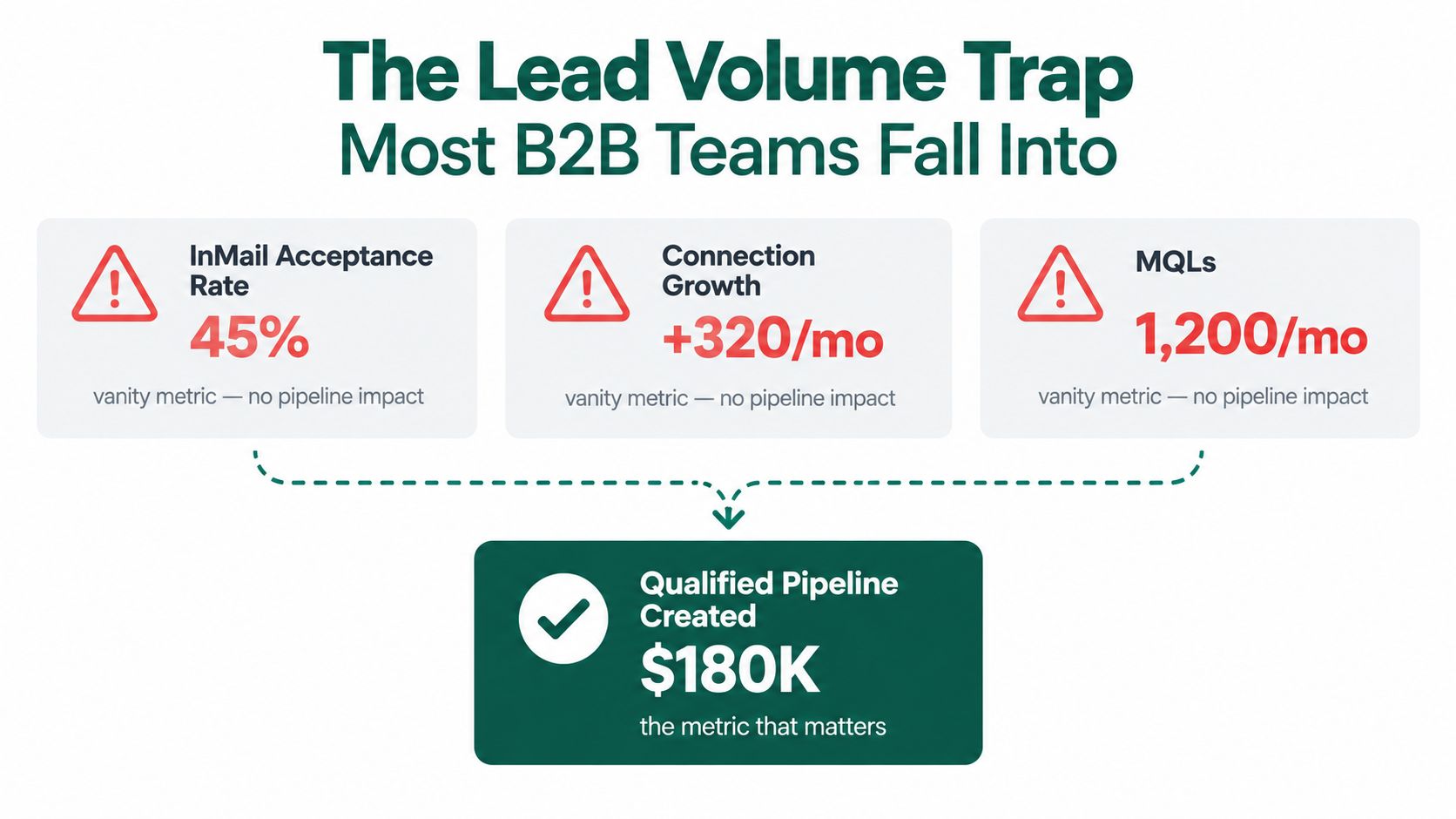
The gap between a lead and an SQL is the gap between interest and commercial relevance. A lead becomes useful when the account fits your ICP, the role has a credible connection to the problem, the timing is plausible, and the next conversation has a defined business purpose. Without those conditions, a larger database only gives sales more records to distrust.
A strong connection rate can conceal weak targeting. A strong form conversion rate can conceal an offer that attracts researchers instead of buyers. A high MQL count can conceal poor routing, weak qualification, or a sales team that never follows up.
This is why outbound lead generation needs a pipeline view, not an activity report. The team should track:
Practical rule: If the team can't connect a LinkedIn motion to a sales stage, treat the motion as unproven.
The target is not more leads. It's fewer, better conversations with people who can buy, influence, or introduce the buying process. Change the reporting model before changing the campaign. Otherwise, every new tactic will only produce a more efficient version of the wrong outcome.
Your LinkedIn profile is part of the sales experience. Prospects inspect it after a connection request, a comment, an ad click, or a referral. A weak profile creates friction before the first conversation begins.
Fix the personal profile in this order:
Your profile shouldn't read like a résumé. It should answer the buyer's silent questions: “Do you understand my situation?” “Have you worked with companies like mine?” “Will a conversation be useful?”
The company page is a verification layer. It doesn't need to carry the entire demand program, but it must confirm that the vendor is active, credible, and relevant.
Complete the About, Products, and contact information. Assign clear ownership to the page. Publish enough useful updates that a visitor doesn't encounter an abandoned feed. Add named customer evidence where you have permission, and make sure employees can find and share the company's core material without rewriting the positioning every time.
Follower count matters less than follower quality. Look at whether target accounts engage, whether employees add credible context, and whether the page supports the claims made in outbound messages. A high follower count with no relevant interaction is weak evidence.
A profile or page that forces prospects to investigate basic credibility is a tax on every request, message, and ad impression that follows. Use this B2B LinkedIn marketing perspective as a useful test: does the presence make the buyer's decision easier, or does it announce that the company exists?
Broad targeting is attractive because it produces a large audience. It's also one of the fastest ways to make LinkedIn look expensive and sales look inefficient.
Targeting should follow the buying problem, not the platform's available filters. Job title alone rarely identifies the buying group. Company size alone says nothing about urgency. Seniority can improve relevance, but narrow seniority filters can remove the operators who feel the pain and influence the decision.
Use this matrix to choose the targeting mode deliberately:
| LinkedIn Audience Targeting Modes for B2B Pipeline | Best For | Common Failure | Pipeline Risk |
|---|---|---|---|
| Firmographic-only | Establishing an account universe by industry, geography, or company size | Reaches people with no relationship to the problem | High volume, weak sales relevance |
| Role-based | Products with a clear functional owner | Treats every person with the same title as equally relevant | Inflated MQLs and poor meeting quality |
| Signal-based | Outreach and ads tied to job changes, relevant posts, competitor engagement, or active research | Signals are collected without a message built around them | Missed timing and generic follow-up |
| Lookalike | Expanding from a proven customer or opportunity set | Copies surface traits while missing the original buying context | Scale without fit |
Pre-PMF teams should avoid building a massive audience before they know which problem creates urgency. Start with a narrow account hypothesis, then include the roles involved in the buying process, not just the executive sponsor.
Once the team has a credible customer and opportunity set, matched audiences and lookalikes can extend reach. Keep exclusions active. Remove current customers when the objective is net-new acquisition, exclude competitors where appropriate, and remove junior roles that can't progress the conversation unless they're known influencers.
For paid campaigns, layer CRM lists against firmographic criteria and engagement signals. For organic outreach, prioritize accounts where someone has created a visible reason to speak. The same audience doesn't deserve the same message across both motions.
Build the ICP before building the list. A practical ideal customer profile template should capture the account context, buying group, triggering event, commercial consequence, and disqualifiers. If those fields aren't clear, targeting will become a debate about filters instead of a decision about pipeline.
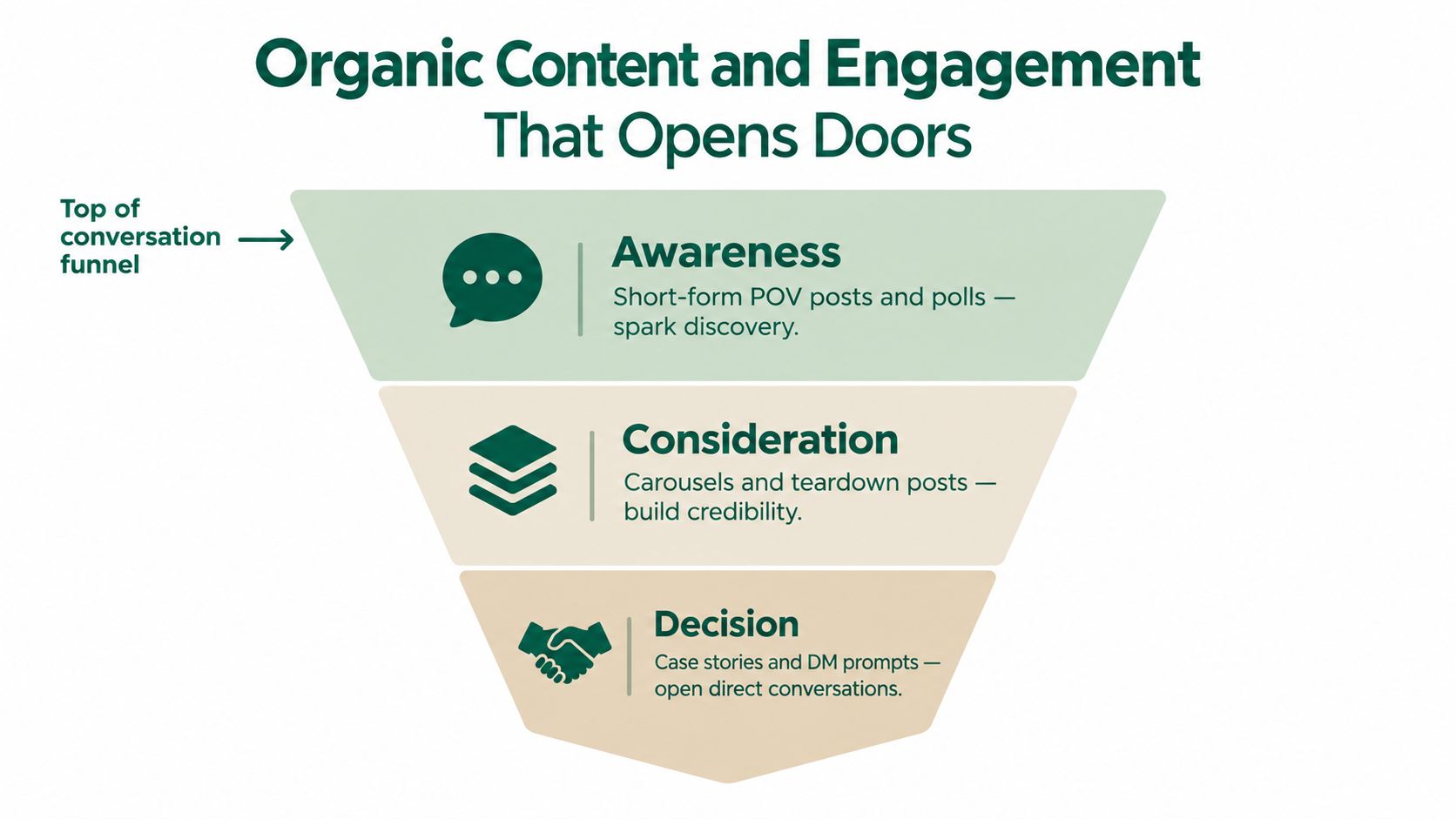
Organic content should create reasons for the right people to start a conversation. It shouldn't exist to keep the company page active.
Use each format for a specific buyer-stage job:
The distinction matters. A founder describing a difficult pricing decision can help a SaaS leader think. A founder describing a conference dinner without a commercial lesson is personal content with no strategic value.
Use a 70/30 split between founder-led voice and company page distribution when the founder is the credible subject matter expert. The company can supply research, editing, and repurposing. It shouldn't flatten the founder's judgment into committee language.
Content needs a deliberate engagement layer. Spend focused time responding to target accounts, competitors' audiences, and thoughtful commentators on relevant posts. Don't leave a useful comment that says only “Great perspective.” Add a counterexample, a practical question, or a sharper interpretation.
When someone signals interest, reply publicly with a question before moving to a direct message. A lightweight DM sequence should continue the topic rather than switch abruptly to a demo request. Route the conversation toward a useful next step, such as comparing approaches, reviewing a relevant use case, or identifying whether the problem is active.
Impressions are distribution data. They don't prove commercial relevance. Track profile views from target accounts, follower quality, meaningful comments, direct-message starts, and the movement from post engagement into sales conversations.
A post that reaches a smaller group of relevant operators can be more valuable than a broad post that attracts peers, students, and unrelated marketers. Organic lead generation on LinkedIn works when content creates recognition before outreach asks for attention.
Cold list outreach creates account coverage. Signal-based outreach creates a reason to contact a buyer now. For pipeline generation, the second motion deserves priority because SQL quality matters more than connection volume.
The benchmark gap is material. A 2026 B2B LinkedIn outreach study reports 10% to 20% connection acceptance and 3% to 8% first-message replies for cold list outreach. Outreach triggered by buying signals, such as job changes, competitor engagement, or relevant posts, reaches 40% to 60% acceptance and 25% to 55% replies in the same study.
Those ranges are not a forecast for every campaign. They show the commercial effect of relevance. A signal gives the message context, improves the odds of a useful reply, and helps sales spend time on accounts with a plausible reason to buy.
| Outreach Motion Comparison | Acceptance Rate | Reply Rate | Best Use Case |
|---|---|---|---|
| Cold list outreach | 10% to 20% | 3% to 8% | Account coverage when signals are limited |
| Signal-based outreach | 40% to 60% | 25% to 55% | Timely conversations tied to visible buyer context |
| Platform-wide connection benchmark | 28.5% | 3.0% note reply | Baseline funnel diagnosis |
| Platform-wide post-connection benchmark | Not specified | 10.4% | Measuring message performance after acceptance |
The platform-wide figures come from the Expandi LinkedIn outreach dataset. Use them for diagnosis, not as promises. The dataset reports a healthy reply rate per accepted connection at about 18%, with strong performance clearing 28%. A campaign can therefore look healthy at the acceptance stage while producing weak conversations.
One message can generate strong replies, but a sequence gives the team more opportunities to reach the right person. Each touch must add a new angle. Repeating the same opener signals automation and gives the prospect no reason to reconsider.
Use signals such as:
The first message should establish relevance through one-to-one marketing principles for targeted outreach. The next message should add a useful observation or a sharper question. The final touch should let the prospect decline, defer, or answer plainly. Ask for a meeting only after the prospect has acknowledged the problem.
Teams formalizing prospect research and contact discovery can evaluate EmailScout for LinkedIn prospecting alongside their CRM and outreach workflow. The tool should support a clear qualification process, not replace one.
A sequence should create clarity, not pressure.
Track requests sent, requests accepted, conversations started, replies after acceptance, meetings created, and SQLs generated. If acceptance is healthy but replies are weak, fix the message. If replies are healthy but meetings are weak, fix the offer or qualification. If meetings happen but SQL quality is poor, fix the audience or the signal criteria.
Respect platform constraints. Basic and free members can add a personalized message to only five connection requests per month, while Premium members can send unlimited personalized messages with connection requests, according to LinkedIn's invitation guidance. Build personalization into the wider sequence instead of assuming every request can carry a custom note.
LinkedIn ads work best when the objective matches the buyer's stage. The mistake is choosing a format because it's available, then asking the format to solve a positioning problem.
Use Sponsored Content to distribute a clear point of view or capture demand from a defined audience. Use Message Ads when the conversation itself is the offer and the audience is narrow enough to justify direct contact. Use Lead Gen Forms for a low-friction asset where reducing form completion effort matters. Use Conversation Ads for segmented nurture, not as a substitute for a relevant message.
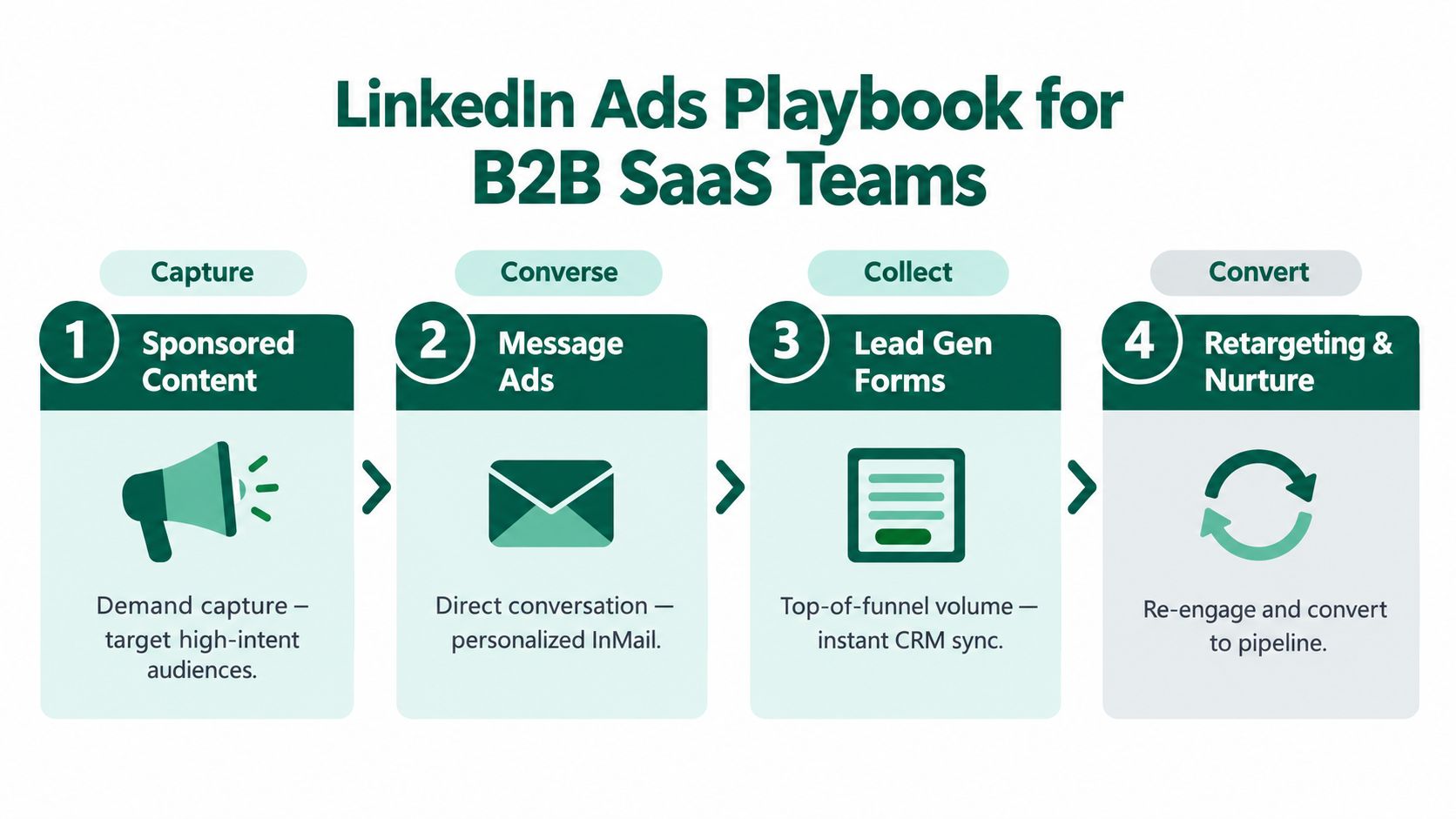
LinkedIn Lead Gen Forms pre-fill a member's profile data inside the platform. LinkedIn's playbook reports an average landing-page conversion rate of 2.35% versus 13% for a LinkedIn Lead Gen Form, as documented in the LinkedIn Lead Gen Ads playbook.
That advantage comes with a trade-off. Native forms reduce friction, but they also reduce the amount of context you collect before the first conversation. Choose them for a focused asset, diagnostic, or event where speed matters. Choose a landing page when the buyer needs education, multiple stakeholders need to review the offer, or retargeting and on-site behavior are central to qualification.
A 2026 benchmark reports an average Lead Gen Forms conversion rate of 13% compared with about 5% for standard landing pages, and another benchmark places these forms in a 10% to 15% range. Those figures are summarized in LinkedIn statistics for 2026. Raw conversion still isn't the final test. A form that converts efficiently but creates weak SQLs is not efficient pipeline generation.
Single-image ads work when the problem and promise are simple. Carousels help segment use cases or show a decision path. Short video is useful for category education when the audience needs to understand a new operating model before considering a vendor.
Retarget based on engagement depth, not only URL visits. Someone who watched, saved, or completed a substantive asset deserves a different message from someone who scrolled past an impression. Exclude employees, competitors, and existing customers when the campaign is intended to create net-new pipeline.
Don't start with a media budget. Start with an offer, audience, conversion path, and SQL definition. Only then can you judge whether the campaign is producing a useful commercial outcome.
Paid distribution amplifies what already exists. It won't repair weak positioning, an unclear ICP, or a sales process that ignores the leads it receives. For a practical reference on campaign structure, review these LinkedIn Ads best practices and judge them against your own stage and sales motion.
Lead generation on LinkedIn becomes a revenue system only when the CRM preserves the path from first interaction to commercial outcome. Without clean source data, the team can't distinguish LinkedIn-created demand from LinkedIn-assisted demand. Without stage definitions, every department applies its own meaning to “qualified.”
Start with the data model. Every paid and outbound link should carry UTM parameters and a source value that survives CRM creation. Add hidden source fields where the system supports them. Store the campaign, audience, creative, offer, and first-touch channel separately from the latest-touch channel. Otherwise, a prospect who engages with a founder post, clicks an ad, and later books through a branded search will appear to have come from only the final touch.
MQL, SQL, SAO, and opportunity should describe actions, not opinions.
| CRM Fields and Stage Triggers for LinkedIn Sourced Leads | Purpose | Owner |
|---|---|---|
| Original source and campaign | Preserve first-touch attribution | Marketing operations |
| Latest LinkedIn interaction | Show the most recent context | Marketing and sales |
| Account, role, seniority, and ICP fit | Confirm relevance before routing | Marketing operations |
| Offer or content engaged with | Give the rep a useful opening | Demand generation |
| Qualification status | Separate response from sales acceptance | SDR or sales |
| SQL date and next step | Measure stage progression and velocity | Sales |
| Opportunity association | Connect activity to revenue reporting | Revenue operations |
| Disqualification reason | Improve targeting and message quality | Sales |
Deduplication matters. Match new form submissions and manually sourced contacts against existing people and accounts before creating records. Preserve new engagement history without creating duplicate ownership, competing nurture, or conflicting sales outreach.
LinkedIn provides a direct reporting path for Lead Gen Forms. Advertisers can open the performance table and select Conversion & Leads from the Columns dropdown to view leads and metrics, as described in LinkedIn's Lead Gen Forms reporting guidance. Use that operational view, then reconcile it with the CRM so platform reporting and revenue reporting don't become separate realities.
Speed matters, but routing without judgment creates noise. Send high-fit, high-intent submissions directly to the appropriate rep with the relevant campaign and asset context. Put lower-intent responses into a nurture path that teaches, qualifies, and gives the prospect a reason to re-engage.
The first follow-up should deliver immediate value related to the action taken. A person who requested a comparison asset should receive useful interpretation, not an unrelated product pitch. LinkedIn nurture can then reinforce the same problem through founder commentary, customer evidence, and practical decision guidance. If an SQL stalls, recycle it with a clear reason and a future trigger, rather than leaving it in an indefinite sequence.
The three reports a CRO needs are straightforward:
The down-funnel case for LinkedIn is stronger than the usual lead-count story. One 2025 analysis reported that LinkedIn influenced 29% of MQLs, 36% of SQLs, and 35% of new business deals, while another benchmark found LinkedIn's share rose from 24.2% of MQL sessions to 30.2% of SQL sessions and 28.3% of new business sessions, according to Dreamdata's LinkedIn Ads benchmarks. The implication is clear. A program can look mediocre on lead volume while contributing meaningfully to later-stage revenue.
That's also why LinkedIn's reported 39% share of B2B budgets and 113% ROAS in 2025 should be interpreted through pipeline reporting, not celebrated as a standalone media result. Efficiency only becomes visible when the team measures what happens after the form, message, or post.
Make three leadership decisions this quarter:
Run the program through a test-and-hold cadence. Use one quarter to instrument the data, one quarter to optimize the audience and message, and one quarter to scale what has produced qualified pipeline. Teams that skip instrumentation usually compensate with more activity. Teams that build the measurement loop can decide what deserves more budget, more sales attention, or a deliberate stop.
Big Moves Marketing helps B2B SaaS leaders clarify positioning, define the right LinkedIn audience, build lead-generation workflows, and connect campaign activity to pipeline reporting. If your LinkedIn program is producing attention without enough sales-ready conversations, visit Big Moves Marketing to discuss a sharper growth system.

%20-%20white.svg)