%20png%20copy.avif)
Better LinkedIn ads rarely begin with bidding, audience expansion, or a new creative format. They begin with a market decision.
B2B SaaS teams waste spend when the ICP is vague, positioning is interchangeable, audiences are built from job titles, and CRM measurement ends at a form fill. The platform then becomes a lead-volume machine. Marketing reports activity, sales questions the quality, and leadership concludes that LinkedIn is expensive.
That diagnosis is usually wrong. The problem is the operating model.
LinkedIn accounted for 41% of B2B paid media budgets in a 2026 benchmark based on more than 66 million sessions and 3.5 million customer journeys, while delivering 121% ROAS. The same benchmark placed the B2B buying journey at 272 days, with 81% happening before sales enters the picture. Those figures support a more useful view of the channel. LinkedIn ads should create and influence demand across a long buying process, not chase isolated conversions. The benchmark analysis makes that shift clear.
The decision sequence is straightforward. Define whom you need to reach. Identify the problem that earns attention. Qualify intent. Connect activity to pipeline. Scale only what produces commercial evidence.
These LinkedIn ads best practices apply whether you're a pre-PMF founder testing a market, a Series A team moving from founder-led sales, or a Series C company tightening account-based growth. The platform won't clarify your market for you. Your strategy has to do that first.
Job titles are useful descriptors. They aren't buying intent.
A campaign aimed at “VP of Marketing” can include a newly promoted leader at a small company, an executive at a global enterprise, and a consultant who'll never buy your product. Those people share a title but not necessarily a problem, budget, urgency, or buying authority. Broad title targeting makes LinkedIn optimize delivery across the easiest people to reach, not the accounts most likely to become customers.
Start with your CRM. Review your closed-won customers and work backward from the purchase. Identify the company characteristics that recur, then connect them to the business problem and outcome that created urgency. A workflow automation product may find that its best customers aren't generic operations teams. They may be operations leaders inside mid-market, PE-backed companies dealing with fragmented processes after acquisitions.
Your audience should reflect that reality. Combine company attributes, seniority, function, industry, and relevant professional signals. Keep each segment coherent enough that one message can speak directly to the buyer's situation.
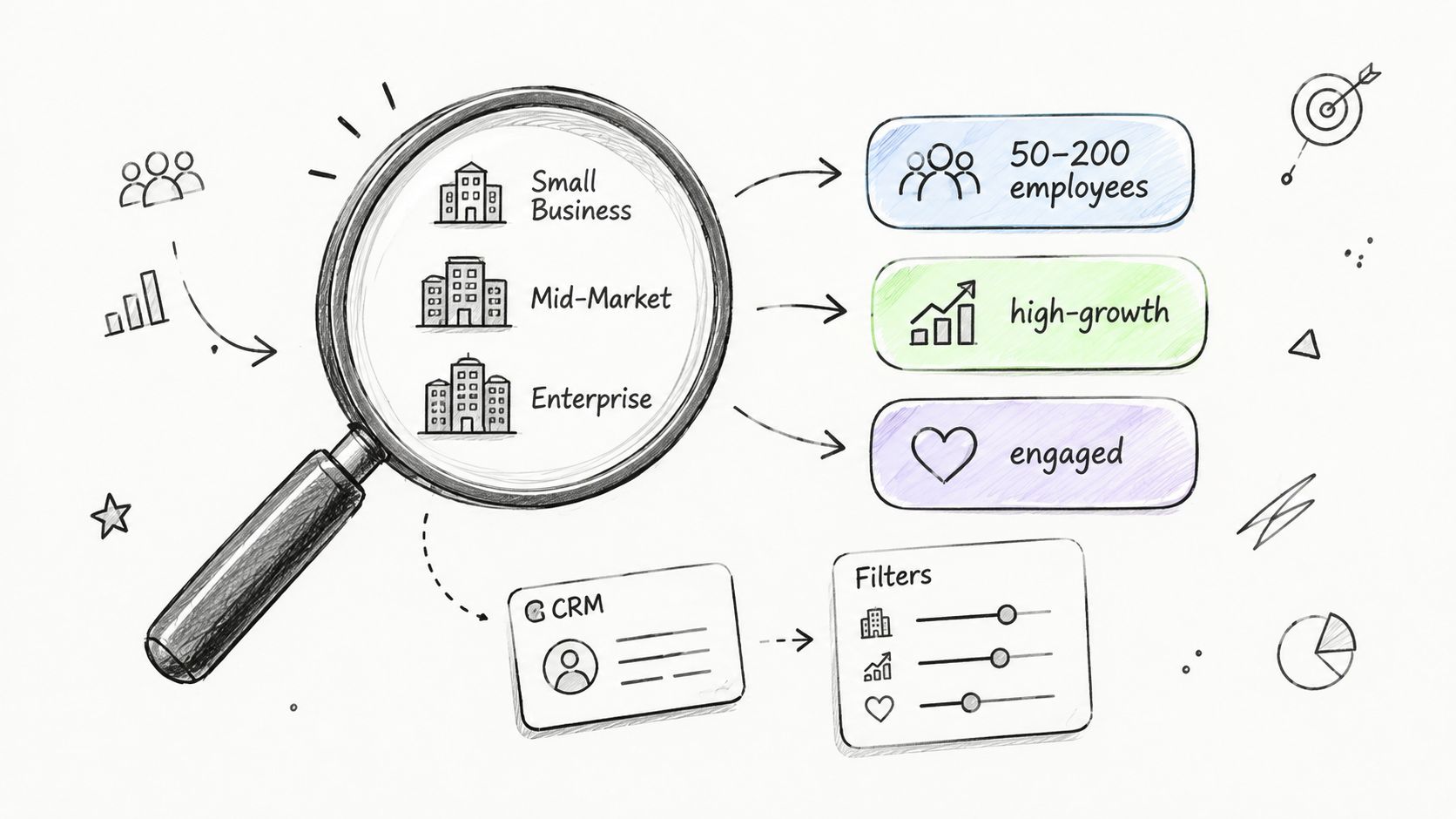
Pull your strongest customer records and score them against:
Don't assume the ICP your sales team describes matches the customers who renew, expand, and close efficiently. Use your ideal customer profile template to turn CRM patterns into an audience strategy.
LinkedIn's own guidance, cited by recent industry explainers, recommends keeping Sponsored Content and Text Ad audiences above 50,000, and Message Ad audiences above 15,000, while limiting targeting to two or three facets. The 2026 targeting guidance matters because precision has a limit. An audience that's too small may restrict delivery and raise costs.
Practical rule: Narrow the audience around a real buying problem, not around every attribute you can find.
Your prospect doesn't open LinkedIn hoping to discover your product category. They open it while thinking about a missed target, an expensive process, a stalled initiative, or a risk their team hasn't solved.
That makes company-first creative a weak opening. “The leading platform for modern revenue teams” asks the reader to understand your category before you've earned attention. A problem-led ad starts with the situation already occupying the buyer's mind, then presents your product as a credible response.
The strongest structure is simple:
A compliance SaaS company should lead with audit preparation, not an abstract promise about enterprise-grade governance. A revenue intelligence product should address manual deal research, not list integrations. The ad earns the click by making the buyer feel understood before it asks for action.
LinkedIn's official single-image specifications set introductory text at 150 characters before truncation, with a 3,000-character maximum and room for up to 10 emojis in that field. LinkedIn's single-image specifications make the practical priority obvious. Your first 150 characters need to carry the commercial argument.
Use customer language from discovery calls. If buyers repeatedly describe “manual reconciliation before every board meeting,” don't replace it with “financial workflows.” Precision creates relevance. Polished language often removes it.
The headline can use up to 200 characters, while the internal ad name can use up to 255 characters, according to LinkedIn's advertising specifications. Treat the external copy as a compressed decision aid, not a mini website.
For deeper guidance on aligning content with buyer needs, see content strategy for websites. Your ad and landing page should make the same promise, using the same problem definition.
Conversation Ads produce a dangerous illusion of success. A response feels like intent, but an easy response often reveals only curiosity.
Open-ended prompts such as “What's your biggest growth challenge?” invite opinions from people who may have no role in the purchase, no active project, and no fit with your product. The campaign reports engagement. Sales receives a mixed audience and spends time separating interest from relevance.
Use the format as a qualification gate instead. Ask questions that reveal whether the person belongs in the sales motion. A go-to-market platform might ask whether the recipient is responsible for planning, whether the company uses a dedicated planning system, or whether a current project exists. A data platform could ask whether the team manages a meaningful number of sources, provided that threshold reflects its actual qualification model.
The sequence should narrow naturally:
Qualification reduces total responses. That's the point.
A smaller pool of people who meet your criteria is more valuable than a large pool of conversational engagement that sales can't act on. The right comparison isn't response rate against response rate. It's qualified opportunity creation and sales effort per opportunity.
Build the questions from your existing qualification process. If sales disqualifies prospects because they lack the relevant function, company profile, or operational need, use those criteria inside the Conversation Ad. Don't ask a friendly question that your CRM can't interpret.
Map every response to a CRM field. Sales should see the qualification status, the answer that created it, and the recommended next action without reading a transcript manually. If your system can't route that information, the format will create administrative work instead of sales efficiency.
A Conversation Ad should make the next sales decision easier, not merely make the campaign report look busier.
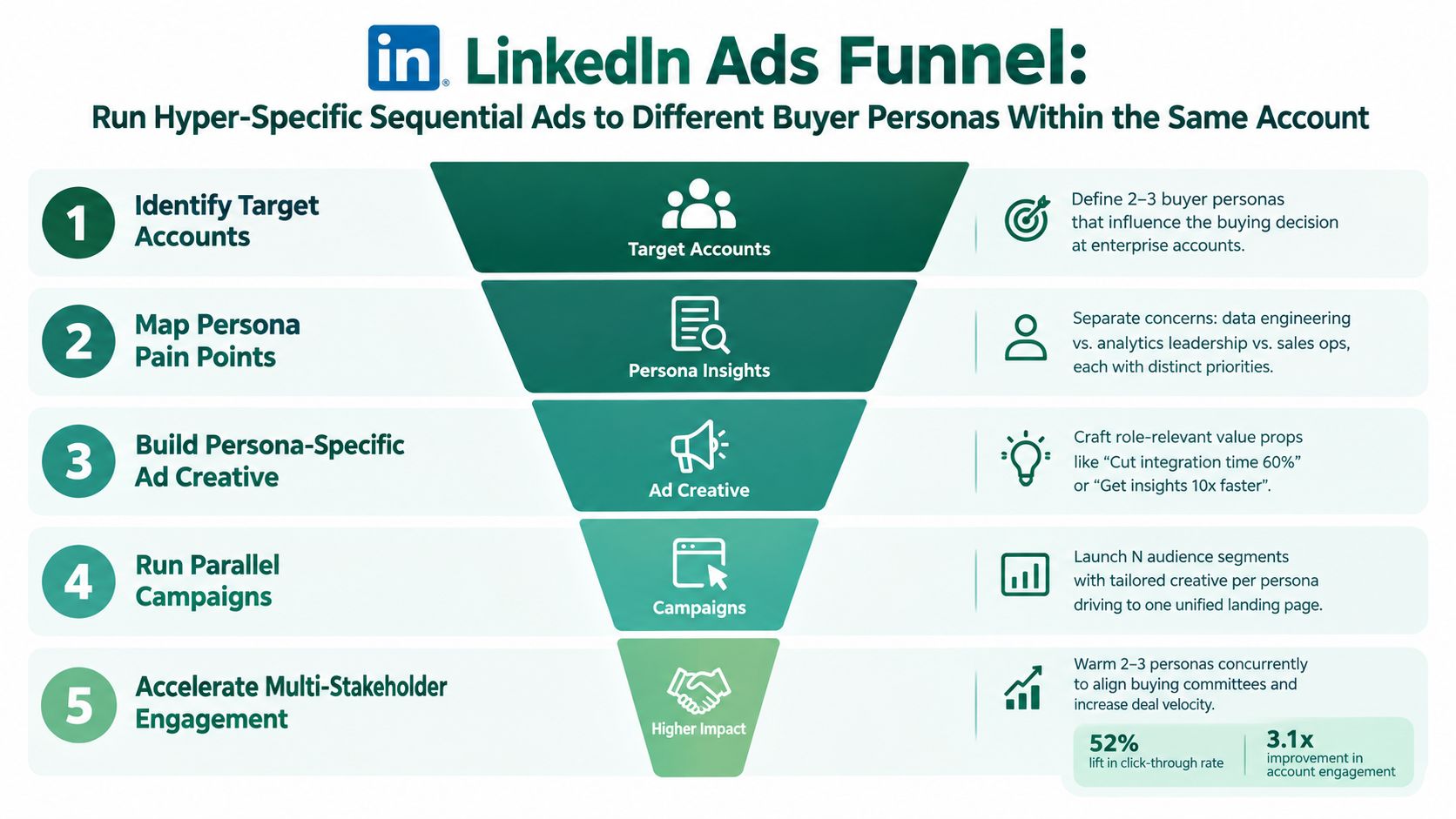
A B2B SaaS purchase rarely belongs to one person. The technical evaluator, functional champion, economic buyer, and implementation owner assess different risks, so one generic ad leaves each stakeholder to translate your message alone.
Build persona segments within the same target account set. Keep the commercial promise consistent, then connect it to each role's incentive. A Head of Data Engineering may respond to reduced integration work and infrastructure cost. A VP of Analytics may care more about faster time-to-insight and adoption. Showing both the same feature-led ad weakens relevance for both.
The landing page can remain shared if it supports the full buying group. The ad still needs to earn attention at the role level. A technical message should prove implementation feasibility, while an executive message should clarify business impact and decision risk.
Persona-specific ads work best as part of an account-based marketing workflow, coordinated with sales activity and broader account-based marketing efforts. A sales leader may see the business case first. A technical stakeholder can then receive implementation evidence, followed by an operations owner seeing workflow and adoption implications. Each exposure addresses a different objection.
Use one core offer where practical, such as a category guide, webinar, or product evaluation. Change the hook, proof, and framing for each audience. This keeps campaign operations manageable while giving sales a clearer narrative across the account.
Do not optimize these sequences for impressions or cheap clicks. Define the handoff before launch. If one persona engages with an implementation asset, route that signal to the relevant sales owner. If the account shows activity across several roles, treat it as buying-group progress rather than separate lead events.
Format testing should support the message, not distract from it. A carousel can present several role-specific ideas in one native experience, while a single-image ad may communicate one urgent business case more clearly. The cited format benchmark offers directional context, but account progression and opportunity quality determine the winner.
A smaller persona segment can outperform broad reach when it brings relevant stakeholders into the same account and reduces sales effort per opportunity. Judge the sequence by buying-group engagement and pipeline movement, not audience size alone.
A low CPL can conceal a channel that produces no sales pipeline.
LinkedIn Sponsored Content benchmark data from more than 5 million dollars in managed spend reports an average 0.65% CTR, $10.11 CPC, $60 CPM, and $276 CPL, with substantial variation by campaign. The independent benchmark provides context, not a target. Optimizing for the cheapest click or lead rewards easy conversions, which may have little connection to buying intent.
Set measurement around the full commercial path: ad exposure, response, qualification, opportunity creation, pipeline, and revenue. Standardize campaign parameters, CRM source fields, lifecycle stages, and attribution rules before launch. Last-click reporting will undervalue an ad that introduces a problem, supports a sales conversation, and influences an account before an opportunity exists.
Dreamdata's 2026 benchmark report describes a buying journey spanning 272 days, involving 10 stakeholders across 88 touchpoints and 4 channels. It also reports that LinkedIn represents 41% of B2B ad spend, delivers 121% ROAS, and has a cost per company influenced of €70. The Dreamdata benchmark report supports measuring account influence and multi-touch contribution instead of isolated lead totals.
Review these measures together:
A campaign with modest click performance can justify more budget if it reaches target accounts and creates qualified opportunities. A campaign producing cheap leads should be cut when those leads consume sales time without progressing.
Use marketing ROI measurement to connect campaign data with budget decisions. Add LinkedIn analytics tools to the reporting stack, then evaluate results over a period that matches the sales cycle. A short reporting window can misclassify a campaign that influences opportunities months after the initial response.
Account-based advertising starts with the accounts your sales team can pursue. Selecting executives across an entire industry creates reach, not account-based marketing.
Build a defined target list around your commercial strategy, then identify the people who influence the purchase inside each company. An effective account-based marketing strategy coordinates paid exposure with sales activity, so several members of one buying group encounter relevant messages while the account is actively being pursued.
This model fits a sales-led SaaS company with a clear target account list, meaningful contract value, and enough sales capacity to follow up. It is a poor fit for a pre-PMF company still testing which segment has a repeatable problem. Precise targeting cannot repair an unproven market.
If a sales rep is opening an account conversation, the ads should reinforce the same problem, point of view, and next step. A different category claim or generic brand message creates conflicting signals. A prospect who sees a relevant insight in the feed and then receives aligned outreach experiences one coherent buying motion.
Start with a manageable list. Map the stakeholders your sales team already knows, including economic buyers, technical evaluators, and operational users. Use matched account or contact audiences only when the underlying data is accurate and permissioned. Account engagement matters more than individual form fills. Look for movement across the buying group, such as several relevant people engaging or returning to evaluation content.
Give sales a clear operating rule. When an account shows coordinated engagement, reps should adjust outreach to the content consumed and the stakeholder involved. Ads create context. Sales converts that context into a conversation.
This high-touch model requires account research, sales coordination, audience hygiene, and message discipline. The trade-off is deliberate: broad targeting buys impressions from companies the sales team will never pursue, while account precision concentrates budget where pipeline can be created.
Account-based standard: If sales can't name the accounts the campaign is meant to influence, the campaign isn't ABM.
Video is useful only when motion proves something a static image cannot. Otherwise, it gives an unclear message more time to lose attention and spend budget without creating pipeline.
A product tour, brand reel, or feature montage forces the prospect to infer the problem, understand the product, and judge the benefit. Give the video one job instead. State the operational problem, show the relevant action, and finish with one next step tied to evaluation.
A workflow platform could open with the cost of manual data entry, demonstrate that process being automated, and invite the viewer to see how the workflow works. The product serves as evidence of the outcome, rather than becoming the entire subject of the ad.
Video often produces weaker click efficiency than carousel or static formats, so format choice must follow the buying task. Use video when a workflow, transformation, comparison, or human explanation needs motion. Use static creative when one statement, customer proof point, or visual contrast communicates the value faster.
Test video against your strongest static creative, not a weak control. Keep the audience, offer, landing page, and conversion event consistent. Change the format and the way the message is demonstrated, then judge performance by qualified conversion and pipeline progression, not views alone.
The opening moments should identify a problem or outcome. Add captions because feed video may be watched without sound. Show the product only when the screen proves the claim. A generic “welcome to our platform” opening gives the buyer no reason to continue.
For example, a security SaaS company can use video to show how an alert moves from detection to remediation. A static ad may work better for a concise customer result or a clear comparison between manual and automated review. Production effort should follow the communication job. A polished video that earns attention but attracts unqualified clicks is not a growth win.
Retargeting is most valuable when the visitor has already demonstrated a relevant behavior. A pricing-page visitor, product evaluator, or webinar attendee has given you more context than an anonymous member of a broad audience. Your follow-up should reflect that context.
Generic retargeting says, “Remember our company?” That message creates no new reason to act. A stronger sequence answers the next question. Someone who viewed pricing may need a buying guide or implementation conversation. Someone who abandoned a trial may need help with setup. Someone who consumed a technical asset may need proof that the product works in their environment.
Install the LinkedIn Insight Tag and build audiences around meaningful page behavior. Keep the ad promise connected to the content that brought the visitor in. A visitor who read about data governance shouldn't receive a generic homepage message. They should see the next piece of evidence that reduces evaluation risk.
Retargeting needs an exit condition. If a prospect has ignored repeated ads, continued exposure can waste budget and damage perception. Suppress converted users, active opportunities, and people who have reached a defined frequency without progressing.
Create separate audiences for different intent levels:
The goal isn't to make your brand visible forever. It's to help a relevant prospect take the next commercially meaningful step while the problem is still active.
LinkedIn should sit inside a coordinated motion with email, sales outreach, and other paid channels. A retargeting ad can't repair a broken landing page or unclear offer. It can reinforce a useful buying path when those foundations are already in place.
A lookalike audience reproduces the bias of its source list. Seed it with webinar attendees and you'll find more people who resemble webinar attendees. Seed it with trial users and you'll expand toward people willing to try, not necessarily people willing to buy.
Use closed-won customers when your company has enough customer evidence to define what “good fit” means. Clean the list before uploading it. Remove duplicates, exclude customers outside your intended segment, and separate materially different customer types if their buying patterns don't match.
This distinction matters for SaaS companies with a large PLG user base but a small sales-led revenue motion. A free user may value experimentation and self-service. Your target enterprise buyer may value governance, procurement readiness, security, and implementation support. A lookalike built from all users can blur the very characteristics your sales team needs.
Customer-sourced lookalikes work only when the customer list reflects the segment you want to scale. Don't mix small self-serve accounts with strategic enterprise customers if those groups have different use cases, contract structures, and retention patterns. Create separate seeds when the commercial motion differs.
Compare the audience against a precision segment using the same offer and conversion event. Evaluate qualified opportunity rate, sales acceptance, and customer acquisition cost. A higher click rate isn't enough if the audience produces weak opportunities.
Early-stage companies with limited closed-won evidence should stay focused on direct ICP targeting and customer interviews. Lookalikes are not a substitute for market learning. They become useful after your CRM shows a repeatable pattern among customers who fit the intended market.
The strategic principle is simple. Expand from proven buyers, not from people who merely expressed interest.
Sales teams don't need every lead at the same speed. They need a clear way to distinguish a person who requested a demo from someone who clicked an ad and left.
A useful scoring model combines the conversion event, account fit, and observed behavior. A demo request from a target account should outrank a content download from an unqualified company. A repeat visit to a product or pricing page should add context. A single click without further activity should remain a nurture signal, not an urgent sales task.
Keep the first model understandable. For example:
Define the sales response for each tier before launching the campaign. High-intent leads should reach the right sales owner quickly. Developing leads can enter a relevant nurture path while marketing gathers more evidence. Low-intent contacts should not consume sales capacity until their behavior changes.
The model needs CRM integration. LinkedIn responses, conversion events, account information, and website behavior should populate fields that sales can see. Without that connection, scoring becomes a spreadsheet exercise that decays as volume grows.
Review the model with sales regularly. If reps reject many “high-intent” leads, your criteria are too loose or your message is attracting the wrong audience. If qualified buyers sit in nurture, your threshold is too strict. Treat sales acceptance as feedback on both targeting and qualification.
Use marketing automation best practices to connect capture, scoring, routing, and nurture. A lead score has value only when it changes who acts, when they act, and what they say.
| Strategy | Implementation Complexity 🔄 | Resource Requirements ⚡ | Expected Outcomes 📊 | Ideal Use Cases 💡 | Key Advantages ⭐ |
|---|---|---|---|---|---|
| Reverse-Engineer Your ICP Into Narrow Audience Segments, Not Job Titles | 🔄 High, CRM analysis, customer profiling & segment testing | ⚡ Moderate, analyst time + small test budgets | 📊 Much tighter audiences → lower CPL, higher conversion (example: 3.2x conv, -40% spend) | Companies with CRM data and closed deals; refine targeting before scaling ads | ⭐ Precision targeting; aligns ads to real sales-qualified profiles |
| Lead With Intent-Driven Content, Not Company Promotion, in Ad Creative | 🔄 Medium, customer research + copywriting iterations | ⚡ Low–Moderate, creative time + ad tests | 📊 Higher CTR and better lead quality (example: CTR ↑2.1x, conv ↑64%) | Problem-aware audiences; when you can surface customer pain language | ⭐ Resonates with buyer problems; pre-qualifies intent in creative |
| Use Conversation Ads as a Qualification Gate, Not a Lead Capture Mechanism | 🔄 Medium, design gating flows & CRM handoff | ⚡ Low, modest spend; integration with CRM | 📊 Lower volume, far higher intent (6–8x conversion uplift on gated flows) | Qualification-focused campaigns where sales efficiency matters | ⭐ Filters out tire-kickers; improves cost-per-qualified-lead |
| Run Hyper-Specific Sequential Ads to Different Buyer Personas Within the Same Account | 🔄 High, multiple persona creatives & sequencing | ⚡ High, more creative, segmentation, and budget | 📊 Strong account engagement (CTR +52%; multi-persona engagement 3.1x) | Enterprise/mid-market accounts with distinct buying committee roles | ⭐ Speaks to each persona; accelerates deal velocity via multi-stakeholder warming |
| Measure LinkedIn Ads Against Pipeline Contribution, Not Lead Volume or CPC | 🔄 High, UTM mapping, closed-loop attribution, cross-team alignment | ⚡ Moderate, tracking tools + analyst time | 📊 Accurate ROI & budget decisions; reveals true revenue impact | Organizations scaling spend that need revenue-driven measurement | ⭐ Ties ad activity to pipeline and revenue; prevents wasted spend |
| Build Account-Based Ads Targeting Company Decision-Makers, Not Role Titles, on Your Actual Prospect List | 🔄 Medium, account research + custom audience uploads | ⚡ Moderate, research effort + targeted ad spend | 📊 Very high engagement and qualified opps (example: 34% CTR; 28% qualified) | ABM-ready teams with a defined set of target accounts (20–50) | ⭐ Surgical precision; high conversion per account and coordinated sales reinforcement |
| Test Video Ads Against Static Ads, But Only If Your Video Addresses a Specific, Outcome-Driven Promise | 🔄 Medium, short-form production and A/B testing | ⚡ Moderate, production cost + testing budget | 📊 Can outperform static when outcome-led (CTR and retention uplift) | Teams with proven static ads and ability to produce concise videos | ⭐ Stronger message retention and stand-out creative when structured correctly |
| Use LinkedIn Retargeting Ads to Re-Engage Website Visitors Who Didn't Convert, Not to Build General Brand Awareness | 🔄 Low, install Insight Tag & create behavior segments | ⚡ Low, modest retargeting budgets | 📊 Higher conversion and lower CPL for warm visitors (example: 9.2% vs 1.4% cold) | Re-engaging recent, behaviorally qualified visitors (7–21 day window) | ⭐ Efficient re-engagement; shortens sales cycle for already-interested users |
| Test Audience Lookalikes Built From Actual Closed-Won Customers, Not Leads or Trial Users | 🔄 Low, export closed-won list and seed lookalike | ⚡ Low, data export + ad spend; requires ≥20–30 customers | 📊 Higher conversion and lower CAC (example: conv ↑ to 11.4%, CAC ↓67%) | Scaling teams with a sufficient closed-won customer base and validated ICP | ⭐ Scales to buyer-like profiles; more efficient acquisition than lead-based lookalikes |
| Build a Lead Scoring Model Within LinkedIn Ads to Prioritize Sales Follow-Up on High-Intent Responders | 🔄 Medium, define rules, automate scoring, CRM integration | ⚡ Moderate, CRM automation & maintenance effort | 📊 Higher conversion on prioritized leads (Tier 1 conv examples: 34–47%) | High-volume lead flows where sales capacity must be prioritized | ⭐ Improves follow-up speed and sales efficiency; focuses reps on hot prospects |
LinkedIn advertising works when the campaign behaves like a pipeline system. That means the audience reflects a CRM-verified ICP, the message names a problem the buyer already recognizes, the creative supports the buying stage, and qualification separates commercial intent from casual engagement.
Reverse that order. They start with a format, choose a budget, select job titles, and then search for a metric that makes the activity look efficient. That sequence creates avoidable waste. The platform can optimize delivery, but it can't decide whether your market definition is accurate or whether your message gives a qualified buyer a reason to care.
Start the next campaign review with five decisions.
First, identify the exact segment and buying problem. Don't accept “marketing leaders at SaaS companies” as an audience definition. Name the company context, role, trigger, and desired outcome.
Second, define the qualification event before launch. Decide what separates an engaged person from a sales-relevant prospect. The event might involve account fit, a direct request, a meaningful product interaction, or a combination of signals.
Third, verify tracking before judging creative. Campaign parameters, conversion events, CRM fields, lifecycle stages, and sales ownership must connect. If your team can't trace a response to an opportunity, it can't make a confident budget decision.
Fourth, compare creative on downstream conversion. CTR and CPL are useful for diagnosing delivery and message response. They aren't sufficient for deciding whether the channel deserves more investment. A higher-cost campaign can be the better campaign if it creates stronger opportunities from the right accounts.
Fifth, scale only when sales-quality evidence supports it. Increase reach after the segment, message, qualification path, and measurement model produce a repeatable commercial signal. Don't expand an audience because delivery is easy. Don't add formats because the dashboard needs more activity. Don't keep a campaign alive because it generated leads that sales never accepted.
The 2026 benchmark evidence reinforces the broader operating model. LinkedIn held 41% of B2B paid media budgets and delivered 121% ROAS in one benchmark, but the same research placed most of the buying journey before sales involvement. LinkedIn can therefore play a substantial role in demand creation and account influence, but only when the rest of the revenue system recognizes those contributions. The benchmark findings are not permission to spend broadly. They're a reason to measure intelligently.
Big Moves Marketing approaches this problem as a strategic growth partner for B2B technology teams. The work starts with positioning, audience clarity, and measurement logic before channel expansion. That helps founders and revenue leaders decide faster, remove wasted growth motion, and give execution a commercial job.
The right question isn't, “How do we get more LinkedIn leads?” It's, “Which accounts should move, what evidence proves movement, and what should sales do next?” Build the campaign around those answers, and LinkedIn becomes easier to manage because every tactical choice has a place in the pipeline.
Big Moves Marketing helps B2B SaaS and technology teams clarify positioning, define ICP-led demand programs, and connect LinkedIn activity to qualified pipeline. Visit Big Moves Marketing to discuss the audience, message, tracking, and growth decisions your next campaign needs.


%20-%20white.svg)