%20png%20copy.avif)

Most B2B SaaS case studies are a waste of time and money. They’re treated as a check-the-box marketing exercise, producing fluffy documents that sales teams ignore and buyers find unconvincing. This is a critical failure of go-to-market execution.
To write a case study that actually closes deals, you must make a fundamental shift in thinking.
You are not telling a story. You are building a case.
Your objective is not to create a feel-good narrative. It is to engineer a high-stakes sales asset that proves your product's value and de-risks a significant purchase for a skeptical economic buyer. Think of it as a documented business case for ROI, ready for the CFO's scrutiny.
Most case studies fail because they are built on a flawed premise. They are marketing-led, vendor-centric, and focused on telling a story. This is precisely why they don’t work.
Sales teams sideline them because they are weak. They lack the hard evidence required to overcome objections from senior decision-makers—the people who sign checks.
The traditional 'Challenge-Solution-Result' template is the primary culprit. It encourages marketing teams to write from their own perspective, focusing on product features and self-congratulatory praise. This is a fatal flaw. A founder or a CFO doesn't care about your solution's elegant architecture; they care about its P&L impact.
The core disconnect is that marketing produces what it thinks sales needs, while sales needs what the buyer actually requires to make a decision. The buyer requires evidence, not a story.
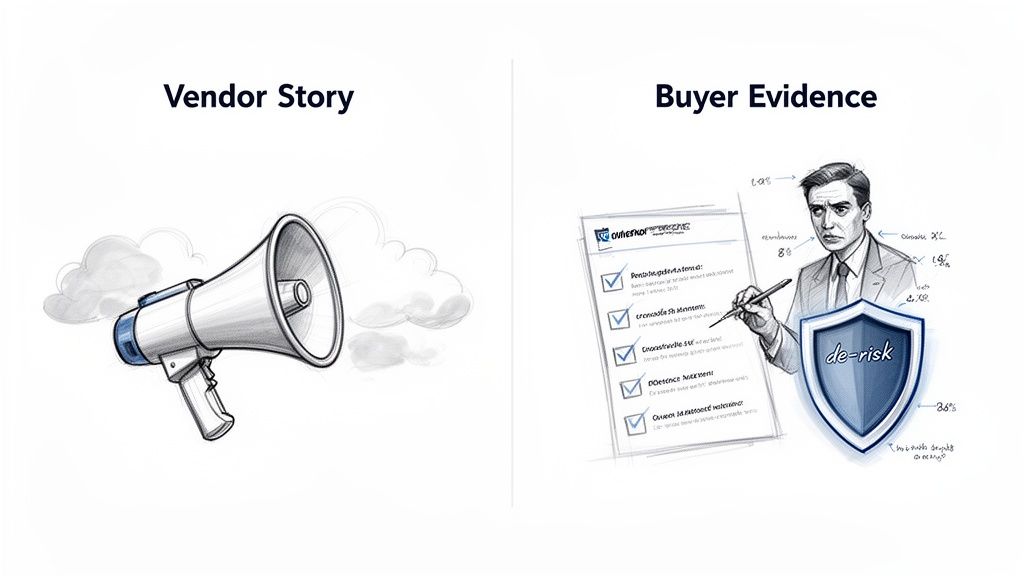
Vendor-centric case studies answer the question, "How great is our product?" instead of the only question that matters to the prospect: "How will this solve my specific business problem, and what is the quantifiable return?" This self-congratulatory language repels savvy buyers.
This is why so many case studies become liabilities, not assets. They are dusty PDFs in a shared drive because they lack the specific proof needed to move a deal forward.
The primary job of a case study is to build a business case and de-risk the purchase in the mind of the economic buyer. This isn’t a semantic change—it reframes the entire objective. A 2026 Demand Gen Report indicated that 79% of B2B buyers consider case studies crucial to their decision-making. For early-stage companies, they are force multipliers, proving value against established incumbents.
This shift changes how you select customers, conduct interviews, and frame results. It’s the difference between a forgettable marketing piece and an indispensable sales weapon. It also requires a strong grasp of your company's overarching story, a topic we explore in our guide to B2B brand marketing.
For additional examples of this evidence-based approach, you can explore this dedicated page on Case Studies.
The following sections provide the blueprint for creating case studies your sales team will use and your prospects will find impossible to ignore.
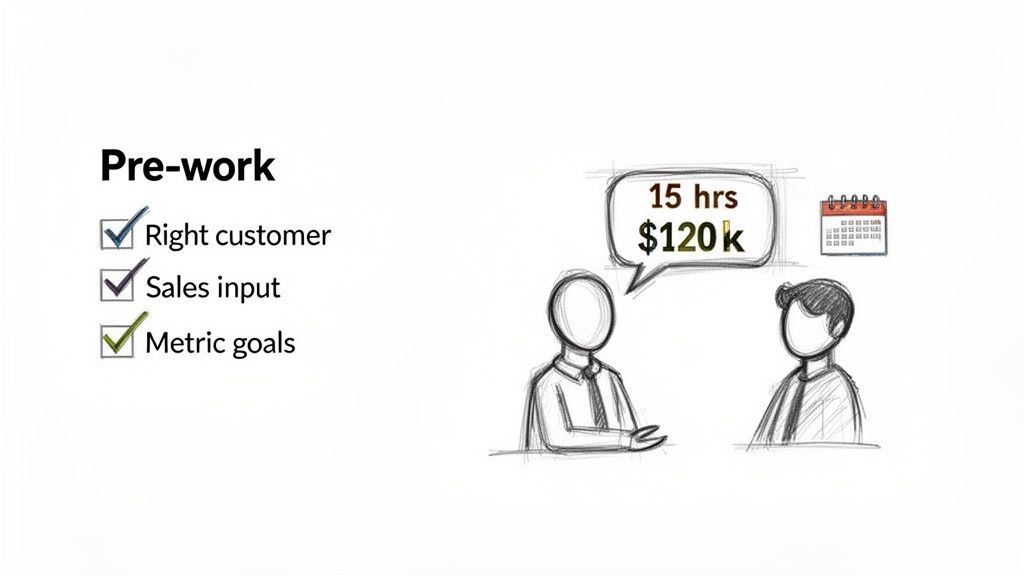
The writing is the final, easiest part. A case study's value is almost entirely determined before a single word is written. Weak pre-work guarantees a weak asset.
Most teams make two critical mistakes. They pick the happiest customer instead of the most strategic one, and they treat the interview like a friendly chat instead of a discovery session. This yields nice quotes but zero quantifiable proof.
This prep phase is not about gathering information. It's about engineering a specific outcome.
Your most vocal advocate is not always your best candidate. A great case study must do a specific job for the business. Before selecting a customer, define what this asset must accomplish.
What is the strategic goal?
Partner with your sales and customer success leaders. Ask them: “Which accounts have a clear, measurable business impact that directly maps to one of our growth goals?” This is a search for evidence, not a popularity contest.
Don't ask, “Who loves us?” Instead, ask, “Whose results prove our most important claim?” The answer to the second question is your candidate.
Your ideal candidate isn't just successful; their success story is a mirror of your Ideal Customer Profile (ICP). Their journey should look almost exactly like the one your target prospect is about to start. This creates instant resonance and credibility.
The interview is your only shot to get the raw material for a powerful business case. Do not improvise. A casual conversation gets you platitudes. A structured discovery session extracts proof.
Your objective is to build a "before and after" narrative backed by numbers. This demands specific lines of questioning designed to pull out quantifiable answers. For a deeper look at this discovery process, see our framework on how to conduct user research.
Your interview script must be a tool designed to pull out hard numbers and get past "I'm not sure" responses.
Don't ask: "How did our product help?"
Instead, ask: "Before you implemented our platform, what was your team's exact process for accomplishing X? How many people were involved? How many hours per week did that take?"
This forces a baseline. It establishes the "before" state in concrete terms.
Then, follow up with impact-focused questions:
These questions pivot the conversation from feelings to finance. They reframe the discussion around business value—the only language an executive buyer speaks. This disciplined preparation is what separates a case study that gets skimmed from one that gets sent to the CFO.
Founders and senior leaders do not read case studies. They scan them for proof. This non-negotiable reality costs most marketing teams dearly.
The traditional, long-form narrative is a relic. It was built for an era when executives had time. They don't.
If a CEO cannot grasp the core impact in under 30 seconds, your case study has failed. This is not about storytelling; it's about evidence-based design. Your goal is to create a document a skeptical CFO can scan and instantly recognize as a business case that de-risks their decision.
The single most important structural change is to place a high-impact summary box at the top. This is your entire case study in miniature. It is often the only thing a decision-maker will read.
This box needs three specific things:
This summary acts as an executive brief. It delivers the payload immediately, satisfying the time-starved scanner while inviting deeper investigation.
The "Challenge-Solution-Result" framework is passive and vendor-centric. A more powerful, customer-focused framework for B2B SaaS is Problem-Solution-Impact. The language shift is subtle, but the effect is profound.
This structure forces you to build the narrative around customer pain and your product's measurable effect on it. As noted by experts on Greenbook.org, when proprietary findings can't be shared, focusing on the business decisions that shifted becomes far more powerful than just showing the data. An AI writing assistant can help enforce this structure during drafting.
The structure of your case study is an argument. It must be logical, scannable, and relentlessly focused on proving business value. Dense paragraphs are where proof goes to die.
Use clear subheadings that signal value. Use bullet points to highlight key metrics. Keep paragraphs short. The visual design should do half the work for the reader. This same principle of clear, evidence-based communication is vital in other high-stakes business scenarios, as our guide on how to give the best presentation explains.
This is where most B2B SaaS case studies fall apart. They describe what the product does but fail to show what the business achieved. The result is a feature list with a customer logo—useless to a CFO weighing a six-figure investment.
The mistake is thinking from your product outward. The correct approach is to start with the customer’s success and work backward. An executive doesn’t care about your “intuitive dashboard.” They care about its second and third-order effects on their P&L.
This demands a rigorous process of translating product features into the hard, quantifiable business outcomes discussed in the boardroom.
Your job is to connect the dots between your product's day-to-day use and its strategic value. This means pushing past weak, first-level metrics and digging for the numbers that represent genuine business impact.
Your prospect is not buying a feature; they are buying an outcome.
Most marketing teams report on feature adoption. High-impact teams report on business transformation. The difference determines whether your case study is a sales asset or marketing collateral.
Vague claims like "improved productivity" are meaningless. They are lazy, unprovable, and instantly dismissed by experienced buyers. Force a level of specificity that is both compelling and defensible.
The final version connects the feature's output (time saved) to a direct financial metric (cost savings) and an operational advantage (faster reporting). This is the level of translation required. Our guide on moving from product features to business outcomes provides a full framework for this essential messaging shift.
This hierarchy is why the most successful case studies always lead with the results.
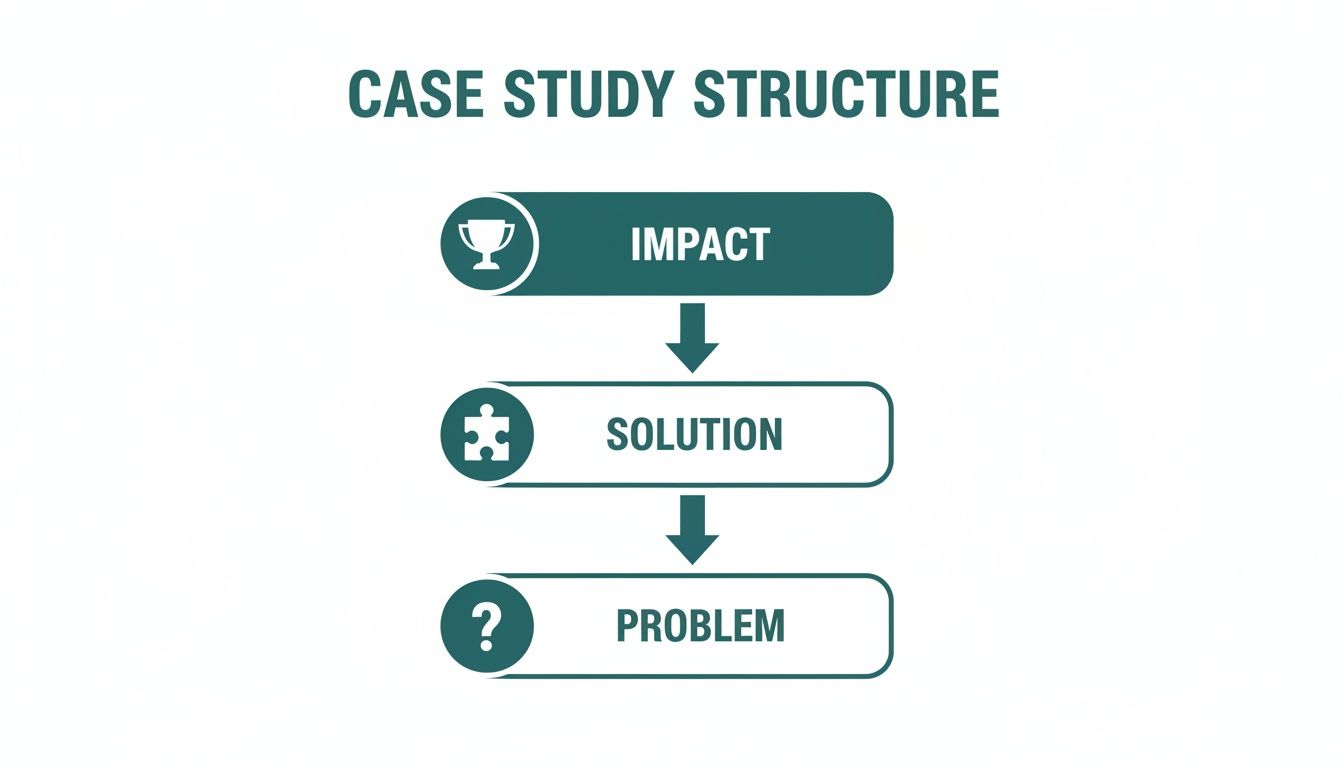
The structure itself reinforces that business impact is the headline, while the solution and problem are supporting details.
To write a case study that resonates with executives, you need a mental model for this translation. During your customer interview, your goal is to uncover the link between your product's functionality and the metrics on a CEO’s dashboard.
Here’s a framework for mapping common SaaS features to the executive-level metrics they influence.
This table is a strategic lens. It forces you to stop thinking like a product manager and start thinking like a CFO. When you quantify and frame results in these terms, your case studies become undeniable proof of the business value you create.
Creating a powerful case study is a serious investment. Letting it die on a forgotten “resources” page is a catastrophic waste. A case study only generates a return when it's actively woven into your sales and marketing motions.
The biggest mistake is thinking of the case study as a single, final document. A strategic approach means atomizing the core story into multiple formats, each designed for a specific context in the buyer's journey. This transforms a static PDF into a versatile arsenal for your entire GTM team.
Your case study is not a “leave-behind.” It is an active tool for handling objections, proving value, and accelerating deals.
To get maximum return, create different versions of the core asset. Each format serves a distinct purpose.
The Comprehensive PDF: The full, detailed business case for sales teams to use in mid-to-late-stage conversations. This version needs all the metrics, quotes, and detailed "before-and-after" scenarios.
The Scannable Web Page: Built for top-of-funnel discovery and SEO. It should feature an executive summary, the most impressive metrics, and powerful quotes in a clear visual hierarchy. It’s built for skimming.
The One-Page Summary: A high-impact, single-page document for conference handouts or quick reference. It must be visually driven, focusing only on the most critical results and the customer's logo.
The Pitch Deck Slides: Extract the most compelling data points and quotes into two or three dedicated slides for sales to integrate directly into their pitch deck, providing third-party validation at critical moments.
This multi-format approach ensures you have the right proof point for the right moment.
Creating these assets is not enough. You must train your sales team to use the case study as an active instrument. This requires a dedicated sales enablement motion.
A case study's true power is unleashed when a sales rep can say, "That's a great question. It reminds me of the situation at [Customer Name]," and immediately share a relevant data point from the study to handle an objection in real time.
This is a core pillar of effective sales enablement best practices. Create talking points that map specific customer objections to evidence within your case studies. If a prospect questions your implementation timeline, the rep should pivot to the case study that highlights a 30-day go-live.
The market for case study writing services has solidified as a distinct industry, with North America now accounting for over 35% of global revenue. This shows how organizations are recognizing these assets as critical for proving value.
By integrating these stories directly into the sales conversation, the case study transforms from a piece of content into a strategic weapon that wins deals.
After working with dozens of B2B SaaS founders and GTM leaders, I’ve seen the same practical questions about case studies derail the process. Here are the direct, unfiltered answers.
Stop asking for "a case study." The phrase implies a one-sided favor. You are asking for their time and brand equity.
Position it as a co-marketing initiative. Explain that you want to spotlight their team’s innovative work. This reframes the dynamic from a favor to a partnership.
Then, make it frictionless. Busy customers say no because of perceived effort. Your job is to make it absurdly easy for them to say yes.
The rule is simple: do 95% of the work. A busy executive shouldn't do anything more than show up for a brief call and grant final approval.
Your process should look like this:
For strategic accounts, offer a tangible incentive: a discount on renewal or early access to a new feature. Remove every ounce of friction and show clear value for their brand.
This is the most common hurdle, and it’s almost always solvable. When a customer’s legal or PR team blocks specific revenue figures, pivot to other forms of quantification. Hard numbers are the gold standard, but not the only way to demonstrate impact.
Your next best options are:
A strong, qualitative quote from a senior executive endorsing the strategic value—like risk reduction or gaining a competitive advantage—can often carry as much weight as a specific number.
This is a quality-over-quantity scenario. For a post-PMF, pre-Series A company, three to five strategically aligned case studies are exponentially more valuable than ten generic ones.
Each one must be a precision tool. Your first few should follow a clear strategic sequence:
Think of each case study as a deliberate move on a chessboard.
No. Absolutely not.
Gating a case study is an archaic tactic at odds with the asset's real purpose. A case study is a sales accelerator, not a lead magnet. Its job is to build trust and provide proof to prospects already in your funnel. A form creates friction for the very people you want to read it:
The goal is to arm your buyers and your sales team with evidence, not to add low-quality names to a marketing sequence. Make your case studies freely accessible. The minimal lead-gen upside is dwarfed by the massive downside of creating friction at a critical point in the buying journey.
At Big Moves Marketing, we help B2B SaaS startups move beyond check-the-box marketing and build strategic GTM assets that drive pipeline and revenue. If you need to sharpen your positioning and arm your sales team with tools that actually win deals, let's talk. Learn more at https://www.bigmoves.marketing.
Explore Big Moves Marketing services and resources:





%20-%20white.svg)