%20png%20copy.avif)
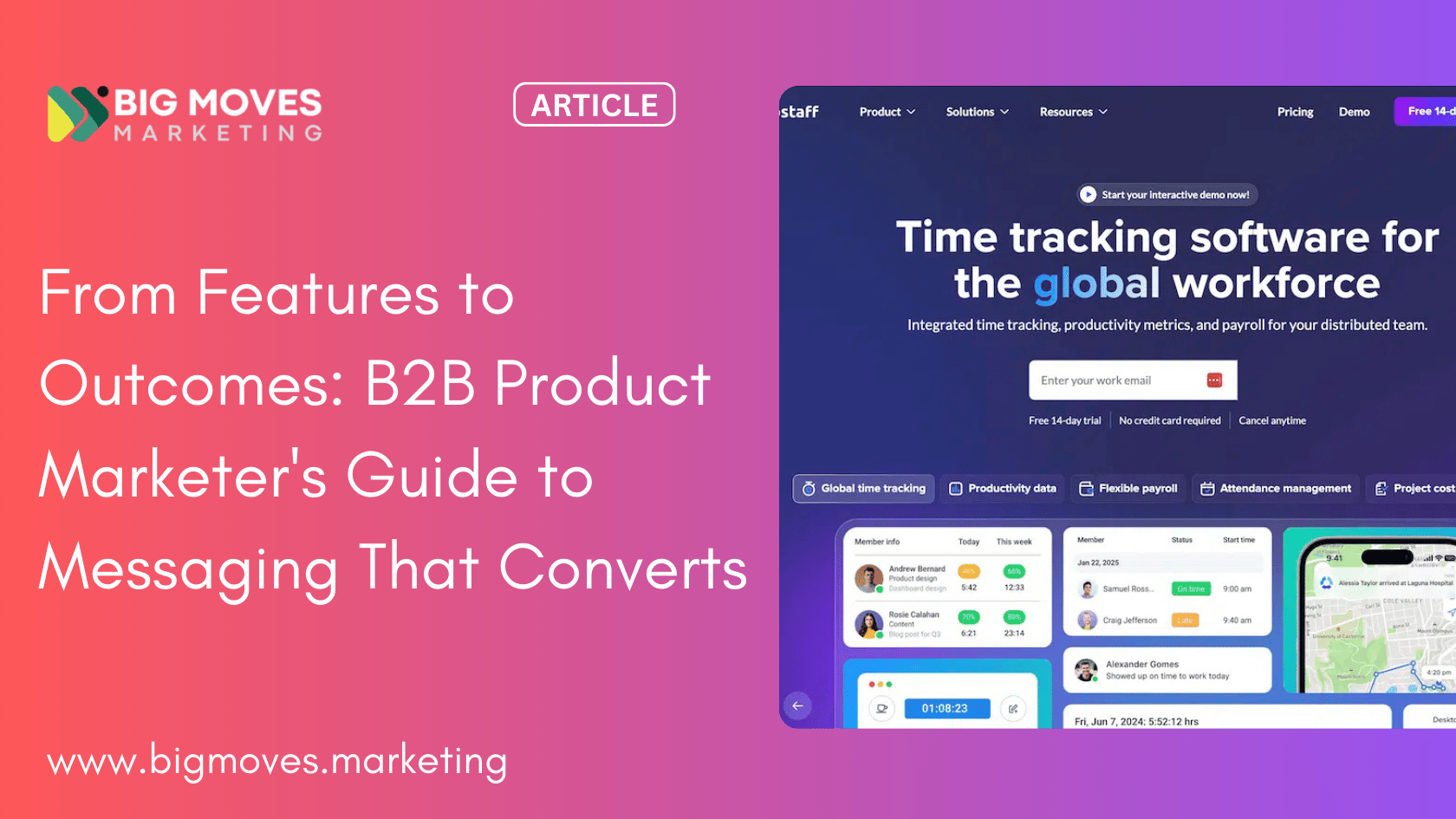
Published on bigmoves.marketing/blog
You've built something genuinely impressive. Your engineering team has poured months — maybe years — into solving a real, painful problem. Your product roadmap is tight, your demos are compelling, and your pilot customers love what you've delivered.
So why is the pipeline stuck?
This is one of the most common frustrations in B2B marketing today, particularly in sectors like industrial technology, SaaS infrastructure, enterprise software, and hardware. The assumption is usually that buyers "just don't get it yet" — that more education, more demos, more detailed case studies will eventually tip the scales.
But in most cases, the bottleneck isn't comprehension. It's clarity.
More specifically, it's the gap between what your product does and how you're explaining why it matters — right now, in the language your buyers actually use, to the right people across a genuinely complex buying committee.
This article explores that gap in depth. We'll draw on the original insights from Stephanie Chavez's piece in MarketingProfs and layer in current research, data, and practical frameworks to give B2B marketers, startup founders, product managers, and sales leaders a comprehensive guide to messaging that actually converts.
Before we talk about your messaging, it's worth understanding exactly what your buyer is going through on the other side of the table — because the landscape has shifted dramatically in the past few years.
According to Gartner, B2B buyers now spend only 17% of their total purchase journey in direct contact with potential vendors. The other 83% happens without you — through self-directed research, internal discussions, peer conversations, and review sites. And when buyers do engage vendors, that time is split across multiple competing options.
A 2024 Forrester report found that the average B2B purchase now involves 13 stakeholders, and nearly 89% of buying decisions cross multiple departments. Meanwhile, Gartner research from 2024 found that a staggering 74% of B2B buying teams experience "unhealthy conflict" during the decision process — and that buying groups who do reach consensus are 2.5 times more likely to report a high-quality deal.
Further compounding this: 77% of B2B buyers describe their last purchase as complex or difficult. The number of stakeholders involved in a single B2B deal has more than doubled compared to a decade ago, growing from around five people to between 11 and 20 depending on deal size and solution complexity.
This is the environment your messaging needs to succeed in. Not a simple one-on-one conversation with a technically-fluent champion — but a distributed, self-directed, multi-stakeholder process where the people trying to buy your product may spend only minutes engaging with your content before they form an impression and move on.
If your messaging isn't immediately clear, relevant, and outcome-focused, you're not just losing attention. You're likely being filtered out entirely before you ever get a chance to demonstrate depth.
Here's the uncomfortable truth that most B2B teams aren't willing to sit with: the reason your product isn't converting often has nothing to do with the market, the economy, or even the length of the sales cycle. It's a messaging problem — and it almost always originates internally.
Product and engineering teams are understandably proud of what they've built. They speak fluently in the language of features, architecture, and technical differentiation. Founders who came up through technical functions tend to build websites, decks, and sales narratives that reflect their own depth of knowledge.
But buyers aren't engineers (or at least, not all of them are). And even technical buyers aren't evaluating your product in isolation — they're building an internal case for stakeholders across Finance, Operations, Legal, and executive leadership, each of whom needs to understand the value in their own terms.
The result? Messaging that makes perfect sense to the team that built the product, but lands flat with the people trying to buy it. When you hear responses like:
...these aren't objections. They're signals that the value hasn't landed clearly enough for the buyer to confidently champion your product to others.
Gartner confirms this dynamic, noting that 80% of B2B deals fail not because of the external sales process, but because of internal consensus-finding. Your buyer's champion needs content that they can use to persuade their colleagues — and if your messaging doesn't travel well through an organization, the deal doesn't either.
Even if your messaging is pretty good, you're fighting for a shrinking window of attention.
Research from Backlinko found that the average human attention span is now just 47 seconds when engaging with online content. Landing pages written at a 5th-to-7th grade reading level achieve an 11.1% conversion rate — more than double the 5.3% achieved by college-level copy. That's a 56% performance improvement from simply making your writing more accessible.
This isn't about "dumbing things down." It's about respecting your buyer's time and cognitive load. When your messaging leads with simplicity and outcomes, you earn the right to go deeper. When it leads with complexity, you lose people before they ever get to the value.
67% of B2B buyers say short-form content is most valuable in their decision-making journey. And yet, 51% of buyers say the content they receive is too generic, and another 51% say it takes too many steps to access. The data is clear: buyers want fast, skimmable, and shareable content that helps them make decisions without being overwhelmed.
Your homepage, your one-pager, your sales deck — all of these need to pass a simple test: can someone who has never heard of your company understand what you do and why it matters in under ten seconds?
At its core, B2B messaging failure is a translation problem. The product team speaks the language of capabilities. Buyers need the language of outcomes.
This distinction matters more than most teams realize.
When Michelin developed its fleet management solution, they didn't sell tires to "trucking companies." They built specific value propositions for each stakeholder role: CEOs cared about overall cost reduction and profitability; fleet managers focused on compliance and operational efficiency; truck drivers prioritized safety and fuel consumption. The same product, three distinct stories — each speaking directly to what that stakeholder is measured on and worried about at the end of a quarter.
This is what great B2B messaging does. It doesn't simplify the product. It clarifies the story — and it tells that story in the right way to the right audience.
The challenge is that most B2B companies build their messaging from the inside out: they start with what the product does and work their way out to why anyone should care. The far more effective approach is to start from the outside in — with the specific pain your customer is experiencing right now — and position your product as the relief they've been looking for.
Consider a manufacturing operations manager running a high-volume facility. Their day-to-day reality involves unplanned downtime, aging monitoring systems that can't provide actionable data, and constant pressure from leadership to justify technology investments with hard ROI numbers. If your product automates diagnostics or prevents failures before they escalate, you're not selling "an AI-powered predictive maintenance platform." You're selling the solution to their worst Tuesday.
That reframe — from feature to felt relief — is the job of messaging.
One of the most common messaging mistakes in B2B is treating the buying group as a monolith. In reality, 72% of B2B purchases involve high-complexity buying groups typically spanning IT, operations, finance, and end users — each with entirely different success metrics and concerns.
Gartner's research from 2024 found that messages tailored to the buying group as a whole — rather than to individuals in isolation — are three times more likely to result in a high-quality deal. Content with individual-level relevance can actually lead to confirmation bias, reinforcing siloed perspectives and making it harder for the group to align.
This means your messaging architecture needs layers:
The technical buyer wants to understand integration requirements, implementation timelines, and functional depth. They'll read the documentation. Give them that access.
The economic buyer — often a CFO, VP of Finance, or a C-suite executive — wants to see clear ROI, payback period, and total cost of ownership. They're thinking in numbers and risk. Speak their language.
The internal champion — the person advocating for your solution in rooms you'll never be in — needs something they can take into those conversations and use with confidence. They need a clear, repeatable narrative that's simple enough to explain to a skeptic in sixty seconds.
The end user needs to feel like this product makes their day easier, not more complicated. If they're anxious about a new system disrupting their workflow, your messaging should acknowledge that and address it directly.
If your current go-to-market approach delivers one single message to all of these people, you're probably losing stakeholders somewhere in the process — and a deal lost at the internal consensus stage looks exactly like a deal lost for any other reason: it just doesn't close.
There's a persistent myth in product-first B2B companies: if we build something genuinely better, the market will recognize it.
The data tells a different story.
Bain & Company research found that more than 80% of B2B buyers have a shortlist of vendors in mind before they even begin formal research — and 90% end up buying from that initial list. Forrester's 2024 State of Business Buying Report found that 41% of B2B buyers already have a preferred vendor before formal evaluation even begins.
This means that by the time you're invited to a competitive evaluation, many stakeholders have already formed impressions. The question isn't just "which product is best?" but "which vendor can I trust to deliver, and can I explain their value to my CFO without embarrassing myself?"
Winning that trust and creating that clarity requires investments in messaging and positioning that most technical B2B teams treat as afterthoughts.
The companies that win consistently aren't always the ones with the most technically sophisticated products. They're the ones that make it easiest to understand, buy, and advocate for their solution internally.
Here's a behavioral shift that every B2B marketer needs to internalize: 89% of B2B buyers self-discover and download content without any sales interaction. Gartner reports that 75% of B2B buyers prefer a rep-free sales experience — and even 61% of buyers actively avoid vendors who send irrelevant outreach.
What this means for your messaging strategy is profound: your content is doing the selling now, whether you intended it to or not.
Your website isn't a digital brochure — it's your first sales conversation, and it's happening without you in the room. Your one-pager, your video, your LinkedIn presence — these are the materials your buyer is sharing with colleagues to build internal consensus. If those materials can't carry the weight of a sales conversation independently, you're dependent entirely on buyers being motivated enough to book a call and give you a second chance to make the case.
Gartner found that customers who received relevant and valuable information throughout their decision-making process were 2.8 times more likely to experience a high degree of purchase ease — and three times more likely to place a larger order with less post-purchase regret.
The investment in content quality, messaging clarity, and buyer enablement isn't just a marketing nice-to-have. It's a direct driver of deal size and customer satisfaction.
One of the fastest and most underused pathways to better B2B messaging is also the simplest: listen to what your customers are already saying.
Only 42% of B2B marketers collect feedback from customers as part of their audience research. That means nearly 60% are building messaging based on internal assumptions rather than the actual language, concerns, and vocabulary of their buyers.
Research from Bain & Company found that as few as 22% of B2B companies consistently measure and act on their customers' experience. This isn't just a missed opportunity for product development — it's a missed opportunity for messaging that resonates with precision.
The words your customers use to describe their problem before they found your solution are often more persuasive than anything your marketing team will write from scratch. When Help Scout discovered that their customers described their email challenge as "emails slipping through the cracks," they used that exact phrase in their messaging. They didn't invent a clever alternative — they listened.
Where to find your messaging goldmine:
Support tickets and customer service conversations contain the raw, unfiltered language of people experiencing the problem your product solves. If you're not mining these regularly for messaging insights, you're leaving gold on the table.
Sales call recordings reveal the objections, questions, and concerns that real buyers voice early in the process. What do prospects struggle to understand? What questions come up repeatedly? Those are gaps in your messaging — and clues about what to address more directly.
Onboarding conversations and success calls surface the outcomes your best customers care most about. What do they tell you they're most excited about? That's often closer to your most powerful value proposition than anything in your current deck.
G2, Capterra, and LinkedIn reviews — both your own and your competitors' — provide an extraordinary window into buyer thinking. Look for language patterns, common frustrations, and repeated outcomes. Gartner predicts that by 2025, 60% of organizations will analyze customer voice and text interactions as part of their VoC program — meaning this is becoming table stakes, not a differentiator.
Here's where the rubber meets the road. If your messaging isn't landing, these four levels of evaluation — and intervention — will help you identify exactly where the breakdown is happening.
Read your homepage headline and sub-headline. Then ask yourself: if someone with no prior knowledge of your company read those two lines, could they explain what you do, who you do it for, and why it matters — without clicking a single additional link?
Most B2B homepages fail this test completely. They lead with taglines like "Transforming the Future of Enterprise Operations" or "The Platform for Intelligent Automation" — phrases that could describe hundreds of products and convey nothing specific to a buyer who doesn't already understand the category.
A better model: lead with the outcome your best customers achieve. "Manufacturers reduce unplanned downtime by 40% with automated predictive maintenance" is not glamorous. But it immediately tells your buyer who you serve, what you do, and what it's worth to them.
Find five people in your organization who work in non-product functions — think Operations, HR, Finance, or even a recent hire. Ask them to read your homepage or your standard sales one-pager. Then ask them to explain your value proposition back to you in their own words.
The gaps between what they say and what you intended to communicate are the gaps in your messaging. This exercise is humbling, but it's also one of the fastest ways to identify where translation is breaking down — before it costs you deals.
Map your standard buying committee: who are the typical roles involved in a purchase of your solution? For each role, answer three questions:
Your current messaging should speak directly to each of these dimensions for each stakeholder. If it doesn't, you have content gaps — and those gaps are creating friction during the internal consensus stage, even when your champion is sold.
Ask this question: if your internal champion were asked to explain your solution to a skeptical CFO in three minutes, with no slides and no product demo — what would they say?
Most champions can't answer that question confidently, because most B2B companies never give them the materials to do so. Creating a "leave-behind" document, a two-minute explainer video, or even a simple FAQ designed specifically for internal champions is one of the highest-leverage investments a B2B marketing team can make.
One of the most consistent messaging errors in B2B is leading with how the product works before establishing why it matters.
Technical founders and product teams instinctively want to explain the mechanism — the architecture, the algorithm, the integration pathway. But buyers, particularly economic buyers and executive sponsors, need to see the "why this matters to us, right now" before they're willing to engage with the "how."
Think of your messaging like a news article: the most important information goes at the top. The business problem your buyer is facing. The specific outcome your product enables. The financial, operational, or strategic impact. Then you earn the right to explain how the technology delivers those results.
This sequencing matters because attention is non-linear. Most buyers don't read your entire deck or website — they skim until they find something that resonates with their situation, and then they decide whether to engage more deeply. If the most compelling part of your story is buried on slide 14, you've lost them before they got there.
The companies consistently winning in complex B2B markets aren't necessarily the ones with the most features or the lowest price. They're the ones that have cracked the code on clarity and stakeholder-specific communication.
Figma entered a market dominated by established desktop design tools with a simple, memorable value proposition: "What you see is what you build." That one line communicated a real workflow transformation — collaborative, browser-based, real-time — without requiring any technical explanation. Designers knew exactly what they'd get and how it would change their day.
Slack made a similar move. Rather than positioning itself as an enterprise communication platform (accurate, but generic), it anchored its message in the felt experience of its best customers: reducing email overload and making work feel less like navigating a maze. The message "Be less busy" resonated because it described what users felt, not what the software did.
Schneider Electric's "Microgrid as a Service" offering illustrates this transformation particularly well: instead of selling energy management equipment, they repositioned the same technology as a service that gave industrial customers access to advanced energy solutions with minimal capital expenditure. The technology didn't change. The story did — and so did the deals.
The common thread across all three: the product isn't oversimplified. The story is clarified. They lead with outcomes and buyer context, and the technical depth follows for those who want it.
One of the most expensive and least discussed problems in B2B go-to-market execution is messaging fragmentation: marketing says one thing, sales decks say another, and what a rep delivers verbally on a call is different again.
A recent study found that 70% of SaaS buyers cite inconsistent messaging as a top reason for lost trust. When a buyer hears something from marketing, then something slightly different on a sales call, and then receives a proposal that tells yet another story, the cognitive dissonance creates doubt — even if each individual message is technically accurate.
The solution is a unified messaging framework: a documented, shared source of truth for how your product is described across all customer-facing functions. This isn't a tagline document or a brand guidelines PDF. It's a practical tool that answers, for each buyer segment and each stage of the funnel:
When sales, marketing, customer success, and even product leadership are telling a consistent story, the cumulative effect on buyer confidence is significant. Your champion can repeat it. Your prospects hear the same narrative across multiple touchpoints. Trust builds faster.
A note on the tools available to B2B teams in 2025: artificial intelligence has meaningfully lowered the barrier to messaging research, testing, and iteration.
60% of high-growth SaaS companies already deploy AI-driven messaging platforms for applications including rapid persona research, automated A/B testing of key messages, and sentiment analysis of buyer interactions. Conversation intelligence tools — which analyze sales call recordings to identify what language correlates with positive buyer responses — are now within reach of companies well below the enterprise scale.
This doesn't replace the need for human judgment in crafting messaging strategy. But it does mean that the feedback loop between messaging hypothesis and market validation can happen much faster than it once did. B2B teams that build a practice of continuously listening to buyer language, testing message variations, and refining based on real data will develop a compounding advantage over teams that treat positioning as a one-time exercise.
Understanding what great B2B messaging looks like is only half the picture. Here are the most common patterns that undermine even well-intentioned messaging efforts.
Feature-listing instead of outcome-framing. A list of capabilities tells a buyer what your product can do. An outcome statement tells them what their life looks like after they buy it. The first creates cognitive work. The second creates desire.
Assuming everyone on the buying committee has the same context. The IT director who has been evaluating your solution for six weeks has a fundamentally different level of familiarity than the CFO who is seeing a summary slide for the first time on the day of the approval meeting. Messaging needs to work at both levels simultaneously.
Using category jargon as a differentiator. In many B2B categories — AI, cloud, automation, SaaS — the vocabulary has become so saturated that phrases that once felt differentiated now feel generic. If your competitors could put their logo on your homepage without changing a word, your positioning needs work.
Treating the website as a product brochure. Your website is the first sales conversation your company has with most buyers — and it happens without any human involvement. If it doesn't proactively address the top three questions your best prospects are asking, it's creating friction rather than building momentum.
Waiting for perfect content before shipping. Messaging is iterative. Waiting until you have the perfect story means you're messaging nothing in the meantime. Ship a clearer version of your current story, measure how buyers respond, and improve from there.
One of the challenges with messaging clarity work is that it can feel intangible compared to traditional marketing metrics. Here's how to track it:
Pipeline velocity — the speed at which opportunities move through each stage of your funnel — is often the first metric to improve when messaging clicks. If deals are spending less time stuck in "needs internal alignment" stages, that's a signal that your champion is better equipped to build consensus.
Proposal-to-close rate tends to improve when economic buyers are getting a clearer picture of ROI earlier in the process, because they arrive at the proposal stage with fewer unanswered questions.
Website engagement metrics — particularly scroll depth, time on page, and the pages visited before a demo request — reveal whether your content is working sequentially or whether visitors are bouncing before they find what they need.
Sales cycle length is perhaps the most direct proxy for messaging effectiveness: when your story is clear enough for internal champions to move it through their organization without constant intervention from your team, cycles shorten.
Businesses using conversion rate optimization tools see an average ROI of 223%, but the real leverage comes from improving the underlying message, not just optimizing the mechanics of the page.
If this article has resonated and you want to audit your current messaging, here's a practical starting point:
Audit your homepage this week. Read only the headline, sub-headline, and hero copy. Does it pass the 10-second test? Can you tell exactly who it's for, what pain it solves, and what outcome it creates? If not, this is your first priority.
Run the colleague test. Ask five people outside your core team to read your homepage. Listen carefully to how they describe what you do. The gaps between their description and your intent are your messaging gaps.
Pull three months of support tickets and sales call recordings. Look for patterns in the language your buyers use to describe the problem. Start using those exact words in your next iteration of messaging.
Map your messaging to your buying committee. For each typical stakeholder in a deal, identify whether your current materials address their specific concerns, risks, and success metrics. Fill the gaps with targeted content.
Create a champion enablement kit. A simple package of materials — a two-page executive summary, a brief ROI model, a slide or two that addresses common objections — that your internal champions can use when advocating for your solution without you in the room.
There's a temptation in product-first B2B organizations to treat great products as self-explanatory. The logic goes: if we build something genuinely better than the alternatives, thoughtful buyers will figure out why it's worth purchasing.
But the research consistently tells a different story. Buyers arrive with preformed shortlists. They spend the majority of their journey self-directed, without any input from your team. They involve more stakeholders than ever, each with different success metrics and concerns. And they make decisions under cognitive load and time pressure that leaves very little room for complex, feature-heavy narratives.
In that environment, the clearest product doesn't just win more deals. It wins faster deals, bigger deals, and deals with less post-purchase regret — because the buyer understood exactly what they were getting and why.
Messaging clarity is not a marketing afterthought. It's a go-to-market advantage that compounds over time: better qualified leads, shorter sales cycles, more confident champions, and customers who stay because their expectations were set honestly from the start.
If your pipeline is stuck, don't rewrite your product roadmap. Rewrite your story.
Because in B2B — where the buying journey is long, the committee is large, and the stakes are high — the best product doesn't always win. The clearest one does.
This article was written for B2B marketers, startup founders, product managers, and sales leaders working in complex B2B environments. Originally published at bigmoves.marketing/blog.
Explore Big Moves Marketing services and resources:




%20-%20white.svg)