Most B2B teams don't have a channel problem. They have a sequencing problem.
They launch Google Ads, LinkedIn, content, and outbound before anyone can state who the product is for, why that buyer should change, and what proof would settle the decision. Spend then does exactly what spend always does. It amplifies confusion faster.
A sound GTM strategy for B2B reverses that order. You settle positioning, define the buying group, build pre-contact proof, and set measurement rules first. Channels come last, because they're the easiest part to buy and the hardest part to fix once money is moving.
Channel-first advice sounds practical because campaigns are visible. It's also how teams buy cheap, unqualified pipeline and then blame lead quality, sales follow-up, or the market.
Cheap leads aren't a bargain if sales has to explain your category on every first call. Low cost per click means nothing when the landing page, ad, and rep tell three different stories. You've paid to create work, not demand.
Use this sequence instead. Each stage has one core deliverable and one exit gate. If the gate doesn't pass, you don't advance, no matter how much activity the team wants to show.
| Stage | Core deliverable | Exit gate before advancing |
|---|---|---|
| 1. Foundation | Audience research, positioning, messaging framework | Positioning explained in one sentence to five target buyers without follow-up questions |
| 2. Segments and ICPs | One beachhead segment, ICP, buying-group map | Named champion, economic buyer and technical evaluator for every target account |
| 3. Pre-contact assets | Category, comparison, proof and ROI content | Core assets answer the top ten questions raised in first sales calls |
| 4. Channel activation | Search, LinkedIn, email and event programs | Each channel tied to one funnel role and one lead signal |
| 5. Measurement | Stage KPIs, CRM account association, attribution rules | Marketing and sales agree on the definitions of a qualified account and opportunity |
| 6. Scale | Expansion to new segments or channels | Two consecutive cohorts hit engaged-account and qualified-opportunity targets |
A gate isn't a milestone you celebrate. It's a condition you enforce.
If five target buyers need follow-up questions to understand your positioning, paid media will need those questions answered at scale, badly. If target accounts have no named economic buyer, more top-of-funnel volume just creates more stalled conversations. If marketing and sales can't agree on a qualified account, your dashboard is an argument waiting to happen.
Activity volume never opens the next gate. Evidence does.
Find the first gate you can't pass. That's where your current spend is leaking, regardless of which channel reports look healthy.
Positioning is the market choice. Messaging is how you express it. Teams blur the two, then wonder why a new homepage headline didn't fix pipeline.
If you haven't chosen which segment to win, which status quo you're replacing, and which business change you cause, you don't have a messaging problem. You have an undecided strategy that copywriters are being asked to conceal. B2B growth is a cumulative effort that heavily relies on a strong brand framework, so unsettled choices compound across every page, ad, and sales call.
The sequence below gets you to a one-page document sales can use without rewriting it in their own words.
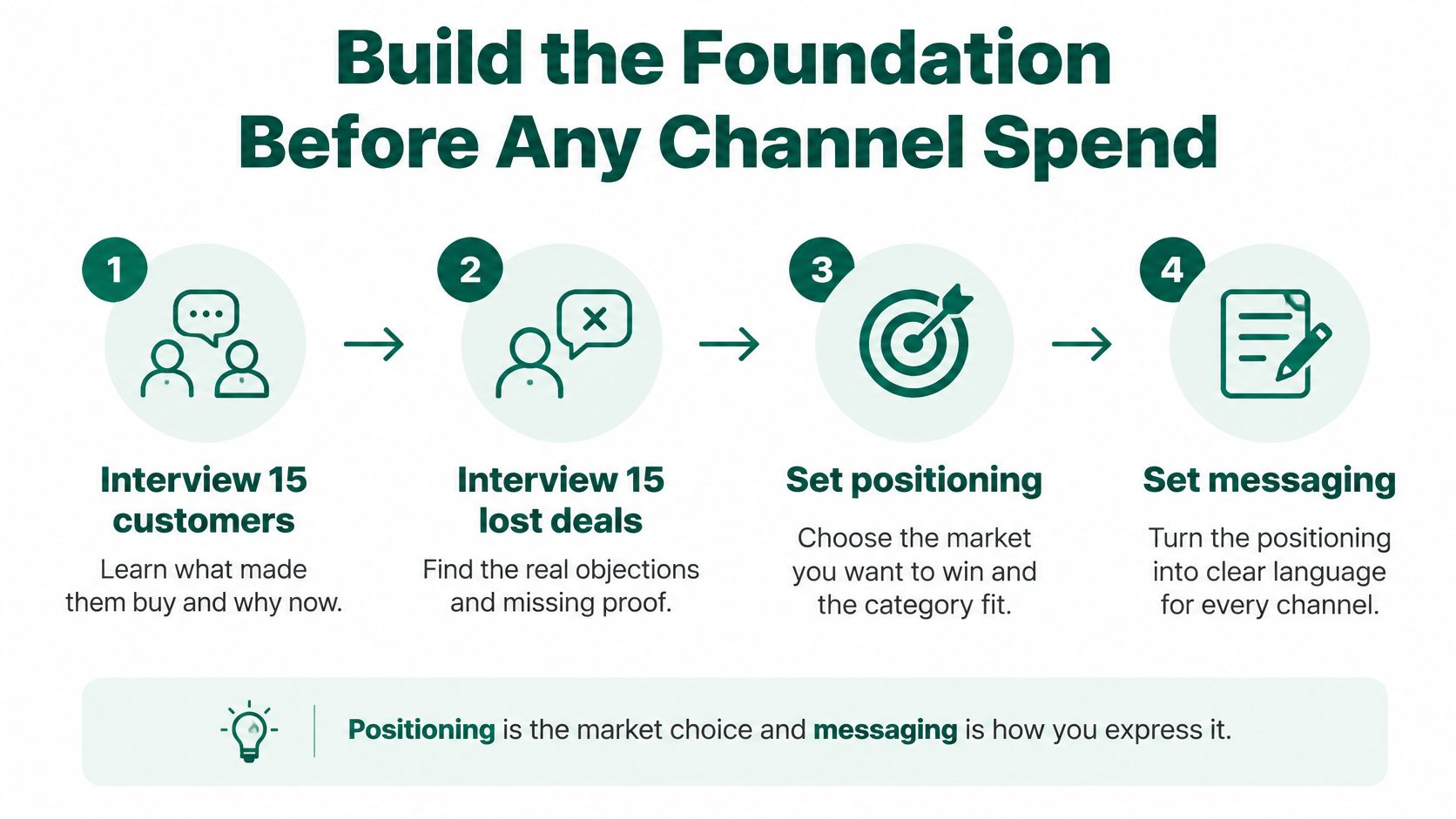
Interview 15 to 20 customers and lost prospects: Ask what they tried before you, what forced the change, and which words they use for the problem. Lost prospects matter as much as customers. They'll tell you which proof was missing and which claim sounded generic. Their vocabulary becomes your copy, not your product team's vocabulary.
Map the alternative they choose: It's often a spreadsheet, a manual process, or an internal build, not the named competitor on your battlecard. That alternative sets the bar. If your message only beats a rival tool, it will lose to doing nothing.
Write the positioning statement: Use this template. For [target segment] who [problem in the buyer's words], [product] is the [category] that [business change], unlike [status quo alternative]. A structured guide to writing a positioning statement that sales can repeat helps if your team keeps producing taglines instead of choices.
Build a messaging spine: Pick three pillars drawn from your strongest proof. Attach one specific proof point to each pillar. If a pillar has no proof, it's an aspiration. Cut it until you can support it.
Test it with five outsiders: Use people who match the ICP and don't work for you. Read the statement once and ask them to restate it. If they restate it wrongly, the statement is at fault, not the reader. Rewrite it.
Founders describe the product from the inside. Buyers judge it against their current workaround.
Say a team sells workflow software and leads with automation features. Buyers who reconcile data in spreadsheets don't wake up wanting automation. They want the month-end scramble gone. Same product, different entry point, completely different response rate.
Practical rule: If your positioning could sit on a competitor's homepage without anyone noticing, you haven't positioned anything.
Don't fund channels to distribute a statement five buyers can't repeat. Fix the sentence first.
Optimizing for marketing-qualified lead volume while most of the buying committee never sees your product is the most common GTM error in B2B SaaS. One engaged manager does not equal an account in motion.
The image below captures the shift from lead counts to account coverage that your team needs to make in its own reviews.

Score ICP fit on firmographic fit, a business trigger such as a funding round, new technical leader, or compliance deadline, problem severity, and buying complexity. Then map the committee. According to MaxIQ's compilation of sales statistics, complex B2B purchases involve an average of 13 internal stakeholders and nine external influencers, and 86% of B2B purchases stall during the process. A three-role threshold is therefore a floor, not a target.
| Role | What it needs | Evidence to supply |
|---|---|---|
| Champion | Internal case for change | Peer reference and a shareable business case |
| Economic buyer | Business outcome and payback | ROI model and cohort results |
| Technical evaluator | Fit, integration and security | Implementation path and security documentation |
| Procurement | Pricing structure and contract risk | Pricing model and risk controls |
| Legal | Data handling and liability terms | Compliance documentation and standard terms |
| Operational users | Daily workflow impact | Workflow walkthrough and onboarding path |
Role-specific content alone can backfire. If finance, IT, users, and executives each receive a disconnected value story, they argue about different purchases. Build one shared business case the champion can forward, then attach role evidence underneath it. Pre-contact confidence and buying-group consensus should be tracked like any other workstream, with named objections, shared decision criteria, and a plan for stalled deals.
This short walkthrough is useful background before you rebuild your account scoring.
Operate the model in the CRM. Associate every contact with an account-level opportunity, track buying-group coverage per account, and forecast an opportunity as qualified only after three or more relevant roles are reached. An ideal customer profile template built around accounts and roles gives you the fields to enforce this.
Measure account engagement by role, coverage, opportunity progression, stage velocity, win rate, and pipeline sourced or influenced. Put form fills last.
The trade-off is real. A narrow beachhead sharpens messaging and makes cycles predictable, but caps your early market. Accept the cap, and set a review date to retest the segment choice with evidence.
Buyers don't respect your org chart. They move between your website, search results, a sales call, email, and an event in the same week, and they expect the story to hold.
McKinsey's global B2B Pulse research found buyers used an average of 10 interaction channels during the purchasing journey in 2024, double the five channels reported in 2016, and 42% of respondents used more than 11 touchpoints. Treating channels as independent programs guarantees inconsistency at exactly the points where buyers compare notes.
Give each channel one job, one signal, and one start condition.
| Channel | Funnel role | Signal that it works | Start when |
|---|---|---|---|
| SEO and content | Discovery and category education | Non-branded entries from problem-based search terms | Positioning and core pages are live |
| Paid search | Capture active intent | Clicks from solution-level terms reaching demo or pricing pages | Landing pages match the messaging spine |
| Reach buying-group roles | Engaged accounts by role, not individual likes | Target account list and role messages exist | |
| Nurture and re-engagement | Asset consumption and replies by account | Lifecycle segments tied to ICP and stage | |
| Webinars and events | Evaluation and proof | Attendance from several roles at one account | Two proof-based sessions ready to repeat |
| Partnerships | Credibility and trusted introductions | Introductions into accounts that match the ICP | Partner shares your ICP and has reference customers |
SEO compounds slowly and keeps working after you publish. Paid search buys speed at a recurring cost and stops the day you pause it. Neither is better in the abstract. The right choice depends on how long you can wait for a signal and whether your landing pages can convert the intent you're buying.
If you're evaluating outside help for search specifically, AY Rank's roundup of b2b saas seo agency options is a useful comparison point. Judge any partner by whether they'll work from your positioning and account list, not by promised traffic.
LinkedIn deserves the same discipline. Likes from individual practitioners feel good and predict nothing. Several roles from one target account engaging with proof content predicts a conversation. A practical breakdown of choosing the right B2B channel mix for growth will help you assign those roles before budget is split by habit.
If a channel has no defined funnel role, it's not a strategy. It's a recurring expense with a dashboard.
Cut any channel you can't tie to one row above. You'll lose activity. You won't lose pipeline.
A pilot launched this quarter won't show closed revenue for months. Judge it on closed deals in its first weeks and you'll kill working programs and keep broken ones that happened to inherit old pipeline.
The signal you need sits upstream of sales. MarketSplash's compilation of sales statistics reports buyers contact sellers roughly 61% of the way through the journey, 94% of buying groups have ranked their shortlist before the first conversation, and reported B2B buying cycles average about 10.1 months. By the time a rep gets involved, most of your GTM work has already succeeded or failed.
| KPI | What it shows | Review cadence |
|---|---|---|
| Target-account reach | Share of ICP accounts with at least one engaged role | Monthly |
| Engaged-account rate | Accounts with two or more role touchpoints in 30 days | Monthly |
| Qualified-opportunity rate | Engaged accounts that become sales-accepted opportunities | Monthly |
| Pipeline per account | Pipeline value per target account, by cohort | Quarterly |
| Sales-cycle length | Days from opportunity creation to close, by segment | Quarterly |
| Win rate | Won deals as a share of decided opportunities, by cohort | Quarterly |
| CAC payback | Months to recover acquisition cost from gross margin | Quarterly |
Three operating rules come before any dashboard.
Marketing and sales must also agree on the fit-and-intent threshold that routes an account to a rep. Without that agreement, attribution debates are just qualification debates in disguise. This guide to measuring marketing ROI without mixing sourced and influenced pipeline sets out the reporting separation in detail.
Judge early cohorts on engagement and qualification rates. Win rate and CAC payback become meaningful only after a cohort has aged through a full sales cycle.
Set that review date when the cohort starts, not when someone gets impatient in week six. Route only accounts meeting your explicit thresholds to sales, and let the rest keep consuming proof until they do.
A 90-day plan isn't a calendar of campaigns. It's a sequence of gates with dates attached so nobody drifts.
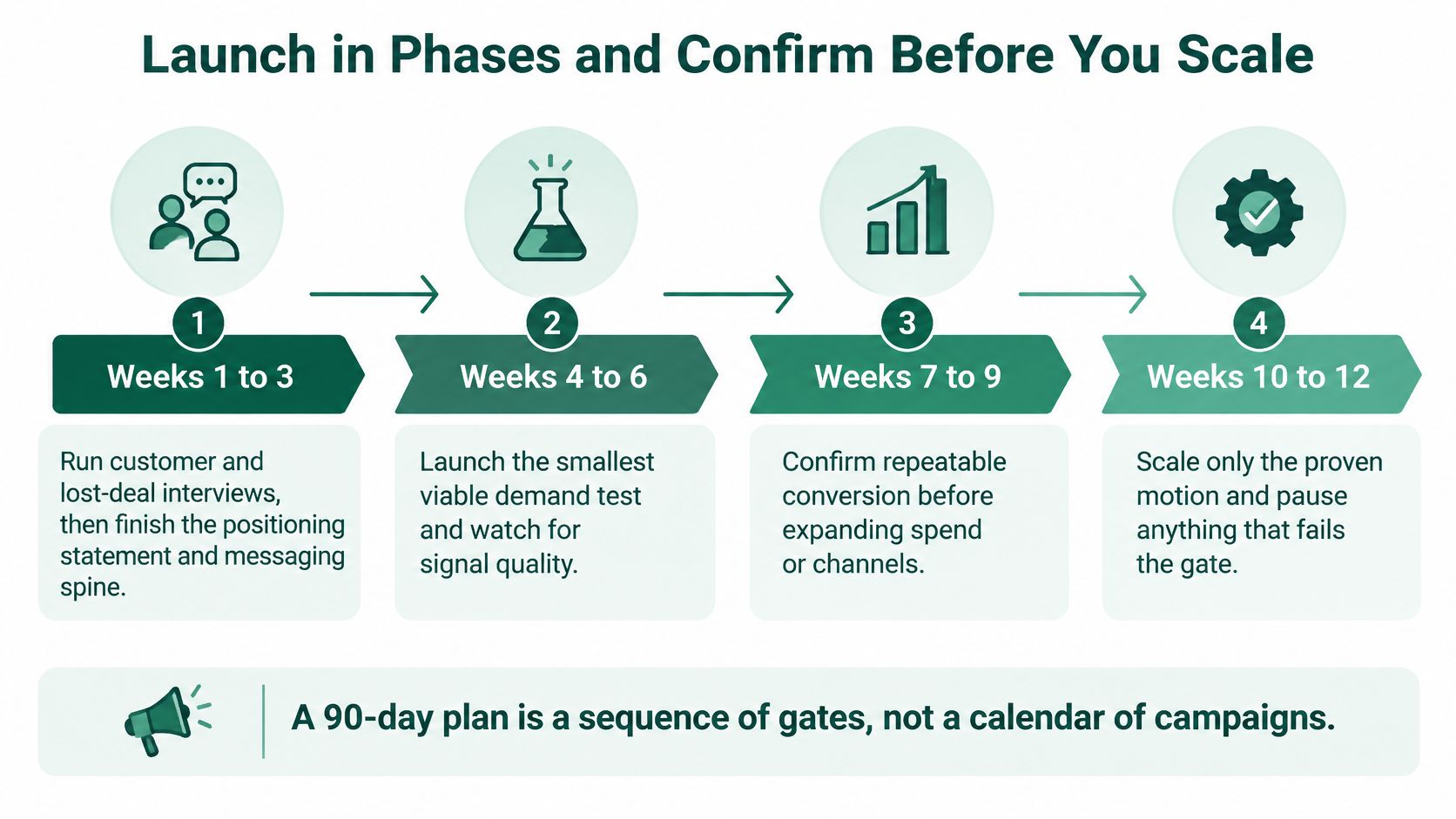
Weeks 1 to 3, foundation: Run customer and lost-deal interviews. Finish the positioning statement and messaging spine. This phase ends when five outside readers restate the positioning correctly, not when the internal deck is approved.
Weeks 4 to 6, segment and assets: Define the beachhead segment, build the buying-group map for target accounts, and produce comparison, proof, and ROI assets. This ends when the top questions from first sales calls are answered on your site. A product launch timeline template with phase gates helps you hold owners to those end conditions.
Weeks 7 to 9, two-channel pilots: Pick two channels only, each matched to one funnel role, with landing pages that use the new messaging. After the basics are in place, we start executing pilots on key B2B channels and can help clients hire resources to grow faster, but hiring for scale belongs after a pilot proves a channel, not before.
Weeks 10 to 12, decide: Review the KPI stack by cohort. Scale the working channel, fix the failing gate, or narrow the segment. Those are the only three outcomes. "Run it longer and hope" isn't one of them.
Say a workflow-automation vendor has strong retention and no repeatable pipeline. Weeks 1 to 3 interviews show buyers compare the product to spreadsheets, not to a rival tool. Positioning shifts from automation platform to replacing manual reconciliation.
By weeks 10 to 12, LinkedIn aimed at finance leads is improving engaged-account rate, so it gets scaled. Paid search is cut because its landing pages still carry the old platform wording. The channel didn't fail on its own terms. It failed the gate that should have blocked its launch.
That's the point of sequencing a GTM strategy for B2B this way. Failures tell you which gate to fix instead of giving you another vague argument about lead quality.
Before approving new spend, run five questions. Each maps to a gate. Any "no" closes that gate until it's fixed.
This audit takes a few days, not a quarter. It produces a short fix list ordered by stage, which is the order that matters. Fixing attribution before positioning just gives you precise reporting on the wrong message.
Most teams don't need more campaigns. They need fewer, better-sequenced decisions.
Where the gaps are wide, start with the work that comes first in the sequence. Our listed services include B2B Strategy, B2B Positioning, B2B Messaging and B2B Website work, and our B2B growth services cover LinkedIn, Google Ads, email marketing and events. The order in that list is deliberate. Strategy, positioning, and the website have to hold before channel spend on LinkedIn or Google Ads can produce pipeline worth forecasting.
Treat a strategic growth partner the same way you'd treat any senior hire. The value isn't campaign volume. It's sharper positioning, a defined buying group, and measurement rules that tell you whether pipeline is real, so decisions get faster and wasted growth motion stops earlier.
Don't wait for a planning cycle to start. Book the customer and lost-deal interviews this week, draft the positioning statement from what buyers said, and test it on five people outside the company. That single sentence, once it survives contact with real buyers, determines whether every dollar after it works or leaks.
If your audit surfaces a positioning, buying-group, or measurement gap you can't close internally, Big Moves Marketing works as a strategic growth partner for B2B SaaS teams, starting with positioning and messaging before any channel pilots. Visit Big Moves Marketing to see how that sequencing would apply to your next launch or segment expansion.