%20png%20copy.avif)
Writing a positioning statement isn’t some fluffy marketing exercise. It’s the process of defining exactly who your target business is, what market category you operate in, the specific problem you solve, and what makes your solution uniquely qualified to solve it.
Think of it as a concise, internal declaration that gets your entire B2B company—from marketing and sales to product development—pointed in the same direction. It’s your north star.
In the ridiculously crowded B2B world, a great product just isn't enough anymore. You can have the most powerful software on the planet, but without sharp positioning, it will get lost in the noise. This isn't just about coming up with a clever tagline; it's about building the very foundation of your growth engine.
A powerful positioning statement acts as your company’s internal compass. It makes sure every team is marching in the same direction, speaking the same language, and working toward a unified vision.
When your positioning is fuzzy, the consequences are severe and you can absolutely measure them. It creates friction across the whole business, which stalls growth and burns through cash. Sales teams fight an uphill battle trying to explain a product that lacks a clear identity, while marketing campaigns just fail to connect with the right businesses.
This isn’t just theory. We’ve seen the research—weak positioning directly tanks key business metrics. Companies with an unclear market position consistently see underperforming marketing results, a ton of waste in their sales pipeline, and shockingly low sales productivity. The effects ripple out, making it a struggle to stay profitable as the product roadmap gets scattered and reactive.
Your positioning statement is the bedrock of your go-to-market strategy. It’s the essential tool for carving out a defensible niche, especially when you're going up against established incumbents or trying to create a new category from scratch.
Getting this right means you have to move past abstract ideas and get concrete. A crisp statement gives you the clarity to make strategic decisions with confidence. It answers the fundamental questions that every prospect, investor, and new hire will ask: Who is this for? What problem does it really solve? And why is it better than the alternatives they're already considering?
Ultimately, strong positioning is more than a ‘nice-to-have’—it’s a requirement for survival and success. It transforms your go-to-market efforts from a series of disconnected tactics into a focused, coherent strategy that actually drives revenue. For a deeper dive into this, check out our guide on strategic B2B SaaS positioning.
With this foundation in place, you equip your entire organization to win more deals, build a fiercely loyal customer base, and establish a market advantage that lasts.
Turning the fuzzy concept of "positioning" into a sharp, effective statement isn't about guesswork. It’s about having the right ingredients. I've found it boils down to six core components. Think of them less as a rigid formula and more as the raw materials you need to build a message that actually resonates with B2B buyers.
Getting each of these right forces you to answer the tough questions about your business, ensuring you have a solid foundation before you even start writing.
This is, without a doubt, the most important piece of the puzzle. And no, "small businesses" is not an answer. You need to define your Ideal Customer Profile (ICP) with razor-sharp precision.
Who are you really building this for? What's their job title? What's the company size, the industry, the tech they're already using?
For example, a compliance automation tool isn't just for "fintech companies." A strong ICP is something like, "Series A to C fintech startups in North America with 50-250 employees who don't have a dedicated in-house compliance team." You can't hit a target you can't see, and this is where creating compelling buyer personas moves from a "nice-to-have" marketing exercise to a critical business tool.
You have to plant a flag and declare the market you play in. This gives customers a mental shortcut, a box to put you in so they can start to understand what you do. Are you a "Revenue Intelligence Platform," a "Contract Lifecycle Management Tool," or a "Customer Data Platform"?
This isn't a passive decision; it's a strategic one. You can choose to fit neatly into an established category to draw on existing demand, or if you're truly introducing a new way of doing things, you might need to create a new category altogether.
Here’s a hard truth: B2B customers don't buy software; they buy solutions to expensive, annoying, or risky problems. Your job is to articulate that pain point with painful clarity.
A great problem statement doesn't just describe the issue; it highlights the negative consequences of leaving it unsolved. For instance: "Our operations team wastes over 20 hours a month on manual compliance reporting, leading to costly errors and audit risks."
When you fail to clearly define the problem—and all these other elements—it shows up in the numbers. It’s not just a messaging issue; it’s a business issue.
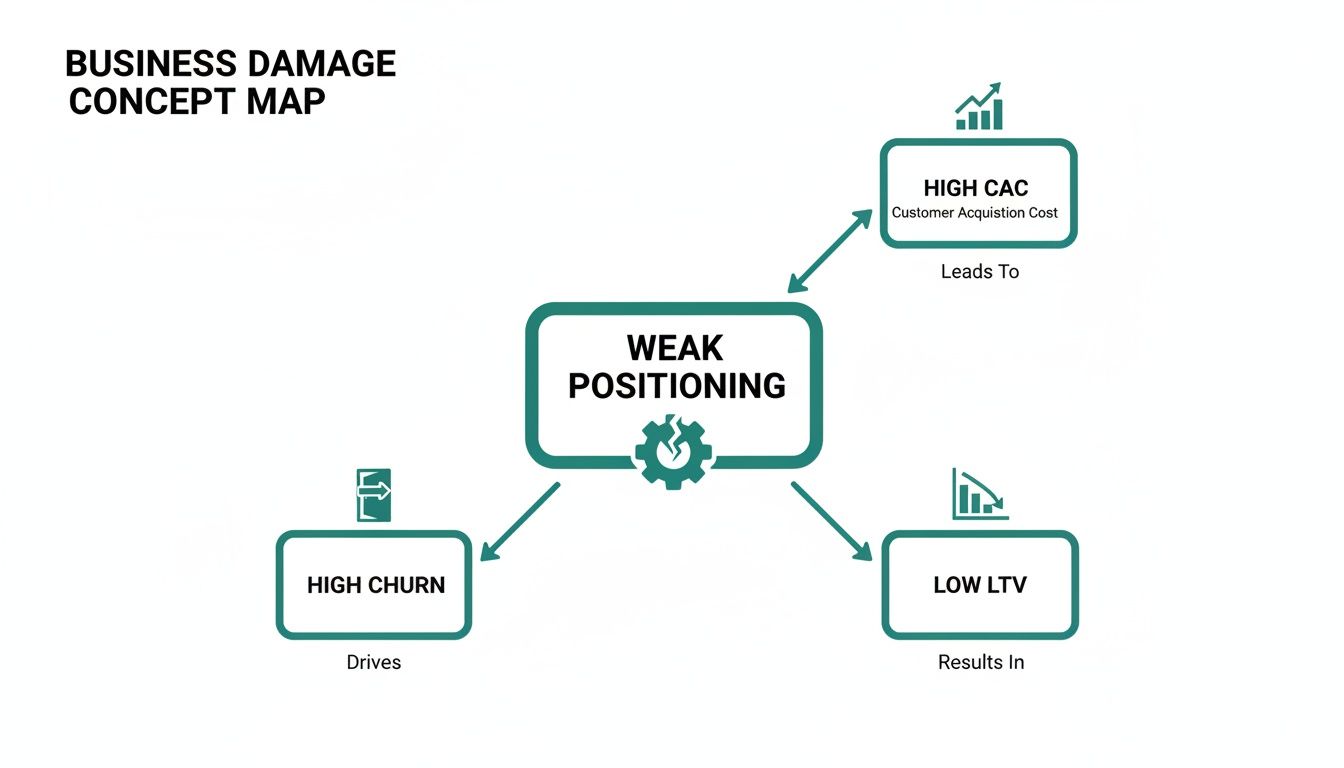
As you can see, weak positioning isn't just a marketing problem. It directly fuels high customer acquisition costs, tanks your lifetime value, and leads to churn. It's a leaky bucket that no amount of ad spend can fix.
To help you get started, here is a summary of the six building blocks we are discussing. This table breaks down what each component defines and the central question you need to answer for each.
This framework ensures you're building your positioning on a solid, well-defined foundation, not just catchy slogans.
Now for the million-dollar question: What’s the one thing you do better than anyone else for your specific customer? Generic claims like "easy to use" or "great customer support" are table stakes—they won't win you any deals. You need a specific, provable, and meaningful advantage.
Your differentiator is your unique promise. It’s the reason a customer should choose you over the established incumbent or a scrappy new competitor. It must be something your specific ICP cares deeply about.
Maybe it's your proprietary AI model that automates a task no one else can touch. Or perhaps it's an exclusive integration with a mission-critical platform in your industry. Whatever it is, it must be defensible.
Bold claims are cheap. In the B2B world, where buyers are naturally skeptical and have their jobs on the line, proof is everything. Your proof points are the reasons they should believe your unique differentiator.
You can deliver proof in several forms:
Finally, who are you? Your brand's character needs to come through in your positioning. Are you the authoritative expert, the friendly and helpful guide, or the rebellious innovator challenging the status quo?
This personality will shape the tone and voice of your positioning statement and every piece of marketing and sales material that follows. It's the thread that ties everything together. To see how personality connects to your core value, this effective value proposition canvas example for growth is a great resource.
Right, you've done the hard work of digging into the six core elements of your positioning. Now it’s time to actually put them together. This is the moment where all those abstract ideas—your ideal customer, the category you play in, the problem you solve, and your proof—get molded into a sharp, powerful message that your whole company can rally behind.
The goal here isn't just to fill in some blanks on a template. It's about forging a statement that carries real weight and drives action.
A solid framework is the best place to start. It brings a necessary discipline to the process and forces you to be incredibly concise, making sure every single word earns its spot. It's the skeleton you'll build your message on.

Think of this template as your training wheels, not the finished product. It’s a battle-tested structure that makes sure you hit all the critical notes in a logical order.
Here’s the basic framework:
For [Target Customer] who [Struggles with X Problem], our [Product Name] is a [Market Category] that [Provides This Unique Value]. Unlike [Top Competitor], we [Offer This Key Differentiator], as demonstrated by [Proof Point].
This structure is so effective because it starts in the customer's world, connects to your solution, and then immediately proves why you're the better choice. It forces you to get specific and back up every claim you make.
Let's make this real. Imagine we're crafting a statement for "ComplyNow," a fictional SaaS company that offers compliance automation for fintech startups.
Here's how we'd plug in our building blocks from the previous sections:
Now, let’s assemble it:
"For Series A to C fintech startups who struggle with the overwhelming burden of manual compliance reporting, ComplyNow is a Compliance Automation Platform that streamlines regulatory tasks to save time and eliminate audit risk. Unlike relying on spreadsheets and consultants, we offer turnkey integrations with their existing financial stack, as demonstrated by our ability to reduce reporting time by 90%."
See how that works? It’s specific, customer-focused, and pins down the value immediately. This statement becomes the internal North Star for ComplyNow’s marketing, sales, and product teams. It’s a powerful tool for getting everyone aligned.
And while this statement is the core, you can see how it expands into your entire GTM strategy by checking out other messaging framework examples.
The template is a fantastic starting point, but you don't want your final statement to sound like it came off an assembly line. The real magic happens when you refine the language to match your brand's unique voice.
Once you have that first draft, start playing with it. Rephrase it in a more conversational, natural tone. The core components need to stay, but you can adjust the delivery.
Here are a few different angles to experiment with:
The key is to use the framework to get your logic straight, then iterate on the words until the statement feels authentic and powerful. The final version shouldn't just define your position—it should inspire real confidence and action.
Frameworks and templates are a great start, but the real magic happens when you see how market leaders put these ideas to work. It’s one thing to talk theory; it’s another to see it in the wild.
Let’s move past the abstract and get our hands dirty by deconstructing how two masters of the craft, Gong and Notion, carved out dominant positions in challenging markets. This isn't just about admiring their taglines. We're going to reverse-engineer their success using the same six building blocks we’ve been discussing.
Gong didn't just join an existing market—they created a new one: Revenue Intelligence. This wasn't an accident. It was a brilliant positioning move that allowed them to define the rules of the game and sidestep the noise of being just another “sales tool.”
Let's pull their strategy apart:
Gong’s entire message is about turning sales from a mystical art form into a predictable science. They aren't selling software that records calls; they're selling certainty. They're selling a direct path to predictable revenue growth.
The most powerful positioning doesn’t just describe a product; it reframes an entire problem. Gong reframed the issue from "how do we track sales activity?" to "how do we unlock the reality of what drives revenue?"
Notion waded into a different kind of battle. The world was already overflowing with established tools for project management, note-taking, and internal wikis. Their path to victory was built on a bold differentiator: unifying all of those functions into one place.
Here’s a look at their positioning components:
Notion's success is one of many powerful differentiation strategy examples you can learn from. Instead of trying to out-feature a single competitor like Evernote or Asana, they redefined the entire category. They built a tool that could replace multiple competitors at once, selling not just features, but freedom and consolidation.
Knowing the steps to write a positioning statement is only half the battle. Just as critical is knowing what not to do. I’ve seen countless promising B2B SaaS companies craft messages that sound incredible on a whiteboard but fall completely flat with actual customers.
These mistakes dilute your impact and make it nearly impossible to stand out. Based on my work with dozens of startups, a few common traps show up again and again. Steering clear of them is the key to creating a statement that's sharp, believable, and built to last.
This is, without a doubt, the most common mistake: writing a statement that’s far too broad. When you try to appeal to the entire market, you end up connecting with no one.
A vague target audience like "for all businesses" is a massive red flag. It tells me you haven't done the hard work of defining your Ideal Customer Profile.
The second version isn't just more specific; it starts an entirely different conversation. It speaks directly to a customer with a well-defined set of problems, making your solution instantly relevant.
Your customers don't buy your AI-powered algorithm or your slick user interface. They buy what those features do for them.
They're purchasing a better business outcome—less risk, more revenue, or time they can get back in their day. A feature-obsessed statement reads like an engineering spec sheet, not a solution to a painful, expensive business problem.
Always translate your features into your customer's most desired results. That's the language that gets budgets approved.
The strongest positioning statements aren't about what your product is. They are about what your product makes possible for the customer.
In B2B, trust is everything. Grand, empty claims like "we're the best" or "the leading solution" without immediate, credible proof are a surefire way to lose a skeptical buyer. They've heard it all before.
Every bold assertion you make has to be anchored to a believable reason why.
This simple shift from claiming to proving transforms your message from marketing fluff into a compelling fact. It gives your sales team the ammunition they need and gives your buyer the confidence to take the next step.
You’ve done the hard work. You have a new positioning statement that’s sharp, clear, and genuinely inspiring. But if it just sits in a shared drive or on a forgotten presentation slide, it's completely worthless.
The final, and frankly most crucial, step is to translate that powerful internal declaration into every single customer-facing action your business takes. This is where your hard work stops being a theory and starts generating revenue.
Think of your positioning statement not as a one-and-done project, but as the central hub for your entire go-to-market plan. It’s the source code for your messaging, dictating the language on your website, the story in your sales decks, and the angles of your ad campaigns. Without this central guide, your efforts will feel scattered and never build the momentum you need.
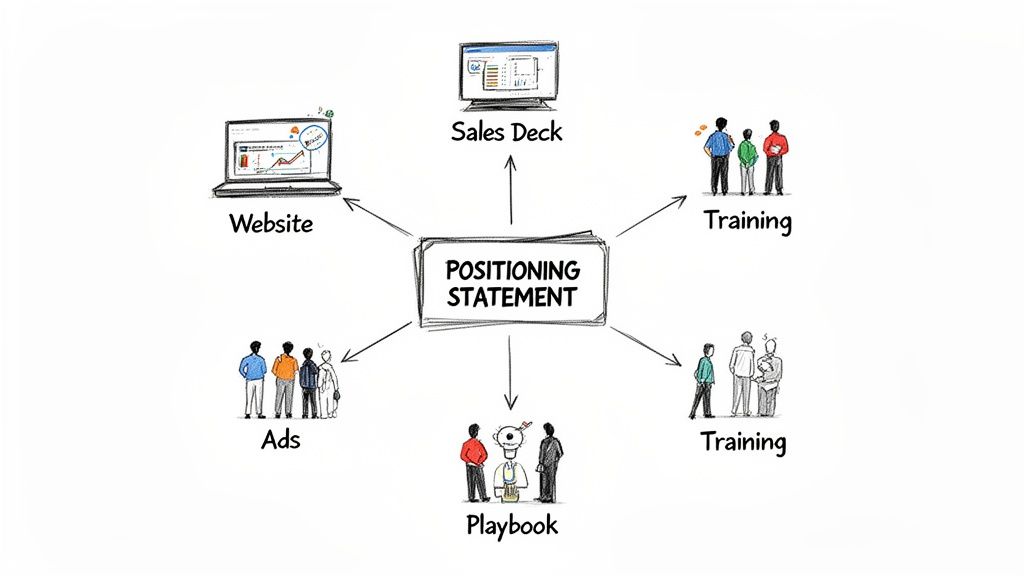
The real goal here is to weave your positioning into the very fabric of your organization. Every single team member, from sales reps to customer support agents, should be able to understand and articulate your core message on instinct. This is how you create a consistent and compelling experience for prospects at every single touchpoint.
Here’s how to put it into action, practically speaking:
To make sure this consistency holds up as you scale, you need a messaging playbook. This is an internal document that becomes the single source of truth for how your company talks about itself. It should include your official positioning statement, the key messages that stem from it, and clear answers to common customer questions and objections.
A critical part of this is knowing how to build a robust sales pipeline, which is nearly impossible without the clear ideal customer profile your positioning provides. This playbook gives your sales team the exact language they need to find and engage those ideal customers effectively.
The benefits of this disciplined approach are real and measurable. Strong positioning translates directly into better business outcomes—think higher ROI on your marketing spend and a steady stream of better-quality leads. Sales cycles get shorter, win rates go up, and you’ll often find you can command premium pricing without blinking.
The true return on great positioning isn't just a better message; it's a more efficient business. You'll see shorter sales cycles, higher close rates, and customers who don't just buy from you—they advocate for you.
This strategic alignment is the final piece of the puzzle. By operationalizing your statement, you transform it from a simple sentence into a powerful engine for growth. To see how all these pieces fit together, explore our complete guide on building a go-to-market strategy for B2B SaaS.
Explore Big Moves Marketing services and resources:





%20-%20white.svg)