%20png%20copy.avif)
Most B2B SaaS companies don't hire a Google Ads agency because they're ready. They hire one because paid search feels measurable, fast, and easier to outsource than fixing the harder problem. The harder problem is usually weak positioning, loose ICP definition, or an offer that doesn't survive first contact with real buying intent.
That's why so many teams conclude that Google Ads "doesn't work" when what failed was message to market fit inside the funnel. A Google Ads account can only amplify the demand that already exists. It can't rescue a category-confused homepage, vague differentiation, or a demo CTA aimed at everyone and persuasive to no one.
Founders and revenue leaders need to get more disciplined. The question isn't, "Do we need help running ads?" The question is, "Will a specialist increase pipeline efficiency, or will they just make our current confusion more expensive?" If your search program is being asked to compensate for bad GTM fundamentals, you'll burn budget with more sophistication, not get better outcomes.
That distinction matters because Google is still the center of search intent capture. Google holds about 89.73% of the global search engine market, and Google Ads has been operating since 2000 when it launched as AdWords. In 2024, Google advertising revenue reached $264.59 billion, up from $237.86 billion in 2023, which tells you how large and durable this ecosystem is (Google Ads market data). The channel is massive. Your readiness to use it well is a separate issue.
If you want a cleaner filter for paid acquisition readiness, start with the same foundations I'd use before any channel pilot: ICP clarity, offer strength, conversion path, and sales follow-up. If those are shaky, fix them before you add media management. If you need a practical lead generation baseline first, Big Moves Marketing has a useful piece on how B2B teams generate leads without wasting motion.
The most popular advice on this topic is wrong. It tells you to hire a Google Ads agency when you lack time or expertise. That's incomplete. Plenty of companies have neither and still shouldn't hire one yet.
The gating factor is whether your commercial system can convert intent into revenue. Search is not demand creation in the way category education, outbound, partnerships, or founder-led evangelism can be. Search captures demand that already exists. If buyers are searching and your positioning is clear, Google Ads can become an efficient growth layer. If buyers are confused by your offer, you pay to expose that confusion faster.
Across early-stage and growth-stage B2B tech, the pattern is predictable:
A Google Ads agency can't fix those issues by tweaking bids.
Practical rule: Don't outsource a channel to solve a strategy problem.
A capable Google Ads agency creates more power when the business already knows who it wants, what problem it solves, and what a qualified next step looks like. Then the agency can structure campaigns around real intent, align landing pages to high-value use cases, and feed cleaner demand into the pipeline.
If that clarity doesn't exist, you're better off slowing down. Tighten the narrative. Narrow the audience. Audit the website. Define what sales will accept. Then decide whether paid search deserves budget.
That's the lens I use with founders. Not "Can someone manage this?" but "Will specialist management multiply signal, or just increase spend on noise?"
A good Google Ads agency is not a button-pushing vendor. For B2B tech, it's an intent capture system. Its job is to translate high-intent searches into qualified pipeline through structure, tracking, landing page alignment, and disciplined bidding.
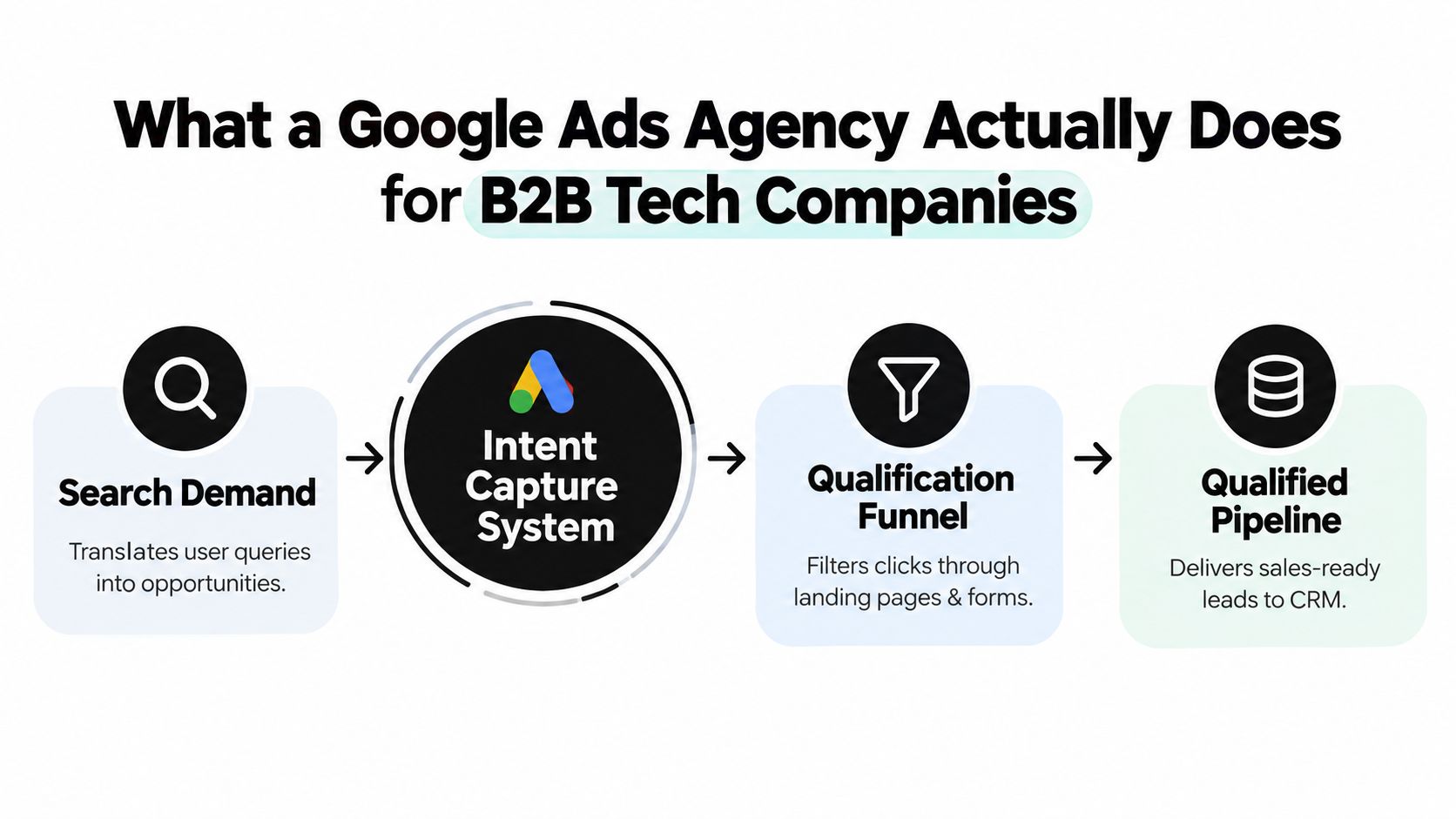
This is the first thing many teams blur. Outbound creates conversations. Content shapes preference over time. Search sits closer to existing demand. Someone already has a problem, already has language for it, and is actively looking for an answer.
That means the agency's job isn't broad awareness theater. It's narrower and more operational. It has to decide which queries deserve money, which clicks are likely to become opportunities, and which paths on the site can convert commercial intent without adding friction.
In a healthy B2B SaaS setup, the agency usually owns five core disciplines:
Google itself has become automation-led, and that's changed the agency role. Strategy now matters more than manual tinkering. In a 2026 benchmark built from 13,474 US search campaigns, average cost per lead fell 4.88% year over year to $66.69, while CPC rose 3.04% and conversion rate improved 8.78%. In another 2026 optimization dataset across 94 accounts and $3.01M in spend, Maximize Conversion Value delivered 6.44x ROAS versus 1.96x for Maximize Conversions (Google Ads automation and bidding recap). The implication is obvious. The advantage isn't access to the platform. It's feeding the platform better strategy and better value signals.
A Google Ads agency should improve decision quality, not just account activity.
Many engagements fail. The client still owns positioning, offer credibility, sales process quality, and what counts as a real lead. Agencies can help pressure-test those things, but they can't manufacture them.
If you're evaluating whether your team is ready for channel execution, this B2B SaaS Google Ads campaign checklist is a better starting point than another agency pitch page.
Founders often evaluate a Google Ads agency as a labor purchase. That's the wrong frame. You're buying a mix of judgment, system design, measurement discipline, and ongoing prioritization. The useful question is whether those services improve pipeline economics enough to justify the fee structure.
For B2B SaaS, the highest-value agency work usually sits in these areas:
A serious agency doesn't dump all search into one campaign and call it optimization. It separates low-intent exploration from high-intent solution searches. It treats branded terms differently from non-brand terms. It recognizes that competitor traffic can be strategically useful but commercially noisy.
That matters because B2B search benchmarks are unforgiving. One 2026 benchmark set reported managed B2B accounts at about 1.30% search CTR and only 0.31% conversion rate, with account conversion-rate ranges of 0.05% to 0.70% (B2B Google Ads benchmarks). When the baseline is that low, sloppy segmentation gets expensive fast.
If an agency can't connect ad clicks to CRM stages, it's operating half-blind. In B2B, a lead is not the outcome. Revenue teams care about accepted leads, opportunities, and pipeline quality.
This is why strong operators push beyond platform conversions. They want to know which campaign themes generate meetings that progress, not just forms that fire.
Many advertisers either ignore Quality Score or obsess over it incorrectly. Google says Quality Score is a keyword-level diagnostic on a 1 to 10 scale, not a KPI and not an auction input. It's based on expected clickthrough rate, ad relevance, and landing page experience (Quality Score explanation).
Even so, relevance work has clear economic consequences. One 2026 benchmark set showed a QS 8 account paying about 37% less CPC than a QS 5 baseline, while QS 4 paid about 25% more and QS 10 could reach roughly a 50% discount (Quality Score and CPC benchmarks). Better relevance doesn't just improve aesthetics. It lowers acquisition cost.
Fees shape behavior. That's why founders should look at the pricing model with as much scrutiny as the agency's deck.
| Pricing Model | How It Works | Best Fit | Watch Out For |
|---|---|---|---|
| Retainer | Fixed monthly fee for management and strategic oversight | Teams that want predictable spend and stable scopes | Agencies may protect margin by limiting iteration if scope isn't explicit |
| Percent of spend | Fee rises with ad budget, often in a defined range | Companies scaling spend where account complexity rises with volume | Incentives can tilt toward spending more, not necessarily improving efficiency |
| Hybrid | Base retainer plus spend-based component or project layer | B2B teams needing strategy, reporting, and changing execution intensity | Contracts get messy if ownership of landing pages, tracking, or creative isn't clear |
A practical budget issue gets ignored in most buying guides. Typical retainers often run about $1,500 to $5,000 per month or 10 to 20% of ad spend, which can make management fees a large share of total budget for smaller advertisers. The same source notes that in a study of 251,236 reports from 15,666 accounts, 29% generated zero conversions over a 90-day period, only 12% reached a Quality Score of 8+, and just 3% qualified as elite performers (agency economics and account performance data). That's the uncomfortable part. You can pay for management and still own an account that never gets economic traction.
If you need help thinking through leadership cost versus channel management cost, this breakdown of fractional CMO pricing is more useful than generic "marketing budget" advice.
Some companies don't need a fractional CMO. They need a specialist team that can take over paid acquisition mechanics cleanly, especially when internal bandwidth is thin and search is already a proven motion.
PPC Geeks fits that profile when the primary problem is channel execution, account stewardship, and spend efficiency across PPC platforms. Their Google Ads agency offering is built around specialist PPC management rather than broad brand strategy. That matters if your buyer journey is already reasonably clear and you need tighter campaign control, better conversion tracking, and more responsive optimization.
PPC Geeks appears well suited when your business needs:
If your category positioning is muddy, founder-led sales is still teaching you who the buyer is, or the website can't explain the product clearly, don't expect any PPC specialist to solve that upstream confusion. In that situation, channel management comes second.
That's the key distinction. Full-service PPC help is valuable when your strategy is established and your issue is execution quality. It is less useful when your core GTM narrative still needs senior-level commercial direction.
The wrong operating model can cost more than the wrong channel. I see this constantly. A founder hires a full-service agency because it feels like progress, when the company needs strategic triage. Or a team hires a freelancer to keep costs low, then discovers nobody owns the system around the ads.
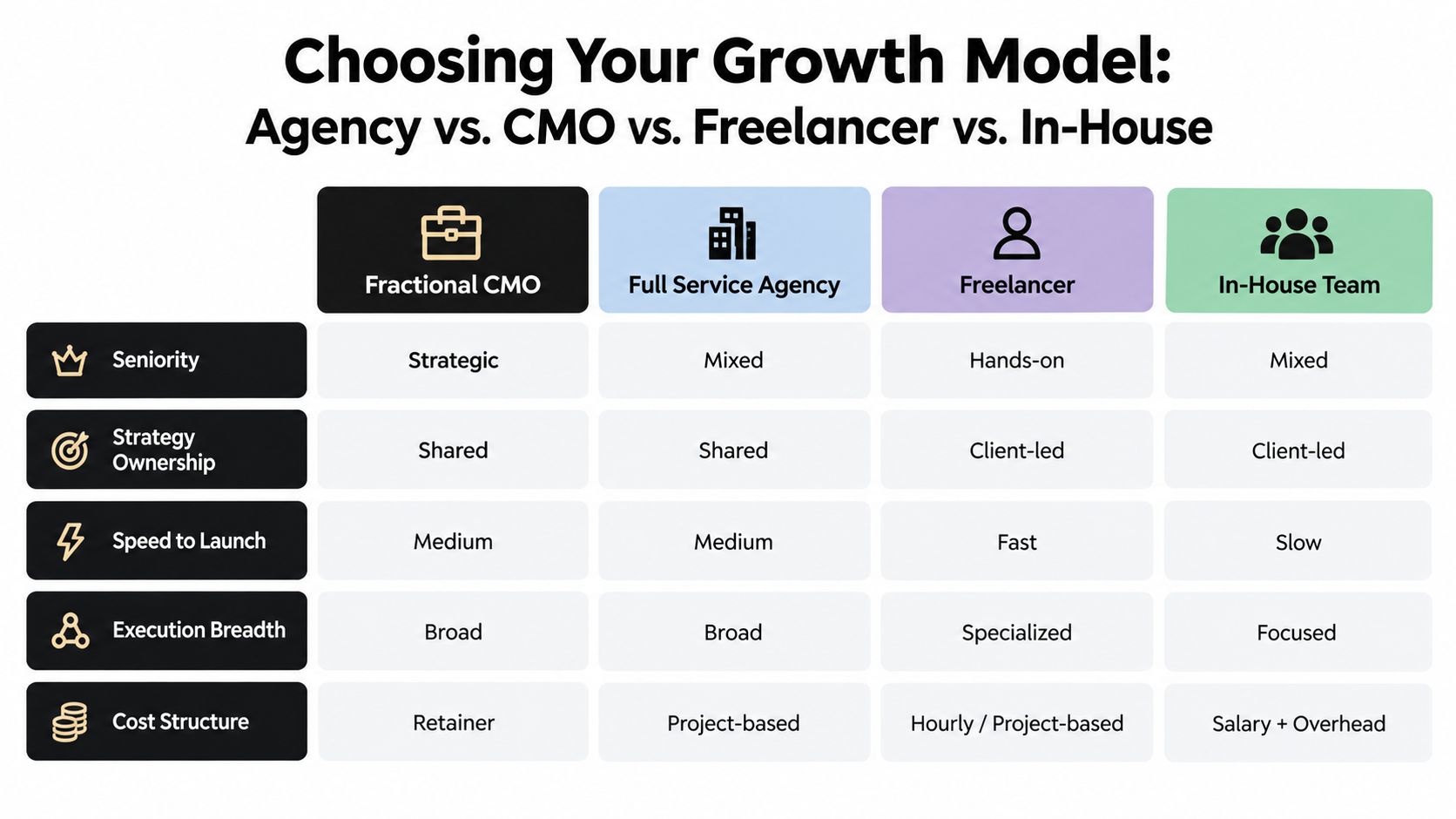
If you're pre-PMF, early post-PMF, or still founder-led in sales, a fractional CMO often creates more value than a Google Ads agency. Why? Because the bottleneck usually isn't media buying. It's message clarity, funnel design, offer packaging, and channel prioritization.
A senior operator can decide whether paid search should even be in the mix right now. That's a better use of money than paying for tactical execution before the company knows what it's scaling. For companies in that stage, fractional CMO support is often the cleaner first hire because it fixes the commercial logic behind channel decisions.
A full-service agency is useful when you already know:
At that point, specialization helps. Agencies can bring process, testing cadence, creative support, reporting layers, and platform fluency faster than most internal teams can build.
Hire a Google Ads agency to scale a working motion, not to discover one from scratch.
Freelancers work when the problem is bounded. Maybe you need campaign cleanup, a tracking audit, or a temporary operator to maintain an account while you recruit internally. That can be efficient.
It breaks when the role expands into strategy, landing page direction, CRM definitions, sales coordination, and executive reporting. Most freelancers aren't scoped for that, and they shouldn't be expected to absorb it.
In-house makes sense when paid acquisition is material enough to require daily proximity to product, sales, and revenue operations. That's usually later than companies think. Until volume and complexity justify a dedicated owner, in-house can become an expensive placeholder.
The rule is simple. If your main uncertainty is strategic, start with senior guidance. If your main uncertainty is execution, use a specialist. If the scope is temporary, use a freelancer. If search is now permanent infrastructure, build in-house.
Most agency selection processes are too soft. Teams ask for case studies, platform badges, and pricing. They should be asking how the agency thinks about intent, signal quality, and commercial accountability.
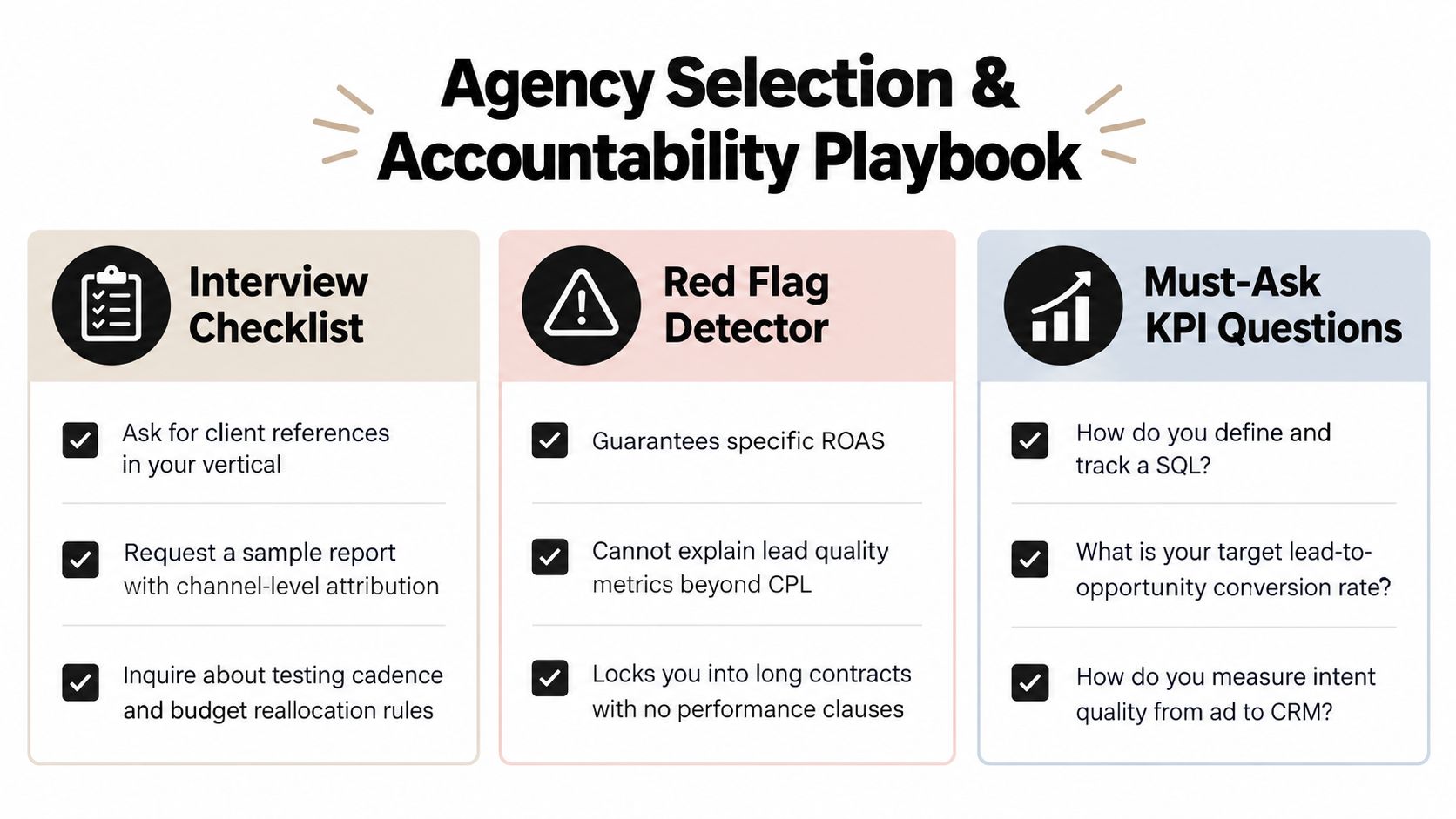
A weak agency can still sound polished. The interview has to force specifics.
Ask questions like:
One useful benchmark for the bigger market context is channel maturity. Global search advertising was estimated at $190.5 billion in 2024 and projected to reach about $218.3 billion in 2026, with forecasts extending to $261 billion by 2028 and $483.50 billion by 2029 in some market estimates. One 2026 industry report also found Google Ads held 98% adoption among surveyed professionals (search advertising market and adoption data). That tells you the edge isn't access. It's operating quality.
CTR matters, but it doesn't deserve executive attention by itself. B2B SaaS teams should review:
Recent benchmark data also shows that some B2B search segments are stronger than broad averages. One 2026 benchmark set reported B2B SaaS non-brand Search at a 3.94% conversion rate with a $13.75 CPC and about $207 per lead (B2B SaaS non-brand search benchmarks). Another 2026 benchmark set for B2B services reported a 4.85% conversion rate and a $93.69 cost per lead (B2B services Google Ads benchmarks). Those numbers matter because they show viable economics often come from focused search intent, not broad traffic.
If an agency reports CTR, CPC, and impressions but can't tell you what became pipeline, they're managing ads, not growth.
A realistic B2B SaaS timeline is not instant scale. First comes tracking validation. Then query learning. Then landing page and offer refinement. Then bid strategy adaptation once enough meaningful conversion data exists.
I usually look for a sequence like this:
If you want a practical filter for evaluating agencies through a B2B lens, this piece on what a B2B agency should actually be accountable for is worth reading before you sign anything.
Theory matters less than operating context. The same Google Ads agency can be valuable in one company and a waste in another because the underlying GTM conditions are different.
A startup selling workflow automation to "operations teams" wants paid search to create traction. The homepage speaks in category clichés. Sales calls reveal three very different buyer types, each caring about different pain points.
In that situation, I wouldn't start with broad paid acquisition. I'd narrow the ICP, build one use-case page around a concrete problem, and run a small search test against high-intent terms tied to that use case. The goal isn't scale. It's learning. If the startup hires a Google Ads agency before doing that, the agency just becomes an expensive research assistant.
Now take a company where the founder has closed enough deals to know exactly which buyers convert, what objections show up, and which use cases survive procurement scrutiny. The website still lags behind that clarity, but the commercial pattern is real.
A specialist can help. The account should separate category terms from use-case and competitor terms, direct traffic to pages that mirror sales language, and import conversion signals that reflect lead quality rather than raw submissions. The agency creates an advantage because the company already knows what "good" looks like.
A later-stage SaaS company already gets inbound demo requests from search. The issue is mix. Sales says too many leads are low-fit, while leadership pushes for more volume.
This is the right moment to shift from surface conversion optimization to value-based bidding and tighter qualification signals. The account should prioritize queries, offers, and landing paths that generate real opportunities. Fewer leads can be the correct outcome if the pipeline gets healthier.
The mature question isn't "How many leads did paid search drive?" It's "Which intent paths create revenue we actually want more of?"
A Google Ads agency amplifies clarity. It doesn't create it.
If you're deciding what to do next, use a hard filter:
If several of those answers are no, don't hire a Google Ads agency yet. Fix the system first. Tighten the message. Rebuild the conversion path. Define what a qualified lead is.
If those answers are mostly yes, then specialist support can make sense. In some companies, that's a paid search agency. In others, it's strategic guidance first and channel execution second. Big Moves Marketing is one option for teams that need foundations, positioning clarity, and a tighter CRM-to-Google Ads measurement model before scaling paid search.
The standard buying question is too shallow. Don't ask, "Who can run our ads?" Ask, "What kind of operator helps us turn intent into revenue without adding waste?" That question usually gets you to the right decision faster.

%20-%20white.svg)