%20png%20copy.avif)
Most B2B SaaS companies don't need a B2B agency. They need a clearer diagnosis.
That distinction matters because agency spending is substantial. The global marketing agencies market was estimated at $452.96 billion in 2025 and is projected to reach $473.57 billion in 2026, with a long-run projection of $591.63 billion by 2031 at a 4.55% CAGR, according to Revenue Memo's marketing agency market data. In the United States alone, the market was estimated at $182.49 billion in 2025 and is projected to reach $251.07 billion by 2031. Buying external help is a major capital decision, not a harmless way to clear a marketing backlog.
The wrong agency can produce polished work while your funnel remains structurally broken. The right one helps you identify the constraint, make fewer low-quality bets, and connect strategy to pipeline. That's the standard founders and revenue leaders should use.
The most common agency brief begins with a symptom. “We need more leads.” “Our content isn't working.” “Our sales cycle is too long.” Those statements may be accurate, but they don't identify the constraint.
A lead shortage can come from weak category positioning, an unclear ideal customer profile, poor offer design, low website conversion, weak distribution, inadequate sales follow-up, or a sales team that can't turn interest into qualified opportunities. An agency can execute against some of those problems. It can't solve all of them at once, and it certainly can't solve an undefined problem through activity.
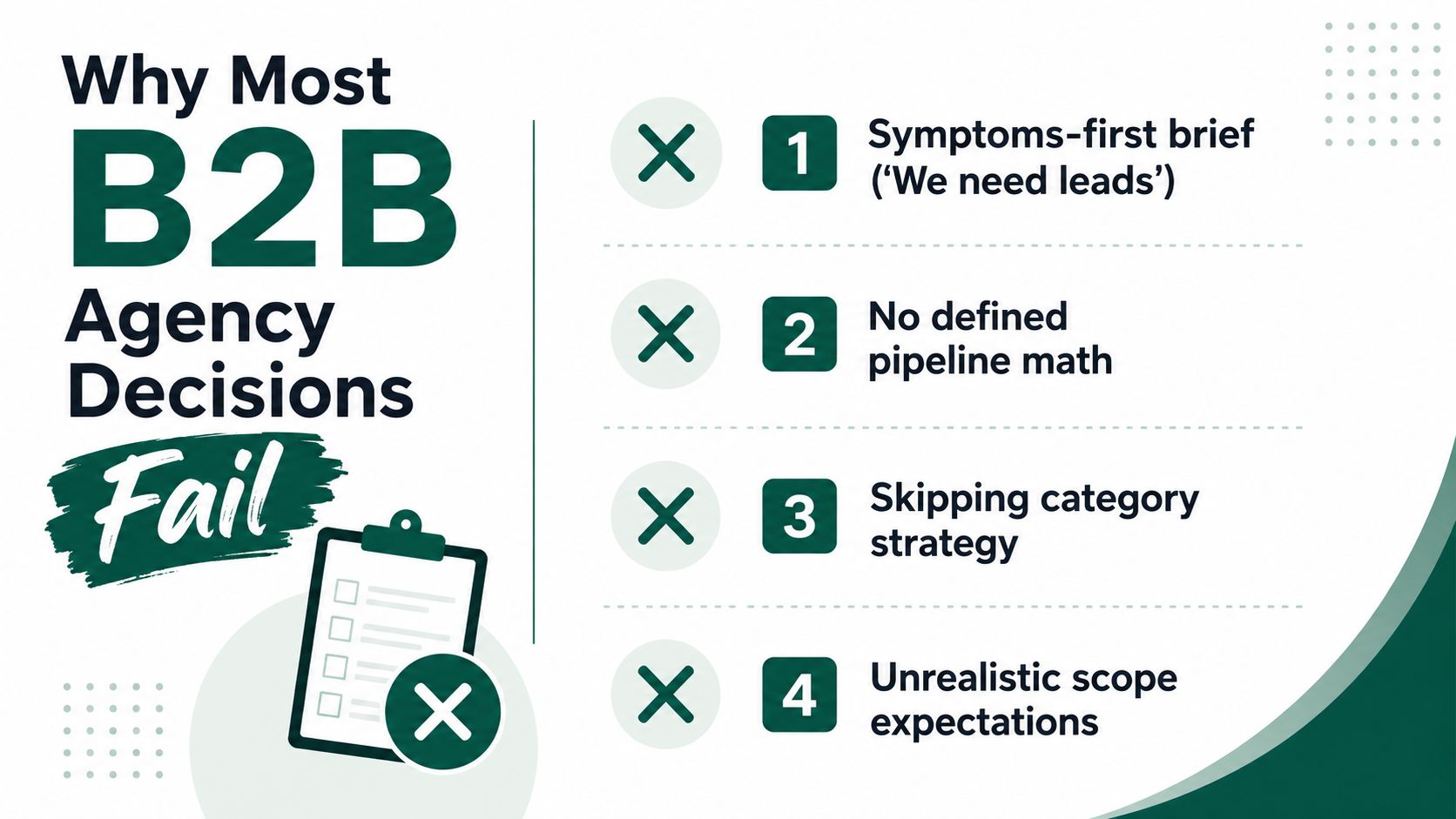
Start with five questions:
If those answers are unstable, an agency will often amplify confusion. More campaigns create more noise. More content creates more surfaces for an unclear message. More paid traffic sends more people into a leaky conversion path.
B2B website performance illustrates why diagnosis matters. A useful operating baseline for blended B2B website traffic is 2% to 5%, with a 2.9% median across industries, based on more than 100 million tracked interactions across 14 industries in Ruler Analytics benchmark data summarized by Grey Matter. But channel behavior differs materially. Organic search is reported around 2.4% to 2.6%, paid search around 1.2% to 1.5%, email around 2.0% to 2.4%, and LinkedIn ads around 2.0% to 3.5% in that benchmark summary. A sitewide average can hide the actual problem.
Practical rule: Hire for a defined bottleneck, not for generalized growth support.
An agency usually adds a team, operating systems, and execution capacity. A fractional executive adds senior direction, prioritization, and decision ownership. Those are different purchases.
External help makes sense when your offer is validated, your sales motion has some repeatability, and the company lacks a specific capability or senior bandwidth. It makes less sense when the product is unstable, the ICP changes every few weeks, leadership hasn't agreed on what to stop doing, or the company expects an outside team to invent product-market fit.
Before you speak with providers, define four things:
A useful agency buyer's guide for small businesses can help structure basic vendor questions, but SaaS leaders need to go further. Your decision should reflect the economics and mechanics of your specific revenue model. The build-versus-buy decision is also strategic. Buying execution before deciding what must remain internally owned is how companies create dependency without creating capability.
Agency size is a poor proxy for fit. A large team can still lack SaaS judgment, while a small team can be exactly right for a positioning problem. Choose based on seniority required, cross-functional volume, and market complexity.
| Operating Model | Best Fit | Primary Advantage | Key Trade-Off |
|---|---|---|---|
| Boutique or fractional | Early-stage SaaS with a senior strategy or messaging gap | Direct access to experienced operators | Narrower functional depth and limited delivery capacity |
| Mid-size specialist | Companies with established acquisition and coordinated channel needs | Balanced strategy and execution across functions | More account layers and variable senior involvement |
| Global network | Enterprise programs spanning regions, compliance environments, and large production needs | Reach, resilience, and operational scale | Higher fees, slower decisions, and heavier service overhead |
A boutique or fractional model usually fits a pre-PMF or early growth company that needs sharper judgment more than a large production machine. The typical gaps are positioning, offer architecture, messaging, campaign design, or interim marketing leadership.
The benefit is direct access to the person making the strategic calls. That matters when the founder needs someone to challenge an unclear ICP, rewrite the category narrative, or decide whether the company should pursue PLG, sales-led growth, or a deliberate combination. The trade-off is functional depth. One senior operator can't simultaneously provide deep paid media, technical SEO, conversion design, RevOps, and sales enablement capacity at enterprise scale.
A mid-size B2B SaaS agency becomes more useful when acquisition already works and the company needs several functions to operate as one system. That may include content, paid media, SEO, creative, analytics, lifecycle programs, and sales alignment.
The risk is distance. The senior strategist who wins the pitch may become an occasional reviewer, while delivery moves to account managers and junior specialists. Ask exactly who will make decisions, who will execute, and how often the senior team will work directly with your leaders. A coordinated team is valuable only when coordination is real.
Global networks are designed for operational complexity. They make sense when you need regional teams, extensive compliance support, broad creative production, or significant paid media management across markets.
They're usually the wrong choice for a Series A company trying to clarify its ICP. Enterprise reach doesn't compensate for a weak strategic premise. The operating model adds resilience and breadth, but also introduces procurement friction, service layers, and slower iteration.
If one senior operator is the gap, buy senior capacity. If several functions must work as one system, hire a coordinated team. If regional scale is the constraint, evaluate a network.
The B2B agency model you choose should follow the problem, not your assumptions about credibility. Headcount is not a strategy.
A polished case study proves that an agency can present a result. It doesn't prove the team can reproduce the underlying mechanism in your market.
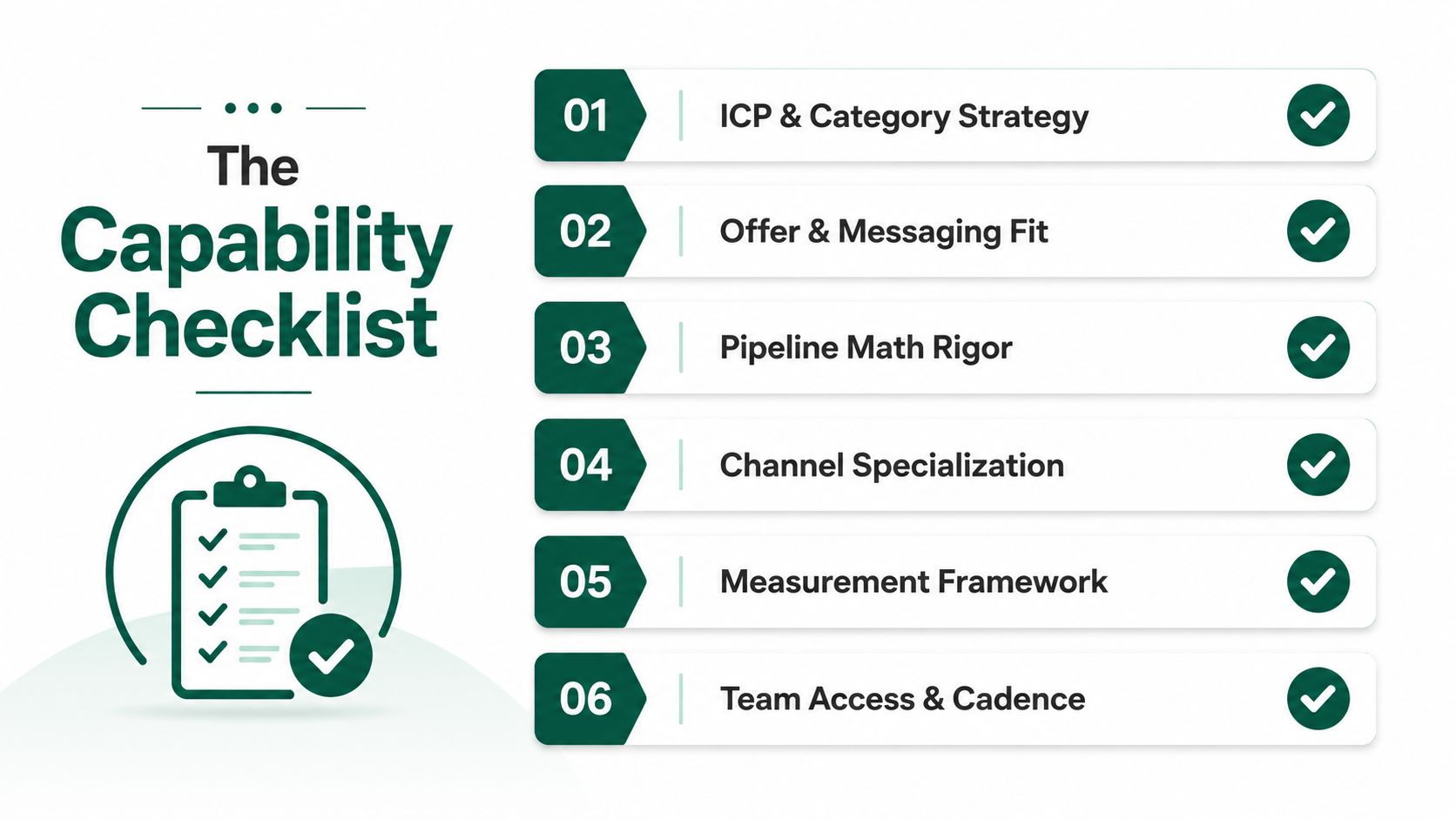
Evaluate capabilities in the order they affect pipeline. An agency that starts with channel tactics before understanding your buyer, category, and offer is already showing you how it thinks.
ICP and category strategy comes first. Ask the agency to explain how it would identify attractive accounts, buying roles, trigger events, and disqualifiers. Strong operators will challenge your current segmentation instead of accepting every segment as equally valuable.
Offer and message development determines whether demand has a reason to convert. The agency should be able to connect customer pain, business consequence, product differentiation, proof, and next action. “We'll refresh the messaging” isn't a method.
Demand generation should reflect the sales motion. A sales-assisted SaaS product may need account-based programs, executive content, partner routes, and sales enablement. A self-serve product may need a different balance of acquisition, activation, and lifecycle work.
Conversion optimization requires more than landing-page design. Ask which conversion event matters, what friction is being removed, and how the team will separate traffic quality from page performance.
Marketing-sales alignment is visible in operating behavior. The agency should know how it will coordinate with sales development, account executives, product marketing, and RevOps. If marketing reports leads while sales reports unusable conversations, the system is not aligned.
Measurement must connect activity to opportunity and revenue. A 2025 benchmark report compiled data from 153 B2B advertisers and $57.6 million in calendar-2025 spend across LinkedIn, Google Ads, Facebook, and Instagram, as documented in Metadata's B2B advertising benchmark report. That scale makes attribution and cross-channel planning operational requirements, not optional reporting polish.
Use questions that force the agency to reveal its reasoning:
Strong answers are specific and tied to observable mechanisms. Weak answers lead with impressions, clicks, rankings, awards, or production volume.
Treat these as decision criteria, not minor concerns:
Require a reference from a company with a similar stage, deal size, sales cycle, and go-to-market motion. Then score each finalist on relevant capability, senior allocation, evidence, commercial clarity, and trust. Presentation aesthetics should carry almost no weight.
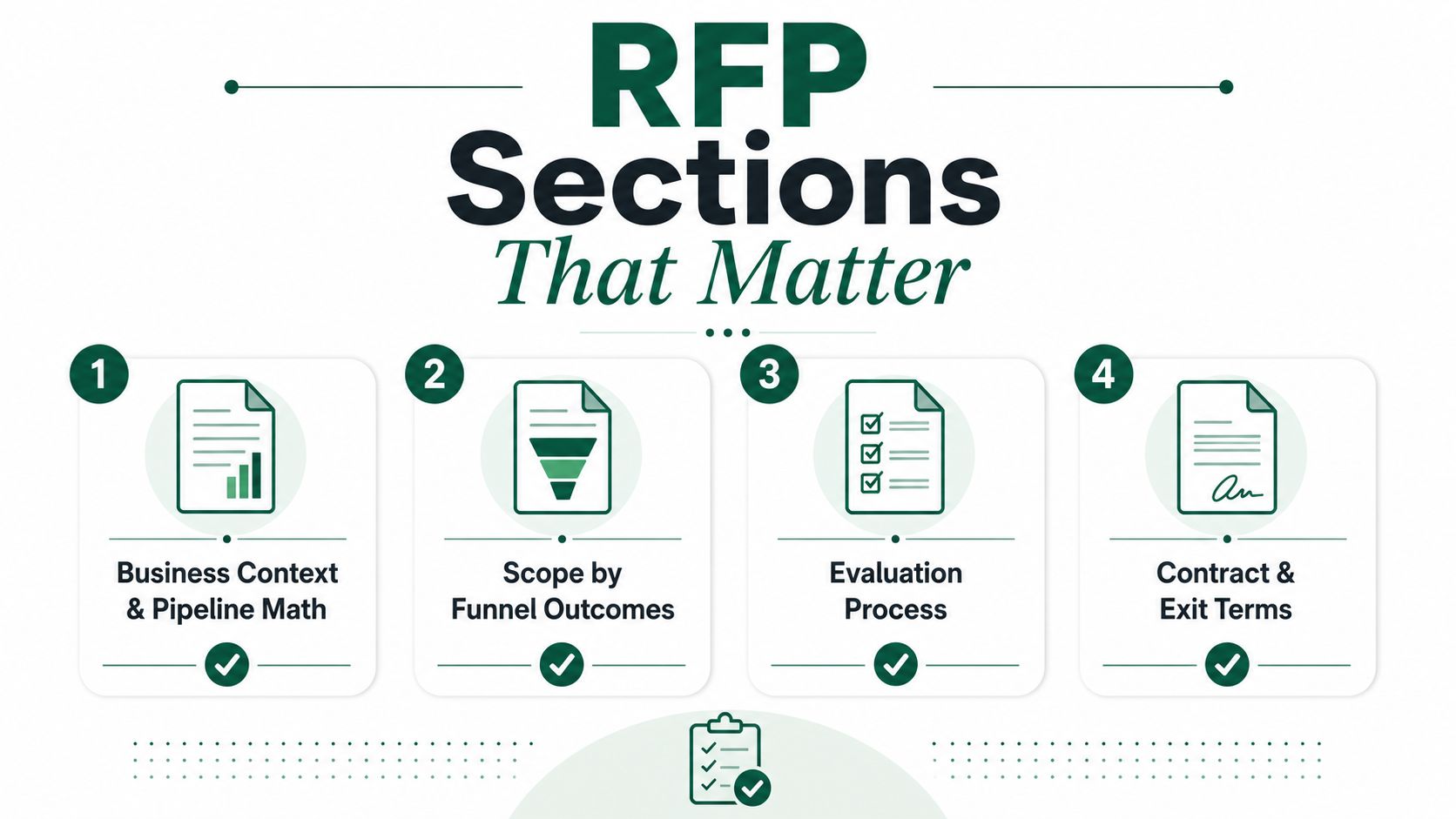
An RFP shouldn't help agencies write prettier proposals. It should make weak proposals impossible to hide.
Give every provider the same commercial and funnel context. If you withhold the information required to diagnose the business, you'll receive generic channel plans dressed up as strategy.
Business context and pipeline math: Explain the product, ICP, sales motion, current acquisition sources, funnel definitions, sales capacity, and known constraints. Include what the company has tried and why it failed or stalled.
Scope by funnel outcome: Don't ask for “content,” “campaigns,” or “social media.” Ask for the work required to improve a defined stage, then list deliverables as evidence of that work.
Evaluation process: Tell agencies how you'll assess strategic thinking, senior participation, relevant proof, data discipline, and commercial clarity.
Contract and exit terms: Define review points, ownership of work, data access, confidentiality, change control, and termination rights.
These questions expose junior staffing, retainer padding, and ownership ambiguity before the contract is signed. They also prevent an agency from assembling a strategy before understanding the funnel. For outbound programs, review practical material on red flags in cold email agencies because vague targeting, weak deliverability ownership, and activity-heavy reporting create the same procurement risks.
Use quarterly business reviews with explicit renewal and kill clauses. Separate strategic direction from execution hours so you can see what you're paying for. Push back on minimums below 60% utilization, because unused capacity can turn a retainer into a tax on optionality.
Require a written change-order process. It should state what changed, why it changed, the effect on timing and fees, and who approved it. Reserve the right to audit time entries when billing is hourly or capacity-based.
Your negotiation language should be direct:
“We'll pay for the strategic work and execution capacity required to influence the agreed funnel outcome. We won't pay indefinitely for activity that doesn't produce evidence of progress.”
Use B2B marketing brief templates to make the RFP specific before providers respond. A clear brief gives you negotiating power because it exposes what the agency can control.
A healthy onboarding process creates informed disagreement early. A weak one creates a shared calendar, a pile of tasks, and silence around the questions that matter.
Consider a Series B SaaS company replacing an underperforming demand-generation shop with a fractional growth team. The company has a functioning product and an active sales organization, but its acquisition programs generate inconsistent conversations and leadership can't reconcile marketing reports with CRM reality.
The first month should be a diagnostic sprint. The team audits the funnel, sharpens the ICP, reconciles analytics with CRM records, reviews sales calls, and identifies where reported conversions stop becoming accepted opportunities.
The founder joins two working sessions each week. That doesn't mean reviewing ad copy or debating button colors. The founder supplies context about strategic accounts, lost deals, product constraints, competitive pressure, and the company's risk tolerance.
By the end of this phase, the agency should state its current view of the bottleneck and list the evidence that could disprove it. If the team avoids taking a position, escalate in the second week. Silence on strategy questions isn't neutrality. It's a warning that the engagement may default to production.
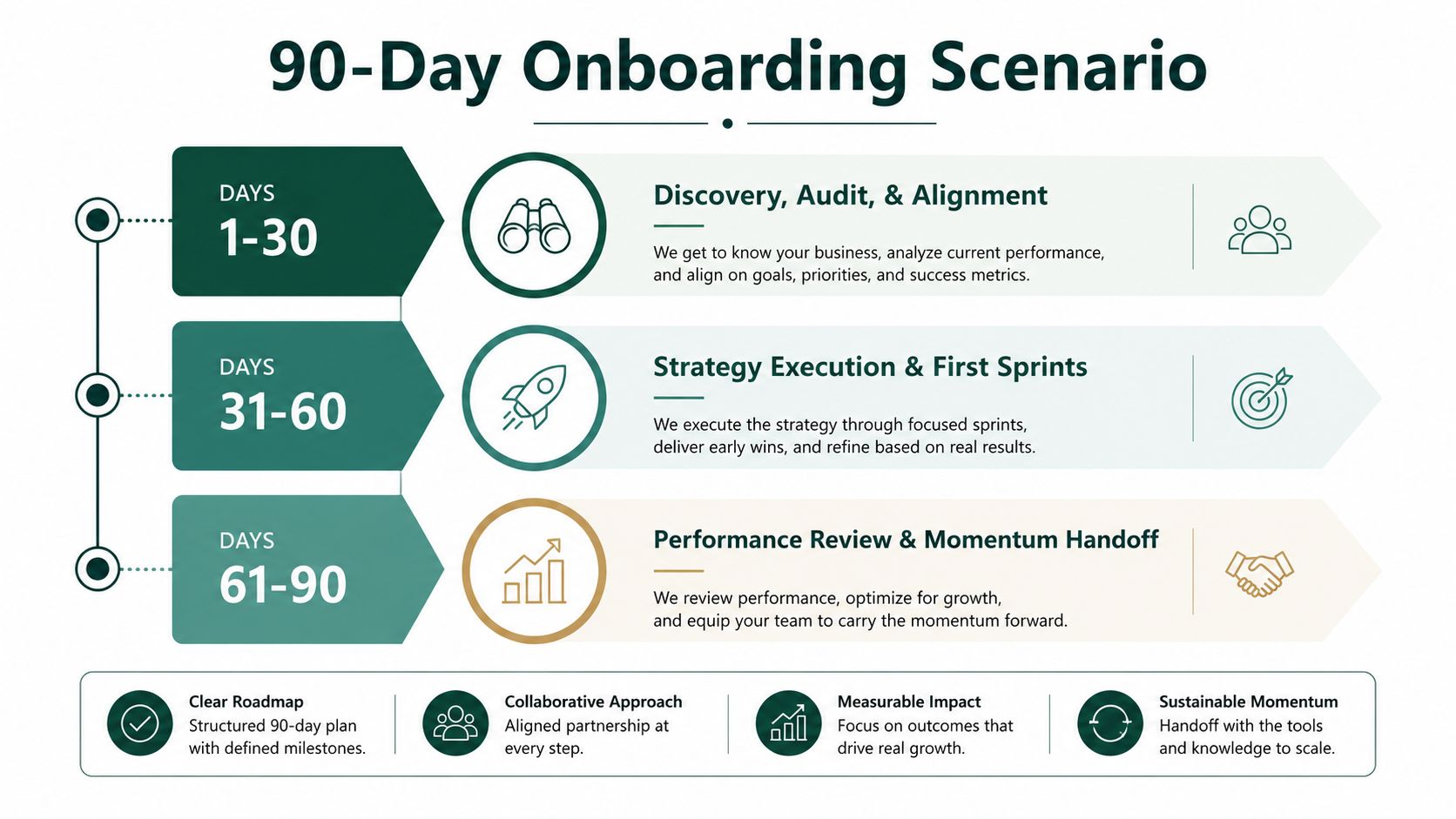
The second month is for locking the operating thesis. The team prioritizes channels, clarifies the offer, defines the creative testing roadmap, and confirms which funnel stages the agency owns versus influences.
Schedule the first quarterly business review during this phase, not at the end of the quarter. The meeting should confirm the baseline, decision rights, leading indicators, risks, and experiments. If channel expansion appears before the team resolves positioning or measurement, stop it.
Ignore premature arguments about visual taste, speculative tool recommendations, and adding more channels. Those conversations feel productive because they're easy to have. They rarely address why qualified buyers aren't moving.
The final month moves into execution with weekly pipeline reviews and a documented escalation matrix. The agency reports what changed, what it learned, what it recommends next, and which assumptions remain unresolved.
The founder's job is to provide context and make strategic decisions. It isn't to manage every tactic. The Head of Growth or marketing owner should control the working cadence, while sales and RevOps provide the operational feedback needed to test quality and acceptance.
Use customer onboarding best practices to formalize ownership, communication, and escalation. A successful onboarding ends with the company knowing how decisions get made without the agency becoming a permanent substitute for leadership.
A short video can also help teams align on the difference between activity and operating momentum:
An agency can ship every agreed asset and still fail commercially. Output proves that work happened. Impact shows that the work changed the economics of the funnel.
Use three measurement tiers, and don't let the first tier masquerade as the third.
| Funnel Stage | Metric | B2B SaaS Benchmark | Agency Credit Model |
|---|---|---|---|
| Acquisition | Visitor-to-lead conversion | B2B websites average 2.6%, while the top quartile reaches 4.5%, according to The Starr Conspiracy's 2025 benchmark | Credit the agency for measured improvement in qualified conversion, not traffic alone |
| Lead qualification | Lead-to-MQL and MQL-to-SQL conversion | B2B SaaS stage summaries report visitor-to-lead at 1.5% to 3.5%, lead-to-MQL at 30% to 45%, and MQL-to-SQL at 20% to 35%, as summarized by Sotros Infotech | Use channel, cohort, and acceptance data |
| Sales motion | Trial-to-paid conversion | Self-serve SaaS is typically 2% to 5%, while sales-assisted products are typically 15% to 25%, according to Orbix Studio's SaaS benchmark summary | Attribute influence only where the agency affected the relevant motion |
| Revenue | Opportunities, closed-won, CAC payback, pipeline velocity | No universal benchmark applies without cohort and channel context | Use sourced and influenced views, with documented weighting |
Clicks, impressions, published assets, email sends, and campaign launches tell you whether a team executed. They don't tell you whether the right accounts cared or whether sales received usable opportunities.
Pipeline metrics are closer to the economic truth. Track qualified meetings, lead acceptance, MQL-to-SQL movement, opportunity creation, and stage progression. A recent benchmark roundup reported a median MQL-to-SQL transition rate of 13.1% in 2024, falling to 9.8% in 2026, as cited in Callbox's B2B lead generation statistics. That gap shows why lead volume can look healthy while qualification leaks value.
Revenue metrics include closed-won revenue, acquisition cost, payback, and pipeline velocity. They lag, so a 90-day review should test leading indicators first, while still setting the data and attribution rules needed for later revenue evaluation.
Suppose a content agency influences opportunities through first-touch discovery, later nurture, and sales enablement. Don't award full credit to every touch. Define a first-touch view and a multi-touch view, then document the weighting method before results arrive.
A one-page scorecard should include:
The point isn't to pretend attribution is perfect. The point is to prevent attribution from becoming a sales document written after the fact. Use marketing ROI measurement guidance to create a shared operating language before the first campaign launches.
Treat agency spend like a portfolio allocation, not a vendor subscription.
A vendor relationship buys deliverables and renews by habit. A growth partnership allocates money across three layers: strategic direction, execution capacity, and controlled experimentation. Each layer needs a different review standard. Strategy should improve decisions. Execution should increase reliable throughput. Experiments should produce learning that changes the next allocation.
The distinction matters more as AI makes production cheaper and internal teams automate more execution. Independent 2026 research from Forrester reports that the share of B2B marketers expecting overall agency budget increases fell by 13 percentage points year over year, while nearly half expect budgets to remain flat, as described in Forrester's analysis of selective agency spending. Buyers are becoming more selective because they no longer want to outsource commoditized activity without a clear strategic reason.
The right agency behaves like an embedded fractional team. It pressure-tests the ICP, reprioritizes channels, exposes internal gaps, and tells you when a program no longer deserves funding. It doesn't protect its retainer by keeping every tactic alive.
The broader market is moving in the same direction. Benchmark coverage reports average gross income up 12.9% year over year across 15 global agencies, with one report placing average gross income at $58.01 million, while highlighting pipeline attribution, AI-assisted creative, and outcome-focused commercial models as emerging selection criteria in B2B Marketing's global agency report. Agency growth doesn't prove buyer value. Your scorecard still has to.
Use three questions at every renewal:
Extend when pipeline contribution is credible, the senior team remains engaged, and the agency is still improving your decisions. Restructure when the strategy is sound but execution is uneven, or when the company's stage has changed and the operating model no longer fits.
Exit when reporting stays activity-based, the agency repeats the same recommendations without learning, senior access disappears, or the relationship survives mainly because switching feels inconvenient. Comfort is not compounding value.
Big Moves Marketing operates as an independent B2B marketing consultancy and fractional CMO partner, combining positioning, go-to-market planning, hands-on execution, and measurement for technology companies. That model is relevant when the core need is clearer strategic direction tied to practical pipeline systems, rather than a large production bench.
The sharper mental model is simple: an agency is an investment vehicle for a constrained growth problem. Fund it when the problem is defined, the owner is accountable, the evidence is measurable, and the learning can change your next decision. Don't buy activity to reassure yourself that marketing is moving.
If your current marketing motion is producing activity without reliable pipeline evidence, Big Moves Marketing can help diagnose the constraint, clarify positioning, and build a focused growth program with senior strategic ownership. Visit the site to discuss whether a fractional CMO or targeted B2B growth engagement fits the bottleneck you need to solve.





%20-%20white.svg)