%20png%20copy.avif)

Fractional CMO pricing typically lands at USD 5,000–15,000 per month, with average guidance around USD 10,000–12,000. Hourly advisory work commonly runs USD 200–500, while fixed-scope projects often cost USD 15,000–50,000, roughly 40%–70% less than a full-time CMO whose total compensation can reach USD 275,000–500,000+. 2026 fractional CMO pricing benchmarks
The popular advice is to ask, “What's the monthly rate?” That's the wrong first question. In B2B SaaS, the key issue is whether you're buying occasional marketing judgment, a senior operator who owns the roadmap, or an accountable leader who can connect positioning, demand generation, sales enablement, and pipeline review.
A cheap retainer can be expensive when it produces recommendations nobody implements. A premium retainer can be rational when the fractional CMO has the authority to resolve ICP confusion, stop low-value channel activity, align marketing and sales, and own the decisions that determine pipeline quality.
Pricing confusion usually signals a scope problem, not a rate problem. Most buyers compare hours, titles, and monthly fees without defining the operating role behind the invoice. That makes two engagements with similar calendars look equivalent when they aren't.
One fractional CMO might spend a few hours each month reviewing a marketing plan and answering founder questions. Another might lead weekly revenue meetings, rewrite positioning, manage a marketing team, oversee agencies, prioritize campaigns, and challenge sales assumptions. Both may describe themselves as fractional CMOs. The work, decision authority, and business risk are completely different.
B2B SaaS teams often make a predictable mistake. They treat executive leadership as a quantity of labor, then try to buy a senior operator by the hour. That works for a second opinion or a focused audit. It fails when the company needs someone to make trade-offs repeatedly, stay close to the sales cycle, and carry responsibility for a coherent go-to-market system.
The buying question: Don't ask how many hours you get. Ask which decisions the fractional CMO owns, which decisions they influence, and what remains with the founder or internal team.
I use embeddedness to describe how the fractional CMO operates inside the company. Low embeddedness means periodic advice. Higher embeddedness means participation in planning, prioritization, hiring, team management, launch decisions, and pipeline reviews. The more integrated the role, the more the engagement behaves like part-time executive capacity rather than consulting.
That distinction matters because an engagement can be under-scoped in two directions. You may overpay for light advisory work if the provider sells a large retainer without meaningful authority. Or you may underbuy leadership by hiring someone for a small number of hours while expecting them to repair positioning, build demand, coordinate sales, and deliver pipeline accountability.
Founders who want a simpler decision framework should start with the buying experience itself. The principles in B2B buyers want simple choices apply internally too. Your company needs a clear choice about the job, authority, and outcome before it can evaluate a fee.
The sharper question is: What level of marketing leadership does this stage of the business require, and what commercial model matches that responsibility? Once that's clear, fractional CMO pricing becomes much easier to evaluate.
The hourly rate is often the least useful way to compare fractional CMO offers. The better question is how much decision authority and pipeline responsibility the engagement carries. Four commercial models cover most buying situations, and each fits a different scope.
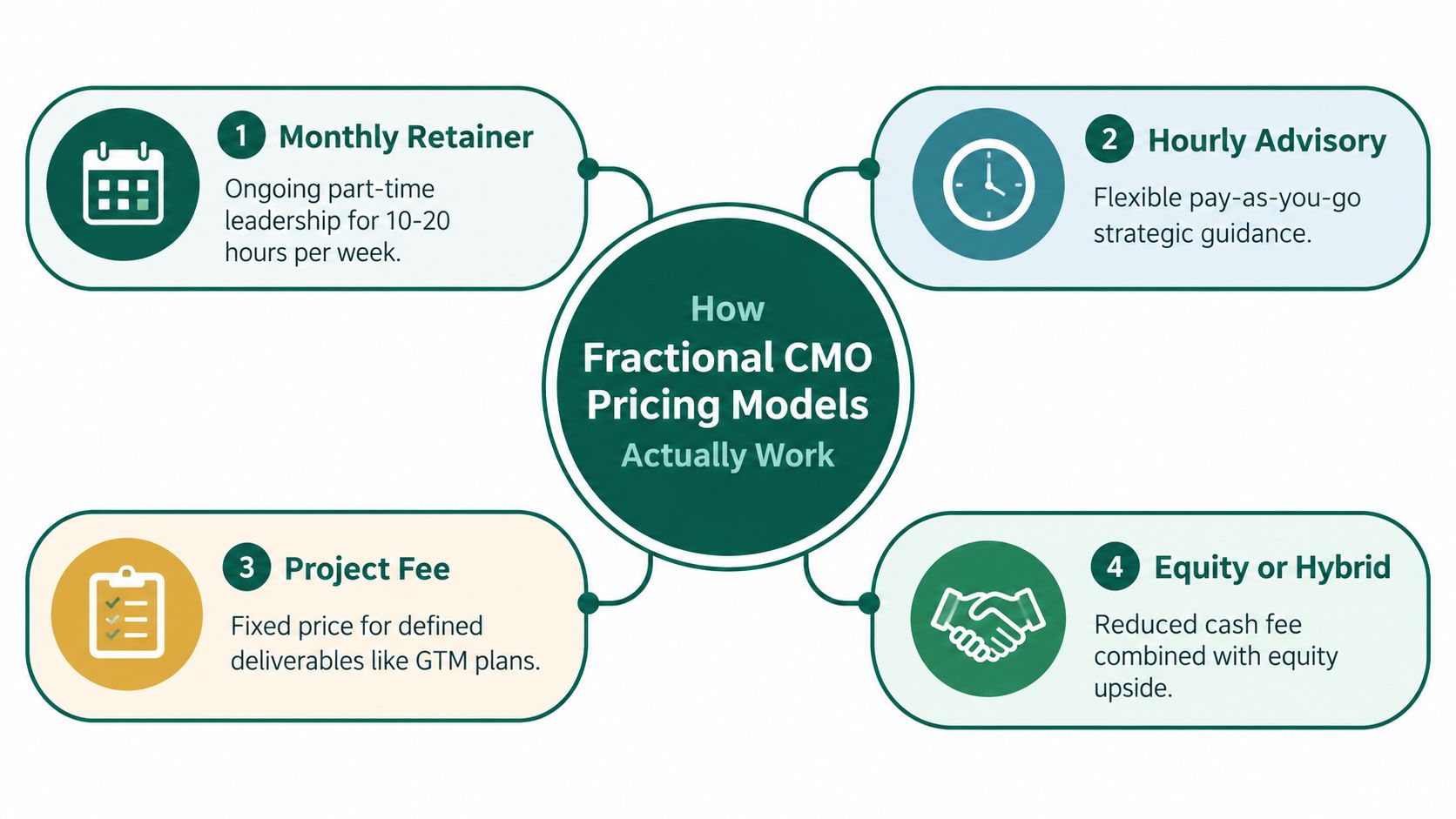
A monthly retainer fits ongoing leadership. U.S. benchmarks commonly place retainers around USD 8,000–22,000 per month, with a midpoint of about USD 12,000–15,000 for established operators working roughly two to three days per week. Effective pricing is often cited at USD 200–450 per hour or USD 1,500–3,500 per day. Retainer and engagement benchmarks
Use a retainer when the fractional CMO owns recurring decisions, including roadmap prioritization, KPI reviews, sales and marketing alignment, launch planning, and team oversight. The company pays for continuity, access to judgment, and accountability across the operating cycle. Hours alone do not capture that value.
The model fails when the scope is vague. “Marketing support” creates no useful boundary for either side. A strong retainer specifies decision rights, meeting cadence, expected involvement, and the areas where the fractional CMO owns outcomes.
Hourly advisory suits a positioning review, GTM audit, investor preparation, executive workshop, or focused second opinion. A 2026 pricing guide reports hourly rates from USD 150–500, with weekly involvement ranging from 5 to 35 hours, depending on scope and commitment. Engagement-type rate guidance
Hourly work gives the buyer flexibility, but it does not provide leadership continuity. Choose it when the company needs expert judgment on a contained question. Do not use it when someone must carry a decision from diagnosis through implementation and pipeline review.
A project fee fits a defined outcome, such as repositioning, a launch plan, a messaging system, or a GTM strategy. The buyer receives a bounded scope and known commercial commitment. The fractional CMO can organize the work around the business problem instead of tracking every hour.
Project fees become inefficient when an operating role is disguised as a deliverable. A launch plan will not resolve weak sales adoption, unclear ownership, or poor campaign execution unless those responsibilities are explicitly included.
An equity or hybrid arrangement combines a reduced cash fee with equity upside. It can fit a capital-constrained company when the fractional CMO has genuine conviction in the opportunity. It should never hide an unrealistic cash budget.
Equity does not replace scope. Set the cash commitment, decision authority, deliverables, vesting terms, and termination rights before discussing upside. Experienced operators will also price delayed liquidity risk into the cash portion.
A practical breakdown of fractional CMO services helps buyers separate executive leadership from isolated execution. Choose the commercial model that matches the role's embeddedness, stage, and pipeline accountability.
A fractional CMO's fee should follow decision authority, not hours alone. Current benchmarks place most fractional CMO retainers between USD 5,000 and 22,000 per month. Narrow-scope or early-stage work can start around USD 3,000–5,000, while project-based engagements often range from USD 5,000 to 30,000+. Broad 2026 pricing benchmarks
Marketplace data provides another reference point. A 2026 analysis reports an average hourly rate of USD 180, a median of USD 175, and a middle 50% range of USD 130–220. Employers post an average of USD 136, while talent asks USD 182, creating a USD 46 hourly gap. Marketplace pricing analysis
Anchor your budget to the decision rights you are transferring, then sanity-check the fee against these bands. A founder seeking occasional judgment needs a different package from a company handing over pipeline priorities, team direction, and revenue alignment.
| Engagement Type | Typical Range | Scope Included |
|---|---|---|
| Light advisory | USD 3,000–6,000 per month | Positioning review, prioritization, executive counsel, and periodic strategy sessions |
| Core fractional leadership | USD 5,000–15,000 per month | GTM direction, KPI cadence, sales alignment, roadmap ownership, and execution oversight |
| Embedded growth leadership | USD 12,000–22,000 per month | Team leadership, channel orchestration, launch planning, vendor management, and pipeline accountability |
| Hourly advisory | Varies by advisor, usually with a minimum block of hours | Audits, workshops, investor preparation, and defined strategic input |
| Project engagement | Scope-based | Defined repositioning, GTM, launch, or strategic transformation scope |
2026 fractional CMO cost guidance also frames pricing by company stage. Pre-seed companies are often quoted USD 3,000–6,000 per month, seed-stage firms USD 6,000–12,000, Series A companies USD 12,000–20,000, and Series B companies USD 18,000–35,000.
Light advisory suits a founder-led company with capable execution resources. The fractional CMO sharpens the ICP, positioning, messaging, and quarterly priorities, then reviews progress. Pipeline ownership remains with the founder or internal team.
Scale Up leadership fits a company with a product and sales motion but no senior marketing direction. The fractional CMO owns the roadmap, aligns campaigns to revenue priorities, runs KPI reviews, and manages internal or external contributors.
Launch-intensive support requires concentrated decisions across narrative, audience, sales enablement, website conversion, campaign sequencing, and launch measurement. A project fee or temporarily higher retainer is cleaner than forcing the work into a stable advisory schedule.
Before signing, use this guide to hiring a fractional CMO to pressure-test scope, authority, and accountability. The cheapest quote is poor value if the founder still owns every important marketing decision.
Hours influence a quote, but decision authority and accountability determine it. Two companies can request the same calendar commitment and receive different fees because one needs strategic counsel while the other needs a revenue-facing operator who can set priorities, redirect budget, and own pipeline decisions.
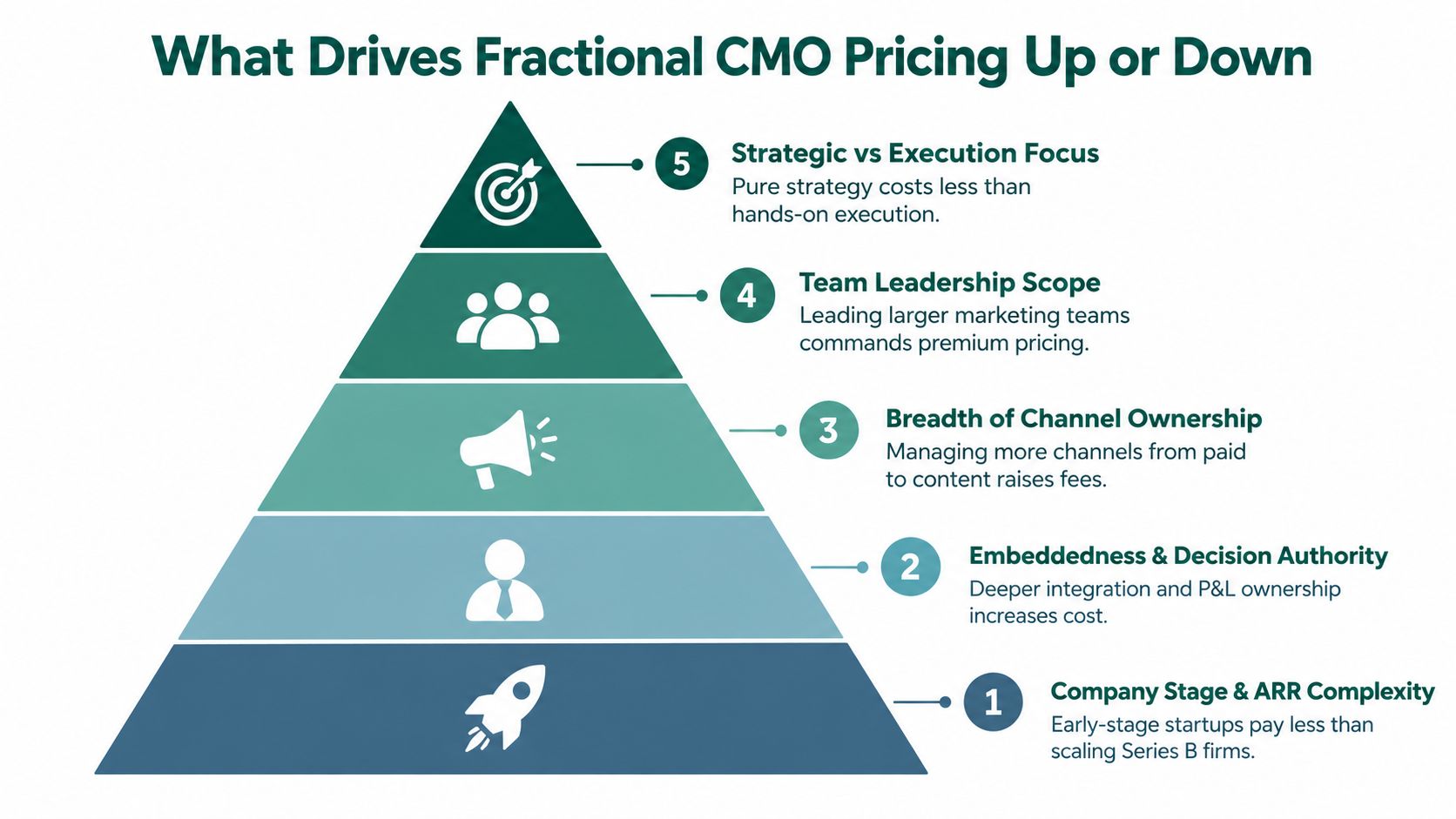
Stage changes the work. Pre-seed teams often need positioning, founder-led sales support, and a credible first demand motion. A growth-stage company may require coordination across channels, product lines, sales teams, and stakeholders.
Benchmark ranges show pre-revenue or pre-seed firms often buying 10–15 hours per month for about USD 3,000–6,000. Seed-stage companies often pay USD 5,000–10,000 for 15–20 hours, Series A companies USD 8,000–15,000 for 20–30 hours, and growth-stage companies above USD 30M ARR USD 15,000–25,000 for 30–40 hours. Stage-based retainer benchmarks
A fractional CMO who only recommends changes costs less than one who sets priorities, redirects budget, manages contributors, and represents marketing in revenue discussions. The more embedded the operator becomes, the more the engagement should be priced around responsibility rather than hours.
Owning one strategic problem differs from coordinating paid acquisition, content, SEO, lifecycle, events, sales enablement, and agency partners. Add team management, and the role becomes operating leadership. That scope supports a retainer tied to ongoing decisions, not a project fee based on isolated deliverables.
Deep B2B SaaS experience, complex sales cycles, technical positioning, or a specialized vertical can command a premium because the operator spends less time learning the category and more time making useful decisions. Geography also changes the market. U.S. retainers commonly fall around USD 8,000–22,000 per month, Western Europe around EUR 6,000–18,000, and Central and Eastern Europe around EUR 3,000–9,000. Regional pricing comparison
Pure strategy requires less involvement than hands-on execution. A fractional CMO who builds messaging, directs the website, sets up measurement, briefs campaigns, and manages delivery carries a larger workload than one who attends a monthly board meeting.
AI can increase throughput without replacing judgment. The same report describes an AI-augmented fractional CMO charging USD 8,000–12,000 per month for work previously priced at USD 18,000. If a provider cites AI-driven efficiency, ask which deliverables the AI shortens and re-price those line items.
The same logic of pricing responsibility over hours applies to broader commercial decisions, including these small business pricing strategies. Price the actual scope, authority, and pipeline accountability, not the visible unit of time.
A good contract protects momentum without trapping either side. The contract should make the operating model explicit, especially when the fractional CMO will influence pipeline, hiring, budget, and sales alignment.
Specify expected weekly involvement, meeting cadence, response expectations, and peak periods. A retainer doesn't mean unlimited access. If a launch requires additional time, define how extra work is approved and billed.
Use hourly or day rates for isolated workshops, audits, or investor preparation. Use a retainer when the work involves recurring prioritization, roadmap ownership, and team orchestration. The wrong model creates disputes because the buyer expects availability while the operator expects a bounded scope.
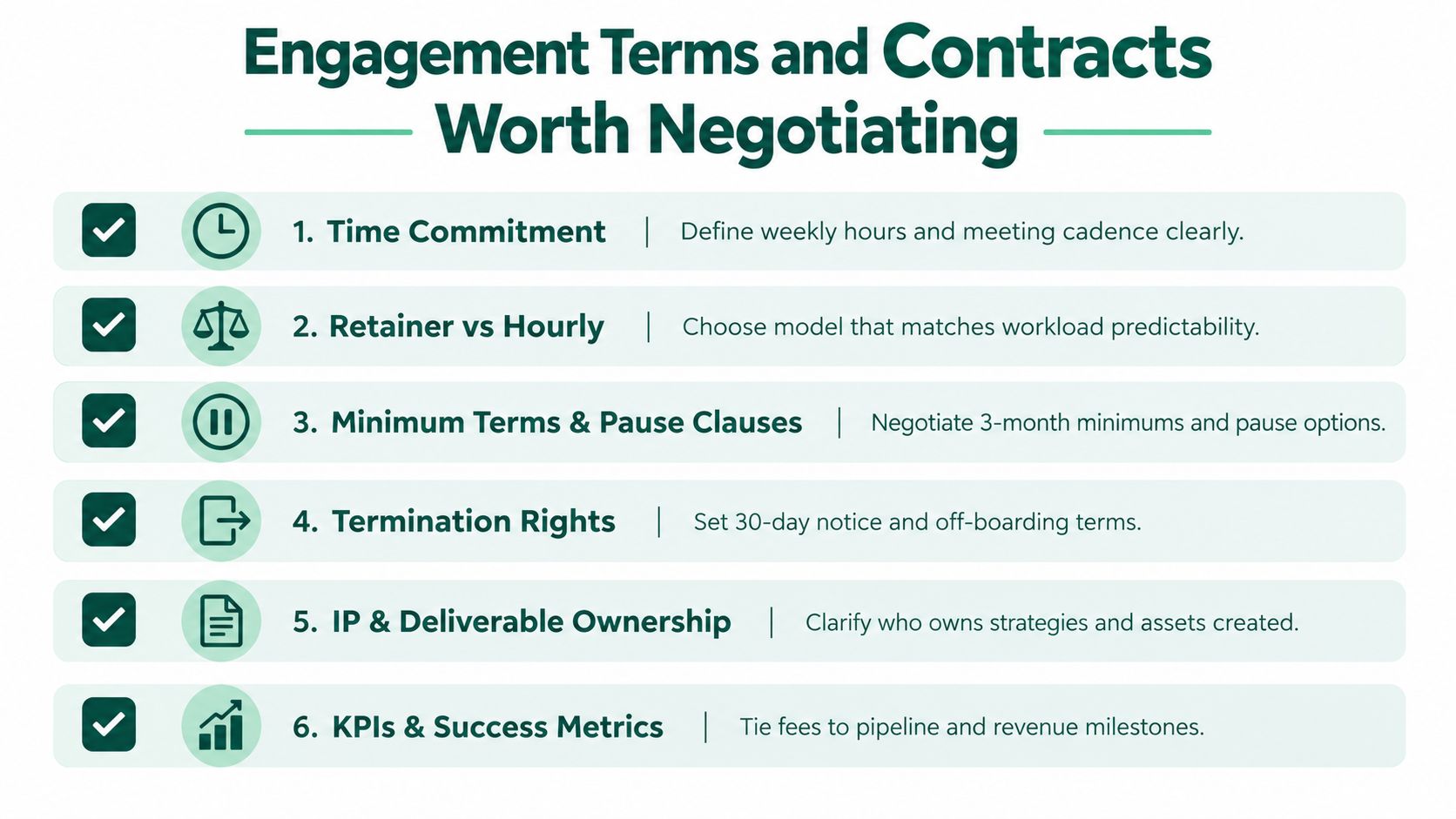
A minimum term gives the fractional CMO enough time to understand the business and establish a working rhythm. A pause clause gives the company an option when priorities or funding change. Termination language should cover notice, handover, access removal, and outstanding work.
Marketplace involvement also affects the economics. Some intermediated platforms can add 25%–40% on top of direct-hire retainers, so a USD 12,000 direct engagement can become approximately USD 15,000–17,000 through a platform. Marketplace markup guidance
Negotiation rule: Pay for committed leadership capacity, but write down the boundary around that capacity.
Don't turn the contract into a promise of revenue that no marketer can control alone. Tie the operating cadence to leading and lagging indicators such as pipeline created, sales cycle movement, CAC efficiency, conversion quality, and execution progress.
Clarify IP ownership for messaging frameworks, strategy documents, campaign assets, website copy, and reporting templates. Also document who owns accounts, data, vendor relationships, and unfinished work at termination.
A practical hiring checklist should sit beside the contract. The fractional CMO hiring framework is useful for testing role fit before negotiations turn into a rate discussion.
Budget should define the level of ownership you assign, not the number of marketing tasks on a list. A pre-seed founder needs positioning, ICP clarity, and sales support, not a miniature enterprise department. A Series B company needs broader funnel accountability, not a few advisory calls.
For pre-seed, prioritize positioning, ICP clarity, messaging, and founder-led sales support. The work should reduce wasted motion before the company adds channels.
At seed, the fractional CMO can build an initial demand system, connect marketing with sales, and establish a usable measurement cadence. Keep the channel plan restrained. More channels will not correct weak audience definition.
Series A usually calls for stronger coordination. The fractional CMO may own channel priorities, launch planning, sales enablement, and team operating rhythm. Series B requires broader responsibility for funnel performance, stakeholder alignment, and revenue planning.
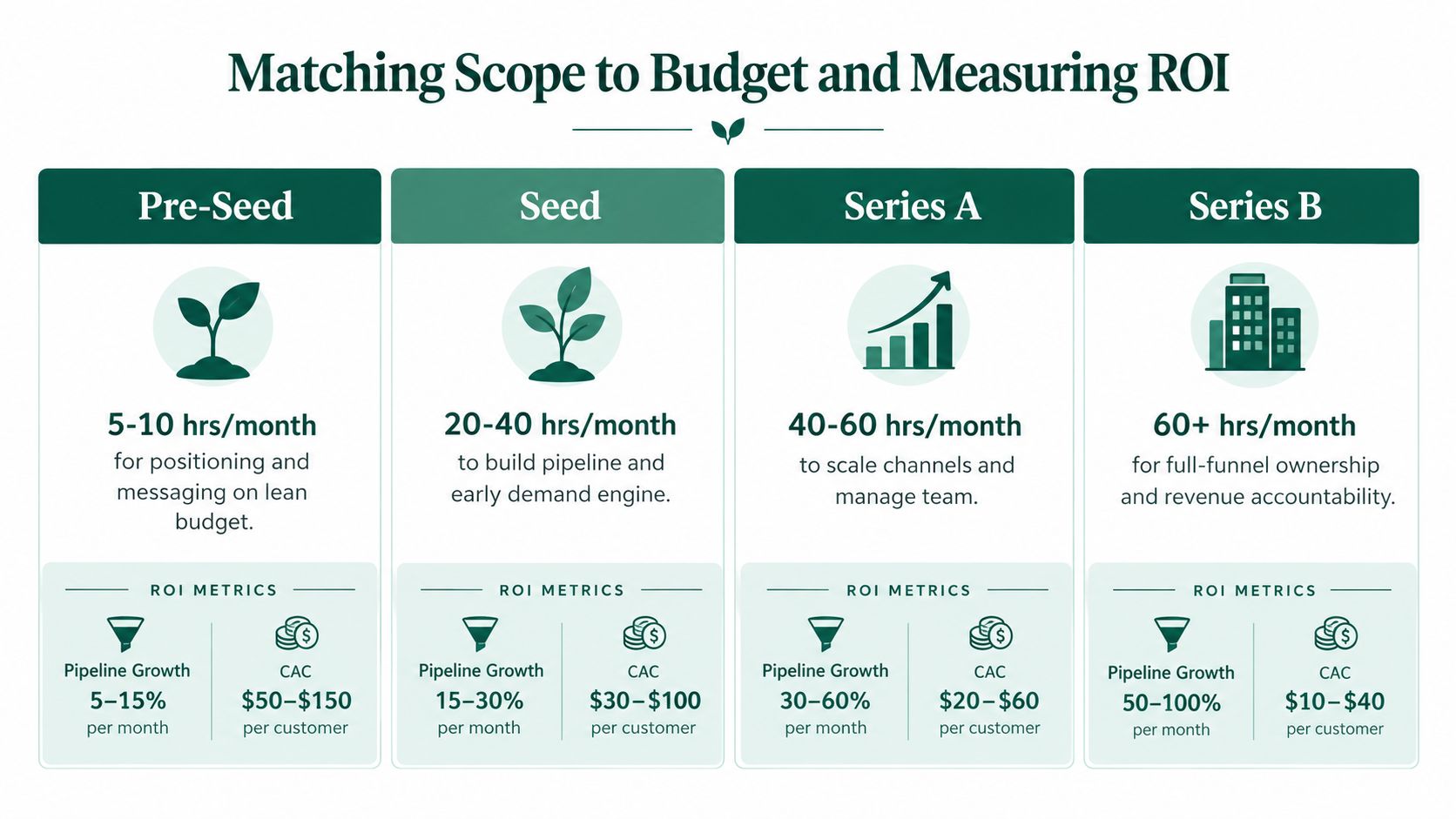
A fractional CMO earns the fee through better decisions and commercial movement. Track:
Board-level test: If you cannot explain which decisions improved pipeline quality or reduced wasted spend, the engagement is producing activity rather than leadership.
| Option | Choose this when |
|---|---|
| Fractional CMO | You need executive judgment, decision authority, and pipeline accountability before a permanent hire makes sense. |
| Senior hire | The role is durable, fully embedded, and large enough to justify dedicated leadership. |
| Agency | Strategy is already clear and the main gap is specialized execution. |
The right choice follows the constraint, not the hourly rate. Use a practical marketing ROI framework to connect activity with pipeline and revenue instead of reporting surface-level engagement.
Fractional CMO pricing follows embeddedness and accountability, not the title. The right fee buys a defined level of judgment, authority, and operating responsibility. It shouldn't buy a vague promise to “help with marketing.”
Brief the fractional CMO around the business problem first. State the ICP, current sales motion, pipeline constraint, internal capacity, upcoming launch or market decision, and the authority you're willing to grant. Then demand a practical first-month plan covering diagnosis, priorities, decisions, owners, and measurement.
The cheapest retainer is expensive when the founder still has to resolve positioning, prioritize channels, manage contributors, and explain pipeline performance to the board. A higher retainer can be sensible when one accountable operator removes those bottlenecks and creates a disciplined marketing system.
Big Moves Marketing fits companies that need positioning clarity, GTM direction, and hands-on fractional leadership tied to execution and pipeline decisions. Lighter advisory is appropriate when your internal team already knows how to execute and only needs senior challenge.
Big Moves Marketing helps B2B SaaS teams clarify positioning, plan go-to-market work, and connect senior marketing decisions to measurable pipeline systems. If you need to scope a fractional CMO engagement around your stage, authority, and budget, visit Big Moves Marketing and start with a direct conversation about the work that needs ownership.
June 26, 2026





%20-%20white.svg)