%20png%20copy.avif)

Most go-to-market consulting engagements don't fail because the consultant lacks a framework. They fail because the company buys deliverables instead of better decisions. A polished positioning deck won't fix an unclear market. More campaigns won't compensate for weak proof. A fractional executive won't create momentum if nobody inside the company owns the decisions after the engagement ends.
For B2B SaaS founders, GTM strategy consulting should be treated as a temporary transfer of senior judgment. The work must clarify who to sell to, why those buyers should act, how the buying group reaches consensus, and which commercial motion deserves more investment. Everything else is supporting material.
The popular advice says to hire a consultant when growth stalls, define the ideal customer profile, select channels, and launch a plan. That sequence sounds sensible. It also produces mediocre outcomes when the underlying problem is misdiagnosed.
A company may say it needs demand generation when its real issue is category confusion. It may ask for a messaging refresh when sales is targeting accounts with no urgent trigger. It may request a new website while product, sales, and leadership disagree about the buyer they want. A consultant who accepts the brief at face value can deliver exactly what was requested and still leave the company with the same commercial problem.
Product launches carry material risk even after teams invest heavily in development. The Product Development and Management Association data summarized by OpenStax found new-product failure rates ranging from 35% in healthcare products to 49% in consumer goods. The lesson for SaaS leaders isn't that every launch will fail. It's that distribution cannot rescue a product with weak customer need, unclear differentiation, or poor adoption conditions.
A serious engagement changes decisions in three ways:
Practical rule: Judge a GTM partner by the quality of decisions they help your team make, not by the number of slides they produce.
Most RFPs filter out the strongest operators because they reward certainty before diagnosis. They ask for a fixed channel plan, a detailed content calendar, and a predetermined number of assets before the consultant has spoken with customers or reviewed pipeline quality. That process selects for presentation skill and production capacity, not commercial insight.
The better question is simple: what decision will this engagement make easier, and who will own it when the work ends? A useful overview of how startup consulting firms differ can help founders compare partners on strategic contribution rather than a catalogue of services, as outlined in this guide to startup consulting companies.
Go-to-market strategy consulting is the work of designing and validating the commercial system that connects a product to a specific market. It covers the choices between customer problem, target segment, positioning, route to market, sales motion, buyer enablement, and revenue measurement.
That definition separates consulting from production. An agency may create campaigns, landing pages, and creative assets. A fractional leader may provide senior direction and help the team execute. A full-time hire embeds in the organization and carries ongoing responsibility. A strategic consultant should bring structure to ambiguous decisions, expose weak assumptions, and turn evidence into an operating plan.

A well-scoped engagement usually assigns the consultant responsibility for:
The consultant advises on execution choices, but shouldn't become a substitute for functional ownership. If the company needs daily campaign management, creative production, or a permanent marketing leader, those are different commercial requirements.
A GTM strategy answers how the company will win a market. A marketing strategy answers how marketing will create attention, demand, and preference within that commercial system. A growth strategy goes wider, including product adoption, pricing, retention, expansion, and the economics of the full customer lifecycle.
Confusing these categories creates bad scopes. A founder who asks for “a GTM strategy” but expects a blog calendar, paid-media management, and weekly reporting is buying production under a strategic label. A strong proposal names the decision, the owner, the evidence, and the handoff.
The sequence matters because each phase reduces a different type of uncertainty. Starting with channel activity before confirming the market creates noisy feedback. Starting with positioning before understanding buying friction produces language that sounds differentiated internally but fails in real conversations.

The first phase combines customer interviews, pipeline review, competitive mapping, market segmentation, and product understanding. The output isn't a generic persona document. It's a practical market model that identifies priority accounts, urgent use cases, buying triggers, objections, and alternatives.
The decision gate is whether the company can state its initial commercial focus precisely. If it can't, the team shouldn't scale acquisition. It should conduct more research, adjust the product story, or narrow the segment.
Positioning becomes a messaging framework, website structure, sales narrative, comparison material, proof architecture, and enablement assets. Each major buyer should be able to understand the problem, the reason to act, the difference between alternatives, and the evidence behind the claim without waiting for a sales call.
Gartner reports that B2B buyers spend only 17% of total purchase time in direct contact with potential vendors, with the rest spent on independent research, internal discussions, peer consultation, and deliberation, according to buyer enablement research. That makes self-serve explanation part of the sales system.
Pilots should test a commercial hypothesis, not merely generate activity. A search pilot might test whether a high-intent problem attracts the right accounts. A LinkedIn program might test reach within a defined buying group. A webinar might test whether an urgent operational issue creates qualified conversations.
Each pilot needs an entry condition, a named owner, a limited scope, and an exit decision. Scale, revise, or stop. Without those rules, pilots become permanent programs that consume attention while avoiding judgment.
The operating sequence is easier to maintain when the team documents its planning method, decision gates, and review rhythm. A practical marketing strategy process can support that discipline.
The final phase transfers the system to internal owners. That means documenting plays, training sales and marketing, defining reporting conventions, assigning review cadences, and identifying which assumptions still require testing.
A consultant who remains the only person able to explain the strategy has created dependency, not capability.
The process is strongest when every phase ends with a decision. Leadership shouldn't approve the next stage because the calendar says so. It should approve the next stage because the evidence justifies it.
For a visual explanation of how teams can move from foundations to handover, this short video adds useful context:
A proposal earns trust when its deliverables make commercial quality visible. A “GTM roadmap” by itself is vague. The document should show which decisions the roadmap supports, what evidence feeds those decisions, and how the internal team will use the output.
A useful positioning statement is short enough for leadership to remember and specific enough for sales to defend. It names the target customer, the problem, the category or alternative, and the meaningful difference. If it could describe five competitors, it is not positioning.
An ICP document should include observable account criteria, buying triggers, exclusions, relevant stakeholders, and signs of urgency. Firmographic labels alone do not help a seller decide which account deserves attention today.
A messaging framework should connect each buyer role to a problem, consequence, value proposition, proof point, objection, and next step. It must work in a homepage headline, discovery call, sales deck, product tour, and comparison page.
The sales playbook should include discovery prompts, qualification logic, objection handling, proof assets, and mutual action steps. A deck that sales never opens is not enablement.
A channel pilot plan should specify the audience, hypothesis, creative or offer, routing process, and decision threshold. A reporting dashboard should connect source activity to account progression, qualified pipeline, stage conversion, sales-cycle movement, retention, and expansion where the data is available.
Big Moves Marketing documents work delivered to 70+ B2B startups and enterprises across the US, India, UK, and Europe in a case study. One engagement documented there produced 6x revenue growth. Another generated 200 qualified prospects. Those are examples of documented outcomes, not promises that every engagement will produce the same result.
A good deliverable changes what the team does on Monday morning. If it only makes the strategy sound more coherent, it is not finished.
Ask whether each artifact has an owner, a use case, and a review date. Ask which assumptions were validated through customer or buyer evidence. Ask what the consultant will stop the company from doing.
Use the marketing ROI measurement guide to pressure-test whether reporting connects activity to commercial outcomes rather than celebrating surface-level engagement.
Most plans describe acquisition and stop there. That's a serious omission for products with multiple stakeholders, technical dependencies, security review, or internal change requirements.
Demandbase research reports that 72% of B2B purchases involve complex, multi-stakeholder buying groups, while buyers prioritize integration capabilities and economic conditions can influence vendor selection, as detailed in its B2B buyer report. The same research reports a typical buying decision involving 13 internal stakeholders and nine external influencers.
That changes what marketing must produce. A technical evaluator needs integration and security evidence. Finance needs an economic model. Operations needs an implementation path. An executive sponsor needs a concise case for change. Procurement needs clarity about risk, terms, and accountability.
A lead-generation plan that serves only the initial champion creates false momentum. The champion may be interested while the wider group remains unconvinced.
Build a consensus layer with:
AI now influences discovery and vendor evaluation. Separate research reports that 72% of B2B professionals used AI during early research, 48% used it to narrow a shortlist, and 62% used it while comparing vendors, with 92% saying AI shaped their vendor shortlist, according to the cited AI buyer research.
The response isn't to publish more generic content. It's to make the company's claims easy to retrieve, understand, compare, and verify. Product documentation, integration pages, customer evidence, implementation detail, comparison content, and pricing explanations all contribute.
Yet AI visibility without trust is a weak objective. The same research reports that 69% of buyers prefer validating AI-generated insights with sales representatives, while 51% say they're more likely to encounter misleading information from generative AI. Your content must help AI systems describe the offer accurately, then give humans enough evidence to challenge or confirm the description.
Change management matters. A practical change management method helps connect buyer confidence to internal adoption, rather than treating approval as the end of the GTM process.
The right model depends on the decision the company needs to make, not on the consultant's preferred packaging. A full-time CMO makes sense when the company has stable revenue, ongoing complexity, and enough internal scope to justify a dedicated executive. That isn't the default for a company still testing its market.
For many B2B SaaS companies from pre-PMF through Series C, a fractional leader or short pilot is the more rational starting point. It brings senior judgment into the company without forcing founders to commit to a permanent hire before they understand the actual role, scope, and operating requirements.
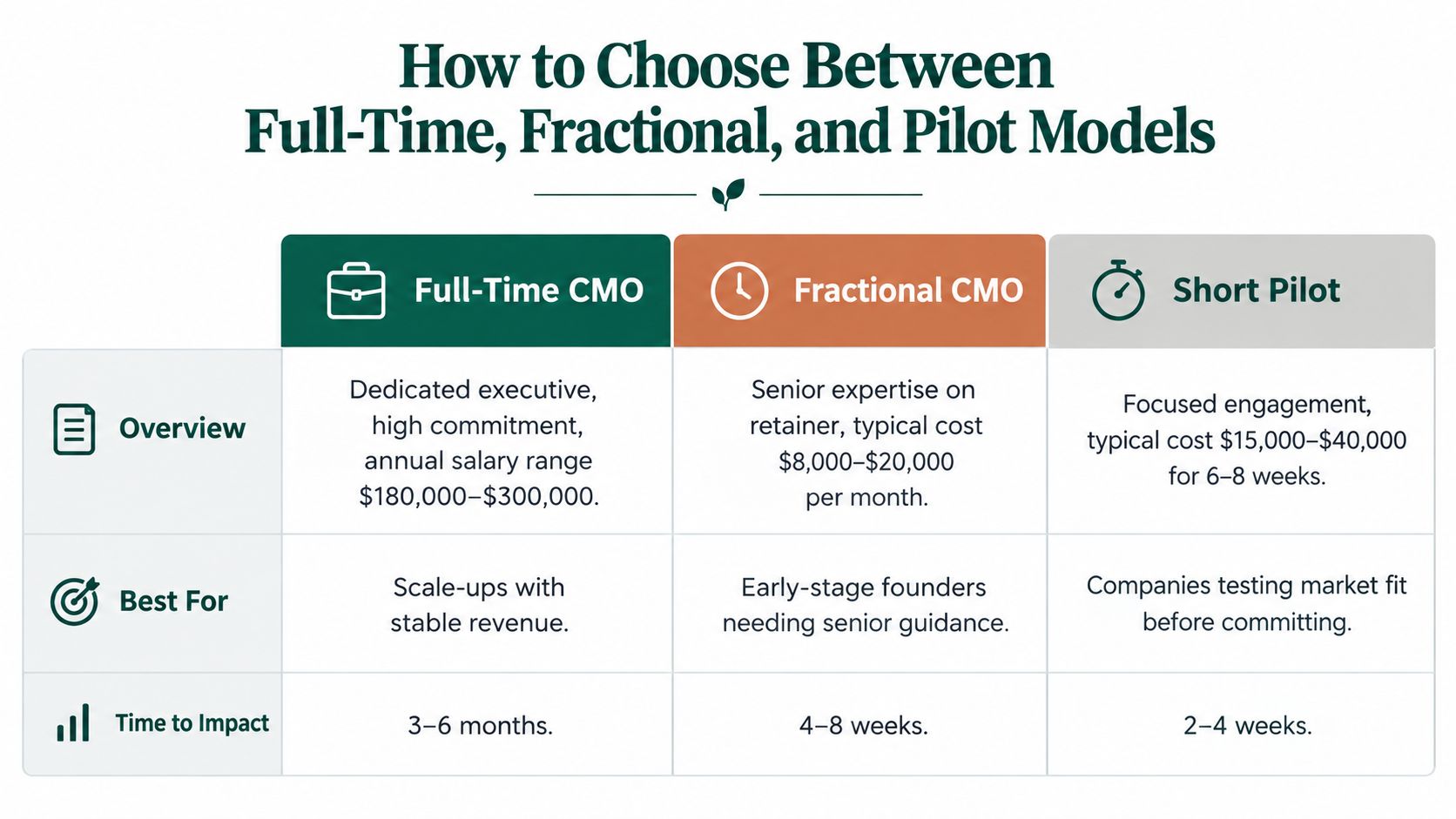
| Model | Best for | Cost band | Speed to senior judgment | Risk level |
|---|---|---|---|---|
| Full-time CMO | Scale-ups with stable revenue | $180,000 to $300,000 annual salary range, as shown in the comparison visual | Slower, because hiring and onboarding come first | High commitment |
| Fractional CMO | Early-stage founders needing senior guidance | $8,000 to $20,000 per month, as shown in the comparison visual | Faster, with focused senior involvement | Moderate |
| Short pilot | Companies testing market fit before committing | $15,000 to $40,000 for 6 to 8 weeks, as shown in the comparison visual | Fastest, when the decision is tightly scoped | Contained |
A pilot shouldn't be a discounted retainer with vague continuation implied. Define the question first. Is the company testing a segment, a message, a sales motion, a channel, or the viability of a senior marketing function?
Then agree on:
The fractional CMO model can suit teams that need both strategic direction and hands-on coordination, but founders should still define the boundaries. A fractional leader shouldn't become an expensive approval layer for every email or campaign.
The best commercial structure reduces the cost of being wrong while preserving access to serious judgment.
A founder at a B2B SaaS company has a strong product, inconsistent pipeline, and a sales team blaming marketing for poor lead quality. Three firms make the shortlist. One presents a large channel plan before asking about win rates. Another promises an aggressive content engine. The third spends the first call asking which segment closes fastest, why deals stall, and what buyers say after losing to alternatives.
The third operator gets the serious evaluation.
The founder asks each candidate for a sample diagnostic, two references from companies at a similar stage, a proposed decision cadence, and an explanation of what the first month won't include. Strong operators don't promise immediate scale before they've inspected the commercial system.
Ask:
Red flags appear quickly. Beware a fixed channel mix presented as universal, a promise of pipeline without access to sales data, a large asset list with no adoption plan, and a consultant who can't explain how the team will make a decision to stop.
Founders evaluating outside partners can also use this practical resource on how to choose a marketing agency in Sydney, particularly for assessing fit, scope, and accountability before signing.
The first weeks should create clarity, not noise. Expect customer and sales interviews, CRM and pipeline review, competitive analysis, website and messaging inspection, and a written set of hypotheses. Channel spend may come later.
A credible kickoff ends with a short list of commercial decisions, named owners, evidence gaps, and an agreed pilot sequence. If the team is already producing a high volume of content before those questions are answered, it's moving faster than it's learning.
GTM consulting should change the next commercial decision, not hand over a stack of outputs. Choose the model around the decision you need to make, the capability you already have, and how much ownership your team can carry.
Use a diagnostic when the core problem is still unclear. Use a scoped pilot when the decision is clear and you need proof before you commit. Use fractional leadership when you need senior judgment and continuity without hiring full time.
The same evaluation criteria apply to Big Moves Marketing. Look for named decision gates, measurable pilots, and a documented handover. If your next commercial decision is which segment to commit to, start with a scoped diagnostic rather than a channel plan.



%20-%20white.svg)