%20png%20copy.avif)
Most B2B SaaS marketing is a frantic exercise in throwing channels at a wall to see what sticks. This isn’t a strategy; it’s an expensive form of hope. A real marketing strategy process is a disciplined, first-principles system for creating leverage. It's built on a non-negotiable foundation: insight before execution. Every dollar and hour must be spent on validated assumptions, not founder intuition.
Founders I work with are often convinced their marketing problem is one of omission. They believe that adding one more channel—LinkedIn ads, a podcast, more SEO—will unlock the pipeline. This is a fundamental misdiagnosis.
The problem isn't a missing tactic; it’s a broken process.
Most teams approach marketing strategy backward. They prioritize action over answers, jumping straight into campaigns and content production before they have clarity on the questions that determine success or failure.
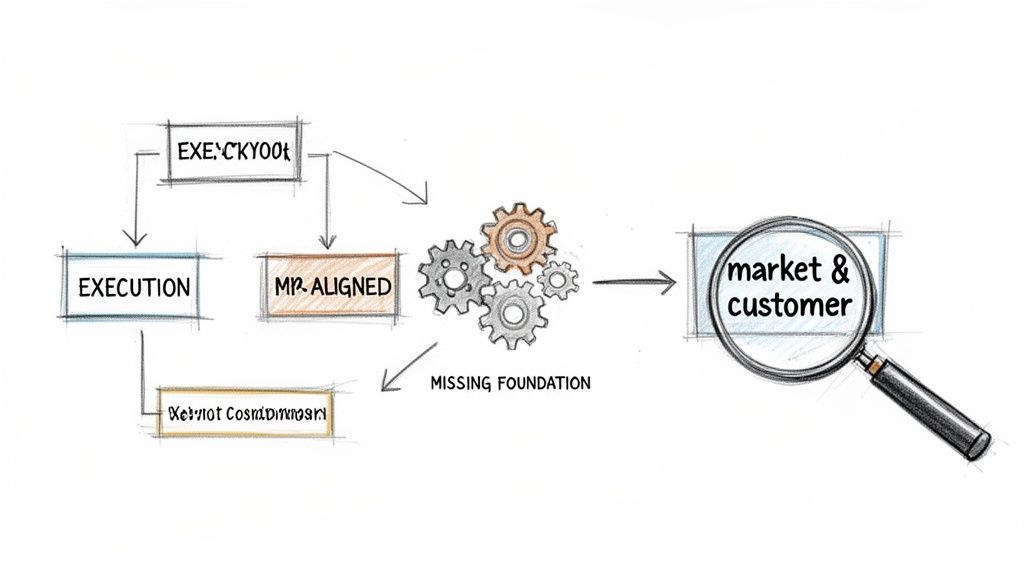
This backward process guarantees wasted capital, burned-out teams, and immense frustration. It typically unfolds like this:
The root cause of failure isn't poor execution on a specific channel; it's the complete absence of a strategic foundation. You're building a house on sand.
A list of marketing activities is not a strategy. A content calendar is not a strategy. A plan to run Google Ads is not a strategy. These are the outputs of a strategy, but somewhere, we began mistaking the artifacts for the work.
A true marketing strategy process is a system for making difficult choices under uncertainty. It forces painful specificity about who you serve, how you win against credible alternatives, and what unique value you deliver. Getting there requires an understanding of a real strategic planning process, which is about making deliberate, informed trade-offs. You can learn more about how a structured approach works by reviewing resources that explain What Is Strategic Planning Process. This forces you to move beyond generating activity and start creating impact.
This guide provides a new model—a first-principles framework that builds leverage from the ground up, starting with deep market and customer diagnosis. We will dismantle the typical marketing process and rebuild it, ensuring every action is a direct result of sharp, evidence-backed insight.
When you fix the inputs, you'll find that challenges like lead generation for SaaS begin to resolve themselves. This is how you stop guessing and start building a GTM engine that actually works.
The first and most violated rule of building a marketing strategy is this: diagnose before you prescribe. Founders and marketing leaders, driven by a bias for action, almost always jump straight to solutions before they have a stable grasp of the problem.
This is where expensive mistakes are born. It’s how you commit six months of runway to a GTM motion based on a gut feeling, or burn capital on ads targeting an audience that will never buy.
The diagnostic phase isn't about brainstorming. It’s a period of ruthless honesty and structured listening, designed to build an evidence-based foundation for every decision that follows.
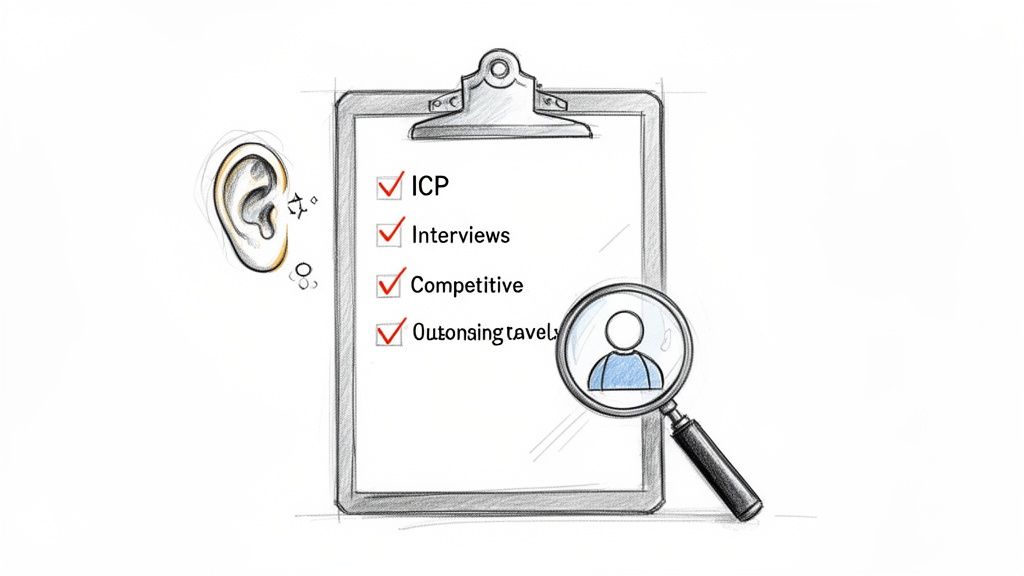
Your Ideal Customer Profile (ICP) is likely a mix of assumptions, aspirational targets, and legacy accounts that no longer fit. The first job is to untangle it. This isn't about creating personas; it's about defining the firmographic and behavioral DNA of companies that get the most value from your product with the least friction.
Your true ICP lives at the intersection of three realities:
Anything outside this intersection is noise. The goal is to define a precise, falsifiable ICP you can use to disqualify prospects as effectively as you qualify them. Without this clarity, your team is wasting cycles on low-probability deals.
With a refined ICP, it’s time to talk to the people who represent it. These are not sales calls or feature-request sessions. The goal is to map their reality—their pain, their buying triggers, and the exact language they use to describe their world.
This isn’t new. The shift to customer-centric planning began in the 1950s, moving businesses from a sales-push model to one grounded in understanding customer needs. This thinking shaped modern B2B strategy, recognizing that skipping deep customer insight is a primary reason why 90% of startups fail.
Stop asking customers what they want. Instead, ask them to tell you the story of the last time they struggled with the problem you solve. Listen for the moment they realized their old way wasn't working. That's your trigger.
Ask questions that uncover their workflow before they bought your tool. Dig into the real cost of their problem—not just financially, but in team frustration, wasted time, and career risk. This is where you find the emotional and rational drivers that form the foundation of all effective messaging.
Finally, you need an unsparing view of the competitive landscape. Most teams do this wrong, creating feature-comparison charts that are useless in a sales conversation. A strategic competitive analysis deconstructs your competitors' positioning, not just their product.
For your top three competitors, answer these questions:
This analysis reveals where you can create differentiation that matters to your ideal customer. It shows you the ground you can credibly claim and defend. For a deeper dive, check out our guide on building a competitive analysis framework that focuses on strategy over tactics.
Only when these three diagnostic pillars—ICP clarity, customer reality, and competitive positioning—are firmly in place can you begin to think about solutions. Prescription without this diagnosis is malpractice.
You’ve done the diagnostic work. You have customer interviews, market data, and competitive intel. Now what?
This is where strategy begins—translating raw insight into a defensible market position. It’s also where most B2B SaaS marketing defaults to generic, feature-led value propositions that sound identical to everyone else.
Positioning isn't a tagline or a mission statement. It is the core argument for why a specific customer should choose you over their other credible options, including the status quo. It’s a deliberate choice to be meaningful to a select few rather than invisible to many.
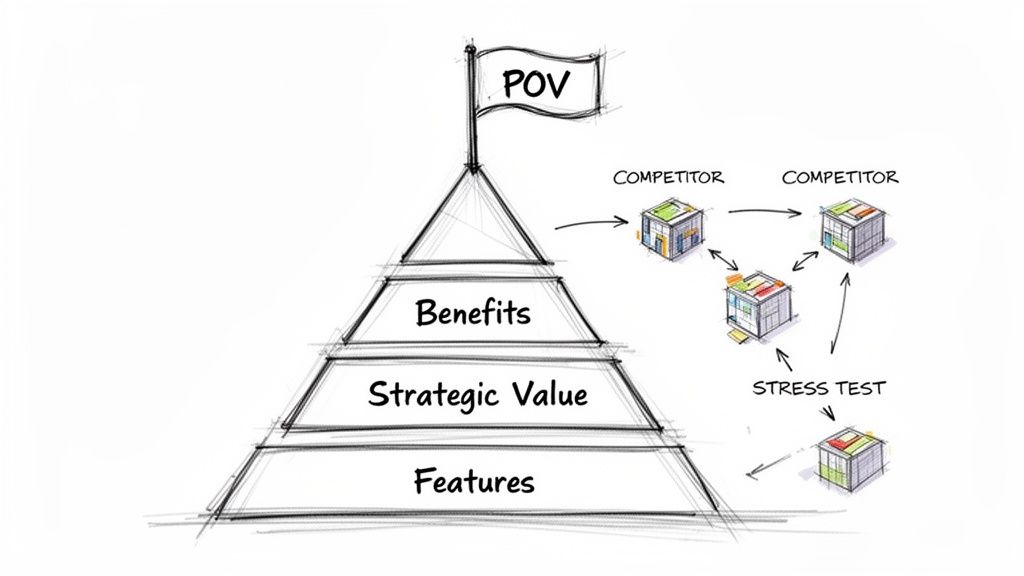
Every great B2B SaaS company is built on an opinionated Point of View (POV). This is your take on the market, the problem, and the future. A weak position talks about what the product does; a strong POV explains why it matters in a way that directly challenges your customer's current thinking.
Your POV becomes the organizing principle for your entire go-to-market motion. It dictates not just ad copy, but how your sales team frames discovery and how your product team decides what to build next.
A strong Point of View acts as a filter. If it doesn't immediately disqualify some buyers, it's not sharp enough. You are not building a solution for everyone. You are building the only solution for a specific someone who shares a specific worldview.
The power of segmentation has been a cornerstone of strategy for decades. Pepsi’s "Pepsi Generation" campaign didn't try to win over everyone. They targeted a younger audience, a move that lifted their market share by 10%. The same principle holds true today, with Gartner reporting that 68% of B2B revenue is driven by well-executed segmented strategies. For SaaS founders, the lesson is clear: a generic value prop is a death sentence.
With a clear POV, you can build a messaging hierarchy. This framework is your best defense against the "feature dump" on sales calls. It connects what your product does to what your ideal customer values.
The structure is simple but powerful:
Sales teams often get stuck at the feature level. Your job is to arm them to have conversations about strategic value—the language of executive buyers. You can learn more about this in our guide on how to write a positioning statement.
The table below breaks down how to bridge the gap from diagnostic inputs to actionable positioning.
This framework ensures your messaging is always rooted in customer reality and strategic choices, not just a list of product capabilities.
Your positioning can't live in a forgotten Google Doc. It needs to be operationalized. That’s why you create a Value Proposition Playbook.
This is a comprehensive internal asset that becomes the single source of truth for how your company talks about its value.
A solid playbook includes:
This playbook is the foundational asset that enables consistent communication across marketing campaigns, sales pitches, and customer success conversations. It's the critical bridge from diagnosis to a winning market position.
A brilliant strategy locked in a slide deck is worthless. Its value comes from execution—the go-to-market (GTM) motion that connects your positioning to real-world sales conversations and pipeline.
This is where most strategies die a quiet death. Misalignment.
Your GTM motion isn't just a list of channels. It's the operational system designed to bring your positioning to life. The two most critical levers are disciplined channel selection and rigorous sales enablement. Get these right, and your strategy breathes. Get them wrong, and you're just making noise.
The default founder mindset is to "be everywhere." This is a catastrophic mistake that guarantees mediocrity. Your goal isn't maximum reach; it’s maximum resonance with your ICP.
You get there by ruthlessly focusing resources on one primary and, at most, one secondary channel. That’s it.
The selection criteria are simple: where can your unique message and sales process be delivered most effectively?
The most common error is choosing a channel because your audience is there, without asking if your message can cut through the noise in that specific context. When aligning your GTM motion with strategy, using the right platforms and tools is crucial. For instance, exploring various LinkedIn growth tools can optimize your B2B SaaS outreach.
A channel isn't just an audience aggregator. It’s an environment with its own rules of engagement. Your strategy has to fit the environment, not the other way around.
Your sales team is the final and most important delivery mechanism for your strategy. If they aren't equipped to articulate your positioning with confidence and consistency, every preceding step is irrelevant.
This is where sales enablement becomes a core marketing function. It’s not about creating pretty slides; it’s about translating strategic concepts into battlefield-ready tools.
Structured sales assets aren't new. The Sears Roebuck catalog, launched in 1888, was a masterclass in systematic positioning, allowing the company to scale by delivering a consistent message. Today, 70% of successful SaaS launches rely on modern digital "catalogs"—like pitch decks and messaging frameworks—to achieve the same goal.
Your non-negotiable enablement assets must include:
Without these core assets, every salesperson invents their own version of the company story. This fractures your market presence and signals a lack of strategic coherence. True alignment means the message crafted in the positioning phase is the exact message delivered in every sales conversation.
Check out our guide to learn more about the 5 steps to align B2B marketing and sales for a deeper look at this critical relationship.
Most B2B SaaS marketing teams drown in data but are starved for insight. They track vanity metrics—website traffic, MQL volume, social engagement—not because they signal business health, but because they’re easy to measure.
This fixation on activity is a critical failure. It creates a dangerous illusion of progress while masking deep strategic flaws. A spike in MQLs means nothing if those leads never convert. A viral post is irrelevant if it attracts the wrong audience.
Measuring the wrong things is worse than measuring nothing at all. It actively encourages your team to optimize for outcomes that have no causal relationship with revenue.
The goal of measurement isn't to create a dashboard that makes marketing look busy. It’s to get an honest answer to the question: "Are the core assumptions of our strategy—our ICP, our positioning, our chosen channels—working?"
To get a real signal, you must elevate your focus from the noise at the top of the funnel to the truth at the bottom. The health of your GTM strategy is reflected in how efficiently you create qualified pipeline and turn it into revenue, not how many eyeballs you attract.
This demands a ruthless focus on three core strategic indicators:
Pipeline Velocity: The ultimate measure of GTM health. It tells you how much qualified pipeline is being created and how quickly it's moving through the sales process. Accelerating velocity means your strategy is resonating.
Sales Cycle Length: Are deals closing faster, or are they getting stuck? A shortening sales cycle is a strong signal that your messaging is clear, your positioning is sharp, and you’re effectively equipping sales.
Win Rates by Segment: Are you winning deals against key competitors and the status quo, especially within your target ICP? High and improving win rates validate your differentiation.
These metrics are uncomfortable because they are tied directly to revenue. They leave no room for ambiguity. They force honest conversations between marketing, sales, and leadership. They are the only metrics that truly matter. For a deeper look into connecting activities to financial outcomes, our guide on how to measure marketing ROI provides a structured approach.
One of the biggest mistakes teams make is trying to track too much. All you need is a simple scorecard to keep leadership focused on these core indicators. It's a high-level summary you review quarterly to make smart, high-leverage adjustments.
It’s about shifting the conversation away from metrics that are easy to game and toward those that tell the real story.
This scorecard forces a massive shift in conversation, moving from "How many leads did we get?" to "Is our strategy creating valuable pipeline faster?" That is the only question that drives intelligent iteration.
This isn't about A/B testing button colors. It's about building a system for stress-testing your most fundamental strategic assumptions against market reality. When these strategic indicators trend in the right direction, your marketing strategy is working. If they stagnate or decline, you have an early warning that a core part of your strategy is broken and needs to be revisited—starting with diagnosis.
Your marketing strategy isn't a document you create once and file away. It’s a living system—a continuous loop of diagnosis, positioning, execution, and measurement. Treating it like a static checklist is the fastest way to become irrelevant.
The process outlined here is designed to force a mindset shift from reactive, tactic-driven marketing toward a proactive, strategy-led approach. Every action becomes a deliberate test of a core assumption. This is the only sustainable way to escape the cycle of wasted marketing spend that cripples so many promising B2B SaaS companies.
Too many leaders view their marketing plan as a set of deliverables. Once the positioning deck is done and campaigns are launched, they mentally check the box. This is a critical mistake.
The market doesn't stand still. Competitors adapt, and customer needs evolve. A static plan is obsolete the moment it's written.
Think of your strategy as a dynamic engine. The key metrics that power this engine are pipeline velocity, cycle length, and win rates.
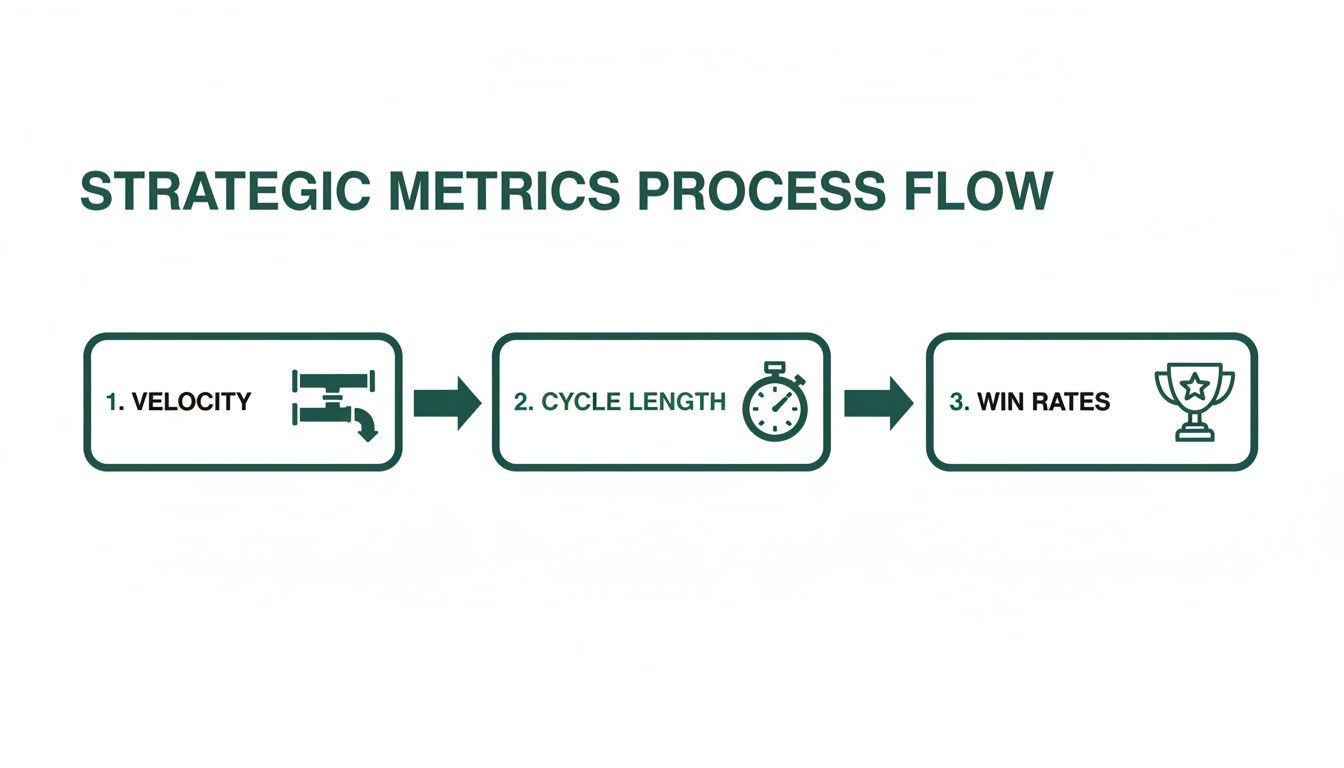
These are the vital signs of your GTM system. They provide the feedback loop that tells you if your strategic engine is running smoothly or needs a tune-up.
A great strategy isn't a map; it's a compass. It provides a clear direction and a framework for making intelligent decisions in motion, not a rigid set of turn-by-turn instructions that will inevitably lead you off a cliff.
Embracing this marketing strategy process as a system builds resilience and agility. It empowers you to stop reacting to the market and start shaping it, creating a GTM function that consistently drives the business forward.
Here are straight answers to the high-stakes questions I hear most often from B2B SaaS founders.
Conduct a full, top-to-bottom strategic review once a year or whenever a major market shift occurs—a new competitor gaining significant share, a fundamental change in buyer behavior. That is the time to pull everything apart and rebuild.
The measurement and iteration part of this, however, is a quarterly ritual.
The leadership team should be reviewing the GTM Health Scorecard every quarter, analyzing pipeline velocity, sales cycle length, and win rates. This is for course correction, not a complete overhaul. Do not mistake a tactical campaign review for a strategic assessment.
The single most costly error is skipping the Diagnosis phase and jumping straight to Execution. It happens constantly. Founders are so invested in their product that they assume they know their customer and their market position.
This is a fatal assumption.
It leads to building entire go-to-market motions on unvalidated beliefs, which is the number one cause of wasted time and capital.
Rigorous, unbiased diagnosis is not optional. It's the only thing that separates a well-crafted strategy from an expensive gamble.
Yes, but the emphasis shifts. The core principles—understanding the user, positioning your value—are universal, but the application is different.
For a Product-Led Growth (PLG) company, the 'Diagnosis' phase leans heavily on quantitative user behavior inside the product. What are users doing? Where are they getting stuck?
The fundamental goals of understanding your user and positioning your value are identical. The execution just happens closer to the product itself.
At Big Moves Marketing, we help B2B SaaS founders move from assumption-driven tactics to a rigorous, insight-led marketing strategy process. If you need clarity and a real plan to build a GTM engine that works, let’s talk.
Explore Big Moves Marketing services and resources:




%20-%20white.svg)