%20png%20copy.avif)
Most B2B SaaS founders operate under a dangerous assumption: a meticulously detailed B2B go-to-market strategy is the key to a successful product launch. This is a critical error.
A GTM plan outlines market-facing actions. It says nothing about the internal behavioral shifts required to execute them. This gap is where launches die.
Founders and GTM leaders pour hundreds of hours into perfecting their launch strategy. They build meticulous plans, craft what they believe is razor-sharp messaging, and assemble a library of sales enablement assets.
Then, the product launches. The revenue engine sputters. Sales teams default to their old, comfortable talk tracks. The pipeline stays stubbornly flat, and that expensive new pitch deck gathers digital dust.
The problem isn't the plan. The bottleneck is your organization's inability to internalize and execute the new strategy.
Your GTM plan describes what needs to happen in the market. A change management method dictates how your team must adapt its behavior to make it happen. Conflating the two is a recipe for a failed launch.
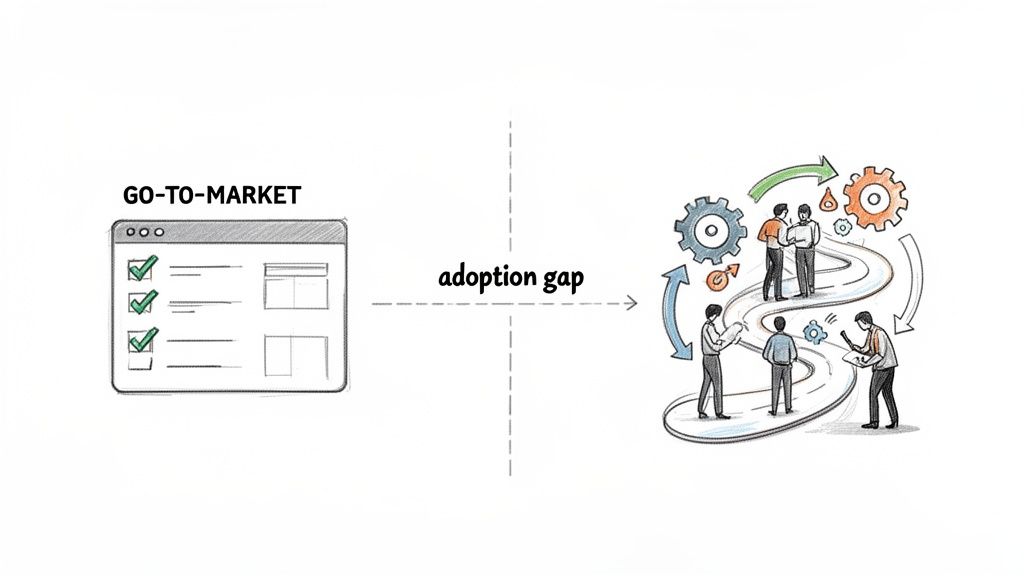
A new product launch isn't a marketing event; it's an internal transformation project. You're asking teams to abandon habits, unlearn comfortable routines, and adopt new ways of working.
Without a formal process to guide these shifts, you're distributing documents and hoping for adoption. Hope is not a strategy.
The data confirms this is a losing bet—only 34% of change initiatives succeed. The rest fail due to poor employee adoption and resistance. For founders, this means every dollar sunk into pitch decks and battlecards is wasted if the team doesn't truly embrace the new way of operating. Research consistently shows that projects with excellent change management dramatically improve their odds.
The hard truth is that your beautifully crafted GTM strategy is inert without an operational framework to drive its adoption internally.
Treating a launch as an exercise in organizational change is the only path to predictable revenue. It forces you to focus on the real work: rewiring the behaviors of the teams responsible for its success.
The world of change management is drowning in academic theory—a graveyard of dense, bureaucratic frameworks too slow for B2B SaaS reality.
As a founder or GTM leader, you don’t need to be a scholar. You need a handful of battle-tested tools that provide leverage, not friction.
This is where most teams get it wrong. They either wing it, relying on hope, or they grab the first popular framework they find without understanding its strategic trade-offs in a fast-moving tech company. The goal isn’t to check a box; it's to pick a tool that accelerates adoption and stops your launch from stalling.
Forget the exhaustive textbooks. For a SaaS launch, only a few concepts truly matter. Let's break them down as operational tools with real-world strengths and weaknesses.
Lewin’s Model (Unfreeze-Change-Refreeze): The original change model, appealing in its simplicity. You prepare the organization (Unfreeze), implement the change (Change), and lock in the new way of working (Refreeze). It provides a clean, high-level sequence. The problem? That "Refreeze" step is a fatal flaw for any agile team. Cementing a new state is completely at odds with the iterative nature of modern SaaS, where GTM feedback loops are constant. It's a decent mental model for a massive, one-time shift, but too rigid for day-to-day execution.
Kotter’s 8-Step Process: Developed by Harvard professor John Kotter, this model excels at building momentum. It starts by creating urgency, forming a guiding coalition of leaders, and stacking short-term wins. This is effective for mobilizing an organization around a big, strategic pivot. The downside? It’s very top-down and procedural. For an early-stage company, marching through all eight steps can feel like performative corporate theater, bogging you down when speed is essential.
The ADKAR Model: This is the most practical change management method for a SaaS product launch. Developed by Prosci, ADKAR focuses on the individual's journey through change. It’s an acronym for the five outcomes every person needs to achieve for true adoption: Awareness, Desire, Knowledge, Ability, and Reinforcement.
Unlike models focused on organizational steps, ADKAR is a diagnostic tool. It forces you to ask the right questions: Does the sales rep have Awareness of why this new product matters? Do they have the Desire to sell it? The Knowledge to pitch it? The Ability to demo it confidently? And is there any Reinforcement to ensure they don't revert to old habits?
This focus on the individual gets to the heart of why a sales team defaults to the old product or why marketing fails to internalize new messaging. It shifts the entire focus from "Did we launch the product?" to "Did our people adopt the change?"
To ensure these models drive results, ground them in a practical planning approach. Using a backwards planning framework can tie your change initiatives directly to concrete outcomes from day one.
Choosing a method isn't about finding the "best" one in a vacuum; it's about picking the right tool for your company's culture, speed, and launch challenge. A good model provides just enough structure without killing startup momentum.
As you weigh these options, think about how the change model will fit into your broader strategy. The same way different marketing activities must work together, your change method needs to complement your overall plan. You can learn more about how these elements combine by exploring the basics of a marketing mix in our related guide.
| Method | Core Principle | Best For SaaS When... | Potential Downside |
|---|---|---|---|
| Lewin's Model | Prepare, implement, solidify. | ...making a single, permanent structural change, like a merger. | Too rigid and linear for iterative product launches and agile teams. |
| Kotter's 8-Step Process | Build urgency and mobilize the organization top-down. | ...driving a company-wide strategic transformation with executive buy-in. | Can be overly bureaucratic and slow for small, nimble teams. |
| ADKAR Model | Drive individual adoption through five sequential outcomes. | ...launching a new product or feature that requires sales team behavioral change. | Requires focused effort to manage each person's journey; can fail without strong leadership. |
For most B2B SaaS launches, the real leverage comes from managing individual adoption. While Kotter's model has its place for massive transformations, its process overhead is often too high. Lewin’s model is a helpful concept but operationally clunky for tech.
ADKAR provides the most direct, actionable, and diagnostic change management method for the core challenge of any product launch: getting your revenue teams to change their behavior and actually sell the new thing.
Picking a change management method isn't about grabbing the most popular framework off the shelf. It's about finding the right tool for the job. Too often, founders go with the one they've heard of—usually Kotter or ADKAR—without assessing if it fits their company.
This is a critical mistake. The wrong framework creates friction and bureaucracy right when you need speed and momentum.
The right method gives you just enough structure to get everyone rowing in the same direction without killing the energy a new product launch needs. It has to be an advantage, not a hurdle. The choice comes down to a clear-eyed look at your company across a few key factors.
First, be realistic about the scale of the ask. Is this a minor tweak or a fundamental change in how your team operates?
A classic failure is treating a major change like a minor one. You can't send a memo when you're asking people to rewire years of ingrained behavior.
Your company's stage is a huge factor. A 15-person startup operates differently from a 150-person Series C company, and your change method must reflect that reality.
The change management method you choose must align with your team's existing operating system. Forcing a rigid, top-down process onto a fluid, collaborative startup team is a recipe for instant rejection.
Consider it this way:
This flowchart helps visualize how factors like culture, process, and desired outcomes should guide your choice.
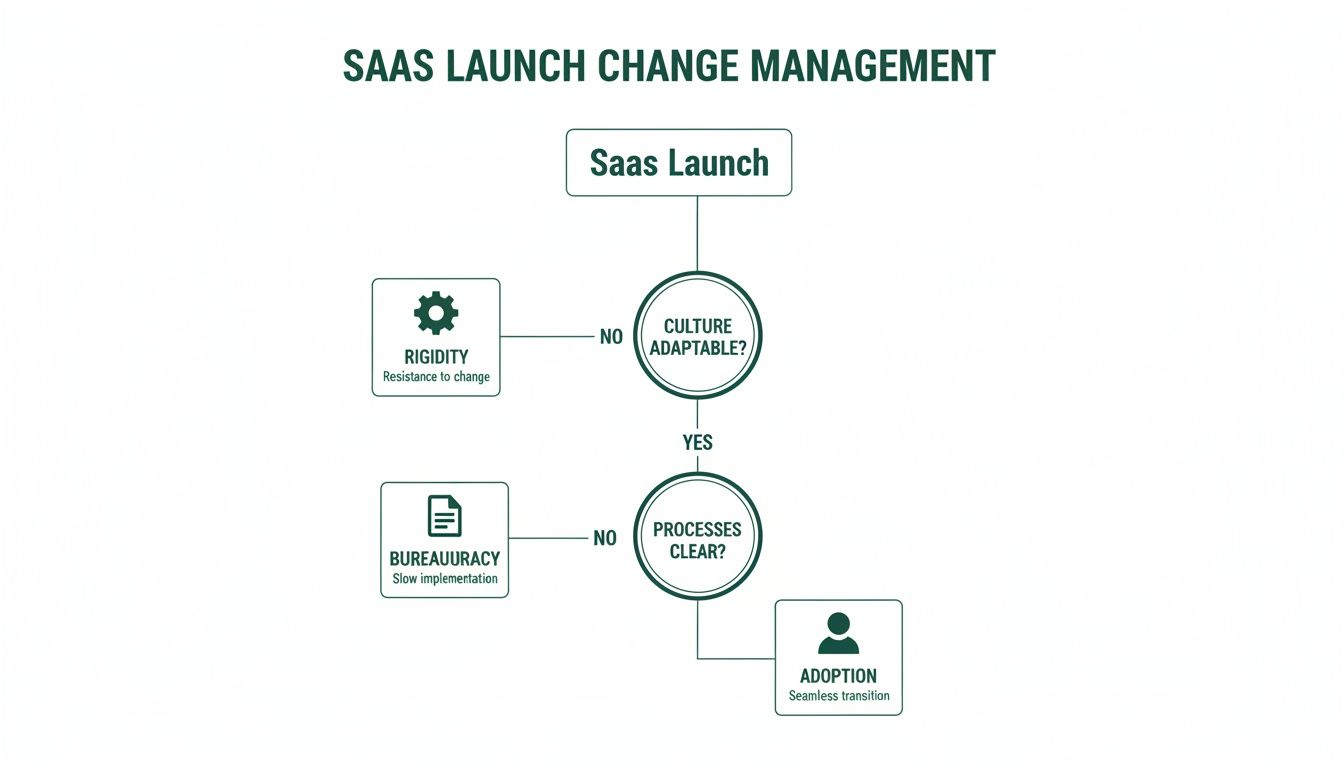
As you can see, successful adoption avoids both rigid, bureaucratic processes and chaotic, unclear ones. It's about finding the right balance of team alignment and process clarity.
Finally, be brutally honest about your company's culture and the market's demands. Is your culture top-down and directive, or bottom-up and collaborative? Is speed the priority, or is perfection more critical?
A top-down culture might respond better to a more directive model. A collaborative one will need a method that invites feedback and co-creation from the start.
Likewise, the timeline is non-negotiable. If you must launch in four weeks, a nine-month change process is dead on arrival. The model must fit the timeline, not the other way around.
Making this choice correctly is a foundational part of your launch strategy. To see how these strategic choices translate into action, check out our detailed product launch plan template. Getting the change management method right is the first, and most important, step in de-risking your entire launch.
Picking a change management model is easy. The real work—where most product launches wobble—is in the execution.
It's a classic founder mistake: you choose a framework, announce it, and assume your team will connect the dots. They won't. This isn't about creating corporate red tape; it's about a clear, focused sequence of actions that works for lean B2B SaaS teams.
This is the playbook stripped of academic fluff, focusing only on the steps that move the needle.
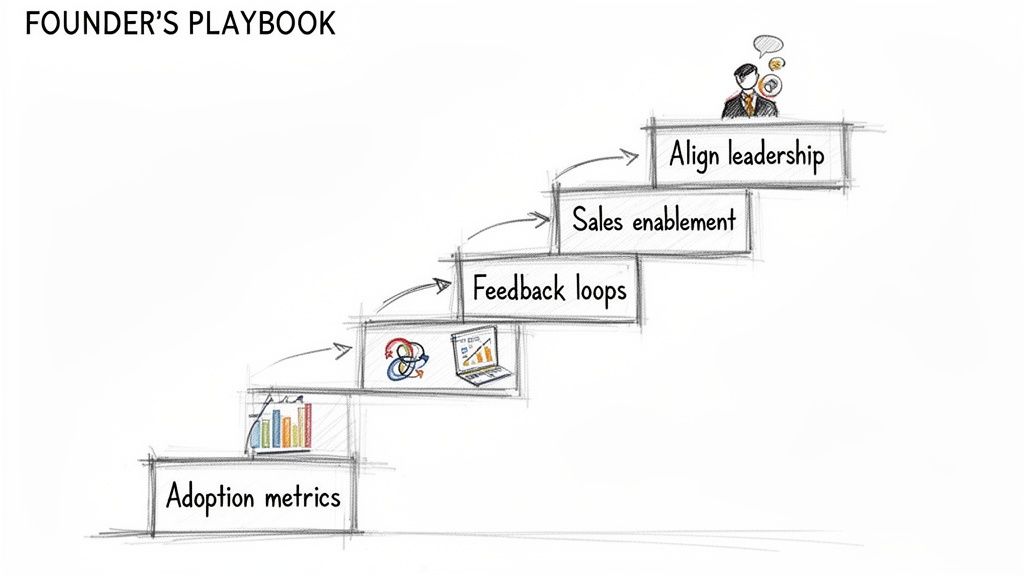
The moment you announce a change, the story splinters. Different leaders offer slightly different versions of the "why," creating confusion and eroding trust.
Before any slide is created or meeting is called, your leadership team must align on one unified message. This isn't a fluffy vision statement. It's a "single source of truth" document answering the hard questions:
This document—an internal memo or short deck—is your anchor. It’s what you point to when conflicting messages arise. Without it, you’re building on quicksand.
Your strategy is just an idea until it lives inside the tools your sales team uses daily. The biggest execution failure is the gap between a high-level plan and the practical assets reps need to sell.
Don't just tell the sales team about the new direction. Arm them to execute it. This means immediately translating your strategy into tangible sales enablement.
Your change initiative isn't real until a sales rep can confidently use a new pitch deck, shut down a tough objection with a new battlecard, and articulate the new value prop in an email.
This requires a tight feedback loop. The people building the enablement must work directly with a small group of trusted reps to pressure-test everything. Does the new messaging land? Is it easy to say? Does it answer real prospect questions?
Expect resistance and confusion. They are part of the process. The fatal error is letting these issues fester in private DMs. You must build systems that bring problems to the surface, fast.
Don't wait for the quarterly all-hands. Set up immediate, low-friction ways for people to give feedback.
This isn't about making everyone feel heard. It’s a tactical intelligence-gathering mission to find and fix friction points before they derail your launch.
Finally, you must change how you measure success. Most leaders default to lagging indicators like pipeline and revenue. These are important, but they tell you nothing about whether new behaviors are taking hold.
You need to define and track adoption metrics. These are the leading indicators that measure the behavioral shift itself.
Tracking these behaviors provides a real-time view of whether the change is sinking in. If adoption metrics are low, you know revenue goals are in jeopardy and can intervene early. This is how you manage change, not just hope for an outcome. This principle is also core to effective customer onboarding best practices, where tracking early engagement is key to long-term success.
Most change initiatives fail for predictable reasons. Over years of working with dozens of SaaS companies, I’ve seen the same fatal patterns play out repeatedly.
Recognizing these patterns is your first step to writing a different script. This is a pre-mortem—the landmines that will derail your launch if you don’t actively sidestep them.
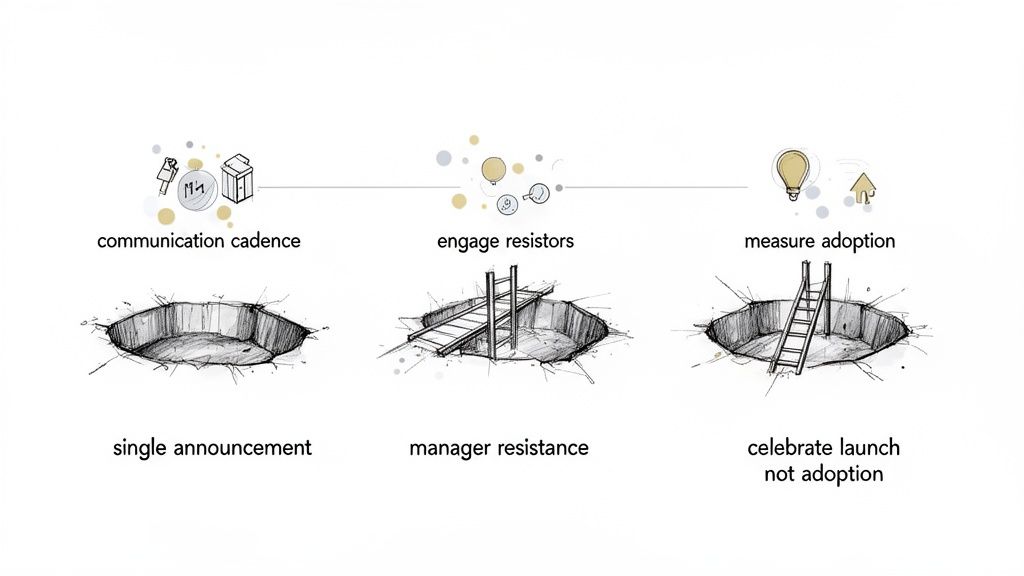
The most common mistake? Believing a single launch memo or a killer all-hands will drive real change. It never does.
You announce the new direction, your team nods, but then... nothing. Their behavior doesn't shift.
The Countermeasure: Implement a deliberate communication cadence. A single announcement is the starting pistol, not the race. Your communication must be a constant drumbeat, reinforcing the "why" and "what" through every channel—Slack updates, weekly huddles, and one-on-one check-ins. Repetition cuts through the noise.
Founders often focus on front-line sales reps, but it’s their managers who quietly sabotage change. Why? Because managers are measured on hitting their team’s number this quarter. Any change that introduces risk to that number is a direct threat.
The Countermeasure: Your sales managers must become your primary change agents. Get them on your side early. Frame the change in terms of how it helps them exceed their targets and makes their team more effective. Equip them to answer tough questions and make their buy-in a non-negotiable part of the plan.
If the leadership team doesn't live and breathe the change, no one else will. When a founder references old positioning or a sales leader tolerates outdated talk tracks, it sends a clear message: this change isn't important.
The Countermeasure: Leadership must be the most visible and consistent evangelists for the change. This means using the new messaging in board meetings, referencing new metrics in company updates, and personally celebrating reps who adopt the new sales motion. Your actions are the real memo.
Speed of execution is a common obsession, but the quality of adoption determines success. Data shows that while 53% of leaders feel pressure to implement changes faster, a collaborative change management method actually cuts implementation time by 33% and boosts engagement. These approaches lift success rates from 34% to 58%, proving that going fast means bringing your team with you. You can explore the research on change management statistics to see these numbers.
Too many teams pop champagne on launch day. This is a mistake. The real celebration should be weeks later, when your adoption metrics prove the change has stuck.
The launch date is a vanity metric; sustained behavioral change is the only metric that matters for your product's life cycle. You can learn more in our guide to the product life cycle and marketing.
The Countermeasure: Shift your definition of "done." Success isn't shipping the product; it's achieving 80% adoption of the new pitch deck or seeing a 20% increase in pipeline from the new messaging. Set clear adoption KPIs and celebrate those milestones with the same energy as a launch.
Effectively sidestepping these pitfalls requires organizational resilience. Understanding concepts like startup failure, pivot, and resilience is crucial for anticipating and neutralizing risks before they derail your growth.
Even with a solid playbook, founders and revenue leaders have tough questions. The theory is easy. The messy reality of running a SaaS company is not.
Here are the straight answers to the questions I get most often from leaders in the thick of it.
Yes. In a startup, "agile" is often a polite word for "chaotic." A formal change management method, even a lightweight one, provides a shared language and a clear roadmap.
This isn't about adding bureaucracy. It’s about eliminating wasted motion. It ensures every single person—from a junior dev to a top sales rep—understands the "why" behind the change, their role, and what winning looks like.
Without that framework, you get misaligned messaging, duplicated work, and internal friction that grinds even the most "agile" teams to a halt.
A simple framework like ADKAR is not red tape for a small team. It’s a checklist that forces you to ensure Awareness, Desire, and Knowledge are in place before you expect action. Think of it as operational discipline that prevents the expensive chaos of a disjointed launch.
Adopting a method forces you to be intentional about the people side of change. That's always where execution breaks down.
Forget vanity metrics like "assets downloaded" or "training sessions completed." They tell you nothing about behavioral change. You must zero in on the leading and lagging indicators of adoption.
Leading indicators are all about behavior. They’re the early signs your team is doing the new thing, long before revenue numbers catch up.
Lagging indicators are the results. They're the business outcomes you wanted, and they only show up after behavior has changed.
Measure the new behaviors, not just the final score. When you tie these behavioral metrics to performance and compensation, you send a clear signal: this change isn't optional. It shifts the conversation from "Did we do the activity?" to "Did our actions create the change we needed?" The principles here are closely related to what you'll find when you learn how to measure marketing ROI effectively.
First, stop thinking of resistance as an obstacle to be crushed. Resistance is data. Your job is to figure out what that data is telling you.
When a top performer or a senior leader pushes back, they're almost always flagging one of three issues:
Don't treat all resistance the same. Diagnose the root cause and address it head-on.
For that skeptical top performer, don't just brief them—enlist them. Ask for their help refining the new messaging. Task them with leading a training session for their peers. Their stamp of approval carries more weight than a dozen memos from the C-suite.
You should also publicly celebrate small wins from reps using the new method. Nothing silences critics like seeing their peers succeed. Most importantly, pull your vocal critics aside and listen. They’re often voicing the unspoken fears of the entire team. Addressing their concerns directly is the fastest way to build trust.
If you've provided support, tools, and clarity, and the resistance continues? Then it's not a change management problem. It's a performance management problem.
At Big Moves Marketing, we help B2B SaaS founders and leaders move beyond theory and execute GTM strategies that drive real revenue growth. If you need to align your team and ensure your next product launch hits its goals, let's connect. https://www.bigmoves.marketing
Explore Big Moves Marketing services and resources:




%20-%20white.svg)