%20png%20copy.avif)

Most advice on a fractional marketing team is lazy. It treats the model as a cheaper substitute for hiring in-house, or as a polished way to say “outsourced marketing.” That’s not the actual decision.
The core decision is structural. Do you need one full-time person to carry strategy, execution, analytics, positioning, and cross-functional alignment? Or do you need a system that gives you the right level of senior thinking and specialist execution at the stage your company is in?
For many B2B SaaS companies, the default hire is wrong. They hire a Head of Marketing too early, expect that person to fix ICP confusion, build pipeline, clean up attribution, support sales, and somehow produce content that sounds like the founder. Then they blame the hire when the model fails.
A fractional marketing team can work. It can also create confusion, drag, and false confidence if you use it badly. The point isn’t whether the model is good. The point is whether it matches your stage, your internal team, and your complexity.
The standard B2B SaaS move is to hire a full-time marketer as soon as growth feels messy. Usually a Head of Marketing. Sometimes a demand gen manager. Occasionally a “strategic generalist,” which is often code for “we want one person to do five jobs.”
That’s the mistake.
Early and growth-stage SaaS companies usually don’t have a single marketing problem. They have a stack of them. Positioning is loose. Sales calls expose message gaps. Paid channels need testing. CRM hygiene is weak. Content sounds generic. Attribution is disputed in every pipeline review. One hire rarely fixes that.

Founders think they’re hiring capability. In reality, they’re creating a single point of failure.
A solo full-time marketer in SaaS gets squeezed from both sides. Leadership wants strategy. The market wants specialized execution. Sales wants enablement. Product wants launches. The website needs rewriting. Paid needs discipline. Reporting needs cleanup. That person ends up context-switching instead of building momentum.
You don’t have a talent problem. You have a design problem.
If your growth motion needs senior judgment plus channel-specific depth, the answer usually isn’t one permanent employee with a heroic job description. The answer is role separation.
Most early marketing hires fail because the company buys capacity when it actually needs diagnosis.
That’s why the comparison between in-house and fractional isn’t just about cost. It’s about failure modes. A bad full-time hire is expensive, slow to unwind, and politically hard to correct. A poorly designed fractional setup can fail too, but it tends to fail faster and more visibly.
Stop hiring based on title first.
Start by asking three questions:
If you’re deciding between a traditional hire and another model, this breakdown of agency versus B2B marketing support models is useful because it forces a fundamental question. Do you need output, or do you need a working marketing function?
Most SaaS teams don’t need a first marketing hire. They need a better first marketing structure.
That’s where a fractional marketing team starts to make sense.
A fractional marketing team is not “a few part-time marketers.” That framing is too shallow to be useful.
This model works like this. You buy a scoped marketing function instead of a single employee. Strategy sits at the top. Specialists plug in where needed. Accountability stays attached to outcomes, not just tasks.
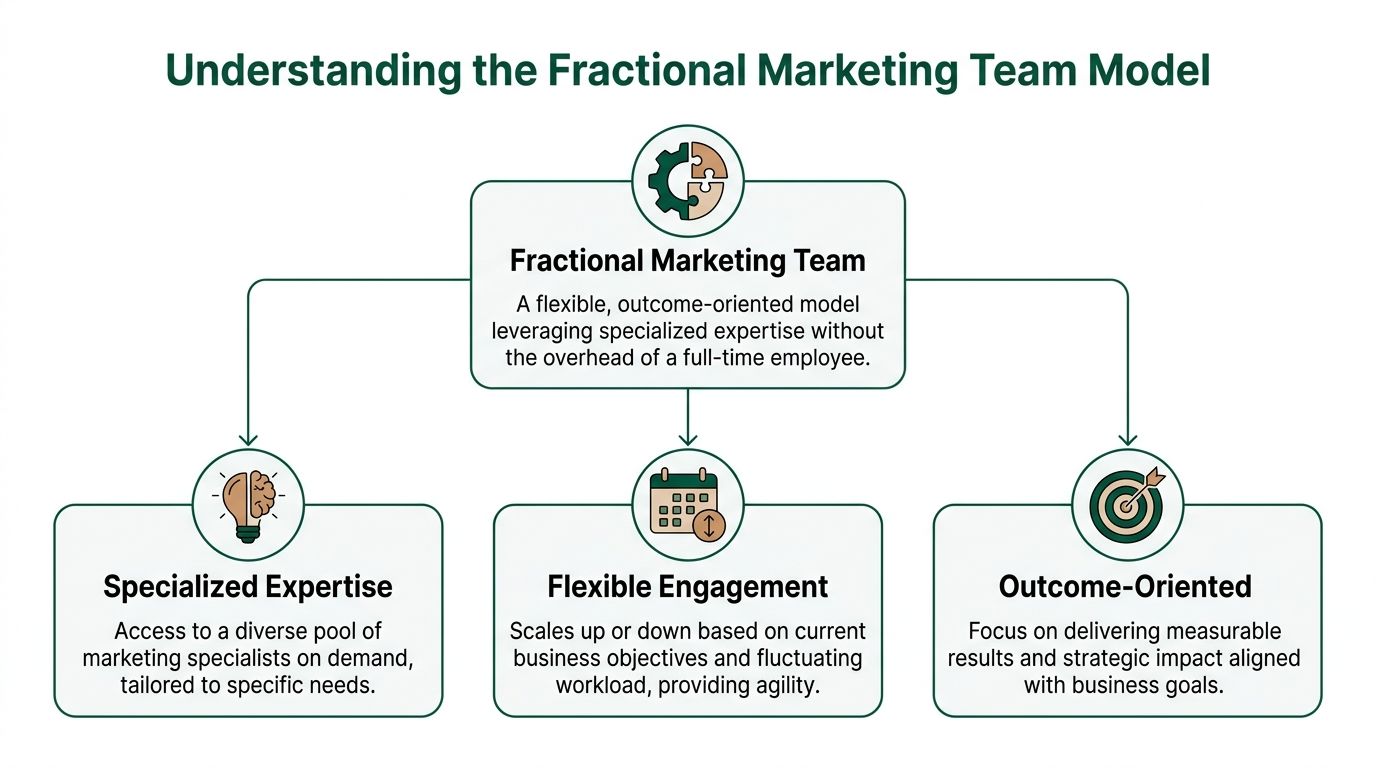
For a B2B SaaS company, a fractional marketing team usually means some mix of:
The value is not part-time labor. The value is role fit without permanent overhead.
According to iFlow Global’s breakdown of fractional marketing team costs and benefits, fractional marketing teams provide 30-60% cost savings compared with in-house hires and can give companies access to specialists in PPC, SEO, content, and design for $3,000-$12,000/month.
That cost advantage matters, but it’s not the main reason the model works. The deeper reason is that B2B SaaS marketing is not one job.
A fractional marketing team is not the same as an agency. Agencies often sell packaged deliverables. Teams buy hours or outputs. The relationship can stay detached from company priorities.
A strong fractional setup should look more embedded than that. It should tie activity to pipeline, positioning, sales friction, and GTM choices.
It’s also not the same as assembling freelancers yourself. You can do that, but then you become the integrator. You manage handoffs, quality, priorities, and decision-making. Most founders are bad at that. They should be. It’s not their main job.
Practical rule: If you have to personally connect strategy, execution, and reporting across three contractors, you do not have a fractional marketing team. You have unmanaged fragmentation.
B2B SaaS has uneven marketing needs. Some quarters demand messaging work. Others demand demand gen testing. Others require sales enablement, website rebuilds, or tighter lifecycle automation.
A fixed in-house team assumes stable needs. SaaS rarely gives you that.
A fractional team is better when your bottlenecks move. You can put senior attention on positioning before a launch, then shift weight toward paid search, content, or ops once the market story is sharper. That’s very different from hiring one generalist and hoping they can stretch across every problem.
If you’re evaluating the strategic leadership piece specifically, this overview of a fractional chief marketing officer is the relevant lens. In most good fractional models, the senior lead isn’t there to “advise” from a distance. They’re there to decide what matters, in what order, and with which specialist support.
Think of a fractional marketing team as modular seniority.
You aren’t renting random capacity. You’re assembling enough strategic and executional competence to move the business forward without pretending one hire can do everything.
That’s why the model can be powerful. It’s also why bad versions of it fail fast. If there’s no clear owner, no prioritization, and no integration with sales and product, then “fractional” just becomes a nicer word for disconnected activity.
A fractional marketing team is not a cheat code. It’s a trade.
You gain speed, flexibility, and access to capability you probably couldn’t justify in full-time headcount. You also give up some immersion, some immediacy, and some of the informal context a strong in-house leader picks up by being inside the company every day.
If you don’t understand both sides, you’ll misuse the model.
The strongest argument for fractional leadership is simple. Senior guidance changes outcomes.
According to GTM8020’s fractional CMO market data, companies adopting fractional CMOs achieve 29% average revenue growth, compared with 19% for companies without senior marketing guidance. The same source notes average engagements last 71 months versus 42 months for full-time CMOs.
Those numbers point to something founders often miss. The value is not just lower cost. It’s sustained senior direction without the churn patterns that often break in-house marketing momentum.
Here’s the honest version.
| Benefit | Trade-off founders must manage |
|---|---|
| Senior expertise | Less day-to-day cultural immersion |
| Flexible staffing | More need for crisp priorities |
| Broader specialist access | More handoffs if leadership is weak |
| Lower fixed overhead | Higher risk of under-scoping critical work |
| Faster ramp in focused areas | Less tolerance for fuzzy ownership |
A lot of founders only hear the left column. That’s how fractional engagements go sideways.
The right column is where the work is.
The biggest failure pattern isn’t quality. It’s integration.
A fractional team can diagnose well and still struggle if the company is disorganized. If product changes priorities weekly, sales ignores messaging, and leadership doesn’t make trade-offs, the external team ends up producing artifacts instead of change.
Another risk is false confidence. A founder sees experienced people in the room and assumes momentum is happening. But if nobody is forcing decision-making, all you’ve bought is better language around the same drift.
A fractional leader cannot compensate for a founder who refuses to prioritize.
There’s also a context problem. Fractional leaders often work across multiple accounts or projects. That can be a strength because they bring pattern recognition. It can also create gaps in informal knowledge. They won’t overhear every customer complaint, every sales objection, or every product debate unless you build systems that surface those inputs.
If you need someone fully embedded to recruit a large team, manage constant cross-functional politics, and operate in the trench every day, the fractional model may be the wrong fit.
If you need sharper strategy, stronger sequencing, and specialist execution without building a heavy org too early, it can be the right one.
That’s why I’d frame the decision like this:
This is the same core build-versus-buy problem that shows up across GTM. If you want a broader strategic lens on that choice, review this build vs buy marketing decision framework.
Most B2B SaaS companies under-hire leadership and over-hire execution. Then they wonder why campaigns don’t compound.
A good fractional marketing team fixes that imbalance. A bad one hides it.
The model works when you use it to create clarity and motion. It fails when you use it to avoid hard leadership decisions.
Most companies don’t need “a fractional marketing team.” They need the right one for their stage.
Founders often make critical errors. They copy a team structure from a later-stage company, layer on paid search before the message is tight, or hire content before anyone can say what the product category really is. Stage mismatch kills efficiency.
The right structure changes as the company changes.
| Stage | Core Fractional Roles | Primary Goal |
|---|---|---|
| Pre-PMF | Fractional CMO or strategic lead, product marketing or messaging support, design or website support as needed | Find message-market fit |
| Post-PMF | Fractional CMO, demand gen specialist, content support, marketing ops help | Build a repeatable demand engine |
| Growth stage | Fractional CMO or senior growth lead, demand gen, product marketing, ops and analytics support | Improve efficiency, scale channels, tighten GTM coordination |
At this stage, most “marketing” problems are clarity problems.
You do not need a broad execution team if you still can’t answer basic questions cleanly. Who is the ICP? What painful problem do they admit in a sales call? Why does your product win? What language makes buyers lean in instead of nod politely?
The right fractional setup is lean:
Bad looks like this. You spend on paid LinkedIn, publish SEO content, and build nurture sequences before the narrative is coherent. That isn’t scale. It’s expensive noise.
Once you have signs that the product resonates, the question changes. Now you need repeatability.
This is the stage where a phased fractional model makes sense. According to Fractionus on B2B SaaS team structure, successful deployments often start with Phase 1 over 30-60 days, where a fractional CMO establishes positioning and messaging. Phase 2 over 60-90 days adds specialists for pilots in LinkedIn, Google Ads, or SEO, often yielding 2x pipeline velocity, while aligning with 40-60% cost efficiency versus full-time hires.
That sequence matters.
You don’t start with channel volume. You start with strategic compression. Then you test channels against a sharper thesis.
A practical post-PMF structure usually includes:
A fractional CMO or senior growth lead
This person decides what not to do. That matters more than founders think.
A demand gen specialist
Someone needs to run disciplined channel tests, not random campaign launches.
Content support
Not for blog volume. For buyer education, sales enablement, category framing, and conversion support.
Ops help
If your CRM and reporting are weak, you’ll misread everything that follows.
If the team can’t tell you which message is landing, which channel is producing qualified demand, and where conversion is breaking, you don’t have a demand engine. You have activity.
By the time you’re into a larger growth motion, the challenge isn’t merely generating more leads. It’s managing complexity without losing signal.
Now marketing has to coordinate with product, sales, customer success, and leadership cadence. PLG and sales-led motions may be colliding. Regional expansion may change your ICP assumptions. Sales wants more pipeline while finance starts asking harder CAC questions.
The fractional setup should reflect that complexity:
At this stage, “bad” often looks more polished. Dashboards improve. Campaigns multiply. The website looks better. Yet pipeline quality drops because positioning drift sneaks in and channel teams start optimizing for easy conversions instead of sales-relevant demand.
That’s why team structure needs to follow the business problem, not org-chart aesthetics.
Founders either overbuild or underbuild.
Overbuilding means hiring too many execution roles before the strategy is stable. Underbuilding means assuming one senior person can both set direction and do all the work.
If you want a more detailed view of how team design should evolve, this guide on how to build your B2B marketing team structure is worth reviewing.
Use a fractional marketing team as a staged system.
Don’t buy a full stack before the business can use it. Don’t starve the function once the business needs it either.
Founders often ask the wrong finance question.
They ask, “What does a fractional marketing team cost?” That matters, but it’s not the decision. The better question is, “What economic problem is this team supposed to solve?”
If the answer is vague, the engagement will disappoint no matter how the pricing is structured.

Not all commercial models mean the same thing.
| Pricing model | What it often signals | Where it works |
|---|---|---|
| Monthly retainer | Ongoing strategic ownership and execution continuity | Best for multi-quarter GTM work |
| Project fee | Narrow scope with a defined outcome | Good for messaging, website, or launch work |
| Hybrid model | Strategic continuity plus defined initiatives | Useful when roadmap and execution both matter |
I generally prefer retainers or hybrid structures for SaaS. Marketing problems compound across time. If the model only pays for isolated deliverables, you often get polished outputs without operating continuity.
That said, project work can be sensible when the bottleneck is clear. Repositioning a category story. Reworking a website. Building a launch narrative. Just don’t confuse project completion with function-building.
The strongest financial case for fractional leadership is not “cheaper than hiring.” It’s “better return on the revenue system.”
According to Breakthrough3x on KPI discipline for fractional CMOs, experienced fractional CMOs achieve an average Return on Marketing Investment of 589% by focusing on KPIs that connect marketing activity to revenue growth, including CAC to LTV ratios.
That’s the right lens. A founder should evaluate a fractional team against business outcomes such as:
If the team is producing assets but not improving those variables, the economics are weak even if the invoice looks reasonable.
Use three buckets.
Revenue impact
Did the team improve pipeline creation, conversion, or expansion support?
Efficiency impact
Did they reduce wasted spend, misaligned channels, or internal thrash?
Organizational impact
Did they improve the operating system? Better messaging, cleaner reporting, tighter planning, stronger handoffs.
The first bucket gets attention. The second and third often determine whether gains persist.
Here’s a useful primer before the video below. Pricing model matters less than whether the team can connect spend, activity, and commercial outcomes.
Don’t pitch a fractional marketing team as outsourced activity. Pitch it as a controlled way to buy missing capability without locking the company into premature fixed headcount.
That argument gets stronger when you can show exactly what must improve: pipeline coverage, message fit, conversion, or go-to-market coordination.
A few firms work in that operating-partner style rather than a pure agency model. Big Moves Marketing is one example in B2B SaaS and tech, where the work spans positioning, messaging, website, and demand generation rather than isolated campaign execution.
If you can’t define the economic problem the team is there to solve, don’t sign the contract yet. Tighten the brief first.
Most founders hire fractional marketing support the same way they hire employees. They review credentials, ask about past wins, and listen for confidence.
That’s not enough.
The primary job is to test whether the person or team can diagnose your business, integrate with your people, and create operating clarity fast. Execution matters. Diagnosis matters more.

Before you talk to candidates or firms, write down four things:
Many searches go wrong when the founder wants strategic help but briefs the market for execution. Or they want execution but secretly hope the team will settle founder disagreements about the ICP.
Ask questions that expose thinking.
Good prompts include:
If you joined us next month, what would you want to inspect first and why?
You want to hear prioritization, not jargon.
What are the most common false positives in SaaS marketing performance?
Strong operators know that lead volume, traffic spikes, and even demo growth can hide weak quality.
How would you work with a sales team that thinks marketing doesn’t understand the buyer?
If they can’t answer this well, integration will be painful.
What would make you say no to this engagement?
Serious people know fit cuts both ways.
Hiring test: If the conversation stays at the level of channels, they probably can’t lead the function.
This is the issue most content avoids.
According to Willowgrey’s analysis of the fractional marketing leader model, integrating a fractional leader with an existing team is a critical challenge, and success hinges on a clear 90-day ramp plan that addresses delegation, strategic direction, and potential friction with existing staff.
That matches what I’ve seen. Fractional leaders don’t usually fail because they lack ideas. They fail because the company never decided whether they were there to lead, advise, or supplement.
If you already have an internal team, make these decisions explicit:
Without that, existing staff will protect turf. They’ll wait out the outsider. That’s predictable.
A strong fractional engagement needs operating cadence.
What you should not do is request endless status updates. Good teams need access to decisions, not just meeting volume.
If you’re at the point of evaluating senior fractional leadership specifically, this guide on how to hire a fractional CMO is a useful complement.
Don’t hire a fractional marketing team to avoid conflict.
If sales and product are misaligned, if the founder changes direction every week, or if no one agrees on the ICP, the external team won’t magically neutralize that. At best, they’ll surface it faster.
That’s still useful. But only if leadership is willing to act on what gets surfaced.
A good fractional marketing team should help you outgrow the need for it in its current form.
That’s the part most providers avoid saying. They shouldn’t. The model has limits.
The biggest one is management bandwidth. A fractional setup works well when the business needs senior judgment, specialist support, and focused operating cadence. It gets strained when complexity rises to the point that the company needs a leader present inside the system every day.
According to Stryve Marketing’s view on fractional team limits, the typical 10-15 hour per week engagement becomes a bottleneck as companies scale, and communication overhead plus continuity risk become real liabilities above the $5M-$10M ARR mark.
That doesn’t mean every company in that range must hire full-time immediately. It means the burden of coordination starts to outweigh the flexibility benefit.
Here are the signals I’d take seriously:
You’ve outgrown the model when the problem is no longer expertise, but sustained internal orchestration.
Don’t make the shift emotionally. Make it deliberately.
A smart progression looks like this:
The mistake is treating fractional as either permanent infrastructure or a short-term patch. It’s neither. It’s a bridge.
Use it to create clarity, process, and traction. Then graduate when the business needs a full-time leader in the foxhole.
If you're deciding whether a fractional marketing team is the right structure for your stage, Big Moves Marketing works with B2B SaaS and technology companies on positioning, messaging, go-to-market planning, and fractional CMO support. The useful first conversation isn't about channels. It's about whether your current marketing problem is really a hiring problem, a strategy problem, or a team design problem.
Explore Big Moves Marketing services and resources:





%20-%20white.svg)