%20png%20copy.avif)
Most advice on hiring senior marketing leadership is wrong because it starts with the org chart. Founders get told to hire a full-time VP Marketing or CMO as soon as growth gets messy. That's backwards. Early-stage and growth-stage B2B SaaS companies don't need a title first. They need judgment, diagnosis, and operating discipline.
If you're trying to hire a fractional CMO, treat it as a risk management decision, not a staffing decision. The right hire gives you strategic clarity, tighter sales alignment, cleaner channel choices, and a faster path out of founder-led marketing chaos. The wrong hire gives you slide decks, channel sprawl, and a polite new way to waste money.
The question isn't whether marketing leadership matters. It does. The question is whether your company can absorb it, use it, and hold it accountable.
The default move is usually the expensive one. Founders assume the first serious marketing hire has to be full-time because full-time feels committed, mature, and scalable. In practice, it often locks the business into a role before the company has clarity on what that role should even own.
That mistake isn't just financial. It's operational. You hire someone too early, give them a vague mandate, expect pipeline, brand, product marketing, hiring, and attribution cleanup all at once, then act surprised when nothing compounds.

A full-time senior marketing hire is often a premature answer to a real problem. This problem is usually one of these:
A fractional CMO is useful when you need a strategic operating layer, not a permanent executive seat. That distinction matters.
Most founders don't need more marketing activity. They need someone who can decide what not to do.
This is why I push founders to avoid hiring for symbolism. You don't hire senior leadership to impress a board deck. You hire it to improve decisions. If the business still has open questions around ICP, ACV fit, founder-led sales dependence, or whether PLG and sales-led motions are fighting each other, a full-time executive can become an expensive passenger.
Current guidance often skips the ugly truth that not every company is ready for this model either. A pre-product-market-fit SaaS with a budget in the $2K to $5K per month range may find a standard $5,000 to $15,000 monthly fractional retainer unrealistic, even if the leadership gap is obvious, as noted in this breakdown of growth-stage fit for fractional CMO hiring.
That's the nuance founders need. Fractional isn't automatically right. Full-time isn't automatically serious.
If you're still searching for repeatability, you may need a sharper advisor, tighter founder-led customer learning, or focused outside help like a startup growth consultant before you commit to any senior marketing structure.
A lot of founders try to hire a fractional CMO when they're tired. That's understandable. It's also a bad filter.
You shouldn't make this decision because marketing feels chaotic. You should make it because the business has reached a point where better strategic coordination will create more output than another junior hire, another agency, or another founder sprint through HubSpot.
If what you really want is someone to “take marketing off your plate,” slow down. A good fractional CMO doesn't remove you from the system immediately. They reduce founder dependence by building a system that other people can run.
That's a different outcome.
The financial logic is usually obvious. For companies in the $1M to $25M revenue range, the total cost of a full-time CMO can exceed $250,000 when salary, benefits, and equity are included, while a fractional engagement at 20 hours per month averages $48,000 to $72,000 annually, according to this analysis of full-time versus fractional CMO cost. That gap matters because most SaaS companies need to preserve capital for product, sales, and delivery, not bury it in an executive hire with unclear scope.
The right timing usually looks less dramatic than founders expect. It's not “growth stalled, hire executive.” It's more specific.
Here are the signals I trust:
The founder is still the routing layer for every important marketing decision.
If messaging changes, campaign priorities, website changes, launch sequencing, or sales enablement requests all go through the CEO, the company doesn't have marketing leadership. It has dependency.
You have a sales motion worth feeding, but not a demand system worth scaling.
This is common post-PMF. Sales can close deals. The issue is inconsistent pipeline quality, weak segmentation, unclear positioning, or random channel activity.
Paid and outbound are running ahead of strategy.
If you're spending money before you have confidence in the buyer story, funnel math, or handoff logic between marketing and sales, you're accelerating confusion.
Your existing team can execute, but they can't prioritize.
Good managers and specialists often know how to ship. They don't always know what deserves attention first.
You need senior judgment across multiple disciplines at once.
Positioning, website narrative, launch planning, demand generation, and sales messaging don't sit neatly in separate boxes in B2B SaaS. They stack.
Practical rule: Hire a fractional CMO when the problem is decision quality across the go-to-market system, not just campaign workload.
A strong B2B marketing consultant can help with strategy, but the fractional CMO model makes more sense when you need recurring leadership, not just point-in-time advice.
Founders also need a list of disqualifiers.
Don't hire a fractional CMO if:
The best use case is simple. You already have something worth selling. You need tighter positioning, clearer priorities, and a senior operator who can turn scattered marketing into a repeatable system.
Most founders over-index on pedigree and under-index on fit. They chase someone with big logos, a polished LinkedIn profile, and a broad story about growth. Then they discover that “growth” meant a very different environment.
A SaaS company selling to mid-market finance teams doesn't need a consumer brand marketer. A product-led tool with low ACV doesn't need the same leader as an enterprise platform with a long buying cycle. Hire for your commercial reality, not your aspiration.
There's a mature talent pool here. In a survey of 261 respondents, over 70% of fractional CMOs reported more than 10 years of marketing experience, with SaaS and tech as a primary client focus, according to this survey on the fractional CMO market. That means you don't need to settle for a generic operator. You can be selective.
What matters most is whether the person can do the hard strategic work that junior teams and agencies usually can't.
Look for someone who has done these things in B2B SaaS settings:
You also need direct experience that maps to your motion.
A strong candidate should be able to talk clearly about contexts like:
Resumes often get misleading. Startup work isn't clean. Titles blur. Teams are small. People often did far more than their title suggests, or far less. If you want a useful lens on how to interpret that ambiguity, this piece on the realities of startup experience is worth reading before you screen candidates.
A practical filter is to ask, “Has this person operated in a company with my kind of sales friction?” Not “Has this person worked at a famous company?”
Some founder instincts are actively unhelpful here.
Ignore these signals unless they connect to actual fit:
A candidate who can't explain why your buyers stall, who your messaging excludes, or where marketing hands off badly to sales, isn't senior enough for the role.
If you want a grounded view of what the role should cover, this explanation of what a fractional CMO does is closer to reality than the usual “strategic oversight” language.
The ideal profile isn't a Swiss Army knife. It's a B2B SaaS operator with sharp commercial judgment, enough channel literacy to direct specialists, and enough backbone to tell a founder when the company is about to fund the wrong motion.
You shouldn't run this search like a normal hire. A fractional CMO engagement is less about volume recruiting and more about pattern matching. You are buying judgment under ambiguity. That means your process needs to expose how the candidate thinks, not just what they've done.
Warm referrals beat broad marketplaces because they come with context. You want someone whose work was observed by a founder, revenue leader, or operator who can speak to how they handled trade-offs, conflict, and prioritization.
My preference order is usually:
Founders get in trouble when they source too widely and evaluate too softly. They end up rewarding charisma, not diagnosis.
Most interviews are useless because they invite polished answers. Ask questions that force the candidate to reconstruct decisions.
Use prompts like these:
Then ask for artifacts. Not polished keynote decks. Ask for working documents they can legally share or describe: a messaging framework, a launch brief, a KPI dashboard outline, a sales enablement doc, a weekly operating cadence.
The best candidates answer with sequence, trade-offs, and constraints. The weak ones answer with language.
Use a scorecard or you'll hire based on vibes. A simple one works better than a complicated one nobody uses.
| Evaluation Criteria | What to Look For | Candidate A Score (1-5) | Candidate B Score (1-5) |
|---|---|---|---|
| Strategic thinking | Can they diagnose root causes, make choices, and explain trade-offs clearly? | ||
| SaaS GTM fit | Have they worked in a motion that resembles your ACV, sales cycle, and buyer complexity? | ||
| Positioning and messaging | Can they sharpen ICP, category framing, and sales-ready messaging? | ||
| Demand generation judgment | Do they know how to prioritize channels and avoid wasted spend? | ||
| Sales integration | Can they define handoffs, shared KPIs, and operating cadence with sales? | ||
| Communication style | Are they concise, clear, and comfortable disagreeing with leadership? | ||
| Execution guidance | Can they direct internal marketers, freelancers, or agencies without becoming vague? | ||
| Cultural fit | Will they work well with your team cadence, decision style, and level of ambiguity? |
A few screening rules help keep the process honest:
One more thing. Don't confuse certainty with competence. The best fractional CMOs are decisive, but they're not theatrical. They know where the actual bottlenecks are likely to be, and they're willing to say “I need access to the data, the calls, and the conversion points before I make that call.”
That's the answer you want.
Good candidates still fail in bad structures. Most fractional CMO disappointments aren't talent problems first. They're scope problems, expectation problems, and cadence problems.
If you want the hire to work, define the engagement around decisions and business outcomes, not a vague promise to “own marketing.”
For most SaaS companies, a monthly retainer is better than an open-ended hourly relationship because it creates consistent attention and recurring accountability. The point isn't to buy random access to a senior marketer. The point is to establish a decision-making cadence.
Pricing needs to reflect what you're buying. Effective fractional CMOs often work on a profit-first model, focus on channels with proven ROI before scaling, and typically charge $200 to $350 per hour or $5,000 to $15,000 per month, with the aim of improving output while protecting margins, according to this analysis of profit-first fractional CMO engagements.
That means a lower retainer usually buys senior oversight, prioritization, and guidance. It does not buy a full in-house marketing department in one person.
If you want one option in this category, CMO as a service is the basic model to compare against agency retainers, solo consultants, and direct fractional hires.
A useful scope of work is concrete. It should tell both sides what gets attention, how decisions are made, and when the engagement should be reconsidered.
Include these elements:
If the scope is fuzzy, the founder will expect execution and the fractional CMO will assume strategy. That mismatch kills the engagement before the work starts.
The structure should protect against two failure modes at once. First, a strategist who never gets access to the inputs required to make good calls. Second, a founder who expects a part-time leader to absorb unlimited execution work.
The first month tells you almost everything. Not because pipeline magically transforms in a few weeks, but because good operators establish signal fast. They clarify the problem, tighten the rhythm, and make a few high-confidence moves that improve the system.
Use the first quarter to test whether this person can build momentum, not just present diagnosis.
Early structure matters. A structured 90-day plan gives the engagement a real chance to work. Benchmarks cited in this 90-day framework for hiring a fractional CMO include a 10% increase in MQLs, 15% gains in marketing efficiency, and a 10% to 20% improvement in website conversion rates. The same source notes that companies with fractional CMOs report a 36% higher likelihood of meeting strategic goals.
Here's the operating view I recommend.
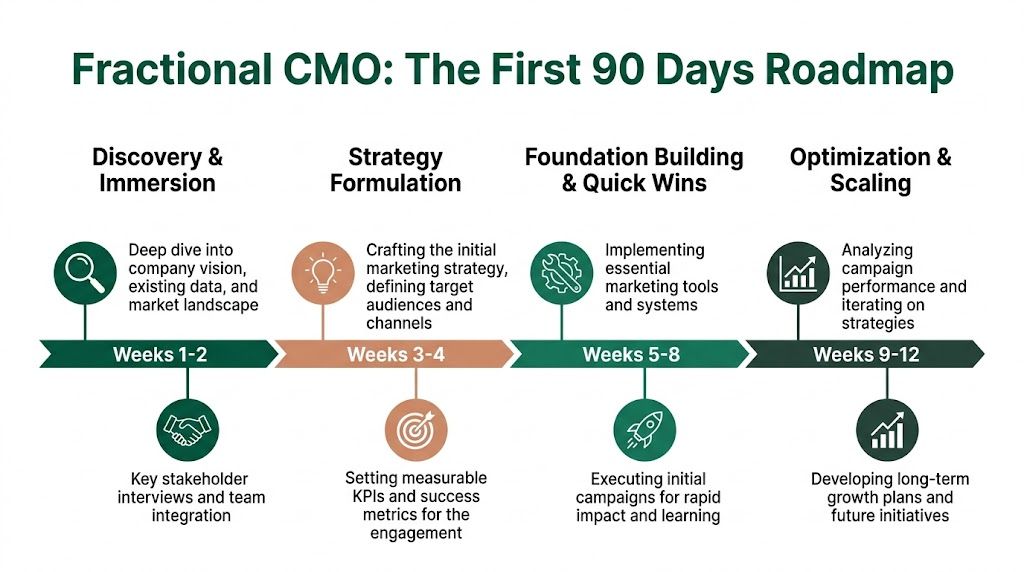
The first phase is about seeing reality without the usual internal distortion. That means access to CRM data, pipeline definitions, website performance, conversion paths, campaign history, sales calls, customer notes, and founder assumptions.
The fractional CMO should be doing work like this:
A good operator also starts building trust quickly. They don't float above the team. They join Slack, show up prepared, and start reducing noise.
This is when strategy has to become operational. Not massive execution. Just enough to validate direction.
The build phase usually includes a handful of core assets:
This is also the point where many engagements drift because founders still expect real-time support from a part-time leader, while sales teams keep moving every day. That integration problem gets ignored in most advice, but it's one of the main reasons these hires disappoint.
Use a simple sales alignment protocol:
If you want a useful mental model for the cadence, this video is worth a look.
By this point, the hire should be moving from diagnosis into control. Not total control. Functional control.
That means:
A good fractional CMO should leave behind dashboards, decisions, and playbooks. Not dependency.
This is also where you test whether the person can build a company capability rather than become a bottleneck with better vocabulary. If everything still routes through them manually, the engagement isn't maturing.
You don't need to wait for month six to know the hire is wrong.
Watch for these signs in the first month:
The right fractional CMO will make the business feel sharper, not busier. Founders should notice cleaner decisions, tighter internal language, and fewer random marketing debates. If all you got was more activity, you hired motion, not leadership.
If you hire a fractional CMO correctly, you're not outsourcing marketing tasks. You're importing senior judgment until the company earns the right to build a bigger function around it.
That's the outcome. Better positioning. Better channel choices. Better coordination with sales. Better hiring decisions underneath the role. Eventually, that should shape the team structure you build next, whether that's a demand gen lead, product marketer, or full in-house executive. If you're thinking ahead on that path, this guide to building your B2B marketing team structure is the right next layer.
The wrong way to think about this hire is “Who can run marketing part-time?” The right question is “Who can help us build a marketing system that stops depending on founder instinct and starts producing repeatable pipeline impact?”
That's the standard.
If you're evaluating whether to hire a fractional CMO, Big Moves Marketing works with B2B SaaS and technology teams on positioning, messaging, website clarity, and go-to-market direction so founders can make the decision with a clear scope, real operating priorities, and less room for an expensive mis-hire.
Explore Big Moves Marketing services and resources:





%20-%20white.svg)