%20png%20copy.avif)
Most advice on a fractional cmo agency is wrong from the first sentence. It frames the decision as a cheaper substitute for a full-time CMO.
That’s lazy thinking.
Founders don’t usually need “cheaper marketing leadership.” They need someone to stop the drift between product, sales, positioning, and pipeline before the company burns another quarter on disconnected activity. The right fractional model isn’t a budget trick. It’s a way to install strategic control at the exact moment growth gets noisy, political, and expensive.
If your team is shipping campaigns but still can’t answer basic questions like why deals stall, which segment converts, or what marketing should own, you don’t have an execution problem. You have a leadership problem.
The common pitch says a fractional cmo agency helps you save money. That’s true, but it misses the point.
B2B SaaS teams hire one because they’ve hit the stage where tactical marketing starts producing less and less without a unifying strategy. They have a website, a few channels, maybe a content calendar, maybe paid search, maybe a sales deck that no one trusts. Activity exists. Coherence doesn’t.
That gap is where growth stalls.
A founder often sees the symptoms first. Pipeline quality feels inconsistent. Sales says leads are weak. Marketing says sales ignores follow-up. The product team wants another launch push. The board wants predictability. Nobody owns the full commercial story from positioning to demand to conversion.
A strong fractional cmo agency exists to fix that.
Early-stage and growth-stage SaaS companies waste more money on misdirected effort than on salary. Hiring a few specialists before the strategy is settled usually creates a machine that outputs noise faster. You get more landing pages, more campaigns, more meetings, and more reports. You do not automatically get a repeatable go-to-market motion.
You can survive without a full-time CMO longer than you can survive without marketing leadership.
That’s the uncomfortable truth.
The model is growing because more companies have realized they need strategic expertise at inflection points, not just permanent headcount. The fractional CMO market reached $1.27 billion in 2026 and is projected to reach $2.68 billion by 2031, alongside a 245% increase in fractional CMO adoption over the past two years, according to fractional CMO market data compiled by GTM8020.
Those numbers matter for one reason. They show this isn’t a fringe workaround. It’s becoming a normal way to build senior marketing leadership.
A good fractional partner improves the quality of decisions before they improve the volume of output. That sounds less exciting than “more leads,” but it’s what moves a SaaS company out of random motion.
They should help answer questions like:
If you’re evaluating a fractional cmo agency as a discount hire, you’re asking the wrong question. Ask whether your company needs a GTM operator who can reduce wasted motion, impose priorities, and build the system your future in-house team can scale.
That’s the primary reason companies hire one.
A serious fractional cmo agency should not show up with a menu of disconnected deliverables. If the offer sounds like “we can do content, paid ads, email, social, SEO, and branding,” you’re listening to a production shop with a strategy wrapper.
What you should expect is a system.
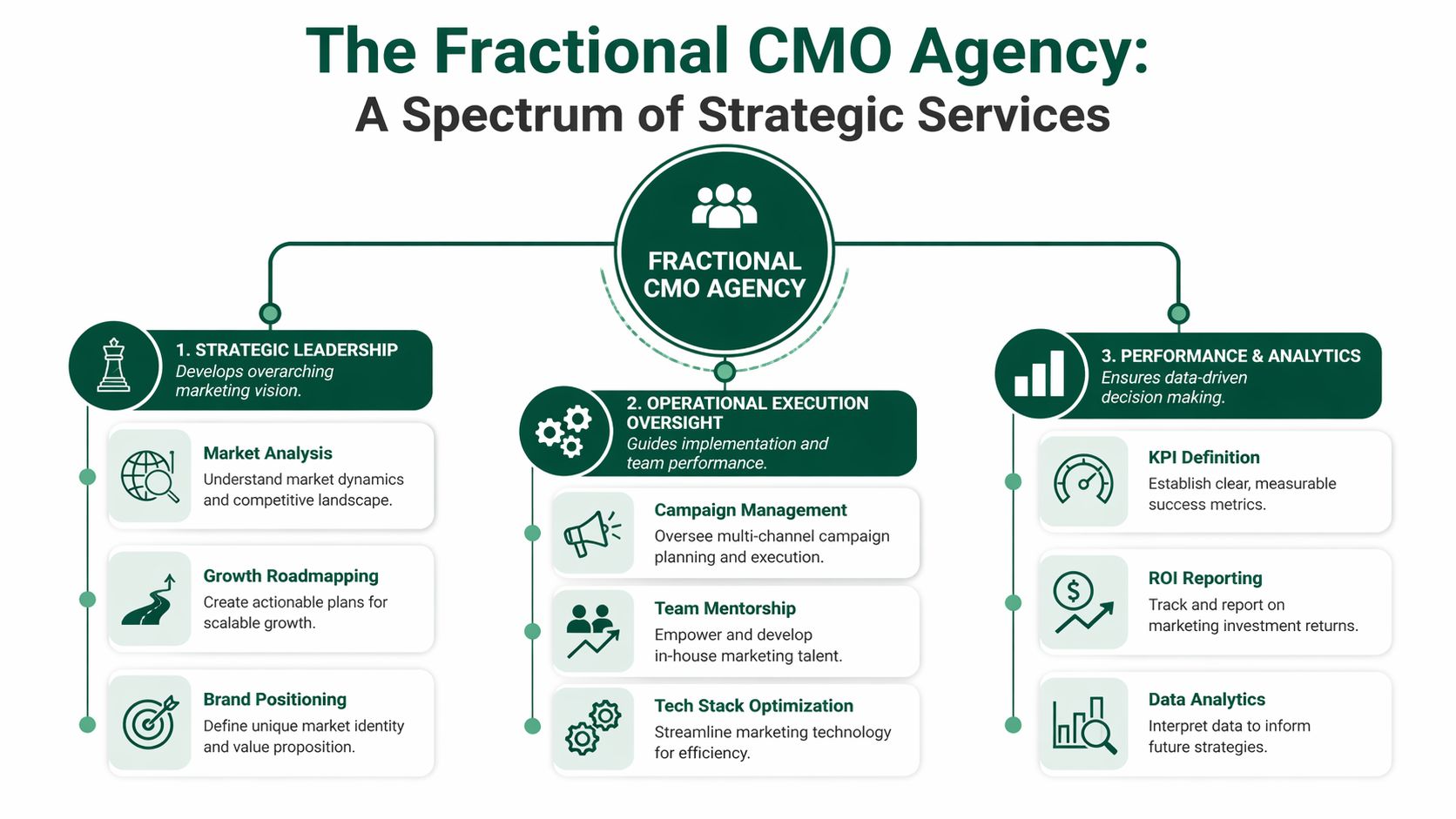
The best firms usually work in pods. Sprint teams handle audits and planning. A part-time leadership layer drives prioritization. Focused project pods handle specific deliverables. According to Activated Scale’s guide to the fractional marketing agency model, that operating structure can produce 20-40% efficiency gains in B2B tech when internal teams, freelancers, and vendors are managed as one system.
The first pillar is go-to-market strategy and positioning.
The starting point for the work should be here because most SaaS marketing underperforms before the first campaign even launches. The problem is usually upstream. The company hasn’t clarified segment priority, category narrative, buying triggers, or why the product wins in real selection environments.
Expect work like:
If you want a deeper breakdown of what this work can include, fractional CMO services for B2B SaaS is the right frame.
The second pillar is demand generation systems.
Weak operators default to channel lists. Strong ones build sequence and accountability. They don’t ask, “Should we do LinkedIn, SEO, webinars, and Google Ads?” They ask, “What buying motion do we support first, and what signal will tell us it’s working?”
That often means:
| System area | What a strong partner builds |
|---|---|
| Channel strategy | A focused plan based on sales cycle, buyer intent, and team capacity |
| Campaign design | Specific programs tied to offers, segments, and conversion goals |
| Website pathing | Messaging and page structure that support qualification, not just traffic |
| Reporting rhythm | A clear operating cadence for reviewing performance and making changes |
The third pillar is sales enablement and revenue alignment.
At this point, many agencies disappear. They launch activity but don’t embed with the revenue team. A real fractional cmo agency does the opposite. It forces alignment between what marketing promises and what sales can close.
Practical rule: If your marketing partner never joins sales conversations, they’re guessing.
This part of the scope often includes:
The point isn’t to buy a bundle of services. The point is to build a working commercial system where strategy, execution, and revenue accountability are connected.
Founders get this decision wrong when they treat a fractional cmo agency like a cheaper substitute for a full-time CMO.
That is the wrong frame.
The choice is about timing and strategic need. Are you trying to patch a resourcing gap, or are you trying to build a repeatable go-to-market engine before you lock yourself into a permanent executive hire? The second use case is where a fractional partner creates outsized value. You bring in senior leadership to impose focus, fix decision quality, and build the operating system that a future in-house CMO can inherit.
Pricing matters. Mandate matters more.
Different models solve different problems. Pick the one that matches your inflection point, not the one with the lowest monthly number.
Retainer model
Choose this when the business needs ongoing senior ownership. This is common from Seed through Series B, but stage is not the deciding factor. The primary signal is operational complexity. If marketing priorities keep changing, sales is pulling in one direction, product is pulling in another, and the founder is still making GTM calls by instinct, you need an embedded strategic partner.
Use this model when:
Project-based model
Use this for a defined strategic problem with a clear endpoint. Good examples include repositioning, launch strategy, ICP refinement, pricing and packaging support, or rebuilding the website around conversion instead of brand theater.
This model works when the company knows what decision must be made and needs senior help making it fast. It fails when the underlying issue is ongoing leadership. Founders often hire for a project when the company really needs weekly GTM management. That mismatch creates a polished deliverable and the same old execution drift three weeks later.
Advisory model
This is the lightest structure. It fits companies that already have a capable marketing lead and want sharper oversight, external challenge, or board-level guidance on major decisions.
Use it carefully. Advisory support does not create momentum by itself. If nobody inside the company owns follow-through, the advice dies in a slide deck.
For a closer look at how companies structure this kind of support, see CMO as a service for growing companies.
A fractional cmo agency is rarely priced by effort alone. It is priced by scope, decision rights, and the level of integration with your leadership team.
A lighter advisory relationship sits at one end. An embedded partner who owns planning cadence, channel priorities, sales alignment, and executive reporting sits at the other. Those are different jobs. They should have different pricing.
Use this comparison to pressure-test fit:
| Decision factor | Full-Time CMO | Fractional CMO Agency |
|---|---|---|
| Commitment | Long-term executive hire | Flexible scope tied to a defined mandate |
| Time to impact | Slower because hiring and ramp-up take time | Faster if the problem and authority are clear |
| Best fit | Company with stable GTM motion and permanent executive need | Company at a strategic inflection point that needs senior leadership now |
| Main risk | Expensive mis-hire with broad expectations | Under-scoped engagement that lacks authority to change outcomes |
The biggest mistake is hiring a senior title before the company has earned the complexity of that hire. A full-time CMO makes sense when the business already has enough channel volume, team depth, planning discipline, and executive clarity to justify permanent ownership.
Until then, the smarter move is often fractional leadership with a sharp mandate. Build the system first. Then decide whether the business needs a permanent executive to scale it.
Founders who evaluate a fractional cmo agency by lead volume miss the point.
The return is a better growth operating system. You are not buying extra campaign output. You are buying clearer decisions, tighter execution, and a GTM engine that can scale without constant founder intervention.

That distinction matters because weak measurement creates fake confidence. A traffic spike looks promising. A batch of demo requests looks productive. None of it helps if leadership still cannot answer basic questions like which segments convert, which channels create qualified pipeline, and where deals stall after handoff to sales.
A strong fractional cmo agency fixes that first. The immediate ROI is visibility. Once the business can trust its numbers, it can stop funding low-conviction activity and start making resource decisions with discipline.
Early success should show up in the quality of your commercial decision-making. If you cannot see performance clearly, every budget conversation turns into opinion, politics, or founder instinct.
Start with four checks:
These are not soft wins. They reduce waste fast.
B2B SaaS teams often spend for quarters without a shared view of what works. Sales blames lead quality. Marketing blames follow-up. Finance sees rising spend and asks harder questions. The root problem is usually simpler. The company does not have a measurement model that connects activity to revenue.
If the CEO cannot see marketing’s contribution to pipeline in a single view, marketing still lacks executive-grade accountability.
If you need a practical benchmark, this guide on how to measure marketing ROI for B2B SaaS teams gives a useful framework.
A fractional cmo agency should produce leading indicators before lagging ones. That is what competent strategic work looks like. First the team gets clarity, focus, and process. Then the revenue metrics improve.
| Early indicators | Later indicators |
|---|---|
| trusted dashboard and reporting cadence | higher quality pipeline |
| clearer ICP and segment focus | stronger conversion through key stages |
| aligned sales and marketing narrative | lower acquisition waste |
| disciplined testing and channel choices | more consistent marketing-sourced revenue |
Impatient founders often make the wrong call. They ask for immediate proof in booked revenue while the company is still fixing tracking, positioning, and sales alignment. Then they switch channels, pile on random campaigns, or replace the partner before the system has time to compound.
Do not do that.
Judge strategic leadership by whether it improves the company’s ability to make better GTM decisions, faster. If that is happening, revenue performance usually follows. If it is not happening, no amount of campaign activity will save the engagement.
That is the right standard for ROI. Better visibility. Better prioritization. Better use of budget. A GTM engine the company can scale.
There’s a specific moment when a B2B SaaS company stops benefiting from improvised marketing leadership. Most founders wait too long to notice it.
The trigger usually isn’t “we need more marketing.” It’s “our current way of making growth decisions has stopped working.”
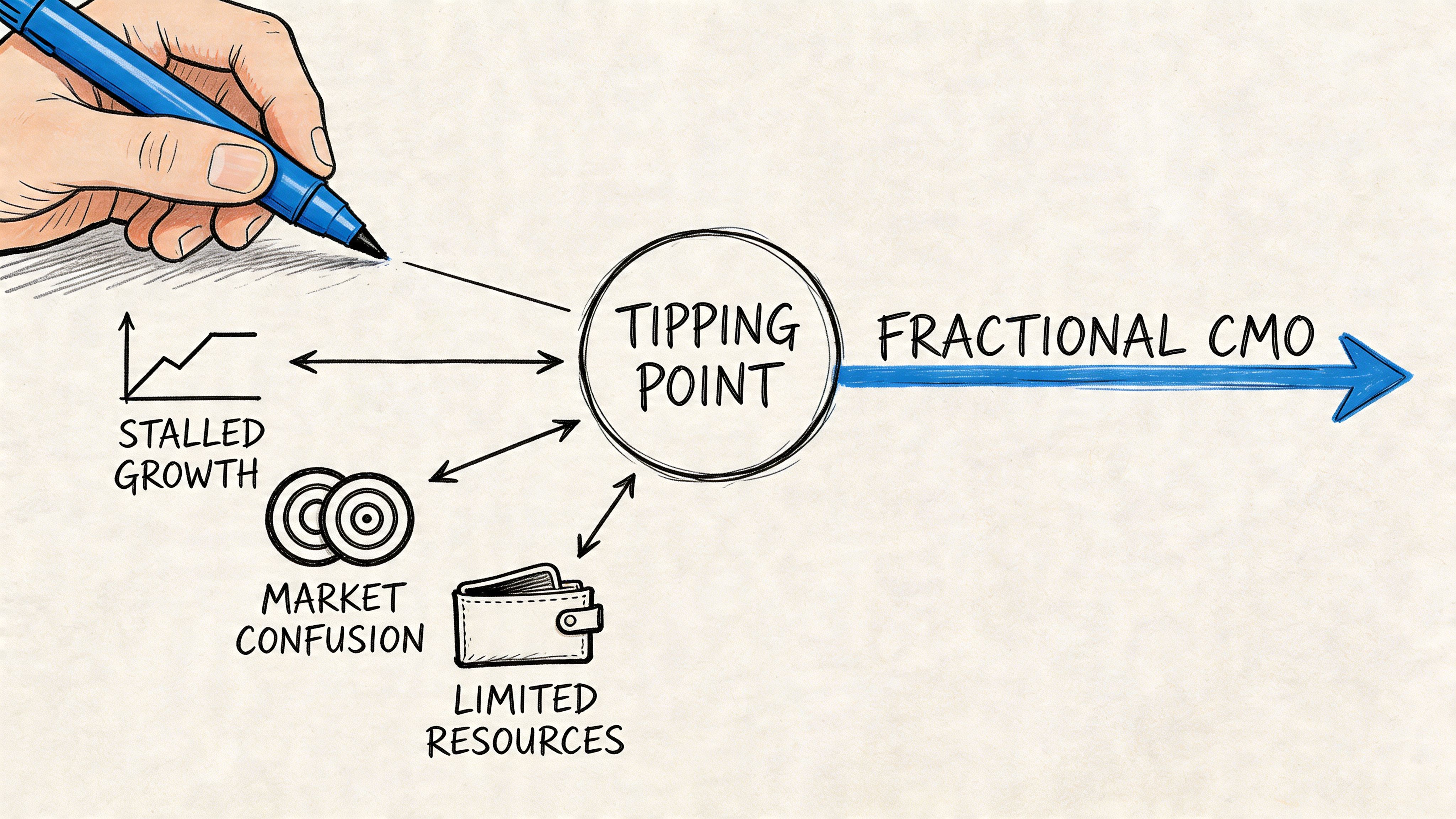
You should seriously consider a fractional cmo agency when one or more of these patterns shows up.
Founder-led sales is hitting a ceiling
The founder can still close, but the company can’t translate that instinct into a repeatable market motion. Messaging lives in the founder’s head. Marketing can’t replicate it. Sales hires struggle to carry it. Pipeline depends too much on personality and too little on system.
Your first marketer is capable but overloaded
This is common. You hired a demand gen lead, content lead, or generalist and implicitly expected them to become your strategic marketing head. That’s not fair to them, and it usually produces reactive execution. Good people get trapped in impossible role design.
You’ve raised capital and now need operating discipline
Once a company has a runway tied to growth expectations, the tolerance for fuzzy marketing drops fast. The board wants accountability. Revenue leaders want signal, not updates. The team needs priorities that survive more than one quarter.
You have activity without narrative
Campaigns are running. The website exists. There’s content. Maybe there’s paid media. But buyers still don’t quickly understand why you matter, who you’re for, or why they should switch. That’s a strategic clarity failure.
If you’re weighing the timing, how to hire a fractional CMO at the right stage is a better decision lens than generic hiring advice.
A fractional cmo agency is not the answer to every problem.
Don’t hire one if:
A fractional CMO can accelerate clarity. They can’t substitute for founder conviction about the product and market.
There’s also a simple time-to-value argument. As noted earlier, the model can move faster than a full executive search when the issue is urgent and cross-functional.
A short explainer is useful here because many founders still confuse role design with channel selection.
The tipping point isn’t about budget. It’s about whether your next phase of growth requires installed leadership before it requires another full-time hire.
Founders get burned when they decide they need strategic help, then hire a firm that speaks in tactics, dashboards, and channel jargon.
A real fractional cmo agency should behave like embedded leadership. Not an outsourced task manager.
That distinction matters because the core difference between a true fractional CMO and a conventional marketing agency is integration. A true fractional CMO embeds with leadership, strengthens internal capability, and closes the strategy-execution gap, while agencies often remain siloed around tactical delivery, as explained in GigCMO’s comparison of fractional CMOs and marketing agencies.
Don’t ask for a capabilities deck first. Ask how they think.
Use questions like these:
If you want a useful contrast point, what B2B marketing agencies typically optimize for helps clarify what strategic integration should look like by comparison.
A lot of firms use “fractional” because the market likes the label. Their operating model hasn’t changed.
Watch for these warning signs:
| Red flag | What it usually means |
|---|---|
| They lead with deliverables | They sell output before diagnosis |
| They avoid revenue language | They don’t want accountability tied to business outcomes |
| They never ask about sales | They view marketing in isolation |
| They promise every channel | They lack prioritization discipline |
| They can’t explain the first 90 days | They don’t have a real operating system |
One more point matters. Stage fit is not optional. A partner who has only worked with mature teams may struggle inside a chaotic Seed or Series A environment. A partner built for early-stage ambiguity may be the wrong fit for a larger org with established process.
Ask for their view on your actual growth constraint, not a list of what they can do.
That answer tells you whether you’re talking to a strategist or a vendor.
Stop framing this as a cost decision. That framing leads founders to buy part-time marketing oversight when what they need is go-to-market leadership.
The right question is simpler. Are you at a strategic inflection point where better direction will improve revenue faster than more execution will? If yes, a fractional cmo agency can help you build the operating system before you lock yourself into a full-time executive hire.
Use the decision table below to force clarity.
| If this is true | Your answer |
|---|---|
| Sales and marketing both exist, but they pull in different directions | Go |
| The founder still owns too much of the story, pipeline narrative, or GTM prioritization | Go |
| Your first marketer or small team lacks senior guidance | Go |
| You need executive-level accountability without waiting through a long hiring process | Go |
| Product-market fit is still unstable | No-go |
| You only need channel execution or project support | No-go |
| Leadership will not share data, customer context, or decision rights | No-go |
Timing matters more than price.
The strongest use case sits in the middle stage. You are past pure experimentation, but you have not yet built repeatable commercial discipline. At that point, a good fractional partner does more than advise. They set priorities, tighten the story, align marketing with sales, and create a GTM engine that can scale past founder-led growth.
That is why the decision should be tied to inflection points, not budget pressure. Hire one when the business needs sharper choices, faster coordination, and clearer accountability. Wait if you are still searching for basic market truth. Hire full-time if the company already has the complexity, pace, and internal surface area that demand a dedicated executive.
One example in this category, as noted earlier, is Big Moves Marketing. It offers fractional CMO and go-to-market support for B2B SaaS and technology companies across positioning, messaging, website strategy, and demand generation. That model fits companies that need strategic control connected to execution decisions.
Make the next move with discipline. Name the constraint. Choose the engagement model that matches it. Then give that partner enough access to diagnose the problem and enough authority to fix it.
No.
A solo fractional CMO gives you one person’s experience and bandwidth. That can work well if the scope is tightly strategic and the company already has execution capacity.
An agency model can give you broader coverage because strategy can connect to specialists, operators, and project support without forcing the founder to coordinate multiple vendors. The trade-off is that you need to verify who leads the strategic thinking. Don’t buy a team if no one is clearly accountable.
It shouldn’t.
The right partner should make your team more effective by clarifying priorities, improving message discipline, and setting better operating rhythms. A junior or mid-level marketer often performs far better once someone senior defines what matters, what doesn’t, and how success is measured.
If the partner’s instinct is to sideline your team immediately, that’s a warning sign. Sometimes personnel changes are necessary. But replacement should follow diagnosis, not ego.
Very involved at the start.
A fractional cmo agency needs founder context to do the job well. That includes product nuance, customer history, sales friction, market beliefs, and strategic constraints. If the CEO tries to “delegate marketing away” without sharing access or thinking, the engagement weakens fast.
Later, involvement usually shifts from daily interpretation to weekly or biweekly decision-making.
Long enough to install a working system, not just produce recommendations.
Some companies need a defined strategic sprint followed by internal handoff. Others need an embedded partner through repositioning, demand system buildout, team coaching, and hiring support. The right answer depends on whether the company needs diagnosis, implementation oversight, or both.
A short engagement can work if the company already has capable operators. It usually fails if leadership hopes a brief project will solve a deeper ownership gap.
The first phase should create clarity fast.
That usually means reviewing sales calls, pipeline stages, current channels, website messaging, attribution quality, team responsibilities, and core GTM assumptions. The output should be a clear view of the commercial bottleneck, the near-term priorities, and the reporting structure needed to track progress.
If the first month ends with only ideas and no decision framework, something is off.
Yes, and often that’s the point.
A strong fractional partner can manage specialists more effectively than a founder can because they can judge channel work against strategy, not just activity. Paid media, SEO, design, content, Webflow, lifecycle, and outbound resources are all more useful when one person or team is setting priorities and reviewing trade-offs across the whole system.
Without that layer, vendors often optimize for their own scope instead of company outcomes.
A healthy offboarding process looks like graduation, not collapse.
By the end of the engagement, the company should have a clearer GTM strategy, working dashboards, documented messaging, a stronger operating cadence, and a better understanding of which full-time hire should come next. That might be a Head of Marketing, VP Marketing, or full-time CMO depending on stage.
If the partner leaves and everything falls apart, they didn’t build a system. They built dependence.
If your team is stuck between scattered execution and the need for real GTM leadership, Big Moves Marketing is one option to evaluate. The firm works with B2B SaaS and technology companies on positioning, messaging, websites, and demand generation through a fractional CMO and go-to-market partner model.
Explore Big Moves Marketing services and resources:





%20-%20white.svg)