%20png%20copy.avif)
Most advice on fractional cmo services is backwards. It treats the role like a cheaper CMO or a smarter freelancer. That framing misses the true job.
A strong fractional CMO is not there to “do marketing.” They are there to fix the decision-making layer above marketing. They clarify who you should sell to, what story the market will believe, where your pipeline should come from, what not to fund, and how to build a function that can survive after they leave.
That matters because most B2B SaaS teams do not have a marketing execution problem first. They have a sequencing problem. They hire channel specialists before they have positioning. They fund demand gen before they have message-market fit. They blame campaign performance when sales, product, and marketing are all working from different assumptions.
If you are considering fractional cmo services, ask a harder question than “Do we need marketing help?” Ask whether you need executive judgment without the fixed cost and inertia of a full-time hire. That is the core decision.
Founders often make the same expensive mistake. They hire a junior marketer, a paid media specialist, or a content person because “we need pipeline.” Then they discover nobody has defined the ICP cleanly, the website says everything to everyone, sales is improvising the pitch, and campaign results are impossible to interpret.
That is not a talent problem. It is a leadership gap.
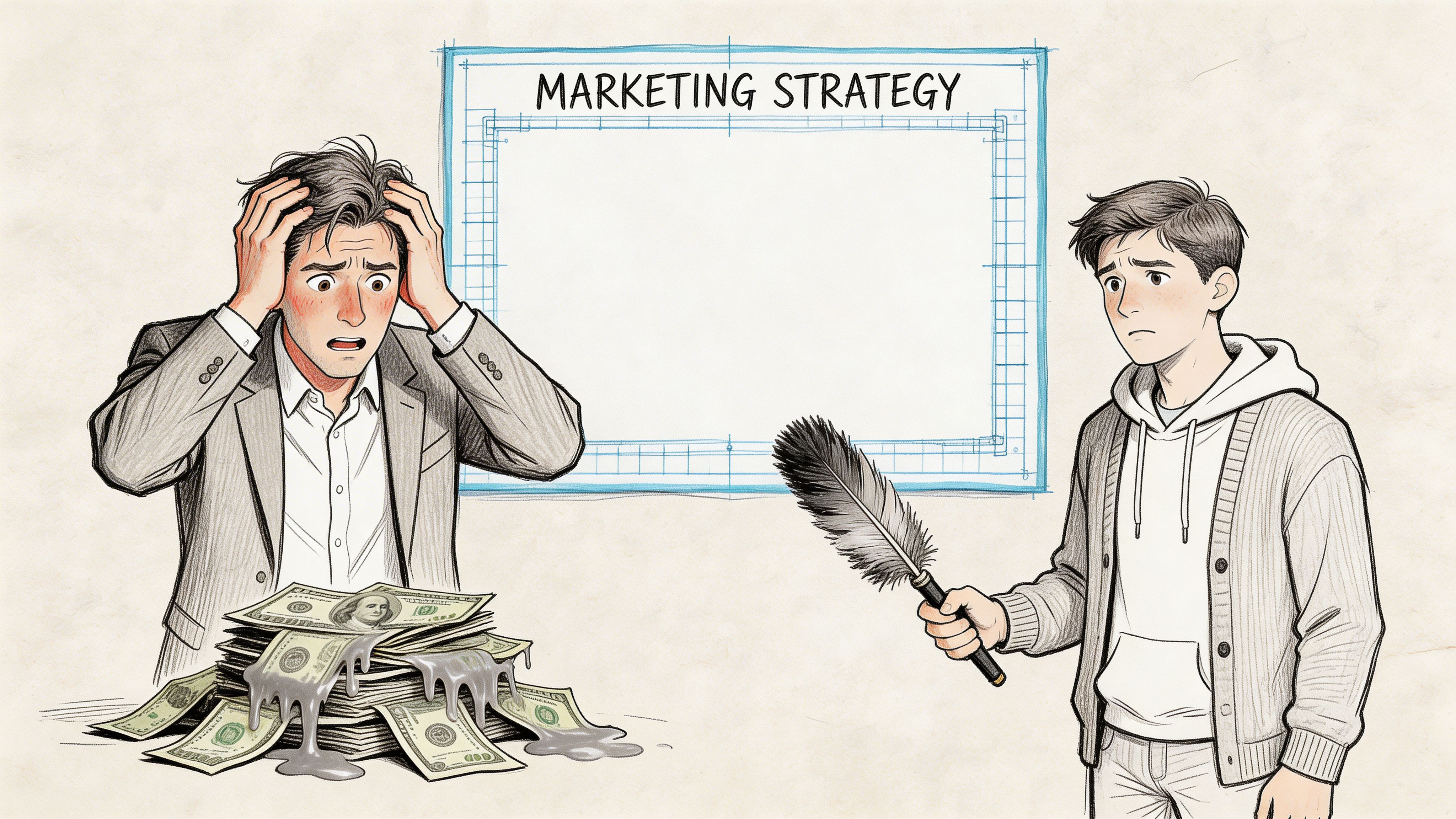
A specialist can only optimize what already exists. If your market story is vague, your funnel is misaligned, and your founder is still the only person who can sell the product properly, hiring execution first usually turns into random acts of marketing.
Early B2B SaaS growth is rarely constrained by a lack of activity. It is constrained by unresolved strategic questions.
If those decisions are weak, more execution just creates more noise.
That is why a leadership-first move often beats a tactical hire. If you need help thinking through your growth model before staffing it, a startup growth consultant is usually more useful than another marketer on payroll: https://www.bigmoves.marketing/blog/startup-consult
If the founder still owns the only coherent version of the pitch, you are not ready to “scale marketing.” You are ready to formalize strategy.
Fractional cmo services make sense when the company needs senior judgment, but not a permanent executive seat yet. You get someone who can make high-level calls on positioning, channel focus, metrics, and team design without locking the business into a full-time hire too early.
The mistake is not under-hiring. The mistake is hiring the wrong layer first.
“Fractional” is an unhelpful word. It makes founders think they are buying less. In practice, they are buying concentration.
A fractional CMO is not a part-time marketing manager. They are a temporary executive inserted at the point of highest uncertainty. Their value is not hours. Their value is judgment under constraint.
If someone sells fractional cmo services and immediately talks about posting schedules, ad variants, or email sequences, they are describing a delivery resource. That may be useful. It is not CMO-level work.
The proper role sits closer to capital allocation and operating design.
A good fractional CMO should decide things like:
That is why the model works for specific moments. Pre-Series A when the story is still soft. Post-PMF when founder-led selling starts to break. Market expansion when product, sales, and marketing need one GTM narrative.
If you want a broader view of how strategic B2B marketing support differs from tactical execution, this breakdown of B2B marketing services is useful context: https://www.bigmoves.marketing/blog/b-2-b-marketing-services
Founders should be skeptical of advisors who diagnose quickly, present a polished strategy deck, and disappear. That is consulting theater.
The better model is embedded ownership. Not ownership in the legal sense. Ownership in the operating sense. The fractional CMO joins leadership conversations, pressure-tests assumptions, sets direction, and forces decisions that an overstretched founder keeps postponing.
The test is simple. After 60 days, are decisions clearer across sales, product, and marketing, or do you just have better slides?
The strongest engagements create a temporary decision engine. They do not just recommend moves. They shape how the company chooses moves.
That is the core reframing. Fractional cmo services are not “part-time marketing.” They are interim executive architecture.
Most founders compare the wrong things. They compare a fractional CMO to a full-time CMO as if the only difference is cost. Or they compare a fractional CMO to an agency as if both are just alternate ways to “get marketing done.”
They solve different problems.
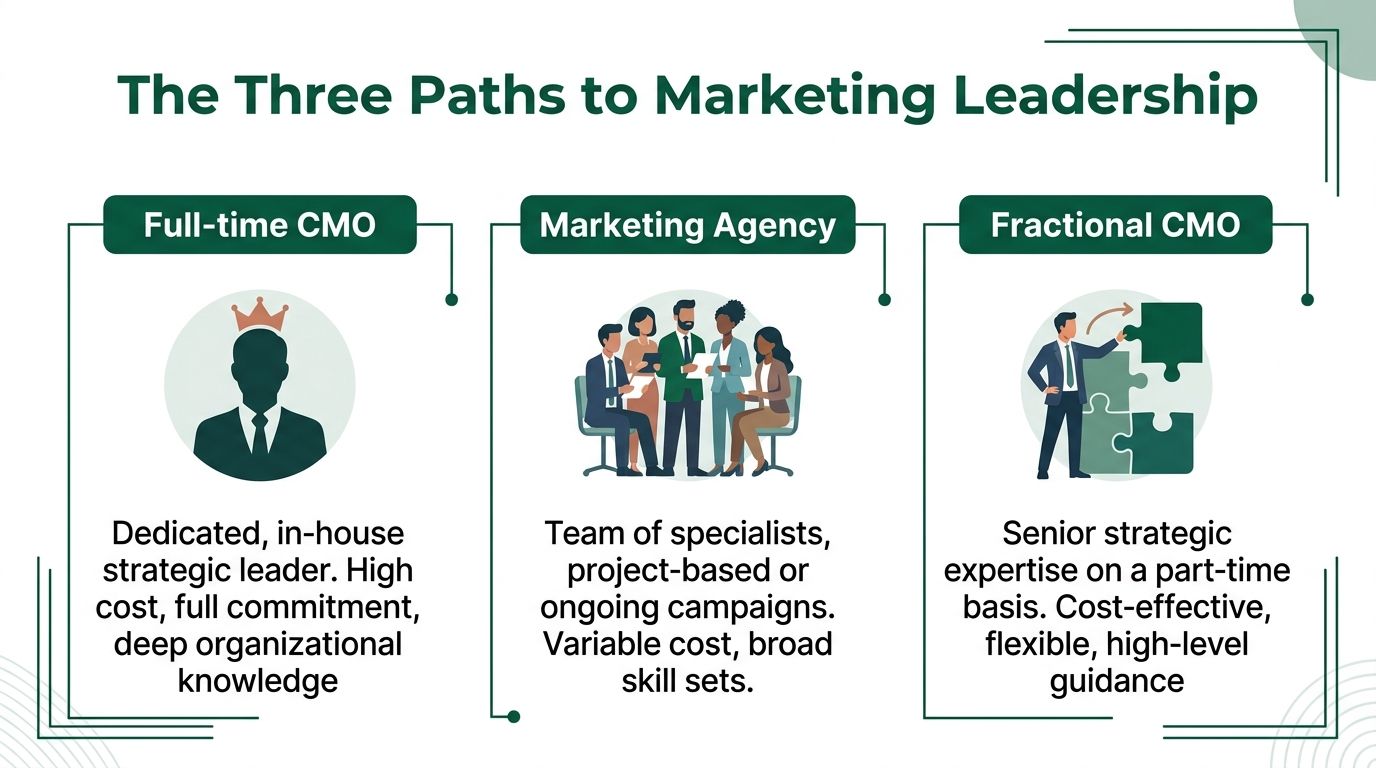
According to Geisheker, companies engaging fractional CMOs achieved 29% average revenue growth, compared with 19% for companies relying on traditional full-time structures: https://www.geisheker.com/best-fractional-cmo-companies/
| Attribute | Fractional CMO | Full-Time CMO | Marketing Agency |
|---|---|---|---|
| Primary job | Strategic direction and function design | Long-term executive ownership | Tactical execution across selected channels |
| Cost structure | Flexible retainer, project, or advisory model | Highest fixed cost and commitment | Variable spend by scope, channel, and output |
| Best stage fit | Early-stage to growth-stage companies with leadership gap | Companies ready for permanent executive ownership | Teams with clear strategy that need execution capacity |
| Speed to impact | Fast when access and alignment are strong | Slower due to hiring and onboarding | Fast on tasks, slower on strategy if inputs are weak |
| Integration with sales and product | High if embedded properly | Highest over time | Usually limited unless tightly managed |
| Risk if misused | Becomes expensive advice without operating access | Overhire before company is ready | Activity without strategic coherence |
A full-time CMO makes sense when marketing is already a permanent executive function, not a problem to be stabilized. If you need someone to own planning cycles, hiring, board communication, cross-functional politics, and long-horizon budget management every day, stop trying to patch the role fractionally.
A marketing agency makes sense when the strategy is already credible and the company needs throughput. If your positioning is strong, your demand model is chosen, and you need more hands in paid search, lifecycle, design, SEO, or production, an agency can be efficient. This outside perspective on In-House Vs. Agency Marketing: Why A Specialist Consultant Wins is worth reading because it gets at the difference between execution bandwidth and strategic guidance.
A fractional CMO makes sense in the middle. You have enough complexity to need senior thinking, but not enough stability to justify a permanent executive. This is common in B2B SaaS when:
There is also a practical difference in operating style. Agencies optimize around deliverables. Full-time CMOs optimize around organizational ownership. Fractional CMOs should optimize around transition. They build the strategic core, prove the model, and help the business decide what permanent team to hire next.
If you are trying to choose between strategic guidance and a broader execution partner, this perspective on B2B agency trade-offs is relevant: https://www.bigmoves.marketing/blog/b-2-b-agency
The wrong choice is usually stage mismatch. Founders hire the structure they aspire to, not the one their company can use right now.
A good fractional CMO engagement should be judged by outputs, not busyness. You are not buying “marketing support.” You are buying decisions made concrete.
The strongest engagements often begin with a strategic audit and system design process. The Idea Farm notes that fractional CMO engagements can drive rapid strategic audits and scalable growth systems, with clients achieving up to 39% overall business growth through data-driven martech implementation and process automation: https://www.theideafarm.net/post/fractional-cmo-services

Most B2B SaaS teams try to scale messaging they have never resolved. That is why demand programs underperform. The market is not rejecting your channels first. It is rejecting your framing.
Expect strategic deliverables such as:
Often, many teams need a structured messaging system more than more top-of-funnel activity. A practical reference point is this brand messaging framework template: https://www.bigmoves.marketing/blog/brand-messaging-framework-template
Once the market story is clear, the next deliverable is not “campaigns.” It is the path from attention to revenue.
That usually includes a demand model, funnel definitions, content priorities, handoff logic between marketing and sales, and a realistic view of which channels deserve budget now versus later.
Common deliverables include:
The role is to make these parts cohere. Otherwise you get a polished site, some paid campaigns, and a sales team still improvising.
A short explanation of the kind of strategic oversight founders often expect from the role is below.
If your fractional CMO cannot explain how messaging, pipeline creation, and sales conversion connect, you hired a tactician with a better title.
The sticker price is the wrong place to start. A fractional CMO is expensive when they leave you with slide decks, vague priorities, and no operating baseline. They are cheap when they prevent six months of wasted spend and help you build a marketing system your future in-house team can run.

Breakthrough3x reports that fractional CMO services typically range from $60,000-$180,000 annually versus $250,000-$570,000+ for a full-time CMO, a 60-75% reduction, and that experienced practitioners achieve an average ROMI of 589% through advanced KPI frameworks: https://breakthrough3x.com/resources/10-essential-kpis-every-fractional-cmo-should-monitor-for-success/
Price only matters in context of scope, decision authority, and how much internal lift the work requires from your team.
Three pricing models show up most often:
If you want a broader reference point for how retainers, project fees, and scope assumptions are typically structured, this overview of marketing agency pricing models is worth reviewing.
Do not buy on hourly math alone. Buy on whether the engagement changes how the company makes marketing decisions, how quickly it identifies bad bets, and how cleanly it can hand the work to a permanent team later.
Cheap fractional CMO services often fail in a predictable way. They stay abstract. You get recommendations without process change, channel ideas without measurement discipline, and executive confidence without better pipeline. High-fee engagements fail too, usually because the founder wants senior strategy without giving access to CRM data, sales calls, or decision rights.
ROI work starts before kickoff. If you wait until month four to ask what changed, you are already in a political argument instead of an operating review.
Set the baseline first. Not after kickoff. Use a simple marketing ROI measurement framework for B2B SaaS teams and agree on the numbers before the first strategic recommendation is made.
As Agami Technologies notes, many discussions of fractional CMO ROI focus on outcomes but fail to explain how to establish baseline metrics and attribution before the engagement begins: https://agamitechnologies.com/blog/fractional-cmo-services-hidden-truth
Use a minimum viable baseline:
| What to baseline | Why it matters |
|---|---|
| Pipeline by source | Shows whether lead quality changes or volume is just being redistributed |
| Conversion rates between key funnel stages | Exposes where the revenue system is breaking |
| Sales cycle patterns | Separates positioning problems from normal deal complexity |
| Average deal quality by segment | Prevents false wins from poor-fit pipeline |
| CAC and payback assumptions | Keeps channel choices tied to actual unit economics |
Then define what the fractional CMO owns.
That sounds obvious. It rarely happens. Founders often credit or blame the fractional CMO for every downstream result, even when revenue movement was driven by product changes, founder-led sales, pricing shifts, or a rep turnover problem.
Use three buckets:
This matters for another reason. You are not just judging this operator. You are deciding what to build internally later. If the engagement improves pipeline but leaves no reporting discipline, no shared definitions, and no repeatable planning cadence, the company has rented judgment without building capability.
A specialized partner can also help build the reporting spine. Big Moves Marketing works with B2B SaaS teams on positioning, messaging, websites, and demand generation when the problem is GTM clarity tied to measurement setup, not just campaign output.
If you cannot define the baseline, you cannot defend the ROI. You are narrating performance, not measuring it.
For most SaaS companies, perfect attribution is a distraction. Credible directional attribution, cleaner operating metrics, and a clear transfer path to an in-house team is the standard that matters.
Do not hire a fractional CMO the way you hire a channel manager. You are not screening for tool familiarity. You are screening for judgment.
The bad hires usually sound polished. They know the vocabulary. They can say “positioning,” “demand gen,” and “funnel optimization” in the right order. Then they prescribe the same playbook they used on a completely different company.
Look for evidence of strategic pattern recognition in B2B SaaS, not broad marketing confidence.
Red flags show up fast:
Good candidates usually speak plainly about uncomfortable things. They will tell you the ICP is too broad, the founder narrative is inconsistent, or the current team structure is wrong for the next stage.
Skip generic interview questions. Use prompts that force specificity.
Ask things like:
Listen for operating logic. The right person will talk about customer calls, CRM evidence, handoff points, win-loss patterns, internal alignment, and sequencing. The wrong person will jump to tactics.
A serious strategic partner is comfortable saying, “I would not fund that yet.”
The hiring standard should be simple. You want someone who can reduce strategic ambiguity, not someone who can make your marketing look active.
The first 90 days determine whether the engagement becomes a force multiplier or another expensive layer of interpretation.
Most failures start with a bad assumption. The founder assumes the fractional CMO will “figure it out.” The fractional CMO assumes the company has clean data, shared definitions, and access to customer truth. Neither is true.
Day one should not start with guesswork. Give access fast.
That means direct access to:
Without that, the engagement starts with politics and reconstruction instead of diagnosis.
First phase. Audit and diagnosis. The partner should pressure-test your ICP, message, funnel definitions, conversion friction, and current spend logic. If this stage produces instant tactical enthusiasm without hard diagnosis, be careful.
Second phase. Strategy and prioritization. Decisions are made here. Which segments matter. Which narrative leads. Which channels deserve pilots. Which metrics enter the executive dashboard. Which work stops.
Third phase. Pilot execution and system building. Now you test the strategy in-market, tighten reporting, create repeatable workflows, and align sales with the new message.
A few habits matter more than most founders realize:
The early success signal is not more activity. It is sharper focus, cleaner decisions, and fewer debates based on opinion.
A fractional CMO engagement without an exit plan is incomplete. If the knowledge leaves with the advisor, you rented expertise. You did not build capability.
This is the part most guides avoid because it exposes the core standard. The role should make itself less necessary over time.
CS Design Studios highlights a critical gap here. The market talks about flexible leadership, but often ignores how companies should transition from fractional support to an internal team. The strongest fractional CMOs address that by building transition plans and documenting playbooks so the systems they create can be operationalized internally: https://www.csdesignstudios.com/unlocking-the-potential-of-fractional-cmo-services/
The handoff should not start near the end. It should shape the engagement from the beginning.
If the strategy lives only in meetings and the logic sits only in one person’s head, the company is still fragile.
The right approach is to codify the operating core as it is built:
The next internal hire should be based on the function you now understand, not the org chart you copied from another startup.
Sometimes that means hiring a Head of Marketing. Sometimes it means hiring a strong demand gen operator under continued strategic oversight for a period. Sometimes it means product marketing first because the core problem is narrative and sales enablement, not traffic.
A good transition usually includes:
That final point matters. If the engagement cannot taper responsibly, it was not designed as a capability build.
The best outcome is not “we kept the fractional CMO forever.” The best outcome is “we now have a coherent marketing function, a clear hiring plan, and a team that knows how to run it.”
If your company needs sharper positioning, a more credible go-to-market plan, or an executive-level view of what marketing should do before you hire a permanent leader, Big Moves Marketing is one option to consider. The firm works with B2B SaaS and technology teams on fractional CMO support, messaging, websites, demand generation, and GTM clarity so founders can make better growth decisions with less wasted motion.
Explore Big Moves Marketing services and resources:




%20-%20white.svg)