%20png%20copy.avif)
Open rate is one of the most dangerous numbers in B2B SaaS reporting because it makes marketing activity look like buyer intent. A loaded image can't validate positioning, create consensus inside a buying committee, or move an opportunity toward revenue. Yet teams still rewrite subject lines, change send times, and defend nurture programs around a signal that may represent a proxy server, a security scanner, or a blocked image rather than human attention.
The better question isn't whether someone opened an email. It's whether the message created a measurable next step. For founders and revenue leaders, that means treating open data as a diagnostic input and measuring clicks, replies, meetings, and pipeline as the operating evidence. The distinction matters across the full lifecycle, from founder-led sales to Series C demand programs. You can use email marketing strategically, but you shouldn't confuse inbox activity with commercial traction.
Open rate flatters activity while hiding pipeline truth. It rewards messages that get rendered, not messages that create buying movement.
That became a serious problem as B2B SaaS sales cycles grew more complex. A prospect may open a message from a founder, forward it to an operations leader, discuss it with security, and return weeks later for a technical evaluation. One image request tells you almost nothing about that sequence. It doesn't tell you who influenced the decision, whether the problem is urgent, or whether the account has moved from curiosity to evaluation.
The pattern repeats across companies. A team sees a strong open rate, concludes that its positioning resonates, and invests further in the same narrative. Sales then reports weak replies and little meeting creation. Marketing responds by increasing send volume or testing more subject lines. The program becomes better at generating inbox events while remaining disconnected from pipeline.
Open tracking is a data reliability problem, not only an email problem. A useful framework on audit-ready KPIs helps clarify the issue: a metric is useful when leaders can understand how it was produced, what it represents, and whether it supports a decision. Open rate often fails that test.
A tracked open generally means that an email client loaded a remote image. It doesn't prove a human read the message. Some clients block images, which suppresses legitimate events. Other systems preload or scan images automatically, which creates apparent engagement without human attention. The same campaign can therefore look weak and strong at the same time, depending on the recipient's environment.
Operating rule: If a metric can't explain why a deal advanced, it shouldn't carry the primary weight in a pipeline review.
The cost isn't just inaccurate reporting. Open data can cause leaders to make the wrong strategic decisions.
If open rates look healthy, a founder may delay a positioning change even when the sales team hears consistent objections. A CMO may preserve a nurture sequence that produces no meaningful responses because the dashboard shows engagement. A revenue leader may conclude that the market is aware but unqualified, when the issue is that the message never made a credible business case.
Use opens to identify broad delivery or subject-line anomalies. Don't use them to validate demand, forecast pipeline, or declare product-market messaging fit. Those decisions require behavior with more friction, such as a click to a relevant resource, a reply that reveals a problem, or a meeting tied to an account and opportunity.
Email open tracking is simple at the technical level. The interpretation is where teams get into trouble.
The most common method embeds a unique 1x1 transparent image in an HTML email. When the recipient's email client loads that remote image, it sends a request to the tracking server. The server records an event, often including a timestamp, IP address, and user-agent details. The image is invisible, but the request is measurable.
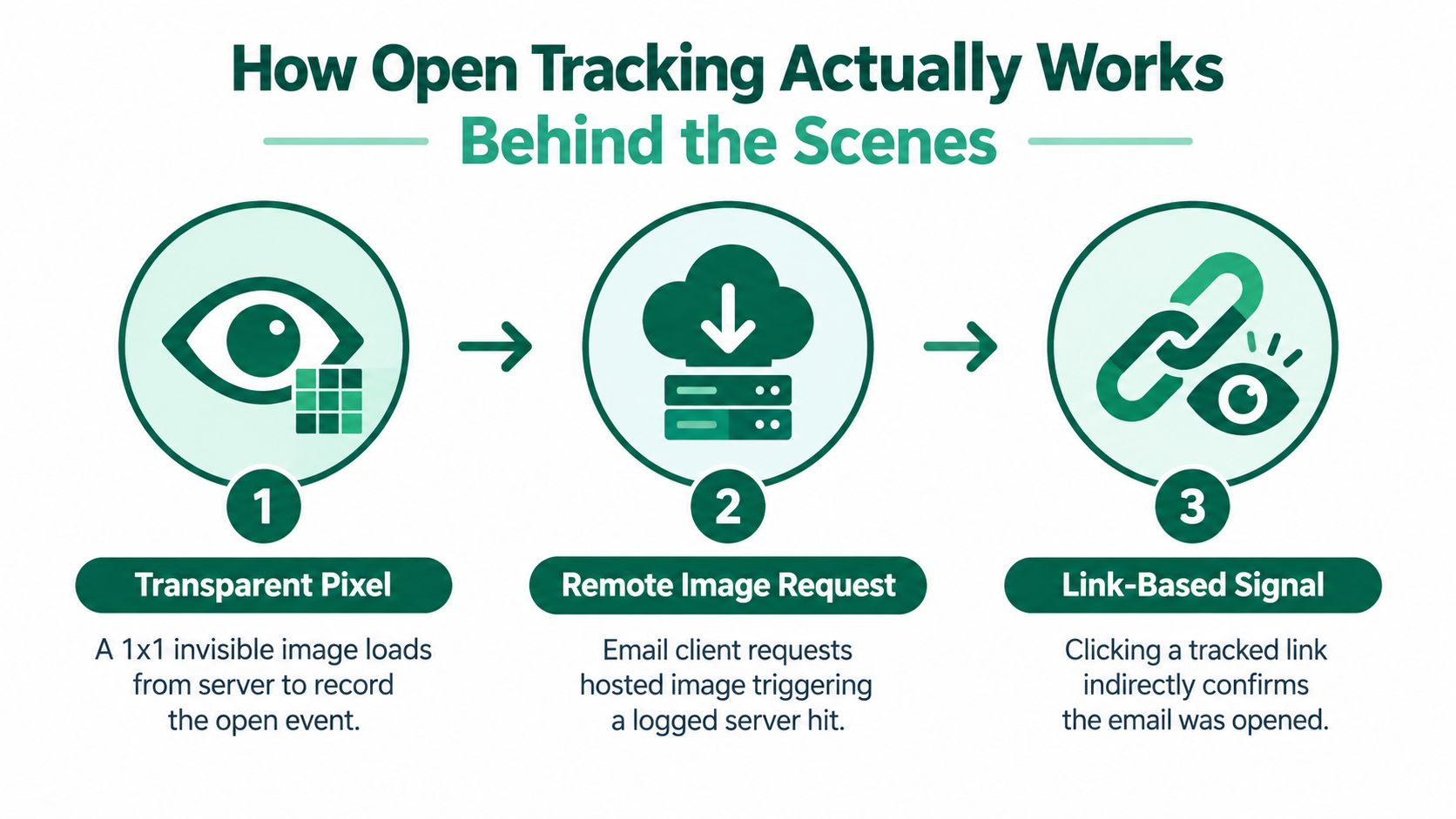
A pixel open occurs when the client requests the remote image. It doesn't require a click and doesn't verify that the recipient read the copy. If remote images aren't loaded, the event usually isn't recorded.
A link-based signal comes from a recipient clicking a tracked link. The email platform routes the click through a tracking URL or redirect before sending the recipient to the destination. This is a stronger engagement signal because the recipient, or an automated system acting on the recipient's behalf, took an action beyond image rendering. It still requires judgment, especially when security tools scan links.
A read receipt is different again. It relies on a request from the recipient's mail client or a response from the client that supports receipts. Many recipients or organizations disable receipts, so they don't provide a dependable foundation for B2B campaign measurement.
For readers dealing with document engagement, the question of can you tell if someone opened a PDF illustrates the same distinction. Detecting a technical event isn't the same as confirming attention or comprehension.
Email platforms typically distinguish between unique opens and multiple opens. A unique open counts a recipient once for a message, while total opens may count repeated image requests from the same recipient. Open rate is commonly calculated as unique opens divided by delivered emails, or by sends minus bounces, depending on the platform's definition.
That formula looks precise, but the denominator and event quality both matter. Image blocking can create an undercount. Automatic image loading and proxying can create an overcount. A campaign report can therefore present a clean percentage built on inconsistent behavior across clients.
The technical mechanism is useful for diagnosing whether a message was rendered. It isn't a reliable proxy for a human reading the email. If you want to understand the relationship between email content and richer media, review the practical guidance on embedding a video in an email, but judge success through the action that follows the message, not the render event itself.
Implement open tracking only after deciding what decision the data will support. If the answer is merely “report engagement,” native tracking from an email service provider is usually sufficient. If you need control over identifiers, event storage, retention, and client-level analysis, a custom setup can provide more visibility, but it also creates privacy and maintenance responsibilities.
Start with the ESP configuration. Platforms such as Mailchimp, SendGrid, Salesforce Account Engagement, and Kit generally provide an open-tracking control. Confirm that your email is being sent as HTML, that the template allows remote images, and that the platform documents how it handles unique and repeated opens.
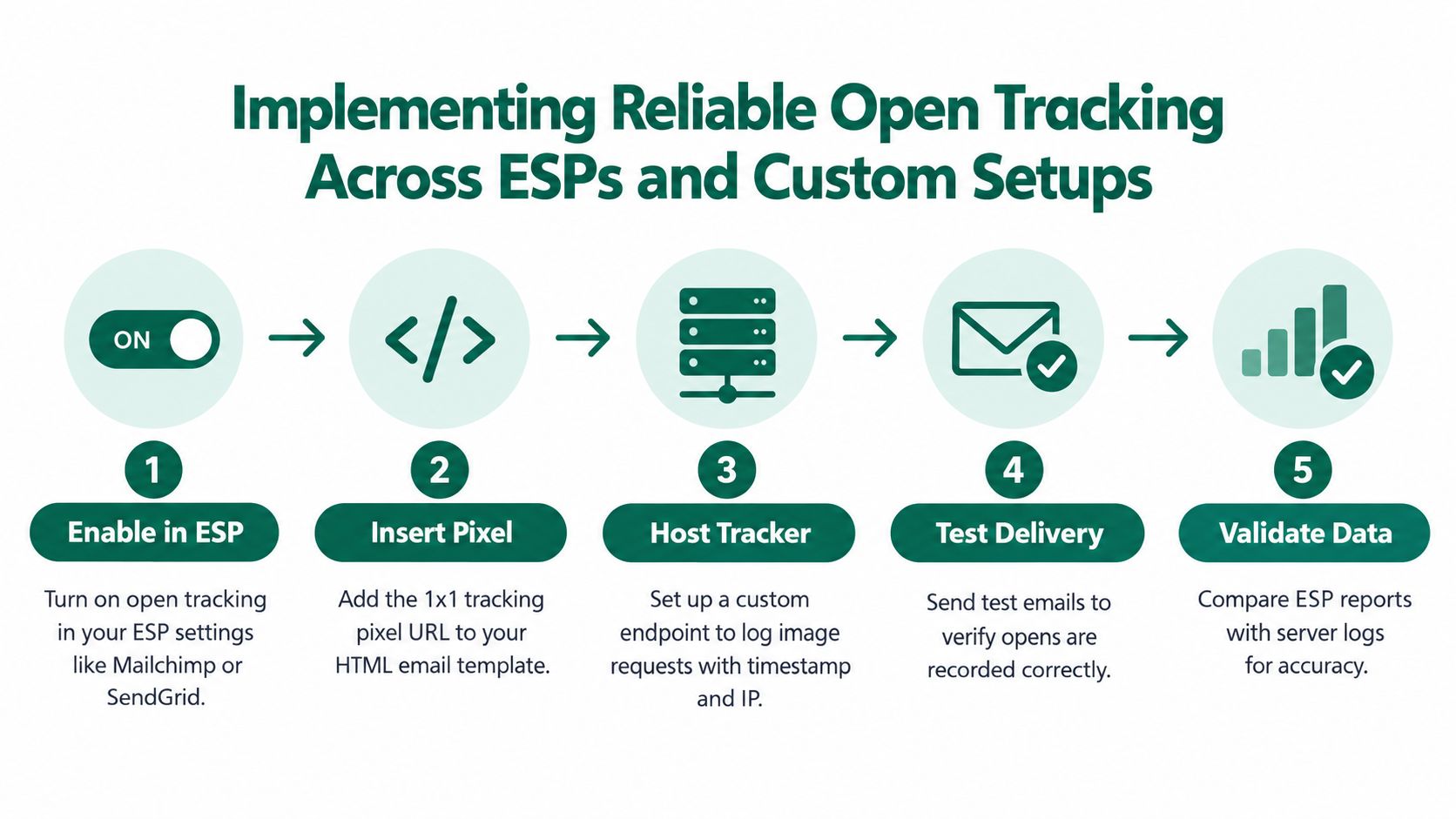
A custom pixel implementation has four core components:
The endpoint should return a valid image response quickly. Slow responses can damage rendering and create confusing delivery behavior. Your data model should also preserve campaign, recipient, and send context, so a technical event can be connected to a later click or CRM activity without reconstructing the relationship manually.
Send test messages to clients with different image-loading behavior. Inspect whether the pixel request arrives, whether the identifier maps to the correct recipient, and whether repeated loads are handled consistently. Compare the ESP report with your server logs, but don't assume either system is the source of truth for human attention.
A free inbox placement test can help diagnose whether messages reach inboxes and whether delivery conditions are undermining your measurement. It won't turn opens into verified reads. Use it to separate deliverability problems from interpretation problems.
Keep automation conservative. Open events can trigger a low-risk follow-up, but they shouldn't independently create a high-intent lead, assign a sales opportunity, or launch aggressive outreach. For a broader view of event-driven programs, review marketing automation workflows. The workflow should support a pattern of meaningful behavior, not one ambiguous request.
Privacy controls didn't merely reduce tracking accuracy. They changed the meaning of the event.
Apple Mail Privacy Protection preloads images through proxy servers. That can generate apparent opens even when the recipient didn't read the message. Gmail and Outlook image blocking can suppress legitimate opens. Corporate security scanners can load images before a human views the email, producing additional false positives. The result is simultaneous inflation and suppression, not one clean bias.
Recent guidance also notes that Apple Mail Privacy Protection affects about 40% of emails, corporate security tools can inflate open data by up to 6.5%, and some estimates place open-rate overstatement at as much as 18 percentage points in environments with substantial Apple Mail exposure. These figures are reported in the analysis of why open metrics may be wrong. Treat them as evidence of measurement instability, not as universal correction factors.
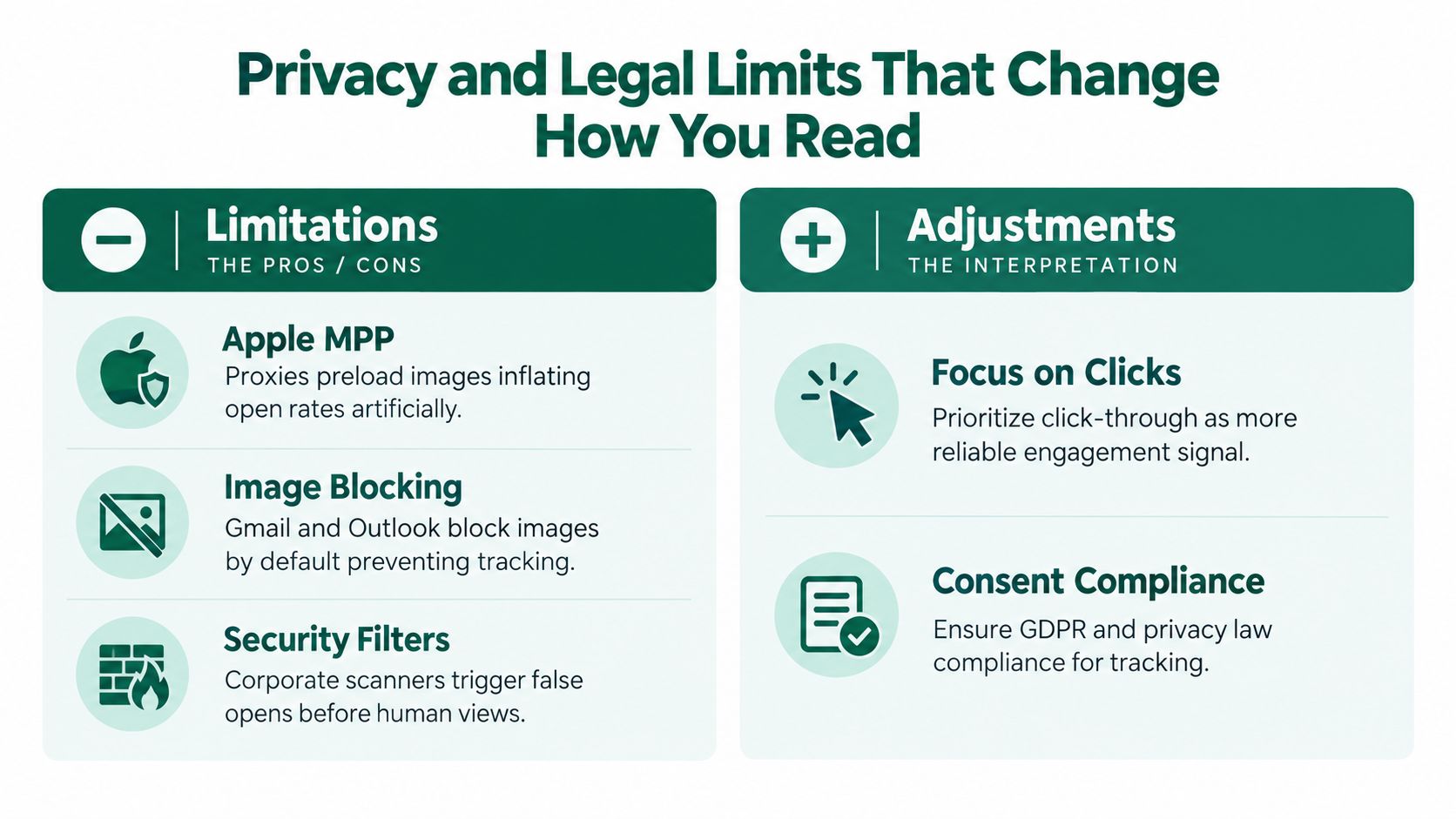
European compliance isn't solved by adding a sentence to the footer. Guidance from France's CNIL and Italy's Garante indicates that email tracking pixels can fall under ePrivacy-style rules and may require prior consent in many marketing contexts, particularly when the pixel identifies or profiles individual recipients. The legal question depends on how the pixel accesses information on a device and how the organization uses the resulting data.
Marketing consent and tracking consent may not be interchangeable. A recipient can agree to receive a newsletter without agreeing to individual behavioral profiling. Mixed US and EU programs should therefore store tracking permission as a distinct, recipient-level signal and suppress the pixel when the required consent isn't available.
Ask privacy counsel to assess scope, consent language, withdrawal, retention, and regional treatment. Don't let a campaign manager make that decision through ESP settings alone. The same discipline applies to broader buyer confidence work, including trust in B2B marketing.
Segment reporting by email client where possible. Use open trends only as directional context, and move decision weight toward clicks, replies, and CRM outcomes. If your team can't explain how privacy behavior affects a reported number, that number shouldn't be presented as precise evidence to the board.
B2B SaaS leaders should rank metrics by distance from revenue. An open is a low-friction technical event. A click shows a stronger action. A reply reveals context. A meeting creates a sales conversation. Pipeline connects that conversation to a commercial process.
That doesn't make every downstream metric perfect. A click can be accidental, a reply can be unqualified, and a meeting can be poorly matched. But each action contains more decision value than an image load because the recipient must do more than allow a client to fetch an asset.
Historical benchmarks show why open rate became so embedded in reporting. Constant Contact's October 2024 benchmark covered 4.3 billion emails across 297,600 campaigns from 1,061 senders and reported a cross-industry average open rate of 32.55%. Klaviyo's 2025 benchmark reported an average campaign open rate of 37.93% and a top-10% performance level of 54.78%. Another 2025 benchmark reported a median of 43.46%, compared with 42.35% in 2024. The figures come from different methodologies, which proves the point: benchmark definitions vary, and open behavior is not a stable commercial KPI. See the benchmark discussion in email open rate statistics.
| Metric | What It Actually Measures | Reliability After MPP | Best Use in B2B SaaS |
|---|---|---|---|
| Open rate | Image rendering by the recipient's client | Low and client-dependent | Directional delivery and subject-line diagnostics |
| Click-through rate | A tracked interaction with a link | Stronger, but still requires bot and scanner checks | Content relevance and next-step engagement |
| Reply rate | A response that adds language and context | More meaningful than an open | Pain discovery, qualification, and founder-led outreach |
| Meeting booked | A scheduled sales interaction | High for intent, weaker if qualification is poor | Demand capture and sales alignment |
| Influenced pipeline | CRM-linked opportunity activity associated with the program | Strong for business review when attribution is consistent | Budget, prioritization, and board reporting |
Set one primary metric for each campaign type. A product education email may prioritize relevant clicks. A founder-led account sequence may prioritize thoughtful replies. A nurture program should be judged by qualified meetings and opportunity progression, not by the number of recipients who rendered the message.
Track cohorts by account, segment, email client, and campaign purpose. Then connect events to CRM stages. A click from a target account that later enters an active opportunity deserves more attention than a larger volume of unqualified opens.
Board-level standard: Report the smallest set of metrics that can support a budget or GTM decision. More rows don't create more truth.
Teams that need a clear attribution model can use marketing ROI measurement to connect channel activity with pipeline and revenue. The reporting system should make it easier to stop weak motion, not easier to defend it.
Open data becomes useful when you treat it as a fault signal rather than a verdict.
A low open rate may reflect blocked images, a malformed HTML body, poor inbox placement, or weak subject-line relevance. A high rate may reflect proxy preloading, security scanning, or repeated loads. The first task is diagnosis. The second is deciding whether the result is important enough to change a GTM decision.
Salesforce guidance identifies practical cases where tracking may not be recorded, including a recipient field containing only an email address with no related record, a blank message body, certain Case or email-to-case flows, and browser settings that prevent embedded images from downloading. Those aren't abstract edge cases. They can make a working campaign look broken.
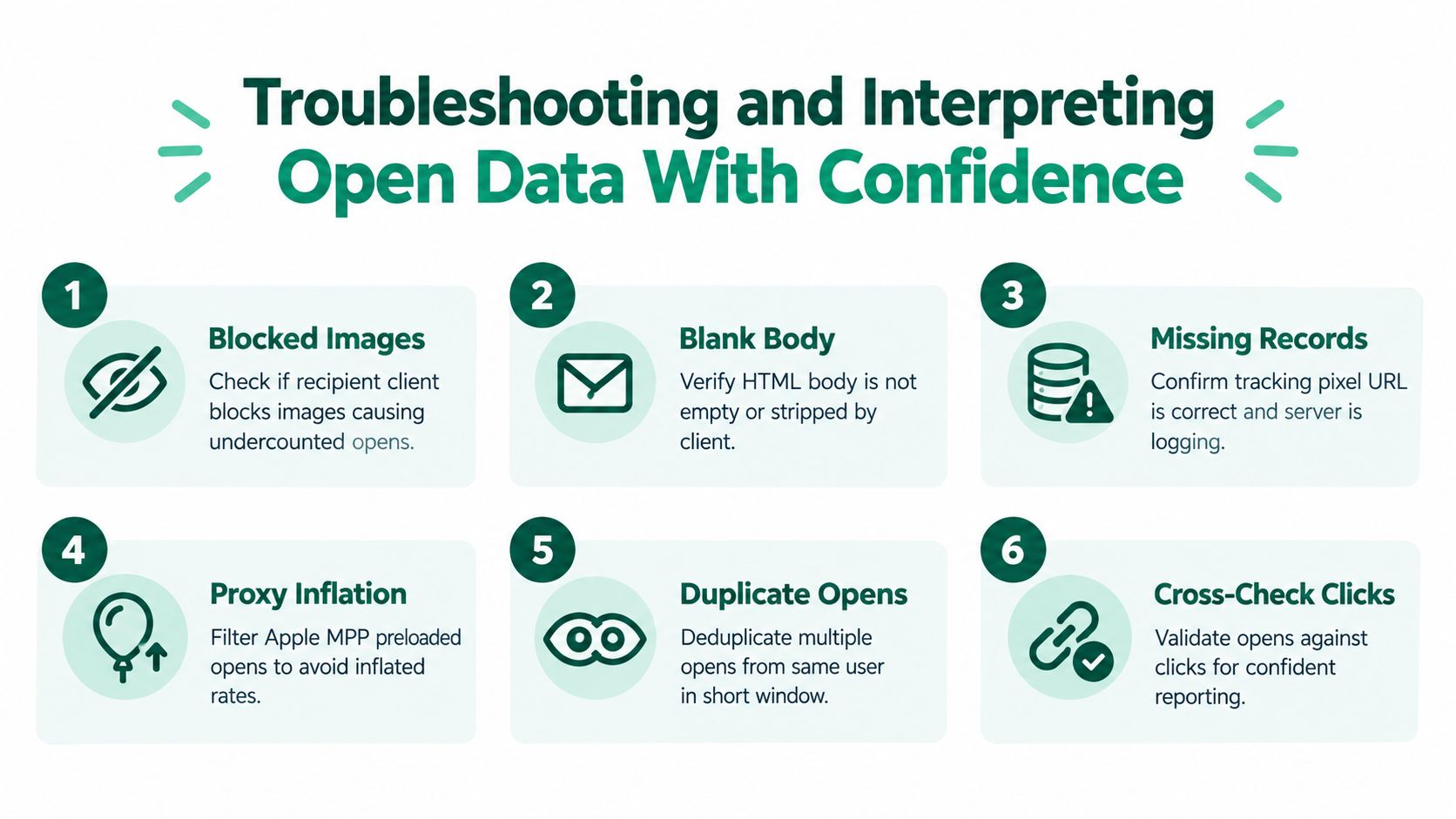
Use this audit sequence:
Trust open data when you're diagnosing whether a message rendered across a controlled technical test. Discount it when client mix, proxy behavior, or scanner activity is unclear. Ignore it as a primary KPI when leadership is deciding whether demand exists, whether a segment is qualified, or whether a campaign influenced revenue.
Don't overreact to a single campaign spike. Compare consistent cohorts and downstream behavior over time. If opens rise while clicks, replies, and meetings stay flat, the program hasn't improved in a way that matters. If opens fall while target-account replies and opportunities increase, the dashboard is wrong about the business outcome.
A reliable measurement system creates decision confidence, not numerical decoration. Big Moves Marketing helps B2B SaaS teams clarify positioning, design growth programs, and connect reporting to pipeline so leaders can stop optimizing ambiguous engagement and focus on commercial evidence.
Big Moves Marketing works with founders and senior GTM leaders on positioning, demand programs, email measurement, and reporting systems tied to pipeline. Visit Big Moves Marketing to replace open-rate theater with clearer decisions and revenue-connected growth motion.




%20-%20white.svg)