%20png%20copy.avif)
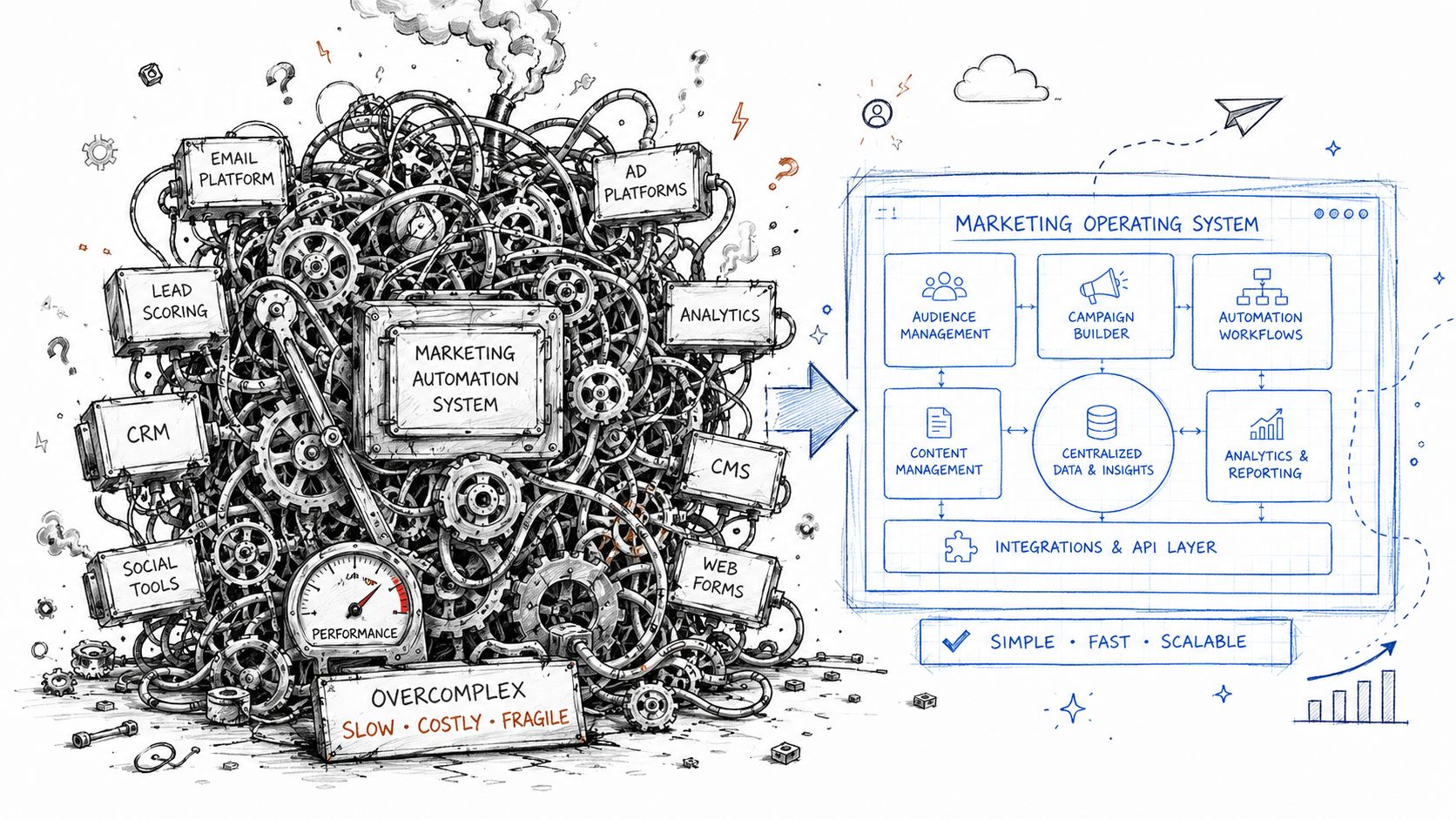
Most SaaS teams buy marketing automation to compensate for unclear positioning, weak lifecycle definitions, and unreliable handoffs. That's backwards. Automation doesn't repair a broken revenue motion. It accelerates it, including the parts that confuse buyers, bury qualified leads, and send sales conversations to the wrong people.
The right mental model is marketing automation for SaaS as a revenue operating system. It should encode your go-to-market logic, respond to meaningful customer behavior, and move an account toward the next commercial decision. Email is only one output. The system includes segmentation, product signals, routing, onboarding, re-engagement, reporting, and governance.
The popular advice says to pick a platform, build a few workflows, and start sending nurture emails. That approach fails because it treats automation as a campaign function instead of an operating model.
A startup with unclear ICP boundaries might automate every form fill. A Series A company with inconsistent lifecycle stages might score a webinar attendee as highly as a product evaluator. A sales-led SaaS business might route a low-fit content download to an account executive while a high-fit account showing strong buying behavior receives another generic email. The software executes perfectly. The system still produces poor pipeline.
That pattern is common across early-stage and growth-stage B2B SaaS. Teams buy software because the symptoms are visible, then discover that the underlying problems sit in positioning, data structure, ownership, and process. Automation amplifies the logic you give it. If the logic is weak, more speed creates more noise.
Ascend2's 2024 State of Marketing Automation summary reported that 69% of surveyed marketing professionals saw at least some success from automation. Only 3% said it was unsuccessful, while just 28% described their strategy as best-in-class. That gap matters. Adoption alone isn't the differentiator. Operational maturity is.
Before you automate, answer four questions:
This is why sales and marketing alignment is an operating requirement, not a meeting cadence. Automation can't resolve disagreement about what qualifies as an opportunity.
Practical rule: Don't automate a decision your team hasn't made manually and consistently.
The rollout should be staged. First stabilize segmentation and lifecycle definitions. Then deploy nurture, onboarding, and re-engagement streams. Finally, measure time-to-value and funnel lift. That sequence keeps automation in its proper role, as support for a clear GTM model rather than a substitute for one.
A pre-automation audit should feel uncomfortable. If it doesn't expose contradictory definitions, missing fields, stalled leads, or unowned handoffs, it's probably too shallow.
Start with the actual path from demand to revenue. List every meaningful source, from organic search and paid acquisition to founder-led outreach, partner referrals, product sign-ups, and events. Then trace what happens after capture. Identify where a lead becomes an MQL, when sales receives it, what qualifies an SQL, and where opportunities stop progressing.
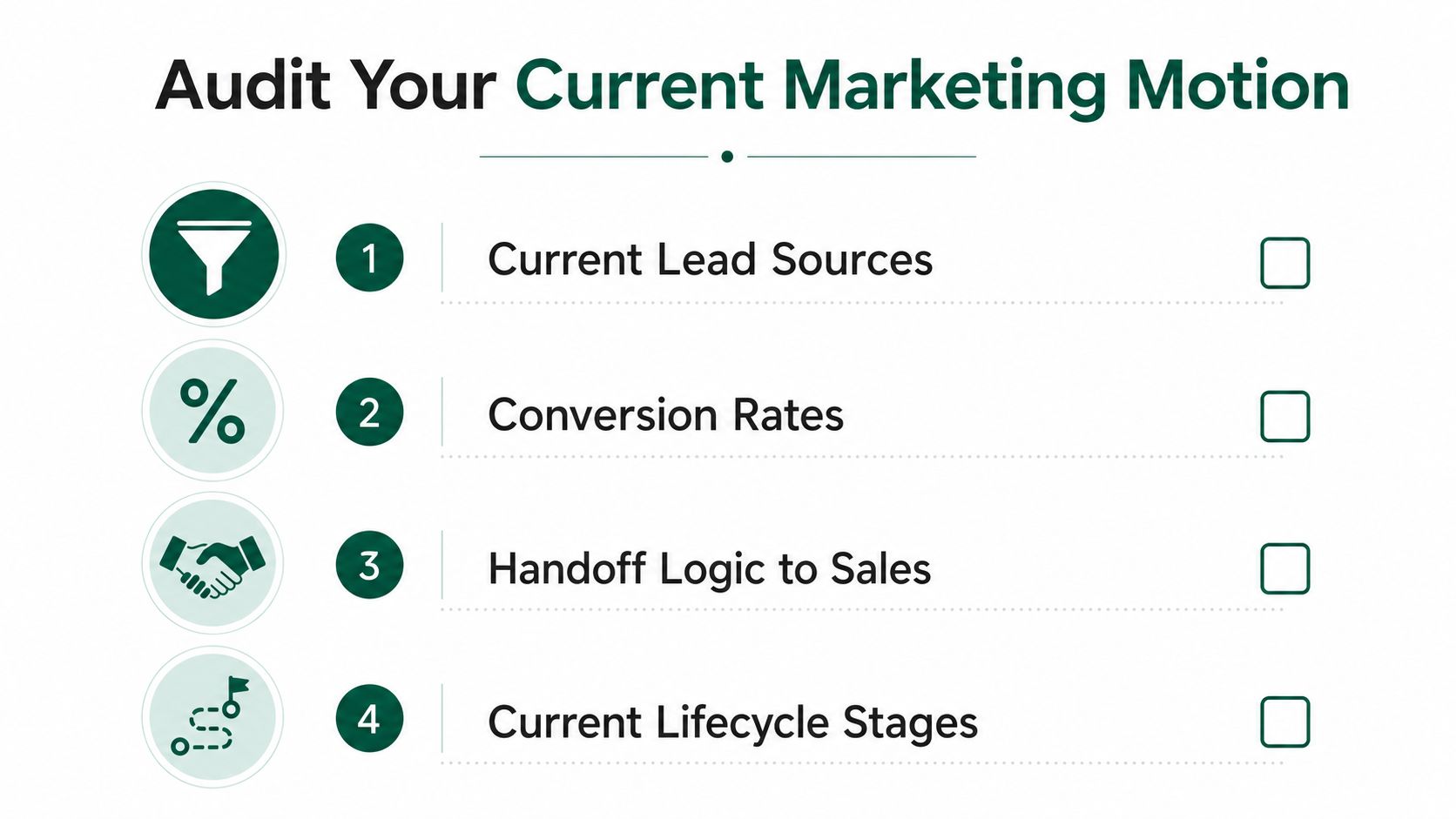
Use four questions to identify what automation can responsibly improve:
A SaaS company often discovers that its “lead problem” is a routing problem. The leads exist, but the CRM doesn't distinguish a student researching the category from a target account evaluating a deployment. Another team finds that marketing reports MQLs while sales measures active opportunities, with no agreed transition between the two.
Marketing automation is now mainstream B2B infrastructure. One 2024 benchmark found 56% of B2B companies used a dedicated marketing automation platform, up from 51% in 2022, while an Econsultancy survey reported 53% were already using marketing automation and another 37% planned to implement it. Those figures come from the Econsultancy State of B2B Marketing Automation report. Adoption is no longer the strategic question. Readiness is.
Choose one movement the system must improve. It might be qualified meetings from high-fit inbound accounts, trial activation, sales acceptance, or re-engagement of dormant opportunities. Don't start with “we need a nurture series.” Start with “which stalled decision should this system help progress?”
Document the baseline, ownership, data required, and expected review point. The benchmark cited above reports a median time-to-value of 4.7 months for a new marketing automation platform, so leaders shouldn't judge the implementation after a few weeks of activity. Use the early period to stabilize definitions, instrumentation, and routing before demanding pipeline proof.
Personas rarely fail because they're inaccurate. They fail because they don't control operational decisions. A slide that says “mid-market operations leader” doesn't tell your system which message to send, whether to route an account, or when to suppress promotion.
A durable segmentation model has one spine. It combines ICP tiers, behavioral signals, lifecycle stages, and intent triggers. Every workflow, score, dashboard, and handoff should draw from the same structure.
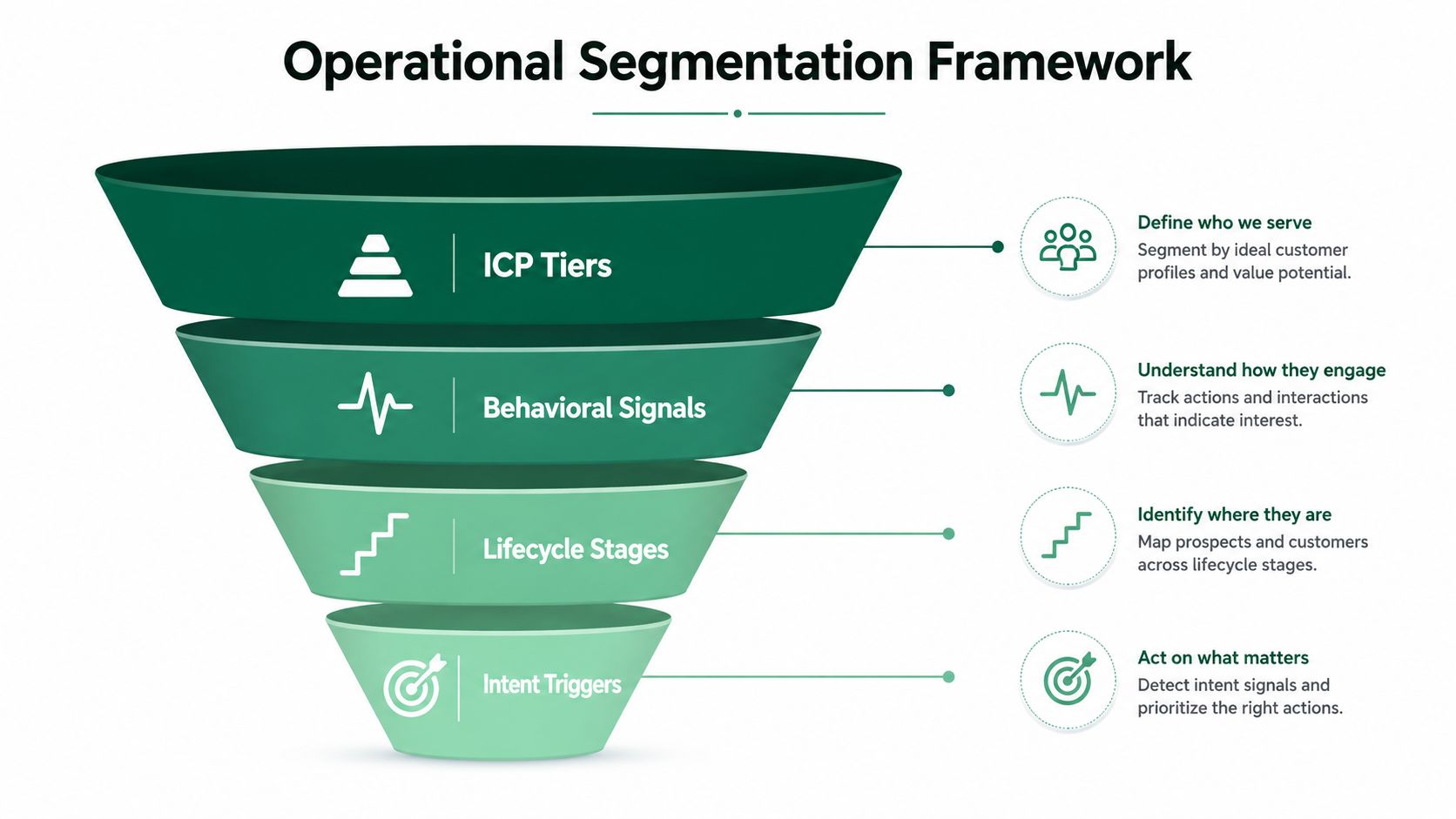
ICP tiers define commercial fit. Separate strategic accounts from viable growth accounts and low-priority segments. Use firmographic and business context that affects the buying motion, such as team structure, operating model, geography, technical environment, or compliance requirements.
Behavioral signals describe what people and accounts do. Content engagement, repeat visits, product usage, invitation of colleagues, integration activity, and pricing interaction can all matter. Don't treat every action as intent. A signal is useful only when it changes your understanding of the buyer's situation.
Lifecycle stages define the relationship. A prospect, trial user, activated account, opportunity, customer, and expansion candidate should not be interchangeable records. Each stage needs entry criteria, exit criteria, a responsible team, and suppression rules.
Intent triggers identify moments that justify a different response. A high-fit account returning to a product comparison page may warrant sales context. A trial user completing setup but avoiding a core feature may need onboarding support, not a commercial pitch.
PLG and sales-led motions require different triggers. In PLG, product usage often carries more weight than a form submission. In sales-led SaaS, account fit, buying committee activity, and a credible business problem may matter before meaningful product usage exists. A hybrid model needs both, without allowing one signal to dominate every route.
A detailed B2B customer journey mapping framework helps expose the moments where the buyer's needs change. Map the journey from first touch through activation, renewal, and expansion, then connect each transition to evidence rather than assumptions.
Limit the number of stages and make definitions teachable. If sales, marketing, product, and customer success each maintain different lifecycle labels, automation will create contradictory experiences.
The rollout sequence is clear. The SaaS marketing automation benchmarks summarized by The Starr Conspiracy recommends establishing segmentation and lifecycle definitions first, then deploying nurture, onboarding, and re-engagement streams, and finally measuring time-to-value and funnel lift. The same benchmark reported nurtured leads generated a 20% increase in sales opportunities, alongside the 4.7-month median time-to-value cited earlier.
The point isn't to build a complex model. It's to build one model that every team can use without interpretation.
Most SaaS teams build too many disconnected campaigns and too few lifecycle systems. Start with five flows that cover the commercial journey from first meaningful interest through expansion.
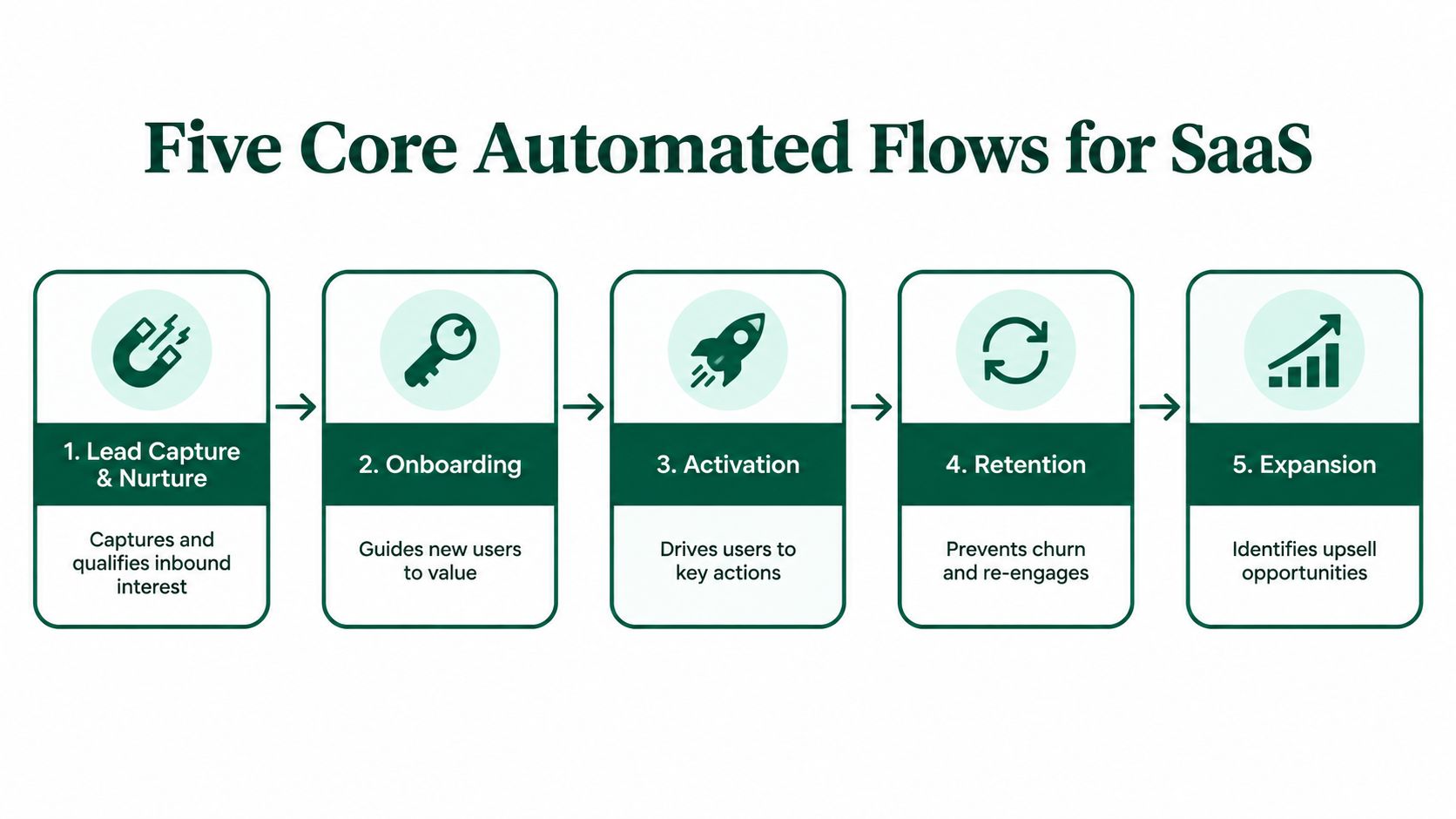
Trigger this flow when a prospect converts on a meaningful asset, requests information, or shows repeated interest from a target account. Branch by ICP tier, problem area, buying role, and engagement. A founder-led sales motion might route a high-fit account to the founder with context, while a lower-priority educational lead receives a problem-specific sequence.
The flow should answer the buyer's next question. It shouldn't send a product brochure followed by more product brochures. Measure progression toward a qualified conversation, not the number of emails delivered.
B2B benchmarks show why triggered sequences deserve attention. Brevo's email marketing benchmarks report 30.63% average opens and 7.39% click-through for automation-focused campaigns, compared with 20.73% opens and 2.27% click-through for standard marketing campaigns. Use that advantage to support a relevant decision, not to increase message volume.
The onboarding flow begins when a user starts a trial, creates a workspace, or completes a sales-assisted implementation step. Trigger messages from the user's actual setup state. A user who hasn't connected a required integration needs a different intervention from one who has invited colleagues but hasn't completed the core workflow.
Keep product education close to product behavior. Send a short explanation, show the next action, and suppress the message once the action happens. Marketing should coordinate with product and customer success here, because onboarding failures often reflect product friction rather than weak copy.
Activation is the point at which the user experiences meaningful value. Define it from observed customer behavior, not a generic event such as login. For a collaboration product, activation might involve a shared workflow. For an analytics product, it might involve connecting data and producing a useful report.
Use behavior to branch the flow. If a user starts an important action and stops, offer help. If a product-qualified account reaches the activation threshold, route context to sales or customer success. Don't ask an activated user to repeat introductory actions.
Retention automation should identify weakening usage before the renewal conversation becomes urgent. Trigger it from inactivity, declining use of a valuable feature, unresolved support friction, or a missed milestone. Match the intervention to the reason for disengagement.
A re-engagement email can't solve a missing product capability or a poor implementation. Give the account a useful path back, such as a targeted guide, a support conversation, or a review of the workflow that originally created value. Suppress broad promotional sends while a risk intervention is active.
Expansion flows should follow evidence of broader need. Usage beyond the current plan, new team members, repeated interest in advanced capabilities, or changes in account scope can create a relevant moment. The handoff should include the signal, the account context, and the likely use case.
Sales should not receive an “upsell alert” with no explanation. That trains the team to distrust the system. Where email is part of the commercial motion, this resource on how to optimize email automation for meetings provides useful guidance on connecting sequences to meeting outcomes.
A practical workflow library can support implementation, but the logic must remain yours. Big Moves Marketing describes a marketing automation workflow as GTM logic encoded in a system, which is the right standard for deciding what belongs in a marketing automation workflow.
Here's the operating test for all five flows: each one must have a clear trigger, a defined next action, a responsible owner, an exit condition, and a measurable commercial outcome.
Platform selection should follow the operating model, not lead it. A large enterprise platform can create unnecessary complexity for an early-stage SaaS team, while a lightweight email tool may fail once product behavior, account routing, and customer lifecycle data become central to the motion.
Enterprise economics make the trade-off explicit. One benchmark estimates a $127,000 median annual total cost for enterprise marketing automation implementations, while another reports an 18-month average implementation timeline for full enterprise deployment, as detailed in the enterprise marketing automation platform benchmarks. Those figures aren't a reason to avoid enterprise software. They're a reason to match platform ambition to process maturity.
| Evaluation Criteria | What Good Looks Like for SaaS | Red Flag |
|---|---|---|
| Lifecycle flexibility | Supports prospect, trial, customer, renewal, and expansion logic without workarounds | The platform assumes one linear funnel |
| CRM integration | Syncs ownership, stage, activity, account context, and suppression rules reliably | Marketing and sales maintain conflicting records |
| Behavioral tracking | Captures meaningful product and web events with usable context | The score depends mainly on email opens and form fills |
| Routing controls | Sends the right account to the right owner with visible reasoning | Sales receives alerts without explanation |
| Governance | Provides permissions, naming standards, auditability, and change control | Anyone can edit revenue-critical workflows |
| Reporting | Connects flow activity to funnel movement and revenue stages | Dashboards stop at delivery, opens, or clicks |
| Implementation burden | The team can operate the system after launch | The vendor or one specialist becomes indispensable |
Scoring deserves the same discipline. Fit and intent should remain distinct. A target account with little activity may deserve focused outreach, while an active but poor-fit contact shouldn't become a priority just because they clicked repeatedly.
Use a simple model that sales can challenge and understand. Start with fit, then add behavior that indicates a meaningful business problem or buying process. Apply decay or expiration to stale activity. Cap scores so one low-value action can't overwhelm the account's actual context.
A score should answer three questions:
Define the MQL with the same rigor. Big Moves Marketing's guidance on marketing qualified lead definition is useful because a label without agreed acceptance criteria creates reporting theater.
For PLG, include product events and account-level usage. For sales-led SaaS, include account fit, stakeholder engagement, and evidence of an active evaluation. Route at the account level where buying decisions involve multiple people. A contact score alone often fragments the opportunity.
Automation earns its place when it improves revenue movement, not when it creates a busier dashboard. Track the path from MQL to SQL to opportunity, time-to-value, handoff acceptance, activation, retention signals, expansion response, and revenue per email where the data model supports it.
Email efficiency can be a useful diagnostic. One 2026 email revenue benchmark reports $3.41 per email sent for automated emails versus $0.155 for campaign emails, a stated 22x difference in revenue per email. Treat that as a benchmark for evaluating triggered relevance, not as a promise your system will reproduce. Revenue attribution depends on offer, audience, sales cycle, product, and measurement quality.
Start with the trigger. If the wrong event starts the flow, better copy won't save it. Then test routing, message relevance, timing, suppression, and handoff thresholds. Change one meaningful variable at a time so the team can identify causality.
Review performance at a consistent operating cadence:
A startup marketing team comparing tools can use this startup marketing tools guide as a practical reference, but no tool list replaces a clear measurement model.
The most damaging failure is over-automation. Teams add branches because the platform allows them, then create experiences nobody can explain. Keep the first version narrow and observable. Expand only when the team understands the response and can maintain the logic.
Dirty data creates a second failure. Duplicate records, stale ownership, missing lifecycle values, and untracked product events undermine every score and report. Establish data ownership and change control before adding more workflows.
The third failure is premature scaling. Teams expect immediate pipeline impact, then declare automation ineffective before segmentation, routing, and attribution stabilize. The earlier benchmark's 4.7-month median time-to-value is a useful reminder that implementation requires operational patience, not passive waiting.
A practical 90-day plan is straightforward. First, audit the motion and agree on lifecycle definitions. Next, repair the highest-impact handoff and launch one nurture or onboarding flow. Then measure movement, remove failure points, and add the next flow only after the first is governed.
Read how to measure marketing effectiveness as a measurement discipline, not a reporting exercise. The core question is always the same: did the system help the right account take the next valuable step?
Automation becomes a revenue operating system when your team can explain its decisions, trust its handoffs, and improve it without adding chaos. That's the standard founders and revenue leaders should demand before approving another platform or workflow.
Big Moves Marketing helps B2B SaaS teams clarify positioning, define lifecycle logic, and build marketing automation systems tied to pipeline rather than activity. Visit Big Moves Marketing to discuss a focused automation audit, GTM operating model, or fractional CMO engagement for your next stage of growth.



%20-%20white.svg)