%20png%20copy.avif)
Most B2B SaaS teams don’t have a marketing automation workflow problem. They have a strategy problem that software is hiding.
What usually gets called automation is just organized activity. A form gets filled. An email goes out. A rep gets notified. A lead gets tagged. Everyone feels productive because the machine is moving. But movement isn’t progress. If the workflow isn’t built to test a go-to-market hypothesis, improve handoff quality, and push a prospect closer to revenue, it’s busy work with better branding.
That’s why the usual advice is so weak. It starts with triggers, templates, and tool setup. Senior teams should start somewhere else entirely. A marketing automation workflow is your GTM logic encoded into a system. It’s the operating model for how marketing, sales, and product respond to buyer behavior at scale.
More automation usually creates more noise.
One industry analysis shows that 79% of businesses use marketing automation and 64% of marketers combine automation with AI. It also notes that B2B SaaS teams can generate 80% more leads with automation (source). Founders read numbers like that and assume the stack is working. It usually isn’t. In a lot of SaaS companies, automation just helps weak process produce bad leads faster.

Lead volume is the easiest metric in the building. Pipeline quality is the hard part.
A workflow does not become smart because it has branches, delays, and lead scores. It becomes useful when it encodes commercial judgment across marketing, sales, and product. It should treat a student downloading a template differently from an ICP account comparing integrations, and differently again from a trial user who invited three teammates and visited pricing twice this week. If your workflow cannot make those distinctions, it is admin theater.
Teams fail when they automate communication before they define buying logic.
That failure shows up fast. Marketing celebrates MQL growth. Sales ignores the alerts because the routing is loose and the context is missing. Product signals sit in another system, so nobody knows whether engagement means curiosity or purchase intent. The workflow keeps running, but nobody trusts it.
That is why workflow strategy is really a go-to-market alignment problem. If your handoff rules, intent signals, and follow-up thresholds are not shared across functions, the automation will amplify conflict instead of revenue. Start with the sales and marketing alignment issues that break lead handoffs, because that is usually the primary bottleneck.
The same standard applies to adjacent growth motions. If partnerships, referrals, or affiliates matter to your pipeline, do not run them as disconnected side projects with their own logic and reporting. Build them into the same revenue system. This guide on how to scale your SaaS with affiliate automation is useful for that reason. It treats automation as program design tied to outcomes, not a pile of triggers in another tool.
Most founders buy workflow software too early. They think the tool will force discipline. It won’t. It will expose the lack of it.
When a team says it needs a marketing automation workflow, I usually hear something else. They don’t have agreement on who the best-fit buyer is, what event signals buying intent, where the product journey changes, or when a lead deserves human follow-up. Software can’t solve any of that.
The usual pattern is predictable. Someone maps the funnel in a slide deck. Marketing writes a few nurture emails. Ops builds branches in HubSpot or Marketo. Sales asks for instant alerts on “hot leads.” Then the whole thing degrades into rule sprawl because nobody made the hard strategic decisions up front.
That’s why the phased approach matters. A proven roadmap argues for starting simple and scaling systematically because broad transformations often collapse under their own complexity. According to this implementation roadmap for marketing automation workflows, full-scope transformations fail 70-80% of the time, and the recommended order is disciplined: start with a single welcome series, then add lead nurturing, then behavioral segmentation.
Practical rule: If your team is designing multiple workflows before agreeing on one high-value entry point, you’re building architecture on top of ambiguity.
This is strategy work, not campaign work. Treat it that way.
Forget fluffy personas. Your workflow should be built around buying motion.
That means answering a narrower set of questions:
A serious B2B team maps these transitions across systems. Website behavior, CRM status, product usage, and sales touchpoints all describe the same commercial journey from different angles.
A simple planning table helps.
| Buying stage | Useful trigger | Communication job | Human handoff |
|---|---|---|---|
| Problem awareness | Content download or webinar signup | Clarify problem and stakes | None yet |
| Active evaluation | Demo request, pricing revisit, high-intent page views | Prove fit and remove friction | SDR or AE review |
| Product validation | Trial activation, invite teammate, key feature use | Drive activation and confidence | Sales or CS depending on motion |
| Expansion or rescue | Usage drop, feature adoption gap, contract milestone | Recover value or expand account | CS or account owner |
A common error is skipping this and jumping to email copy. That’s backwards. Copy is the last mile. Logic is the asset.
For teams working on category education and founder visibility alongside lifecycle motion, consistency matters. Your outbound content and your workflow language should reinforce the same market thesis. That’s why a clear LinkedIn posting strategy can matter more than another nurture branch. If your public narrative and private lifecycle messages disagree, prospects feel the inconsistency.
A good workflow system starts narrow. You need one flow that matters, not six mediocre ones.
I’d build in this order:
Welcome or inbound acknowledgment first
Pick the highest-signal entry point. For many SaaS teams, that’s a demo request, a qualified contact form, or a trial signup with business email. The point isn’t volume. The point is reducing wasted response time and standardizing follow-up quality.
Lead nurture second
Add a long-cycle nurture only after you’ve defined what disqualifies a handoff and what behavior upgrades a lead. Otherwise nurture becomes a parking lot for unresolved GTM confusion.
Behavioral segmentation third
Only introduce branching once your team trusts the underlying signals. Branching on unreliable events creates false precision. It looks advanced and performs poorly.
Good automation doesn’t start by asking what the platform can do. It starts by asking what decision the business keeps making inconsistently.
Before software selection, force the team to document:
If you haven’t done that, you don’t need a new workflow. You need a real B2B marketing strategy.
A useful marketing automation workflow is modular. It’s not a static sequence you admire in a whiteboard session. It’s a controlled operating system for specific commercial moments.
The four blueprints below show where B2B SaaS teams should focus first. Not because they’re trendy. Because they sit close to revenue.
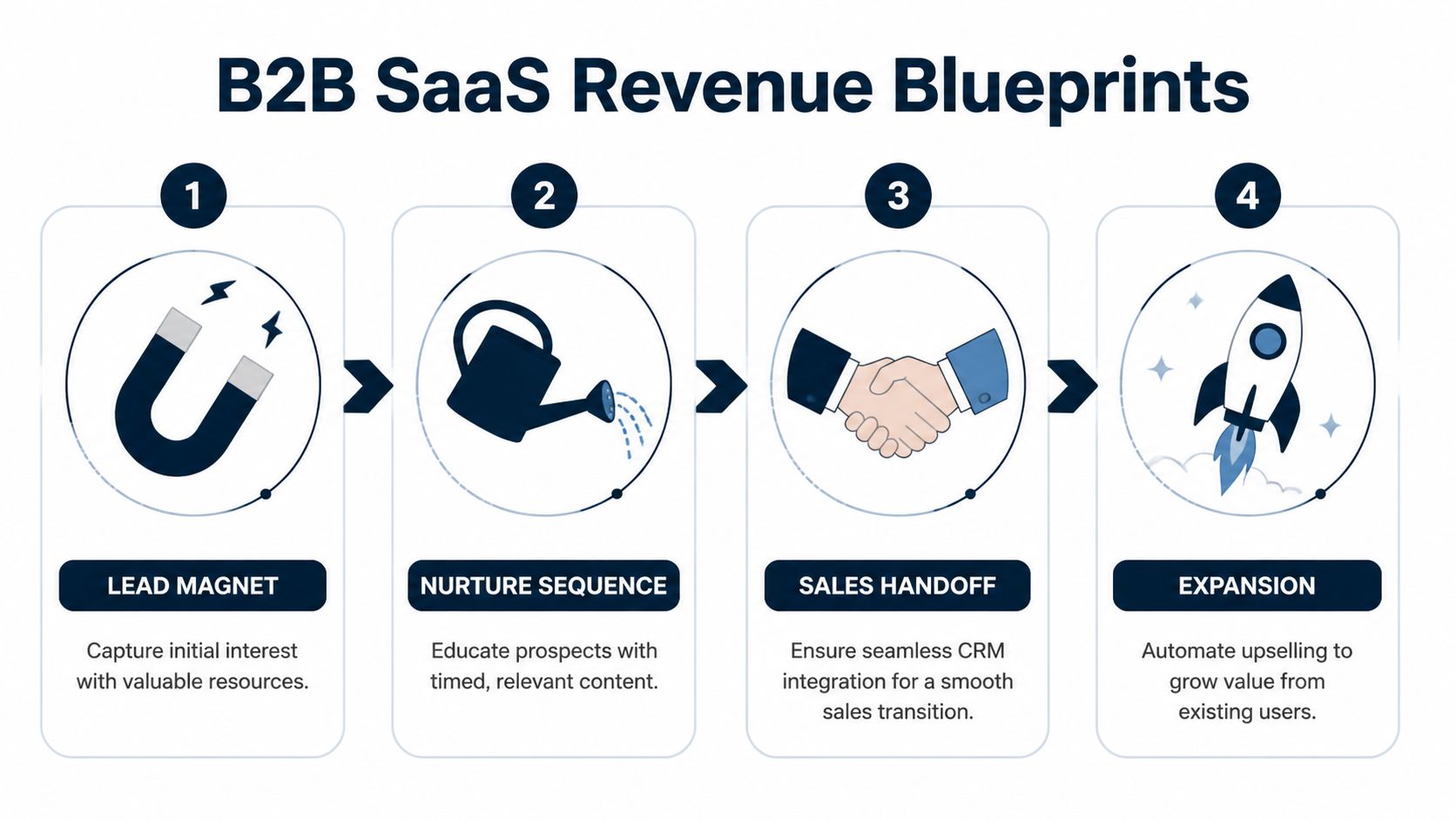
This is the workflow for demo requests, pricing-page conversions, contact-sales forms, and hand-raisers who are telling you they want a commercial conversation.
The common mistake made is treating every inbound form as if it deserves the same path. It doesn’t. The right move is controlled triage.
Goal
Move high-intent prospects into the right sales conversation quickly, while filtering weak-fit demand without creating friction for strong-fit buyers.
Trigger
Demo request, contact-sales form, or a combined signal such as a return visit to a commercial page plus a business-email form fill.
Core logic
Start with fit assessment. Not by asking twenty qualification questions on the form, which kills conversion, but by enriching against firmographic data and combining that with visible intent signals.
Then branch:
Workflow quality becomes apparent. If someone from your ICP requests a demo and also visited security, integrations, and pricing, the follow-up should reflect enterprise evaluation behavior. If someone downloaded one top-of-funnel asset and clicked “contact sales” out of curiosity, the system should avoid burning rep time.
A useful handoff checklist looks like this:
| Signal type | What it suggests | Workflow response |
|---|---|---|
| Pricing revisit | Commercial evaluation | Prioritize rep follow-up |
| Security or compliance page views | Procurement or enterprise interest | Route with enterprise context |
| Teammate invites or multi-user interest | Internal buying spread | Flag account potential |
| Generic top-of-funnel content only | Research mode | Keep in nurture unless fit is exceptional |
One more point. The follow-up email should not recap your product. It should reduce next-step friction. Time options. Relevant proof. Clear ownership. That’s it.
Most SaaS companies waste the most time here.
They build “nurture” as a content conveyor belt. Every contact gets the same thought leadership sequence until they unsubscribe, go dark, or accidentally become an MQL because they clicked something irrelevant. That’s not nurture. That’s deferred spam.
Goal
Convert ambiguous interest into observable buying intent without forcing a premature sales handoff.
Trigger
Content download, webinar registration, newsletter signup, report access, or event follow-up when there’s interest but not enough evidence for sales action.
Core logic
This workflow should diagnose, not just distribute.
A strong long-cycle nurture does three things:
That means each message has a job. One email reframes the problem. Another introduces an operational consequence. Another shows proof by use case. Another invites a lower-friction conversion, such as a benchmark call, calculator, or product tour.
The sequence should branch based on pattern, not just elapsed time. If a prospect repeatedly consumes integration, migration, or pricing-related content, they’re no longer top-of-funnel in the same way as someone casually opening newsletter content.
Nurture should answer, “Has this account earned sales attention yet?” If it can’t answer that, it’s just content scheduling.
This is also where many teams underuse list quality. If your database is bloated with poor-fit contacts, nurture metrics become meaningless. Segment by ICP, role, and likely buying job before you write a single sequence. If you need to tighten the raw material first, a cleaner approach to building and maintaining a B2B email database matters more than adding more emails.
For teams preparing a new category push, feature launch, or pricing shift, the workflow should also support launch readiness. A disciplined operational checklist is particularly helpful for this. If you’re about to introduce a new offer or product motion, this resource on how to prepare for your product launch is useful because it forces alignment between messaging, timing, and activation paths.
Exit condition
Either the contact shows enough behavioral evidence for a sales conversation, or they remain in a lower-frequency education stream. Don’t leave people trapped in a looping nurture forever. Stale automation teaches your market to ignore you.
For PLG and hybrid SaaS companies, this is the workflow with the most strategic value and the most internal politics.
Marketing often owns acquisition. Product owns activation. Sales wants to jump in when intent is obvious. If nobody defines the rules, the trial experience becomes fragmented. Prospects get onboarding emails from marketing, tooltip nudges from product, and opportunistic outreach from sales that ignores actual usage state.
Goal
Move a trial user from signup to meaningful activation, then to paid conversion with the right amount of human intervention.
Trigger
Trial signup, freemium activation, sandbox creation, or account creation tied to a product-led motion.
Core logic
This workflow should be built around product milestones, not email cadence.
Examples of useful branches include:
The biggest mistake here is over-educating before users experience value. Most trial flows talk too much. The user doesn’t need your entire roadmap. They need one concrete win tied to the problem that caused signup.
A practical design rule is to align each message to a blocked user decision:
If you can’t answer those in sequence, the trial workflow is unfocused.
Many SaaS teams call themselves data-driven and then put almost no automation effort into the installed base. That’s irrational. Existing customers are the clearest source of both risk and growth signal.
Goal
Detect value erosion early, support adoption, and expand accounts when behavior suggests readiness.
Trigger
Usage decline, feature adoption gaps, license thresholds, milestone anniversaries, support patterns, NPS responses, or contract-related events.
Core logic
This workflow should do two opposite jobs well. Rescue weak accounts before they drift, and create expansion moments before the customer has to ask.
For risk reduction, watch for changes that imply value isn’t landing. Lower login frequency. Abandoned setup milestones. Sharp drop in a feature tied to retention. Repeated support requests around the same job. The workflow can trigger education, CSM review, targeted enablement, or executive check-ins depending on account importance.
For expansion, look for signs of maturity. More users. Cross-functional adoption. Repeated use of advanced features. Requests that map cleanly to higher-tier plans. Those should trigger a different path with proof, pricing context, and, where appropriate, human outreach.
Automation thus becomes strategic. It connects product truth with commercial action. Done well, it stops customer marketing from becoming a generic newsletter function and turns it into account progression logic.
The workflow isn’t the engine. The data model is.
Most underperforming automation systems don’t fail because HubSpot, Marketo, Salesforce, Segment, or Customer.io are weak tools. They fail because the underlying data is unreliable, fragmented, or delayed. Teams then blame execution when the core issue is architecture.
This reality is more brutal than many organizations want to admit. 65% of B2B automated leads never reach sales due to inconsistent data and KPIs, and poor data quality causes 40% of workflow failures, according to this analysis of data hygiene and workflow breakdowns. The same source says cleaning data before automation can boost ROI by 3x.
That means data hygiene is not admin work. It’s revenue work.
If lifecycle stage definitions differ between marketing and sales, your routing breaks. If account ownership is stale, alerts go nowhere. If product events are inconsistently named, behavioral branches lie. If duplicate contacts sit across systems, attribution becomes fiction.
A founder should ask for a simple audit:
A broken sales handoff is usually a data problem wearing a process costume.
If your CRM is messy, fix that first. Here, a clean B2B CRM foundation matters more than another nurture sequence.
The best-performing workflow systems share one trait. They connect the same buyer across three environments: website, product, and CRM.
That doesn’t mean every tool must do everything. It means the workflow platform needs access to the moments that matter. Form fill. Demo booked. Trial activated. Workspace created. Key feature used. Team invited. Opportunity opened. Deal stage changed. Renewal risk flagged.
Without this shared event model, you get bad branching logic:
This short breakdown is worth watching because it helps teams think about architecture, not just campaigns.
A lot of teams wire together tools with fragile workarounds and call it integration. Then they’re surprised when contact properties fail to sync, timestamps drift, and routing logic behaves unpredictably.
Not all integrations are equal. There’s a material difference between:
| Integration type | Typical reality | Strategic implication |
|---|---|---|
| Native sync | Cleaner object mapping and more reliable updates | Better for core lifecycle workflows |
| API-level custom integration | More control and precision | Better when product events drive GTM |
| Lightweight connector | Fast to deploy but often brittle | Fine for non-critical tasks, risky for handoff logic |
If a workflow controls lead routing, sales alerts, lifecycle progression, or expansion triggers, it sits too close to revenue for sloppy plumbing. Build those paths on dependable integrations and clear ownership. Save the looser connectors for peripheral tasks.
If your workflow report starts and ends with clicks, you are not measuring a revenue system. You are grading marketing theater.
A marketing automation workflow should earn budget the same way a rep, channel, or product bet does. It should prove that it improves conversion quality, speeds up sales motion, increases pipeline creation, or expands revenue from existing accounts. If it cannot do that, it is administrative noise dressed up as sophistication.
That standard changes how you report. It also exposes how many SaaS teams are optimizing the wrong layer.

Open rate is a channel metric. Pipeline contribution is a business metric. Confusing the two is how teams stay busy for quarters without learning anything useful.
A workflow can produce healthy engagement and still hurt growth. It can send polished emails to leads sales will never close. It can delay outreach to accounts showing strong buying intent. It can keep active opportunities trapped in nurture logic that no longer fits the deal stage. None of that shows up in a pretty engagement dashboard.
Founders should be blunt here. If the team cannot explain how a workflow affects revenue, the workflow has not earned trust.
If the report stops at clicks, nobody has proved commercial value.
Measure workflows in layers. Start with system health. Then look at stage movement. Then judge commercial impact.
Operational metrics
Confirm that the workflow works as designed. Are triggers firing on time? Are contacts entering the correct paths? Are ownership assignments happening correctly? Are there sync errors, dead branches, or logic conflicts?
Stage progression metrics
Check whether the workflow changes buyer movement inside the motion it was built to influence. In a demo workflow, look at speed to booking, qualification rate, and no-show reduction. In a trial workflow, track activation, product milestone completion, and conversion to sales conversation. In customer workflows, watch adoption milestones, renewal risk signals, and expansion readiness.
Business impact metrics This is the critical scorecard. Did the workflow improve lead-to-opportunity conversion? Did it create pipeline, accelerate opportunity progression, or increase win rate for influenced accounts? Did an expansion workflow increase product-qualified accounts, expansion pipeline, or retained revenue?
Use a simple filter to keep reporting honest:
| Measurement layer | Weak question | Better question |
|---|---|---|
| Operations | How many emails went out? | Did the workflow execute correctly? |
| Engagement | What was the click rate? | Did contacts move to the next meaningful stage? |
| Business impact | Did people engage with the flow? | Did this workflow create, accelerate, or protect revenue? |
Attribution discipline becomes critical here. Use CRM-linked reporting, consistent UTM structure, clean campaign naming, and lifecycle definitions that sales and marketing both accept. If a workflow touches revenue and nobody can trace that touchpoint back to an account, opportunity, or product event, your instrumentation is weak.
This section is the part most automation guides miss.
A workflow is not just a sequence. It is a hypothesis about how your market buys. It should express a clear belief, such as: product-qualified accounts convert faster with rep outreach inside 24 hours, or trial users in a specific segment activate more often when messaging reflects their use case instead of generic onboarding. That hypothesis should then be tested against pipeline outcomes, not vanity engagement.
That framing forces alignment. Marketing owns the trigger logic and message. Sales owns follow-up quality and opportunity feedback. Product supplies the behavioral signals that indicate real intent. If one team is missing, the experiment is flawed before it starts.
If you need a stronger operating model for that kind of evaluation, use these marketing automation best practices for revenue-focused teams as the baseline.
A/B testing subject lines is fine. It is also a low bar.
Useful workflow tests ask commercial questions:
Those tests produce decisions. Decisions improve pipeline.
The goal is simple. Stop asking whether the workflow generated activity. Start asking whether it changed business outcomes in a way leadership can verify. Once you do that, automation stops being a software project and starts acting like part of your go-to-market engine.
Most workflow failure is predictable. Leaders miss it because the system looks active.
Here are the six failure modes worth checking for.
Diagnostic question: Can the team explain what commercial decision this workflow is supposed to improve?
If not, it’s a software artifact, not a GTM asset.
Diagnostic question: When did someone last review whether this workflow still matches the current sales motion, product reality, and ICP?
A stale workflow keeps shipping old assumptions into a changing market.
Diagnostic question: Does the workflow know what the product, CRM, and sales team already know about this account?
If not, every message risks being context-blind.
Diagnostic question: Are branches triggered by real behavior or just by elapsed time?
Time delays are easy to build and weak at reading intent.
Diagnostic question: Can your team connect this workflow to pipeline creation, conversion quality, or revenue influence?
If the answer is no, you’re reviewing motion, not performance.
Diagnostic question: Could the same contact qualify for multiple live automations that send inconsistent messages?
That’s common, and it erodes trust. If you need a sharper framework for reviewing that kind of system-level issue, these marketing automation best practices are a useful starting point.
A good marketing automation workflow doesn’t feel busy. It feels precise. It moves the right accounts forward, keeps teams aligned, and gives leadership a clearer view of pipeline reality. That’s the standard.
If your automation stack is generating activity but not clarity, Big Moves Marketing helps B2B SaaS teams rebuild the system from the strategy layer down. The focus is simple. Sharpen positioning, define the GTM logic, and turn workflows, website paths, and channel experiments into something that can prove pipeline impact.
Explore Big Moves Marketing services and resources:



%20-%20white.svg)