%20png%20copy.avif)

Most advice about consulting services for startups is wrong.
Founders get told to hire consultants when they are overloaded, understaffed, or missing expertise. That framing creates bad decisions. You do not hire a consultant because you need help. You hire one because the cost of making the wrong decision is higher than the fee.
That distinction matters in B2B SaaS. A weak positioning decision can poison your site, sales calls, outbound, paid acquisition, and fundraising narrative at the same time. A bad GTM hire can burn a quarter. An avoidable architecture mistake can slow product delivery just when you need momentum. Those are not workload problems. They are strategic impact problems.
The right consultant shortens the path to a better decision and blocks expensive mistakes that look reasonable in the moment. The wrong one becomes overhead dressed up as expertise.
Founders often buy consulting services for startups the same way they buy temp labor. That is the mistake.
A consultant is not there to absorb tasks you do not want to own. If you hire one to “take marketing off your plate” or “fix growth” without a sharp problem definition, you are buying ambiguity. Ambiguity is expensive.
The consulting market keeps growing because companies want measurable results, not just advice. The global consulting market is projected to reach US$277.2 billion in 2025, driven by demand for hands-on execution and clearer outcomes, according to Right Angle Global’s consulting trends analysis. Founders are not paying for ideas. They are paying to move faster with fewer bad bets.
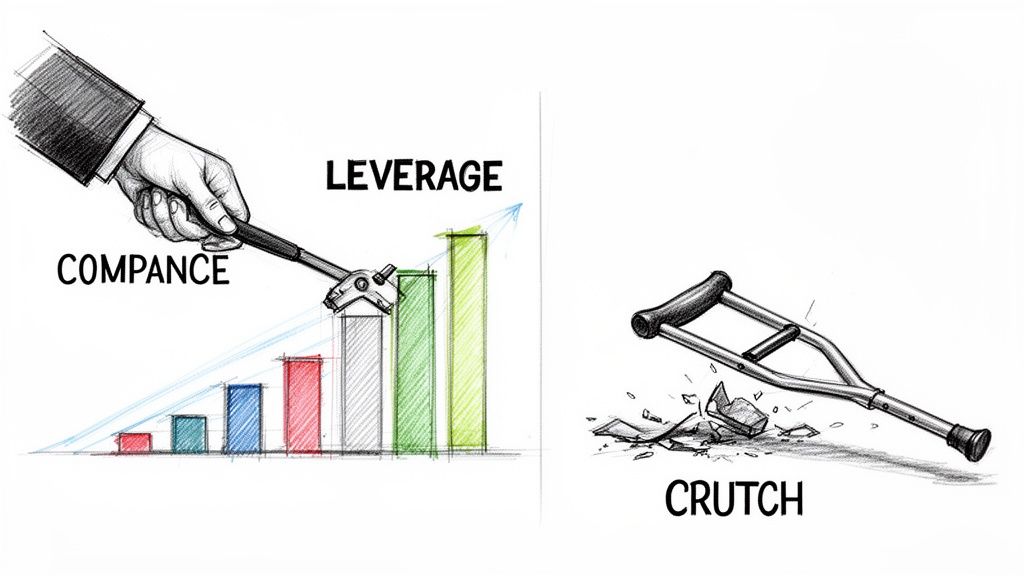
In practice, the strategic advantage from a consultant shows up in a few ways:
That last point gets ignored. Many early teams have enough energy. What they lack is sequence. They run website work before positioning. They add channels before proving message. They hire before defining ownership.
If the core issue is founder indecision, co-founder misalignment, or a weak product, no consultant can save you from that. They can expose it faster. That is valuable. But they cannot replace core judgment.
Buy consulting when it helps you make fewer high-cost mistakes. Do not buy it to avoid doing hard internal work.
This is the same economic logic behind build versus buy decisions in SaaS growth. Sometimes internal ownership is right. Sometimes external expertise is far cheaper than learning through delay. The question is not whether you can do it yourself. The question is whether you should pay tuition in time, pipeline, and misfires to learn it yourself.
The best consulting engagements create permanent value. They tighten your thinking, sharpen your market story, and change how your team makes decisions after the consultant is gone. If that is not on offer, do not hire them.
Timing matters more than most founders admit. Hire too early and you spend scarce cash solving imaginary problems. Hire too late and the problem has already spread into your funnel, product roadmap, and team behavior.
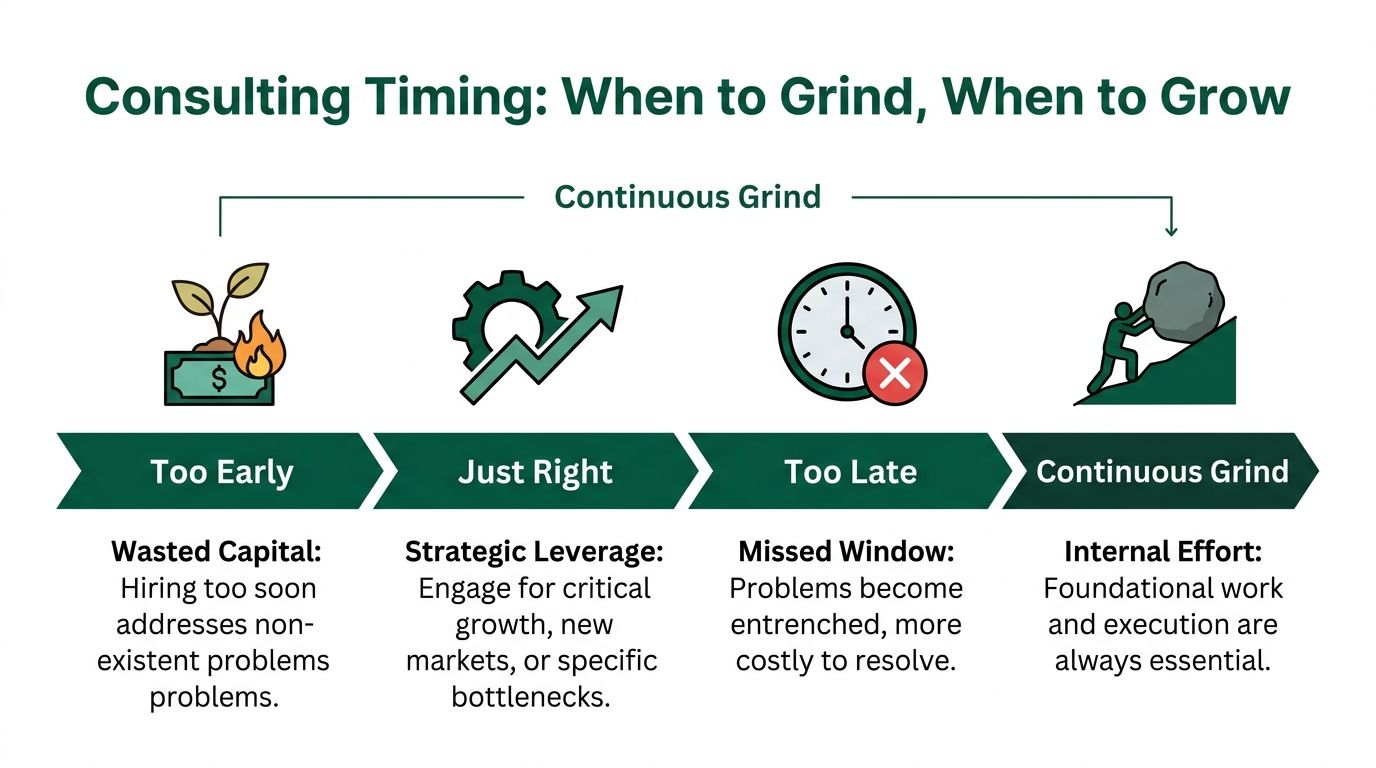
The cleanest way to think about this is simple. Grind on what only the founding team can discover. Hire for what requires pattern recognition you do not yet have.
Data supports the shift toward flexible expertise. Cansulta’s startup consulting page notes that fractional models can deliver outcomes like 100K+ leads at 30-50% lower cost than a full-time executive salary, and says 40% of B2B SaaS startups are opting for flexible engagements amid funding pressure. That does not mean fractional is always right. It means many teams have realized they need senior judgment before they need a full-time headcount commitment.
Some work cannot be outsourced without losing signal.
You should keep it internal when:
Consulting services for startups become useful at inflection points.
At first, founder-led sales is efficient. Then it starts breaking. Calls depend too much on founder charisma. Reps cannot repeat the pitch. Objections vary wildly by segment. Pipeline quality becomes inconsistent.
That is the moment to bring in help on positioning, messaging, and sales enablement. Not because sales is broken, but because knowledge is trapped in the founder’s head.
This is common after the first growth hire. Paid spend starts, content starts, outbound starts, but nobody can explain why one message works and another dies. The team confuses activity with signal.
A strong GTM consultant forces sharper hypotheses, channel discipline, and operating cadence. Good. That is what you need.
Series A and later rounds pressure-test your narrative. Investors will ask why your category matters, why your retention story is believable, and why your GTM can scale past founder involvement.
If your answers are vague, get outside help before the process starts. Trying to retrofit strategic clarity during diligence is a bad idea.
Use this filter before you spend:
| Situation | Grind internally | Hire a consultant |
|---|---|---|
| Early customer discovery | Yes | Rarely |
| Repeating founder sales playbook | Sometimes | Often |
| Message-market mismatch across segments | No | Yes |
| New market entry or major repositioning | No | Yes |
| Team accountability problem | Yes | Rarely |
Hire when the bottleneck is judgment, sequence, or pattern recognition. Grind when the bottleneck is conviction, customer contact, or internal discipline.
A lot of startup waste comes from confusing the two.
“Consultant” is too vague to be useful.
If you cannot say what job the consultant is supposed to do for the business, you are not ready to hire one. Founders make a predictable mistake here. They hire a growth consultant when the underlying problem is positioning. They hire a brand consultant when the underlying problem is sales friction. They hire a demand gen specialist when the product story is still muddy.
Think in terms of business problems, not service labels.
Hire this person when the team cannot answer a basic question cleanly: why should your ideal buyer choose you over the alternatives?
Symptoms look like this:
This consultant should help you define the market frame, competitive narrative, buyer pains, proof structure, and message hierarchy. If they jump straight into website copy without that work, you are buying surface polish.
This is the right hire when the issue is route-to-market, not just words.
You need this kind of advisor when you are asking questions like:
This role is useful when you have choices and need sharper sequencing.
A lot of B2B SaaS teams wait too long for this. They assume enablement is for larger companies. Wrong.
If reps are reinventing the story on every call, if discovery is inconsistent, or if proposals fail to match the buyer’s problem framing, you need enablement. The outcome is not “better collateral.” The outcome is a more repeatable sales motion.
Not every startup consulting decision lives in marketing or revenue.
Technical consulting matters when architecture choices are blocking speed or creating future drag. Vention’s startup consulting page states that expert technical consulting can accelerate time-to-market by 30-50% and reduce integration failures by up to 40% versus ad-hoc approaches. If your product roadmap is constrained by stack confusion, brittle integrations, or rising technical debt, a GTM consultant will not fix that.
A fractional CMO sits above isolated channel work. This is not a campaign manager with a better title. This role is useful when a startup needs senior marketing judgment across positioning, planning, execution sequence, and team alignment without adding a full-time executive too early.
A capable fractional leader should connect strategy to operating decisions. That includes channel priorities, message consistency, site narrative, pipeline goals, and handoff into sales. If you want a deeper look at what that role should include, this breakdown of the fractional CMO model is useful.
Do not hire based on what the consultant calls themselves. Hire based on the constraint inside your business.
If the problem is “we do not know how to grow,” that is too vague. Keep digging until the fundamental failure point is obvious.
Once the failure point is visible, the right type of consultant becomes much easier to identify.
Pricing tells you how the consultant thinks about risk, scope, and accountability. Founders who focus only on the fee usually miss the primary issue, which is incentive alignment.
Consulting Success reports that startup consulting projects typically range from $5,000 to $50,000, with 33% of consultants reporting average project values in the $15K-$50K bracket. The same source says companies can achieve a median 7x return on consulting investments. That return is possible only if the work changes business outcomes, not if it just creates artifacts.
| Model | Best For | Budget Predictability | Risk Profile |
|---|---|---|---|
| Hourly | Diagnostics, short advisory work, unclear scope | Low | High for founders |
| Project-based | Defined problems with clear outputs | High | Moderate |
| Retainer | Ongoing strategic support and decision-making | Medium | Depends on trust and cadence |
| Equity-based | Rare special situations with long-term alignment | Low | High for both sides |
Hourly looks flexible. It often is not.
It works for short consultations, audits, or specific decision support. It breaks down when the problem is broad or evolving, because every new question expands time and cost. If you choose hourly, insist on a cap, explicit assumptions, and decision checkpoints.
This is usually the cleanest model for startups.
A fixed-scope engagement works well for positioning, messaging, market analysis, website narrative, or a GTM plan. You know the output, the timeline, and the cost. The catch is simple. If the problem is poorly defined, the project will still fail, just more neatly.
Retainers make sense when you need ongoing strategic involvement.
Good examples include a fractional CMO arrangement, regular GTM steering, or sustained support during a transition period. The risk is drift. A vague retainer becomes expensive recurring ambiguity. You need clear decision rights, operating cadence, and direct access to the person you hired.
Most founders romanticize this. They should not.
Equity can make sense in unusual cases where the consultant is embedded and tied to long-horizon company value. In most cases, it creates confusion. You want clean incentives, not messy quasi-employment without genuine ownership structure.
Founders often get fooled on this point.
A messaging framework, ICP map, pricing recommendation, or Webflow site is a deliverable. Those things matter. But you are not buying documents. You are buying a change in business performance.
Use this test on every proposal:
If the consultant cannot answer those questions, the proposal is weak, even if the deck looks polished.
For founders thinking through pricing logic in more depth, this perspective on value-based pricing in B2B services is the right lens. Pay for business value created, not just time consumed.
Most founders run a weak buying process.
They look at the consultant’s site, scan logos, maybe ask for a case study, then jump on a call and decide based on chemistry. That is lazy. If you are buying consulting services for startups, you should evaluate the consultant the way a good investor evaluates a company. You are backing judgment under uncertainty.

The strongest consultants do something noticeable very early. They improve your understanding of the problem before you hire them. They ask better questions than your team has been asking internally.
A true operator can usually diagnose the category of problem fast.
If you describe weak pipeline and they immediately ask about segmentation, message consistency, sales call variance, and proof structure, that is a good sign. If they default to “we should run more demand gen” without understanding the chain beneath it, that is not.
This matters in data work too. CaseBasix notes that top consultants can turn raw data into predictive models that boost conversion rates by 25-40%, often starting with silo audits, cloud data models, and dashboards tied to a CAC:LTV ratio greater than 1:3. A serious consultant should be able to explain the logic from diagnosis to operational change. If all you hear is vocabulary, walk away.
Frameworks are useful. Dogma is dangerous.
Ask how they would adapt their process if:
A strong consultant will have a point of view, but they will not force the same template onto every company.
You are not buying potential. You are buying motion.
Ask them what happens in the first month. Who do they interview? What artifacts do they need? What meetings do they run? What decisions do they expect to sharpen? What do they personally deliver?
That last question matters. Many consultants sell seniority and deliver through juniors. If that is the model, it should be explicit.
This short clip is worth watching before you start a search.
| Criterion | What good looks like | Warning sign |
|---|---|---|
| Problem diagnosis | Sharp reframing of your issue | Generic “growth” talk |
| Adaptability | Can tailor approach to stage and motion | Forces one playbook |
| Execution bias | Clear first month and direct ownership | Vague process and heavy decks |
| Commercial clarity | Clean scope, assumptions, boundaries | Fuzzy scope and hand-wavy outcomes |
A consultant should reduce uncertainty before the contract starts. If the sales process increases confusion, the engagement will too.
If you are comparing options, this guide to choosing B2B marketing companies gives a useful filter for separating strategic partners from channel vendors.
Good consulting hires start before the search begins. If your team is unclear internally, the market will hand you polished nonsense and call it strategy.
Use this as a gate.
Most bad engagements fail before kickoff. The company buys consulting without preparing the environment needed for good work.
Skip “tell me about your experience.” Ask questions that expose how they think.
What is an opinion you hold about B2B SaaS growth that many teams get wrong?
You want a real point of view, not safe consensus.
What would make you tell us not to hire you?
Good consultants know where they are useful and where they are not.
What information would change your recommendation?
This tests whether they think probabilistically or just sell certainty.
The answers matter less than the specificity. Sharp consultants answer with context, constraints, and trade-offs.
Keep the agreement simple and hard-edged:
If you want another practical lens on startup advisor selection, this piece on hiring a business consultant for startups is aligned with the same principle. Buy clarity first. Then buy execution support around it.
Founders struggle with consulting because the category feels abstract. It should not. A good engagement has a clear input, a defined scope, and visible behavior change inside the business.
This is the right project when the company has product conviction but weak market clarity.
A typical scope includes:
The deliverables might include a positioning statement, message hierarchy, proof points, competitive framing, homepage structure, and a sales narrative. Useful. But the true outcome is different.
You should expect:
A project like this is not meant to make you “sound better.” It is meant to make the company easier to buy.
This works when you do not need a full-time executive yet, but you do need someone senior enough to connect strategy, execution sequence, and pipeline accountability.
The work usually spans:
The expected result is not endless strategic discussion. It is a more coherent operating rhythm. Priorities become clearer. Teams stop pulling in different directions. Experiments become sharper.
One example of this model in market is Big Moves Marketing, which works as a fractional CMO and GTM partner for B2B SaaS teams across positioning, messaging, website direction, and demand generation.
A strong consultant-led project usually creates three layers of value:
| Layer | What you see | Why it matters |
|---|---|---|
| Immediate | Clearer messaging, sharper roadmap, better prioritization | Removes confusion |
| Operational | Better coordination across founders, marketing, and sales | Reduces execution drag |
| Strategic | Stronger decisions on segment, channel, and narrative | Compounds over time |
Here are realistic patterns I have seen repeatedly.
A SaaS company thinks it has a lead generation problem. After review, the underlying issue is that the team is selling to multiple buyer types with one generic message. The consultant reframes the ICP, rebuilds the message architecture, and aligns the site and sales narrative. Pipeline quality improves because the company stops attracting the wrong conversations.
A product-led team wants to move upmarket. They assume the answer is outbound volume. It is not. Enterprise buyers do not respond to a self-serve product story. The consultant rebuilds the commercial narrative around governance, risk reduction, stakeholder value, and implementation confidence. Sales now has a credible enterprise story instead of a repackaged PLG pitch.
A founder wants help “with marketing.” The consultant identifies that there is no clear decision-making cadence, no clear owner for experiments, and no shared definition of pipeline quality. The engagement becomes part strategy, part operating system. That is often the highest-value work.
The best engagement changes how the company thinks and operates. The documents are just evidence that the thinking happened.
A consultant diagnoses a business problem, gives direction, and often helps shape decisions and systems around it.
A coach focuses on the founder or leader. Better questions, better judgment, better leadership behavior.
An agency is usually hired for execution in a defined area. Media buying, SEO, content production, design, development, outbound ops.
If you need strategic clarity, do not hire an execution vendor and hope they reverse-engineer strategy for you. Most cannot.
Keep the engagement tight.
Use a regular cadence. Share the uncomfortable information early. Give them access to actual call recordings, genuine objections, direct CRM notes, and true team friction. Sanitized inputs produce useless outputs.
Also, insist on decision moments. Every engagement should create points where the team chooses a path. Endless analysis is usually fear wearing a professional outfit.
Watch for these signs:
If the work is strategic, urgent, and still evolving, consulting is often the better first move. If the function is stable, clearly scoped, and needs day-to-day ownership, hire full-time.
A lot of teams hire too early because they want certainty through org charts. Headcount does not create clarity. It often hardens confusion.
Long enough to solve the core problem. Short enough to avoid dependency.
For sharply defined work, that usually means a focused project. For broader GTM leadership gaps, a retainer can work if the role is explicit and the company uses the input well.
No.
A consultant can help you see whether the issue is PMF, positioning, sales execution, segmentation, or category framing. That distinction is valuable. But if buyers do not care enough about the problem, no amount of consulting polish changes the fundamental truth.
Start small, but not shallow.
Use an initial diagnostic or scoped strategy engagement to test the consultant’s thinking, speed, and fit. If the work sharpens decisions and improves execution, expand from there. If it creates more language than movement, stop.
If you want a strategic partner that helps B2B SaaS teams clarify positioning, sharpen messaging, and make better go-to-market decisions before adding wasted growth motion, Big Moves Marketing is built for that kind of work.
Explore Big Moves Marketing services and resources:




%20-%20white.svg)