%20png%20copy.avif)

Figuring out how to price your software is less about what it costs you to build and more about the real, tangible value it delivers to your customers. The smartest B2B pricing strategies are anchored to the economic impact your solution makes—things like boosting a client's revenue or saving them hundreds of operational hours. When you frame it this way, the conversation shifts from an expense to an investment, setting you up for sustainable growth.
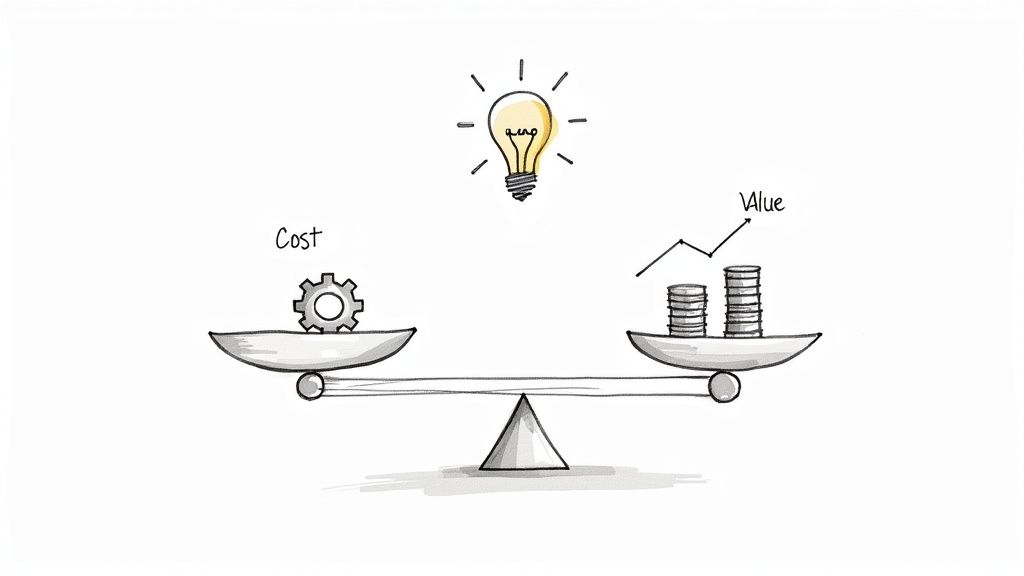
Your pricing tells your product's entire story in a single number. Get it right, and it acts as an accelerant for your whole business. Get it wrong, and even a brilliant product can stall out before it ever gets going.
Too many B2B founders fall into the easy trap of cost-plus pricing, where they just calculate their expenses and tack on a margin. It’s simple, sure, but it’s dangerously shortsighted and almost always leaves a ton of money on the table.
Another common route is just looking at what other companies are charging and matching it. While you can't operate in a vacuum, letting your rivals set your price means you're letting them define your product's worth. A much more powerful approach is to build your pricing around the actual value you provide.
To build the right foundation for your software, it helps to see the main pricing philosophies side-by-side. Here’s a quick look at where value-based pricing fits in and why it’s often the most strategic choice for B2B SaaS.
While cost-plus and competitor-based models have their place, value-based pricing forces you to align your success with your customers' success—the hallmark of a modern SaaS business.
Value-based pricing all starts with one fundamental question: What measurable, financial outcome does our software create for our customer? Answering this requires a crystal-clear understanding of who you serve. The first step, before you even think about numbers, is to define your Ideal Customer Profile (ICP).
If you haven't nailed this down, stop right now. Creating a detailed ICP is non-negotiable for understanding the problems you solve and for whom. For a structured approach, check out our guide with an ideal customer profile template to get started.
The core of value-based pricing is communicating your product's worth in your customer's language. It transforms the price from a cost into a strategic investment with a clear, calculable return.
Adopting this philosophy changes everything. It forces you to connect every single feature to a real-world business problem and its financial consequences. To build a strong foundation here, it’s worth understanding the core principles behind valuing and pricing goods and services.
Forget listing features and start mapping them directly to the outcomes your ideal customers are trying to achieve. Your job is to translate your software’s capabilities into tangible business results they can understand and quantify.
Here’s a simple framework to get your thinking started:
This initial work is what builds the essential narrative for your pricing page and sales calls. It's the groundwork that lets you build a pricing structure that feels less like a transaction and more like a true partnership.
The secret to confident pricing isn’t found in a spreadsheet or by peeking at your rival’s website. It’s discovered by talking to your customers. Guesswork is a recipe for disaster, either leaving a ton of money on the table or pricing yourself right out of a deal. To really get this right, you have to go straight to the source.
And I don't mean sending out some generic survey that only scratches the surface. Real, actionable insights come from structured, qualitative interviews that get to the heart of the problems your customers are trying to solve. The whole point is to move beyond what they think they'll pay and uncover the actual economic value your software creates for their business. This becomes the bedrock of a powerful, value-based pricing strategy.
Before you can slap a price tag on your software, you need to understand its impact in terms your customers actually care about. Value isn’t about your cool features; it's about the bottom-line outcomes those features deliver. Your job is to translate your product's capabilities into cold, hard business metrics.
This starts by identifying the key results your software drives. Does it help them make more money, save time and resources, or sleep better at night by reducing risk? These are the three pillars of B2B value.
When you start quantifying these outcomes, you stop selling software and start selling a measurable return on investment. This data is pure gold for your pricing discussions and your marketing messages. For a deeper dive into gathering this kind of intel, check out our detailed guide on B2B market research.
Here's a hard truth: directly asking "So, what would you pay for this?" is a waste of time. It almost never yields an honest answer. Customers will naturally lowball you, and the question is so hypothetical that the data is basically useless. You have to be more subtle to get to the truth.
Your interviews need to focus on understanding their pain points so deeply that the value of your solution becomes obvious. The conversation should feel less like a sales pitch and more like a consultative problem-solving session.
Your goal isn't to ask about price directly but to understand the cost of their problem. When you know what the pain is costing them, you know what the cure is worth.
A fantastic, proven method for this is the Van Westendorp Price Sensitivity Meter. It's a framework that uses four specific questions to zero in on an acceptable price range without ever asking for a single number directly.
By plotting the responses from a handful of interviews, you can visually pinpoint an optimal price point where the maximum number of buyers find your price acceptable. This data-driven approach takes emotion and guesswork out of the equation, giving you a solid, defensible foundation for your pricing. Armed with this knowledge, you can build out tiers that speak directly to the value your different customer segments are really looking for.
Alright, you've done the hard work of figuring out what your customers actually value. Now comes the moment of truth: building a pricing structure that captures that value. Nailing your pricing model is more than just a finance exercise; it's a strategic move that dictates how you attract customers, keep them around, and ultimately, grow your business.
The goal here isn't to be clever or complicated. It's to create a system that's easy for customers to grasp, scales with them as they succeed, and gives you that sweet, predictable recurring revenue.
The whole software world is moving at a breakneck pace. We’re seeing the price optimization software market projected to explode from $1.68 billion in 2025 to a massive $3.59 billion by 2030. What's driving this? Cloud-based tools, which already grabbed over 61% of the market revenue in 2024 and are growing at a wild 18.43% clip each year.
This shift means subscription models are no longer optional. The old-school, cost-plus approach is dead. Today, you have to align your pricing directly with the value your customers get. You can dig into the numbers yourself in the full price optimization market analysis.
This decision tree gives you a great visual for how to get from initial research to a pricing model that actually makes sense.
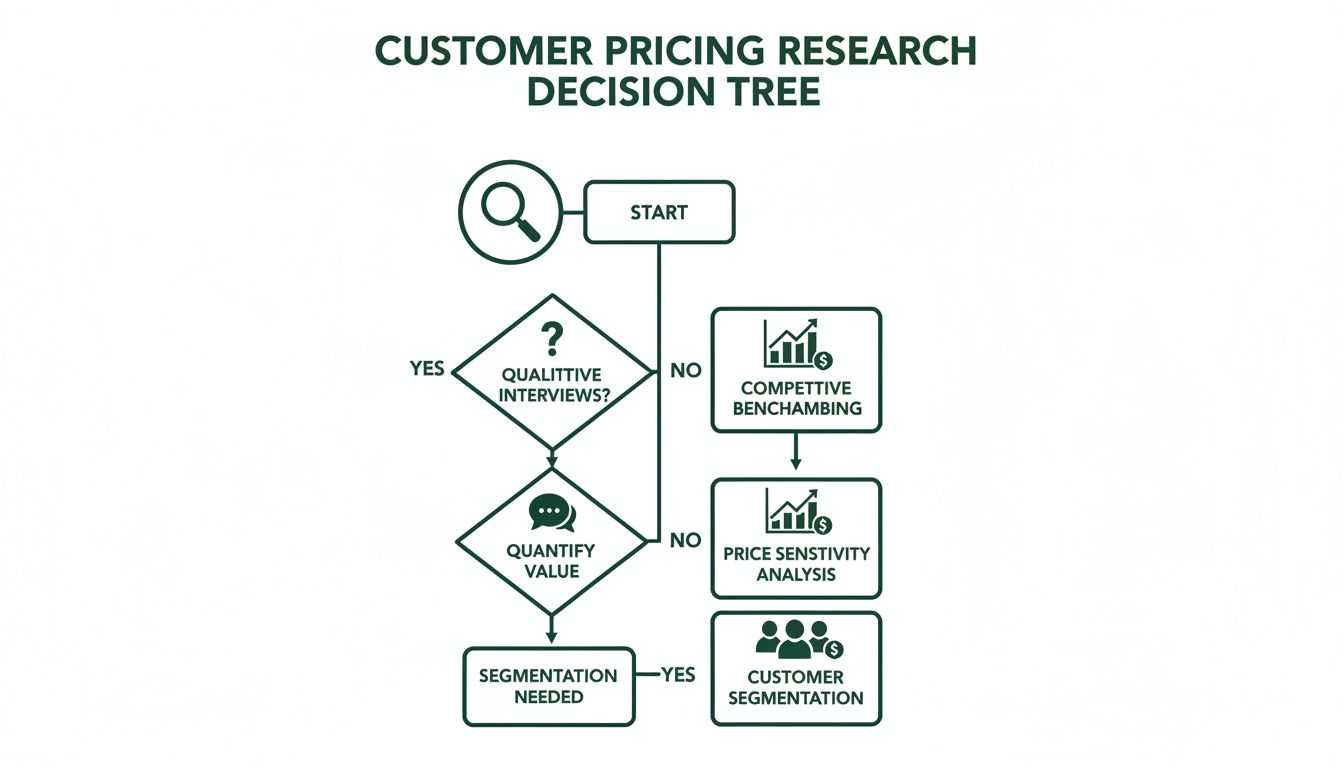
As you can see, everything starts with understanding customer problems. Only then can you translate those insights into a financial impact and pick the right model.
Let's break down some of the most common B2B SaaS pricing models you'll encounter.
Choosing a pricing model can feel overwhelming, but most successful B2B SaaS companies use a variation of just a few core strategies. This table breaks down the essentials—what each model is, how it works, and who it's best for.
Each of these models has its place. The trick is to pick the one that best reflects how your customers get value from your product and how their business is likely to grow over time.
Per-user pricing, often called "per-seat" pricing, is about as straightforward as it gets. A customer pays a flat fee for every person on their team who needs access. It's simple to explain and makes revenue forecasting a breeze.
For instance, a project management tool might charge $25 per user, per month. A 10-person team? That'll be a clean $250 a month. Buyers love this clarity because they can instantly calculate their costs.
But that simplicity can be a double-edged sword. It can become a barrier to adoption in larger companies when the cost per seat starts to look intimidating. Teams might start gatekeeping access to control costs, which kills your product's ability to spread organically within the organization.
Tiered pricing is probably the most popular kid on the block in B2B SaaS, and for good reason. You create a few different packages at various price points, each offering a specific bundle of features or usage limits. This lets you target everyone from tiny startups to massive enterprises.
A well-designed tiered structure is basically a growth map for your customers. They can hop on an affordable entry-level plan and upgrade as their needs get more complex.
The secret to great tiering is aligning each package with a specific buyer persona. The features separating your tiers shouldn't feel random; they need to solve the evolving problems of a growing business.
Think about a marketing automation platform. The tiers might look something like this:
This model offers incredible flexibility, but you really have to know your customers to package it correctly. Get it wrong, and you'll just confuse buyers or create tiers with no compelling reason to upgrade. Your tier design is a huge piece of your market strategy, so it helps to understand what product positioning is and how it all connects.
Usage-based pricing (or consumption-based) is gaining a ton of momentum. Here, customers simply pay for what they use. It's an incredibly fair model that perfectly aligns your price with the value a customer receives.
The classic example is a cloud provider like Amazon Web Services. You pay for the exact compute power, storage, and data you consume. Another great one is Twilio, which charges per text message sent or per minute on a call.
The biggest plus? It removes the friction of a big upfront commitment. Customers can start small and let their costs scale as their usage—and hopefully their business—grows. This can lead to some massive revenue from your most successful customers. The catch is predictability. Forecasting monthly costs can be tough for both you and your customer, which can be a dealbreaker for businesses that need to stick to a strict budget.
Let's get one thing straight: ignoring your competition is just as dangerous as blindly copying their pricing page. A strategic look at what other players are doing isn't about matching them dollar-for-dollar. It's about understanding the market conversation your customers are already tuned into.
This kind of analysis is your key to finding a unique, defensible position. It gives you the confidence to explain precisely why your product is worth what you're charging.
Your goal here isn't to start a price war—that’s a race to the bottom where the only winner is the company with the deepest pockets. Instead, you're on a hunt for gaps in the market, underserved customer segments, and opportunities to deliver value in a way nobody else is. Think of it as gathering market intelligence, not just mimicking your rivals.
This process provides the context you need to build a pricing strategy that's both informed and different, letting you walk into the market with a crystal-clear message about your product's superior value.
A competitor’s pricing page tells you maybe 20% of the story. To really get what they're doing, you have to dig much deeper and see their entire business through a potential customer's eyes. Your job is to deconstruct their whole value proposition, not just the numbers on a webpage.
Start by mapping out a few key areas for each of your main rivals:
The real gold is in understanding the 'why' behind their pricing. What specific customer pain point are they trying to solve with their 'Pro' plan that the 'Starter' plan doesn't touch? That's where you'll uncover their strategic priorities.
Answering these questions reveals how they’ve decided to position themselves and, more importantly, helps you pinpoint where your product offers a clear advantage. If you want a complete framework to keep all this research organized, our in-depth guide to performing a SaaS competitive analysis walks you through the entire process.
A value map is a surprisingly powerful tool for plotting your solution against the rest of the market. It’s a simple visual that helps you instantly see where you stand and, crucially, where the opportunities are to carve out a unique space. It’s way simpler than it sounds and doesn't require any fancy software.
Just grab a whiteboard or open a blank slide. On a simple two-axis chart, put "Price" on the vertical axis and a key "Value Metric" on the horizontal axis. This value metric should be the most important differentiator in your market—it could be anything from "Depth of Features" to "Ease of Use" or "Integration Capabilities."
Now, place your company and your key rivals on this map. You’ll probably spot a crowded area right away, where a bunch of companies are offering similar features at a similar price. But the real insight comes from seeing the empty spaces—the opportunities to offer more value at a fair price or to serve a niche that everyone else is ignoring.
This exercise forces you to be brutally honest about where you truly shine. It’s not about being the best at everything; it's about being the undeniable choice for a specific type of customer with a very specific need.
This kind of data-driven approach is quickly becoming the standard. The dynamic pricing software market is exploding, jumping from $3.05 billion in 2024 to a projected $3.49 billion in 2025, and it’s on track to hit $6.02 billion by 2029. This growth is being driven by B2B software companies using real-time analytics to monitor other companies' prices and capture nuanced data on what customers are actually willing to pay. You can dive deeper into these dynamic pricing software market trends to see just how much data is shaping modern pricing strategies.
This is it—the moment where all that research and strategy hits the real world. Launching a new pricing structure can feel like a high-wire act, but with a solid playbook, you can turn a moment of high stakes into a smooth transition that actually builds customer trust.
A flawless execution isn't just about flipping a switch. It's about getting your internal teams in sync and crafting communication so clear that it leaves no room for confusion or frustration.
The first, most practical step is to get everyone on the same page internally. This isn't just a marketing project. Your engineering team needs a clear timeline to update the billing system, and your finance team has to be ready for the new revenue models.
Most importantly, your sales and support teams need to become the undisputed experts on this new model. They’re on the front lines, and they have to be able to explain not just the what, but the why behind every change with total confidence.
For new customers, your website’s pricing page is your number one sales tool. It has to be simple, clear, and laser-focused on the value you deliver. Don't just list prices and features; frame each tier around the specific problems it solves for a certain type of customer.
Think in terms of value. For instance, instead of saying a plan includes "Advanced Analytics," reframe it as "Unlock data-driven insights to grow your revenue." That small change shifts the entire conversation from a cost to an investment.
Your sales team needs more than a new price sheet. You need to arm them for success.
This prep work ensures every prospect gets the same confident, consistent message, which is absolutely critical for a smooth rollout.
Your existing customers are your lifeblood. How you manage a price change with them will make or break their long-term loyalty. Upsetting your loyal users is the fastest way to spike your churn rate and tarnish your reputation.
A price change is one of the most sensitive interactions you can have with a customer. Approach it with empathy, communicate the added value clearly, and give them ample time to adjust. The goal is to reinforce their decision to partner with you, not make them question it.
When you're ready to communicate the changes, here are a few proven strategies to consider:
Your communication needs to be proactive and crystal clear, explaining the benefits they'll get from the new structure. Think of this process like you're onboarding them all over again; a great experience makes all the difference. In fact, you can support a smooth transition by reviewing some customer onboarding best practices to ensure everyone has a positive experience.
Getting your pricing right isn't a task you just check off a list; it's a discipline you have to build into your company's DNA. Stop thinking about your pricing strategy as a static decision. It's actually a living, breathing part of your growth engine, and it needs constant tuning to keep running smoothly.
The market is always moving, your product is constantly evolving, and your customers' needs are never standing still. Your pricing has to adapt right alongside them.
Treating pricing as a continuous process of refinement is what separates the merely good companies from the truly great ones. The moment you push your new pricing structure live isn't the finish line—it's the start of a brand-new feedback loop. This is where you begin collecting real-world data to see if your strategic bets are actually paying off.
Once your new pricing is in the wild, your job immediately shifts to analysis. You're hunting for signals in the data that tell you what’s working and, just as importantly, what isn't. Your key metrics become your new best friends, offering clues into how customers are behaving and what they think of your value.
Start by keeping a close eye on these key performance indicators:
This data-driven mindset is becoming non-negotiable. The market for price optimization and management software is expected to explode from $3.08 billion in 2025 to a staggering $9.86 billion by 2034. This growth is being driven by AI and machine learning tools that help companies make real-time pricing decisions, which have been shown to boost profitability by 15-25%. You can find more details in this analysis of the price optimization software market.
Adjusting your pricing takes both courage and a delicate touch, especially when you have a loyal customer base. You can't just change things on a whim, but you also can't afford to let your pricing get stale and outdated.
Your pricing strategy should be just as dynamic as your product roadmap. Schedule regular pricing reviews—at least once a year—to make sure your monetization model is keeping up with the value you’re delivering.
When you see signs that a change is needed, resist the urge to make sweeping changes across the board. The smarter move is to test new structures methodically. You could run pricing experiments with a segment of new customers or in a specific geographic market to gather data without rattling your entire user base.
Ultimately, the goal is to keep your pricing perfectly aligned with your product's journey. As you roll out powerful new features and deliver more and more value, your pricing should reflect that. It’s this mindset that ensures your pricing remains a powerful driver of sustainable growth for years to come.
Even with the best strategy in place, pricing is never a "set it and forget it" activity. Sticking points and tricky questions always pop up. Let's walk through some of the most common hurdles I see B2B founders and marketing leaders face. Getting these right can be the difference between steady growth and a churn problem you can't seem to solve.
Your pricing strategy should be as alive as your product roadmap. A good rule of thumb is to put a formal pricing review on the calendar at least once a year.
This doesn't mean you have to change your prices annually. But it does force you and your team to ask the hard questions: Does our pricing still reflect the value we deliver? Have we added major new features that justify an adjustment?
If you’ve just rolled out a game-changing feature set or are breaking into a new market segment, that's your trigger. Don't let your pricing get stale.
Think of your pricing as a feature of your product. Just like any other feature, it needs to be maintained, tested, and optimized over time to ensure it’s delivering the best possible results for your business.
Communication is everything. When you're raising prices on existing customers, your best friends are transparency and empathy. Just dropping a surprise invoice on a loyal customer is one of the fastest ways to destroy trust and watch your churn rate spike.
Here’s a simple game plan for a much smoother conversation:
For the vast majority of B2B SaaS companies, the answer is a firm yes.
Hiding your pricing behind a "Contact Us for a Demo" button creates friction. It immediately makes potential customers suspicious and can scare off perfectly qualified leads who are just trying to do their initial research. You're making them work too hard.
Putting your pricing out there signals confidence and transparency. It lets prospects self-qualify, which means your sales team can stop wasting time on tire-kickers and focus on serious buyers who already know they're in the right ballpark.
Of course, there's an exception to every rule. If you're selling highly complex, six-figure enterprise deals with tons of custom configurations, then a "Contact Sales" approach probably makes more sense. For almost everyone else, clear pricing is one of your most powerful sales tools.
Ready to build a go-to-market strategy that aligns your product, pricing, and sales process for maximum impact? At Big Moves Marketing, I specialize in helping B2B SaaS startups launch products that win deals and drive revenue. Let's build your launch plan together.
Explore Big Moves Marketing services and resources:




%20-%20white.svg)