%20png%20copy.avif)

Most founders look for the best pitch deck examples to copy. This is a mistake. It produces generic narratives that dilute your unique position and force investors to pattern-match you into obscurity.
A deck that wins isn't built from a template. It's built from strategic sequencing and a clear, unflinching story connecting a painful problem to your specific, defensible solution. The best pitch deck examples aren't blueprints to copy; they are case studies in strategic communication. While a basic resource like a definitive startup pitch deck template offers a starting structure, the real work is in adapting fundamental principles to your story.
This list moves beyond surface-level teardowns. It breaks down the strategic choices behind each slide—the narrative structure, the metric selection, and the core logic that resonated with investors. We will analyze the thinking from premier sources like Y Combinator and Sequoia Capital, giving you direct access to the frameworks that have funded category-defining B2B SaaS companies. The goal is to deconstruct, not imitate.
Most pitch deck resources provide templates. Big Moves Marketing addresses the actual point of failure: the underlying strategy. It’s a Fractional CMO service led by Veb (Vaibhav), a B2B SaaS growth specialist who works with founders on the GTM logic—positioning, messaging, differentiation—that must exist before a compelling deck can be built. This is for founders who understand a great deck is a symptom of a clear strategy, not a collection of slides.
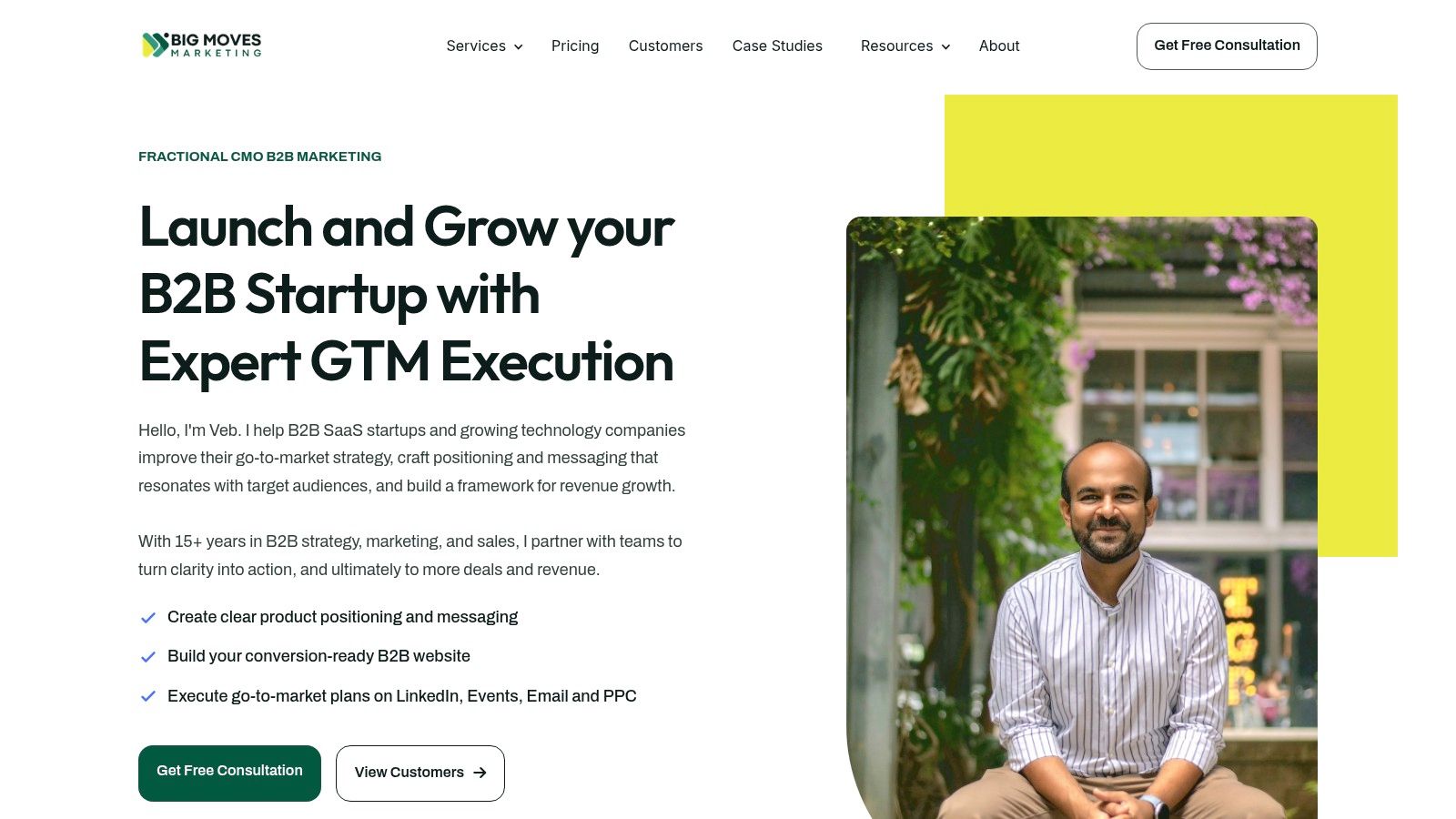
The core problem Big Moves Marketing solves is that most decks fail because the story is weak, the market positioning is vague, and the problem-solution narrative lacks conviction. Instead of just helping you find one of the best pitch deck examples to imitate, the focus is on building the strategic foundation that forces investors and buyers to pay attention.
The approach is built on first principles. A winning pitch requires difficult work on messaging and competitive positioning before a slide is created. This directly contrasts with platforms offering templates without addressing the strategic gaps in a startup's narrative.
"A pitch deck isn't a document; it’s the sharpest articulation of your GTM strategy. If the strategy is fuzzy, the deck will be too. We start with the hard part: getting the positioning right. The deck becomes the output of that clarity."
– Veb, Founder of Big Moves Marketing
With over 15 years in B2B marketing for more than 70 companies, Veb’s process is rooted in execution. The service is less about providing examples and more about becoming a hands-on partner to engineer your narrative. This is an end-to-end approach, moving from strategy (positioning) to assets (pitch decks, battlecards) and finally to execution (demand generation).
Big Moves Marketing is not for teams looking for a quick template. It is designed for B2B SaaS founders who need senior-level strategic guidance to nail their market positioning and translate it into a powerful fundraising and sales narrative. If your message isn't resonating with investors or customers, this is the type of partnership that delivers clarity.
Pricing is determined after a free, no-obligation consultation to assess a company’s specific needs. This aligns the scope with the founder's goals, whether it's a one-off project for a Series A pitch deck or an ongoing Fractional CMO engagement.
While most resources offer galleries of completed decks, Sequoia Capital provides something more fundamental: the blueprint. Their guide, "Writing a Business Plan," is not a visual example but the canonical structure behind some of the most successful pitch decks in history. For founders drowning in conflicting advice, this is the definitive signal amidst the noise. It’s less of a deck example and more of a deck operating system.
This resource forces a founder to answer the hard questions a top-tier VC cares about. It provides a strict, ten-slide framework that prioritizes substance over style. There is no ambiguity; each slide has a purpose, from articulating the company’s core purpose to defending the "Why Now?" timing.
The Sequoia framework is one of the best pitch deck examples because of its ruthless efficiency. It strips away the narrative fluff that founders often hide behind and replaces it with a logical sequence of arguments.
Access: The guide is available for free on Sequoia's website.
Link: Sequoia Capital's Writing a Business Plan
If Sequoia provides the investor's logical blueprint, Y Combinator (YC) offers the founder's practical starting line. Their guide, "How to Build Your Seed Round Pitch Deck," is a masterclass in focused, early-stage communication. It is less about complex narrative arcs and more about getting straight to the point with the ten essential slides that answer a seed investor's most pressing questions. It’s the definitive guide for pre-seed and seed-stage founders who need to build momentum fast.
This resource cuts through the noise of what could be in a deck to define what must be in a seed deck. YC’s advice is built from seeing thousands of companies succeed and fail at this exact moment. It is relentlessly focused on problem, solution, traction, and team—the core signals investors look for at the seed stage.
The YC framework is one of the best pitch deck examples because it is optimized for speed and clarity. It removes ambiguity and forces founders to concentrate on the evidence.
Access: The article and accompanying advice are available for free on YC’s website.
Link: Y Combinator's How to Build Your Seed Round Pitch Deck
To see how modern pitch decks perform in the wild, TechCrunch's Pitch Deck Teardown series is the real-time arena. This isn't a gallery of historical successes; it's a live-fire exercise where currently circulating decks are reviewed slide-by-slide by seasoned investors. It provides an unfiltered, practitioner-level look at what gets funded now, reflecting the current climate and the metrics VCs expect.
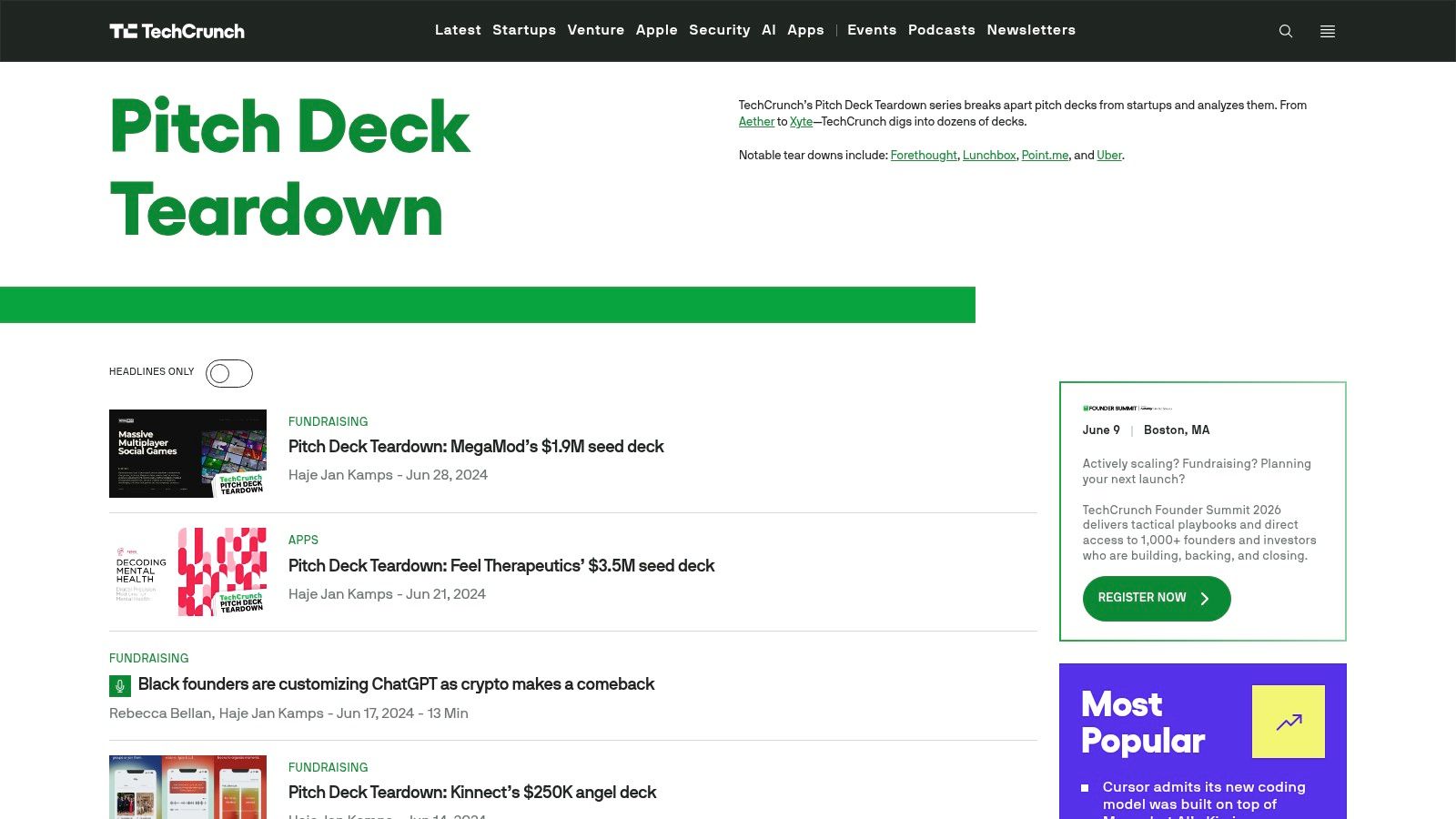
The series acts as a direct feedback loop for founders. Instead of admiring a finished product, you get to sit in on the critique. The commentary focuses on the specific arguments, data points, and design choices that either strengthen or weaken a pitch. This is like getting free coaching on your competitors' homework, revealing their winning moves and critical errors.
What makes the TechCrunch series one of the best pitch deck examples is its immediacy and practical application. It bridges the gap between abstract advice and the reality of a fundraising round.
Access: Many teardowns are behind the TechCrunch+ paywall. A subscription is required for full access to the archive.
Link: TechCrunch Pitch Deck Teardown Series
While most galleries offer static pitch deck examples, DocSend provides an intelligence layer on top of them. Its platform combines a library of real-world decks with proprietary data on how investors actually read them. This isn't just about seeing what a successful deck looks like; it's about understanding which slides investors linger on, which they skip, and in what order they consume your story.
DocSend’s approach is quantitative. By analyzing thousands of founder-investor interactions, it publishes research that reveals the data-backed reality of fundraising. This transforms deck creation from a storytelling art into a science of engagement, pairing some of the best pitch deck examples with performance metrics. It tells you what works based on verifiable viewing data, not opinion.
DocSend's power comes from its blend of qualitative examples and quantitative feedback. It bridges the gap between a well-designed slide and a slide that holds an investor's attention.
Access: The blog content and research reports are available for free. Using the document sharing and analytics platform requires a paid plan after a free trial.
Link: DocSend's Pitch Deck Examples
While other resources provide static PDFs, Slidebean acts as an interactive pitch deck museum. It offers a large, curated library of reconstructed decks from iconic startups like Airbnb, Uber, and Coinbase, complete with analysis. It’s an essential stop for founders looking to understand the narrative arcs that won over early investors. More than just examples, it’s a study in startup storytelling.
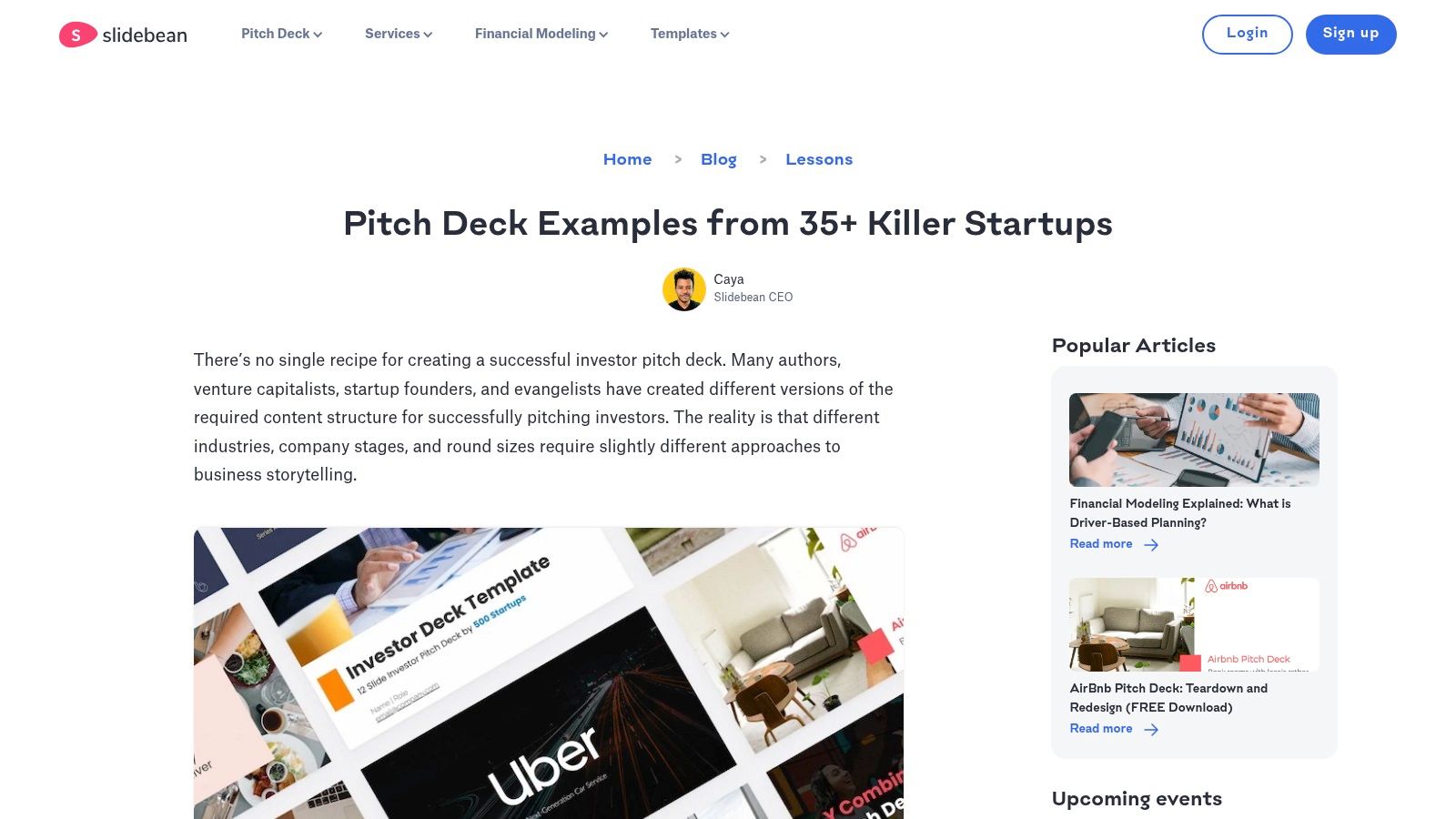
Slidebean’s value is in its deconstruction. They break down the flow, question the slide choices, and offer context that raw files cannot provide. For a founder staring at a blank canvas, seeing how giants of the industry first articulated their vision is a powerful starting point. It demystifies the process by revealing common patterns in successful narratives.
What makes Slidebean one of the best pitch deck examples is its focus on repeatable storytelling frameworks. It reverse-engineers success, turning famous decks into actionable lessons.
Access: The library of pitch deck examples and articles is free to browse. Using the deck builder and premium templates requires a paid Slidebean plan.
Link: Slidebean's Pitch Deck Examples
While many resources are static galleries, Pitch is a dynamic platform that closes the gap between inspiration and execution. It curates a collection of modern pitch deck examples from successful startups and makes them immediately actionable. Instead of looking at a PDF, you can open a template based on a successful deck and start editing it within the Pitch platform, transforming ideas into a polished investor narrative quickly.
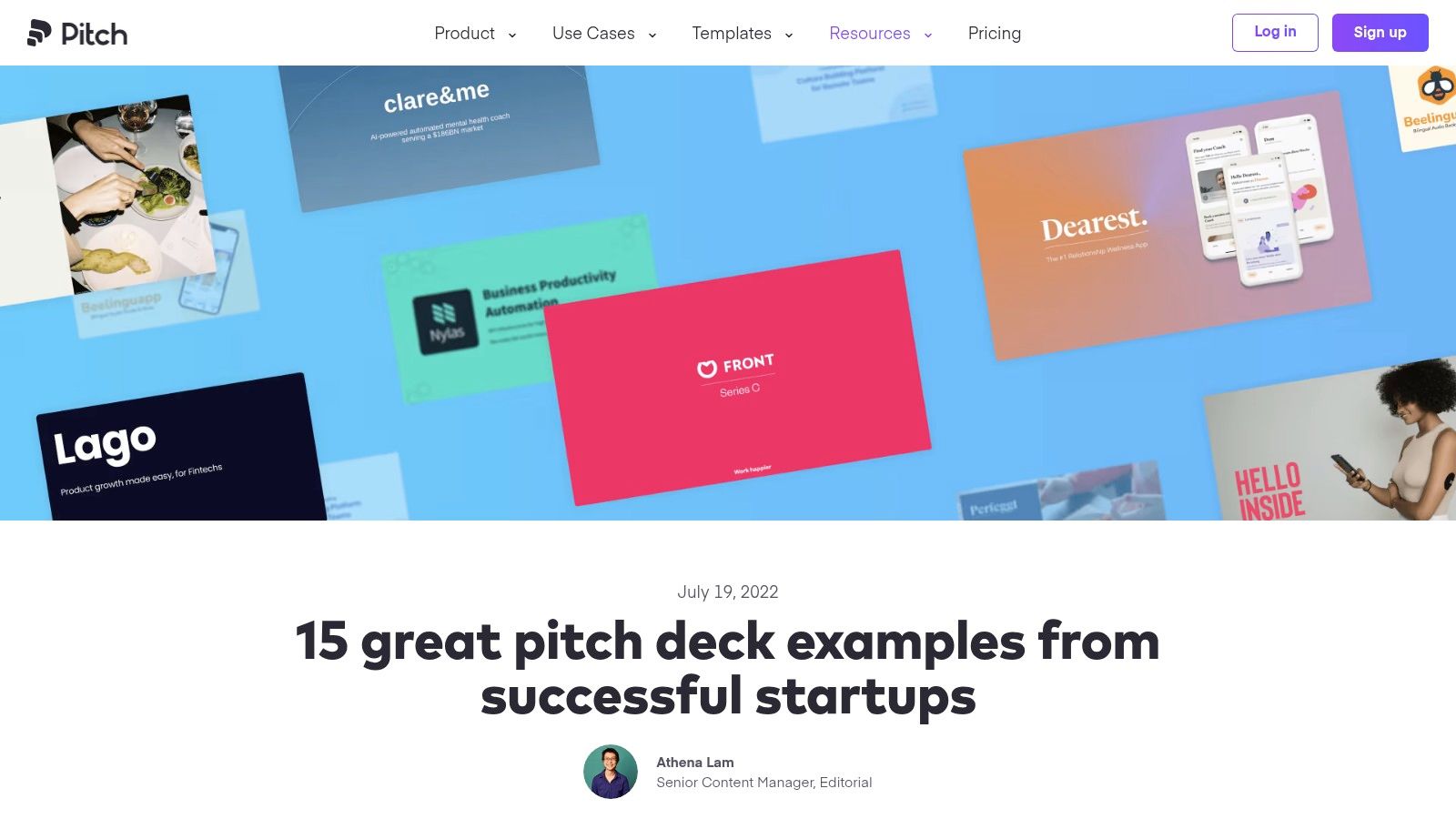
This approach makes Pitch an end-to-end solution. It combines a library of some of the best pitch deck examples with the collaborative software needed to build your own. The platform emphasizes clean, on-brand design, allowing teams to maintain visual consistency while working together on messaging. It’s a practical tool built for the reality of startup life: moving fast without sacrificing quality.
Pitch’s strength lies in its seamless integration of learning and doing. It removes the friction between studying a great example and creating your own version.
Access: The gallery of examples is free to browse. A freemium plan is available, with paid plans required for advanced collaboration, analytics, and larger teams.
Link: Pitch's 15 Great Pitch Decks
| Service | 🔄 Implementation Complexity | ⚡ Resource Requirements | 📊 Expected Outcomes | 💡 Ideal Use Cases | ⭐ Key Advantages | Access / Cost |
|---|---|---|---|---|---|---|
| Big Moves Marketing | Medium–High — strategic planning + hands‑on execution and onboarding | Dedicated budget for fractional CMO, paid channels, Webflow dev time; founder collaboration | Faster GTM, conversion‑ready site, measurable lead and revenue uplift (case examples) | B2B SaaS/AI/tech founders needing a senior GTM lead to move from MVP to growth | End‑to‑end GTM, fast execution, strong case studies | Bespoke pricing after free consult; NDA and flexible options |
| Sequoia Capital | Low — follow a concise framework/checklist | Minimal — time to draft and edit slides | Investor‑grade, focused pitch decks that clarify priorities | Early‑stage founders preparing investor decks | High credibility and strict slide checklist | Free and publicly available |
| Y Combinator | Low — seed‑stage slide flow; straightforward to implement | Minimal — writing + optional template use | Seed‑aligned narrative emphasizing problem, traction and GTM | Pre‑seed/seed SaaS teams preparing for investor meetings | Aligned with investor expectations and YC guidance | Free and publicly available |
| TechCrunch (Pitch Deck Teardown) | Low to Medium — consume easily; applying suggestions may require redesign | Time to review examples; subscription needed for full access | Current VC reactions and practical, slide‑level improvements | Founders seeking modern, practitioner feedback across stages | Real decks with expert commentary and actionable fixes | Many teardowns behind TechCrunch+ paywall (metered access) |
| DocSend (Dropbox) | Low — readably structured; deeper insights if using product | Time to read research; paid DocSend required for analytics/sharing | Data‑backed guidance on slide order and investor engagement metrics | Data‑minded teams optimizing narrative and investor viewing | Combines qualitative examples with quantitative viewing data | Blog/research free; analytics and sharing tools are paid |
| Slidebean | Low — templates speed creation; customization takes moderate effort | Subscription for templates/platform features for full access | Quick visual drafts inspired by famous decks and storytelling guidance | Founders seeking visual inspiration and fast first drafts | Reconstructed famous decks, templates, and educational content | Articles free; templates and platform require paid plan |
| Pitch (presentation platform) | Low — editable templates and collaborative editor | Freemium workspace (limits); Pro seats for advanced collaboration | Polished, on‑brand decks produced collaboratively and quickly | Teams needing collaborative, brand‑consistent pitch decks | One‑click editable templates and modern visual patterns | Freemium with storage/team limits; Pro paid plans |
We’ve dissected some of the best pitch deck examples, from the foundational logic of Sequoia to the practical execution seen in tools like DocSend and Pitch. The objective was never to provide a gallery of templates to copy. The goal was to reveal the underlying strategic thinking that makes these documents effective.
A great pitch deck is not a design project. It is an artifact of your strategic clarity. It is the final, compressed output of hundreds of brutal decisions about your market, your customer, your product, and your go-to-market model. The slides are merely the container for that clarity. When a deck fails, it's rarely due to font choice; it's due to a fractured or incomplete strategy.
The most powerful takeaway from analyzing these decks is the direct line from strategy to slide.
The common thread is that the story is a direct reflection of the business's core logic. The deck doesn't create the story; it reveals it. If your narrative feels weak, fixing the slides is a temporary patch. The real work is fixing the strategy.
Moving from inspiration to action requires a shift in mindset. Stop thinking about "building a pitch deck" and start thinking about "codifying our strategy." Viewing the best pitch deck examples is not for imitation, but for internalizing the patterns of clear strategic communication.
Here are your actionable next steps:
Ultimately, the deck is a mirror. It reflects the quality of your thinking, the alignment of your team, and the coherence of your vision. Use these examples and tools not as a shortcut, but as a catalyst for achieving the strategic clarity your business demands. That is the only path to a deck that commands attention and secures investment.
A compelling story starts long before the slides are made. If your narrative is unclear or your GTM strategy feels disconnected from your product, the issue is deeper than your presentation. At Big Moves Marketing, we work with B2B SaaS founders to sharpen that core strategy, ensuring your positioning and messaging are powerful enough to win. See how we help founders achieve strategic clarity.
Explore Big Moves Marketing services and resources:




%20-%20white.svg)