%20png%20copy.avif)

Most leaders hunting for sales pitch deck examples are looking for a formatting shortcut. This is a strategic error. They copy slide structures, adopt aesthetics, and hope to reverse-engineer a narrative. The result is a disjointed presentation—a collection of "best practice" slides that lacks a coherent argument. It fails to persuade because it was assembled, not engineered from a clear strategic core.
This analysis is different. We are not providing templates to copy. We are deconstructing the strategic models that drive high-value B2B sales conversations.
A powerful sales deck isn't a document; it's a tool for structuring a conversation. It guides a prospect from their current state of pain to a future state of value, with your product as the undeniable bridge. Every slide must perform a specific function in that logical sequence. Change the framework, and you change the entire conversation.
Instead of a gallery of decks, we will break down ten proven strategic models. For each of these sales pitch deck examples, we will analyze the underlying logic, the sales psychology at play, and the specific scenarios where that framework creates leverage. You will learn not just what the slides look like, but why they are ordered that way and how they work together to build conviction. Stop looking for templates. Start mastering the frameworks that win.
The Problem-Solution-Market (PSM) framework is the foundational structure for most B2B SaaS sales decks. It anchors the entire narrative in the customer's quantified pain. This classic three-act structure imposes discipline. Instead of leading with features or vision, you start with a deeply understood problem the customer faces daily. This immediately signals to buyers that you have done the work.
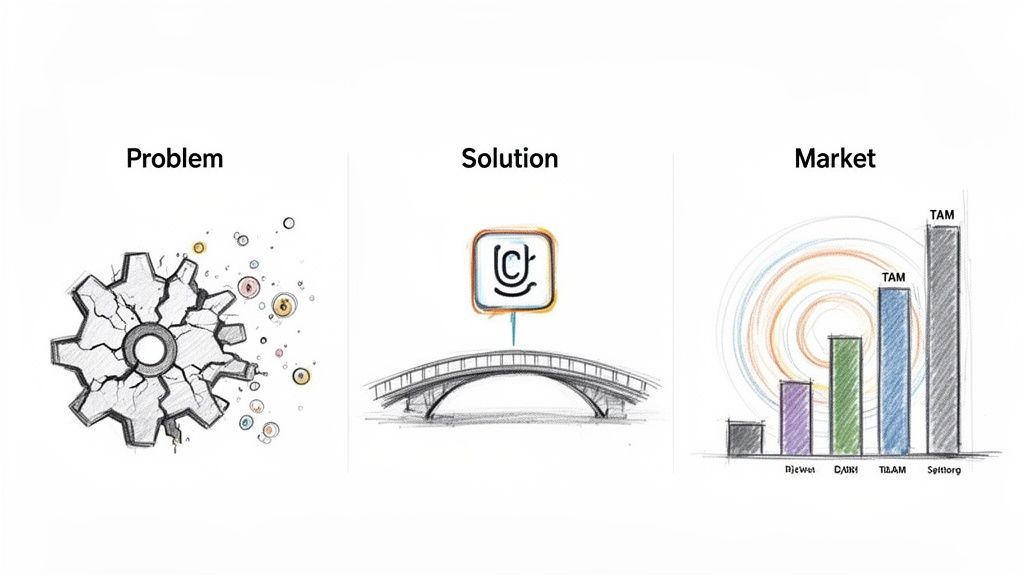
This format mirrors a logical buying decision. First, the audience must agree the problem is real and urgent. Second, they must believe your solution is uniquely capable of solving it. Finally, they need to see the problem is significant enough to warrant investment. It’s a sequence that builds conviction. Slack’s early decks didn’t sell a messaging app; they sold a cure for the pain of chaotic, productivity-killing internal email.
The PSM model’s power lies in its simplicity and focus on external validation. It forces you to prove you understand the buyer's world before you mention your product. This is critical for earning credibility and attention. The market validation slide is where many decks falter, presenting generic TAM/SAM/SOM figures. Instead, it must prove the problem is widespread and growing, making the pain you’ve identified a strategic priority for your ideal customer profile.
To execute this, founders must connect their solution's validation back to a quantifiable market need. A Founder's Guide on How to Measure Product Market Fit provides a practical framework for this.
Metrics and features resonate with analysts. Stories resonate with decision-makers. The Story-Driven Narrative Deck abandons a purely logical sequence for an emotional one, connecting the product to a larger mission or transformation. This human-centered approach uses customer anecdotes, founder journey, and relatable scenarios to build an authentic connection—especially with executives buying a future state, not just a tool.
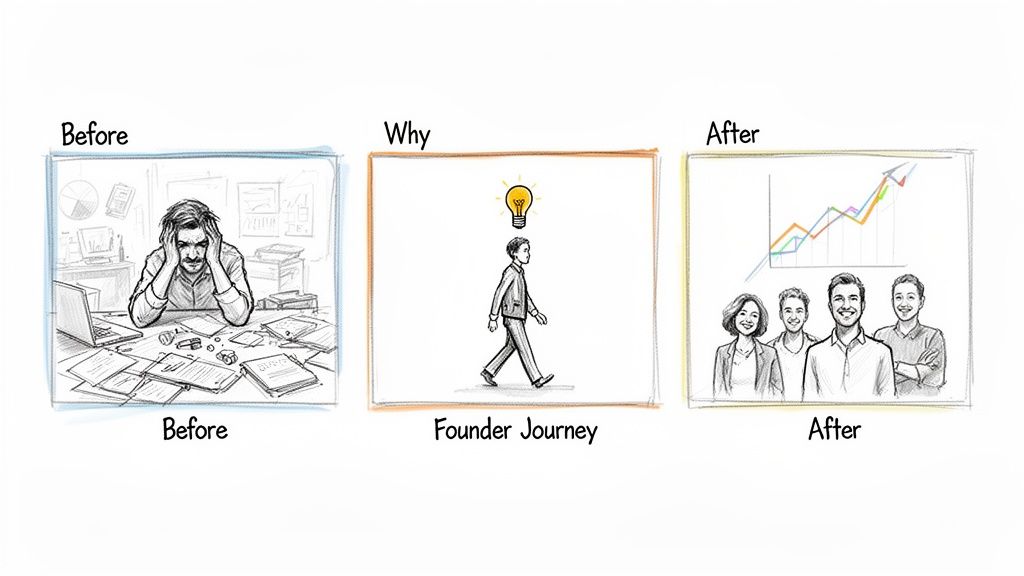
This method is effective because it bypasses the "what" and "how" to focus on the "why." While a PSM deck proves a problem exists, a narrative deck makes the audience feel the weight of that problem and the relief of the solution. Airbnb’s early pitch wasn’t about a booking platform; it was about belonging. This approach frames your solution as the inevitable turning point in a compelling story, making the buyer the hero of their own transformation.
The strategic advantage of a narrative deck is its ability to create memorability and emotional buy-in that data alone cannot. It reframes the sales conversation from a transactional evaluation of features to a strategic partnership aimed at a shared vision. This is particularly powerful for category-creating products where the problem isn't yet widely acknowledged. The story itself defines the problem and establishes its urgency. The founder’s journey, used correctly, isn't self-indulgent; it's the ultimate proof of commitment and unique insight.
When selling to enterprise accounts, the conversation inevitably shifts from solving a user's problem to justifying budget for a CFO. The Value-Stack or ROI-Focused Deck is engineered for this exact moment. It moves beyond features and benefits to answer the only questions that matter to an economic buyer: "What is the financial return of this investment?" and "How can I prove it?" This approach is non-negotiable for any SaaS company with a high ACV targeting sophisticated, procurement-driven organizations.
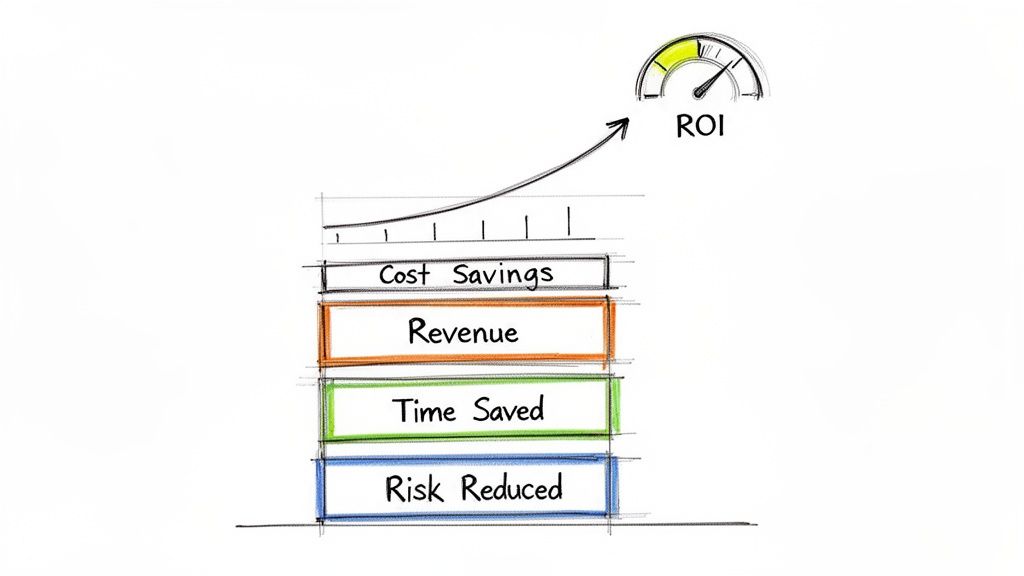
This deck works by translating your solution's impact into the language of the C-suite: dollars and cents. It deconstructs your value into quantifiable pillars like cost savings, revenue enablement, operational time saved, and risk reduction. Salesforce doesn’t just sell a CRM; its ROI decks model precise increases in sales team productivity and revenue per rep. This format is less a pitch and more a collaborative business case, equipping your champion to defend the purchase internally.
The power of an ROI-focused deck is its ability to preempt the procurement cycle's most difficult questions. It reframes the purchase from an expense into a strategic investment with a measurable, defensible payback period. This requires a level of rigor many sales teams lack. You must anchor your financial models in credible data from customer case studies, industry benchmarks, or the prospect’s own metrics. A weak ROI argument built on flimsy assumptions destroys credibility.
The goal is to provide a clear, conservative financial narrative a CFO can trust. This means showing your work, stating your assumptions, and even providing sensitivity analysis. Understanding this narrative is foundational to defining what your product actually delivers. For a deeper dive, explore our guide on articulating what a value proposition is and how to build one.
In crowded B2B markets, pretending competitors don't exist is a fatal error. The Competitive Battle-Card Integrated Deck is an advanced approach that preemptively frames the competitive landscape in your favor. It doesn't just present your solution in a vacuum; it strategically positions it against known alternatives, turning potential objections into powerful differentiators. This deck is built for the sophisticated buyer who has already done their research.
This format works by embedding competitive intelligence directly into the sales narrative. Instead of a defensive, feature-by-feature comparison, it focuses on contrasting your core philosophy or architectural advantages. Figma, for example, didn't just sell design features; it sold the philosophy of collaborative, browser-native work—a fundamental departure from the isolated, desktop-bound model of tools like Sketch. This reframes the entire buying decision from "which tool has more features" to "which way of working is the future."
The power of this deck lies in its confidence and control. By introducing the comparison on your own terms, you anchor the evaluation criteria around your strengths. This is not about bad-mouthing the competition. It's about drawing clear lines in the sand that highlight a superior approach to solving the customer's problem. This requires deep insight into competitor weaknesses—not just missing features, but foundational limitations. It shows the prospect that you understand the entire ecosystem.
This high-level deck should be supported by detailed internal resources. Building them sharpens your own understanding of the market. To dive deeper, explore this guide on building a competitive battle card template.
For many modern B2B SaaS products, especially those with intuitive UIs or clear, demonstrable value, the best sales pitch deck is barely a deck at all. The Product Demo-Driven Deck is a minimalist framework designed to do one thing: get out of the way of the product. It rejects the slide-heavy narrative in favor of a live, interactive walkthrough. This approach signals supreme confidence in your product's ability to sell itself.
This model is a direct response to buyer fatigue with generic, text-heavy presentations. Instead of telling the prospect how you solve their problem, you show them. The slides serve as a lightweight wrapper, providing just enough context to frame the problem and establish the use case. Teams at companies like Calendly and Figma have mastered this, using the deck simply to set the stage before the product becomes the star. It's a strategic choice to shift the conversation from theoretical value to tangible proof.
The power of this approach lies in its customer-centricity. It forces the sales motion to revolve around the buyer’s specific workflow, not a pre-canned company narrative. By minimizing slide content, you create space for a conversation driven by the prospect's real-time questions and reactions within the product. This is critical for complex enterprise sales where different stakeholders have different needs. A successful demo-driven pitch isn't about showcasing features; it's about co-creating a solution to the buyer's problem live on screen.
However, this method demands exceptional product quality and deep salesperson expertise. If the product is buggy or the rep cannot navigate it fluidly to address specific pain points, the entire pitch collapses. It's a high-risk, high-reward strategy that, when executed well, dramatically shortens the path to conviction.
The one-size-fits-all sales deck is an artifact of immature go-to-market motion. As you scale, clinging to a generic narrative signals a fundamental misunderstanding of your buyers. The Vertical-Specific/Use-Case Deck addresses this by tailoring the entire pitch to a specific industry or buyer persona, translating broad value propositions into a language that resonates with their unique reality. This isn’t about changing a logo on a slide; it's about reframing the core problem through the lens of that vertical’s specific pains, regulations, and business drivers.
This approach demonstrates market expertise, not just product knowledge. When HubSpot presents a deck to marketing agencies, it speaks to client retention and service scalability. When pitching to internal marketers, the focus shifts to lead generation. The product is the same, but the story is entirely different. This level of customization immediately separates you from competitors who force prospects to connect the dots themselves. It’s a powerful move from "here's what our product does" to "here's what our product does for a business like yours."
Verticalization is a strategic decision to trade breadth for depth. It concedes you cannot be everything to everyone and instead commits to being the indisputable best choice for a select few. This focus is a force multiplier for your sales team. A well-executed vertical deck arms them with industry-specific case studies, relevant competitor comparisons, and ROI models that use metrics the prospect already tracks. It’s a critical tool for moving upmarket where generic messaging fails.
The effort required means you must be disciplined. Start with your top two or three verticals where you have existing wins. Partner directly with sales reps and customers in that vertical to co-create the narrative. This ensures the deck reflects the ground truth of their challenges, making it one of the most effective sales pitch deck examples for achieving resonance.
The Three-Horizon Growth Deck elevates your sales narrative from a tactical solution to a strategic partnership. This framework, popularized by McKinsey, forces you to articulate not just what you solve today (Horizon 1), but how you will grow with your customer into adjacent opportunities (Horizon 2) and ultimately help them navigate future disruptions (Horizon 3). This is a power move for founders selling into large enterprises where buyers are vetting your long-term viability as much as your current feature set.
This forward-looking approach builds immense confidence. It shows you are a platform with a clear growth trajectory, not just a point solution. HubSpot masterfully executed this, evolving from a simple marketing tool (H1) to a full CRM platform (H2), and now into an ecosystem player shaping the future of customer engagement (H3). For a buyer, this de-risks the investment by painting a picture of compounding value. It answers the implicit question: "Will you still be a critical partner in five years?"
The strength of the Three-Horizon model is its ability to balance immediate, provable value with ambitious, long-term vision. Horizon 1 must be grounded in existing traction and validated customer results. Horizon 2 then logically extends from your current capabilities into near-term expansions. Horizon 3 is your bold, transformational vision. This structure makes your ambition credible.
Many sales pitch deck examples focus only on present pain. By mapping out this growth journey, you shift the conversation from a simple transaction to a long-term strategic alliance, justifying a higher price point and deeper integration into the customer's operations.
For mature markets or risk-averse enterprise buyers, your product’s features are secondary to one critical question: “Who else that I trust is already using this?” The Social Proof/Credibility-Heavy Deck addresses this head-on by front-loading validation. Instead of building a case from the problem up, it opens with an overwhelming display of trust signals: customer logos, analyst recognition, and impressive usage metrics. This approach shifts the buyer's mindset from "Should I take a risk on this?" to "Can I afford to be left behind?"
This strategy works because it leverages a powerful enterprise buying heuristic: risk mitigation. No CIO wants to be the first to adopt an unproven technology. Seeing logos of their peers or admired brands acts as a powerful shortcut for due diligence. Stripe doesn’t just sell a payment API; it sells the confidence that comes from being trusted by companies like Amazon and Google. This makes the deck less of a persuasive argument and more of a confirmation of a safe, smart decision.
The core of this approach is de-risking the purchase. While a problem-solution narrative establishes need, a credibility-heavy narrative establishes safety and inevitability. It is particularly potent for companies moving upmarket or entering a crowded space where differentiation is hard to communicate through features alone. By leading with proof, you reframe the sales conversation around adoption momentum and market leadership. The focus is less on what you do and more on who trusts you to do it.
This deck type must be more than a vanity slide of logos. The proof must be specific, relevant, and quantifiable. Merging high-level brand recognition with metric-driven results is key. For more insight on how to build these proof points, you can review our collection of impactful case studies.
The 'Jobs to Be Done' (JTBD) framework shifts the entire axis of a sales pitch from what your product is to what your customer hires it to do. Popularized by Clayton Christensen, this buyer-centric structure bypasses feature lists to focus on the fundamental progress a customer is trying to make. This approach is potent because it uncovers the true, often unstated, buying motivation.
This format works because it reframes your competition. Customers don't just 'hire' your software; they might hire a spreadsheet, an intern, or 'doing nothing' to accomplish a job. By framing your pitch around the job, you force the buyer to evaluate their current inefficient workaround against your superior solution. Calendly isn’t selling a scheduling tool; it's hired to do the job of "eliminating the frustrating back-and-forth of finding a meeting time," a job previously done poorly by email.
The JTBD deck's power comes from its deep empathy and focus on causality. It answers the question, "What circumstances in your world caused you to seek a new solution today?" This forces you to understand the push and pull factors of the buying decision, not just the functional requirements. The narrative becomes less about your product's superiority and more about its inevitability as the best way to accomplish a critical job.
This approach demands rigorous customer interviews focused not on feedback but on deconstructing past purchase decisions. You must uncover the functional, social, and emotional components of the job. For example, a CFO hires accounting software not just to close the books (functional), but to gain credibility with the board (social) and reduce personal anxiety during audits (emotional). Addressing all three dimensions creates a deeply resonant case.
When your primary growth path involves displacing a large, entrenched competitor, a generic sales pitch deck is insufficient. The Comparison/Versus Deck is a specialized asset engineered to do one thing: make switching from the incumbent feel not only logical but inevitable. This format doesn't shy away from naming the competitor; it puts the comparison front and center, directly addressing the buyer's unspoken question: "Is this really better enough to justify the pain of switching?"
This approach is fundamentally about de-risking change. It acknowledges switching costs and team inertia as real obstacles, then systematically dismantles them. Instead of a general value proposition, it presents a migration-focused argument. Great examples include Figma’s early decks targeting Sketch users by highlighting the pains of file versioning, or Notion's play to win teams from Confluence by contrasting its flexibility with Confluence's rigid structure. It shifts the conversation from "what do you do?" to "why are you the superior choice over what we use today?"
The power of a Comparison/Versus Deck lies in its empathy and directness. It shows the prospect you understand their current world, including the specific limitations of their existing toolset. This builds immense credibility. This deck is built on a foundation of documented incumbent weaknesses, framed from the customer's point of view. This isn’t about badmouthing a competitor; it’s about demonstrating a deeper understanding of the job to be done. It turns your solution into an upgrade, not just an alternative.
To execute this, you must have an unshakeable grasp of your unique position in the market. This deck is a masterclass in demonstrating clear, defensible differentiation. For a deeper dive into crafting this core argument, explore our guide on how to achieve meaningful product differentiation.
We have analyzed ten distinct archetypes of B2B SaaS sales pitch decks, from the classic Problem-Solution-Market narrative to the ROI-focused Value-Stack. Each of these sales pitch deck examples serves a specific strategic purpose, tailored to a unique combination of market maturity, buyer sophistication, and product complexity.
The most critical takeaway is this: your sales deck is not a document. It is the tangible output of your go-to-market strategy. A weak deck almost always signals a weakness in the underlying strategy—ambiguity in your ICP, a lack of conviction in your unique value, or a misunderstanding of the problem you solve.
A high-converting deck is never an accident. It is the result of brutal clarity and deliberate choices.
Across all examples, three principles separate elite decks from average ones:
Studying these sales pitch deck examples is only the first step. The real work is translating these patterns into a tool that drives pipeline for your business. Stop thinking about slide design and start thinking about strategic alignment.
Pressure-test your own strategic inputs. Before you open a slide editor, answer these questions with unflinching honesty:
A powerful sales narrative is born from a powerful strategic foundation. To ensure your deck reflects this, it's vital to have well-defined brand positioning. Explore various brand positioning statement examples to see how leading companies distill their essence into a sharp, defensible message. This is the bedrock upon which a compelling sales story is built.
Ultimately, the goal is not to have a "perfect" deck. It's to have an effective one—a living document that evolves with every sales call. These examples are not a finish line; they are a starting point for building a sales engine fueled by clarity, conviction, and strategic intent.
A high-performing sales deck is the final expression of a clear go-to-market strategy. If you are struggling to translate your company's value into a narrative that closes deals, the problem often lies deeper than the slides themselves. At Big Moves Marketing, we help B2B SaaS founders achieve strategic clarity, so their sales and marketing motions have the foundation they need to succeed.
Explore Big Moves Marketing services and resources:





%20-%20white.svg)