%20png%20copy.avif)
Most advice about AI in digital marketing starts with the wrong question: which tools should your team buy?
That question assumes the bottleneck is production. For most B2B SaaS companies, it isn't. The bottleneck is deciding which market to pursue, which problem to own, which message will earn attention, and which activity contributes to pipeline.
AI can produce a campaign brief, landing page, nurture sequence, sales email, and ad variations before lunch. None of that guarantees that the campaign deserves to exist. The obvious content gains are becoming interchangeable. The durable advantage sits elsewhere, in segmentation, positioning, message-market fit, and attribution discipline.
Marketing adoption has moved quickly. A 2026 survey reports that 87% of marketers use generative AI in at least one recurring workflow, up from 76% in 2025 and 51% in the first quarter of 2024. The same source says AI and machine learning now power 24.2% of marketing activities, compared with 13.1% in 2024, and marketing leaders project that share could reach 55.9% within three years. (2026 AI marketing adoption data)
That shift makes AI a standard layer in the marketing stack. It doesn't make every AI program strategically useful.
For B2B SaaS teams with a defined ICP, another content generator rarely moves pipeline. A sharper answer to why this buyer should choose you now does.
AI is still being deployed mainly as a productivity lever. Teams use it to draft posts, rewrite emails, produce ad variants, and summarize calls. Those applications reduce production time, but they do not improve judgment on their own. A vague ICP gives AI more ways to express vagueness. Weak positioning reaches more channels without becoming more persuasive.
Output is easy to count, so teams often mistake it for progress. Dashboards show completed briefs, published pages, email sends, and creative variants. They do not show whether the company is more relevant to a high-value buying group, or whether a campaign changed the odds of creating pipeline.
The operating test: If an AI workflow does not improve a market, audience, message, budget, or routing decision, classify it as administration, not strategy.
That distinction explains why active AI programs can leave pipeline unchanged. The team has not revised its assumptions about the buyer or the market. It has only shortened the path from an untested idea to a live campaign.
The market reinforces the production-first approach. A market summary places global AI marketing revenue at about $47 billion in 2025 and projects $107 billion by 2028. Another research summary reports that marketers using AI save an average of 6.1 hours per week. (Adobe AI marketing trends) Reclaimed hours matter only when leaders redirect them toward sharper decisions, not more interchangeable assets.
For a B2B SaaS company, AI in digital marketing should improve four operating decisions:
The content factory is already crowded. Competitors can generate comparable first drafts. Your advantage comes from deciding which segment deserves the draft, what evidence it needs, and how you will judge the result.
For a direct warning about production without strategy, read why AI without strategic thinking is destroying B2B marketing results. Judge every AI initiative by the decision it improves, not the assets it produces.
A useful definition starts with the marketing operating system, not a vendor category.
AI in digital marketing is a set of capabilities that captures signals, predicts outcomes, generates options, and supports or executes decisions across the buyer lifecycle. That definition matters because a writing assistant, a lead-scoring model, and an autonomous campaign workflow solve different problems. Buying them as if they're interchangeable creates fragmented data, unclear ownership, and expensive duplication.
| Layer | Purpose | B2B Data Inputs | Typical Failure |
|---|---|---|---|
| Perception | Capture intent, behavior, language, and account signals | Product usage, website activity, CRM history, sales call transcripts, support tickets | The system sees activity without understanding buying context |
| Prediction | Estimate propensity, churn risk, conversion likelihood, or account fit | Billing events, lifecycle stage, historical opportunities, usage patterns, firmographics | Incomplete or biased history produces confident but weak scores |
| Generation | Create copy, creative, code, summaries, and synthetic research options | Approved messaging, call transcripts, product documentation, brand rules | The output sounds plausible but misses positioning or invents details |
| Decisioning | Recommend or execute routing, next-best action, budget, and timing | Unified campaign, CRM, product, and revenue data | The workflow optimizes a proxy instead of pipeline quality |
The four layers depend on different data conditions. A model can't infer expansion intent reliably if product events aren't connected to account records. A content model can't protect technical accuracy if it receives a thin brief and no approved source material. A routing workflow can't prioritize sales-ready accounts if CRM stages are inconsistent.
A copilot helps a person perform a task, such as drafting an email or summarizing a call. An agentic workflow takes a sequence of actions under defined permissions, such as identifying an account, enriching its record, selecting a sequence, and requesting human approval. Embedded inference sits inside an existing system and produces a score or recommendation, such as propensity data inside a CRM or marketing automation platform.
Each model creates a different operating burden. Copilots require judgment and review. Agents require permissions, exception handling, monitoring, and a reliable stop mechanism. Embedded inference requires confidence that the underlying data and model output fit the business decision.
Digital marketing and AI strategy is most useful when treated as a stack design question. Start with the decision you need to improve, trace the data required to make it, then choose the smallest AI capability that can support that decision. Don't start with the tool. Start with the failure in the current workflow.
AI earns its place in a B2B SaaS stack when it changes who gets attention, what they see, when sales engages, or how the team learns. Four use cases meet that standard when implemented with discipline.
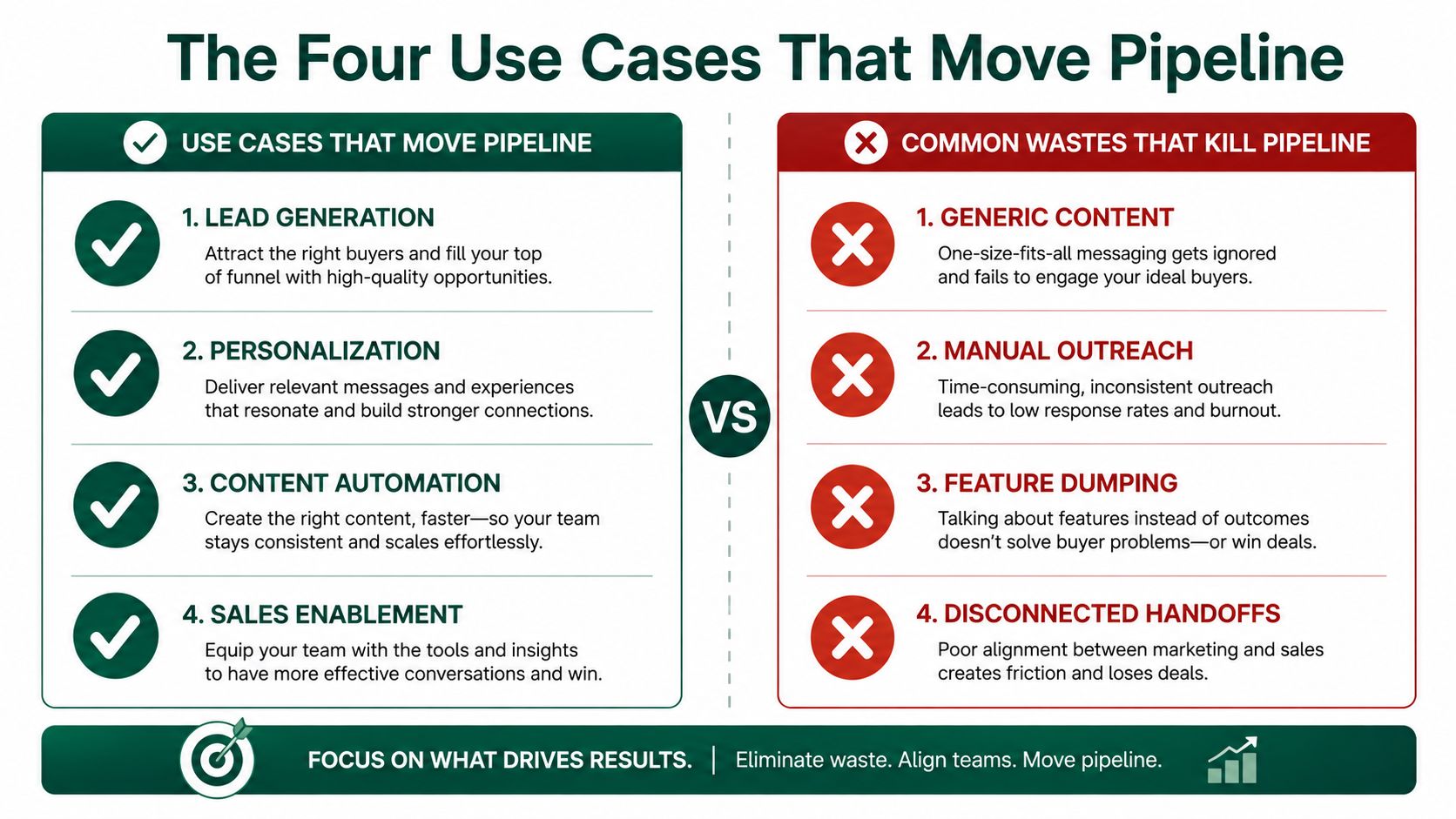
Good lead generation stacks signals instead of worshipping a single score. Combine firmographic fit, product behavior, site engagement, sales history, and credible third-party intent. Then use AI to enrich the account record and change an action, such as routing a product-qualified account to the right SDR, suppressing a poor-fit company, or prioritizing an account showing a relevant buying trigger.
A weak implementation adds an AI score to the CRM and leaves routing unchanged. That creates a decorative field, not a pipeline system. If the score doesn't alter territory, sequence, timing, or qualification, it isn't earning its cost.
Good: an AI model identifies a cluster of high-fit accounts whose technical teams are active in a product area associated with expansion, then routes them to a specialist with a relevant proof point.
Waste: buying intent data, sending every account the same sequence, and calling the resulting activity “AI-powered prospecting.”
Personalization should reflect a meaningful difference in context. Role, ICP tier, lifecycle stage, product maturity, and current problem are useful dimensions. A website that changes one adjective based on a company name isn't personalization. It's decoration.
AI-driven personalization performs best with credible first-party data and contextual timing. A systematic review found that it can improve perceived relevance, usefulness, convenience, engagement, and purchase intention, while also increasing privacy concern, perceived intrusiveness, and doubts about authenticity when the experience feels excessive. (Systematic review of AI personalization)
Good: an operations leader sees proof related to workflow reliability, while a finance leader sees the economic case and implementation risk.
Waste: inserting a visitor's company name into a generic page and pretending the buyer won't notice.
AI is excellent for research synthesis, repurposing, outlining, internal linking suggestions, and controlled variant creation. It can accelerate SEO work when the team already understands the searcher's problem and the company's differentiated answer.
It shouldn't publish unedited bottom-of-funnel pages. Buyers evaluating technical software need specificity, evidence, trade-offs, implementation detail, and a credible point of view. Generic model output tends to smooth those edges away.
Use AI to create options. Keep humans responsible for the claim, argument, examples, and final judgment. The winning content workflow isn't “generate and publish.” It's brief, challenge, draft, verify, sharpen, measure.
Sales enablement becomes valuable when information travels in both directions. AI can summarize calls, classify objections, score deal risk, identify missing stakeholders, and suggest next actions. Marketing should use those outputs to update messaging, proof points, nurture logic, and qualification criteria.
Good: call summaries reveal that late-stage buyers consistently ask about migration risk, so marketing builds an objection-handling asset and sales adds the issue to discovery.
Waste: generating a summary that nobody reads, storing it in an inaccessible system, and learning nothing from it.
For a broader view of AI in advertising and acquisition workflows, see artificial intelligence in advertising. The rule across all four use cases is the same: automation should change behavior, not merely reduce keystrokes.
A CFO won't approve an AI program because the team saved time. Time matters only when it changes a financial outcome.
The strongest business case links AI to CAC payback, sales velocity, win rate, expansion, and marketing efficiency. That requires a mature enough ICP, dependable lifecycle definitions, and CRM data that reflects reality. Without those conditions, AI tends to optimize whatever is easiest to observe, usually clicks, opens, or activity.
Positioning-driven segmentation can improve the quality of pipeline. If AI helps identify which accounts share a painful use case, urgent trigger, and credible ability to buy, the team can concentrate spend and sales effort. The financial effect should appear in opportunity quality, conversion through stages, and win rate, not just engagement.
Lifecycle orchestration can support ACV and retention. A model that recognizes activation risk, expansion signals, or stalled adoption can trigger a more relevant intervention. The aim isn't to send more lifecycle messages. It's to move the right customer toward successful usage, renewal, or expansion.
Attribution discipline can redirect budget. AI makes pattern detection faster, but it doesn't make attribution automatically correct. Teams still need clear definitions for sourced pipeline, influenced pipeline, conversion, and incrementality. The benefit appears when leaders stop funding saturated activity because it generates visible engagement without creating additional revenue.
Decision velocity can reduce organizational waste. A marketing team that can evaluate segments, messages, and channels quickly can stop weak motions earlier. That isn't a vague productivity gain. It reduces the time and spend committed to a bad assumption.
| AI Lever | P&L Metric Affected | Realistic B2B SaaS Lift Range | Preconditions to Capture Value |
|---|---|---|---|
| Positioning-led segmentation | Win rate, CAC payback, pipeline quality | Avoid fixed promises. Validate against a controlled baseline | Clear ICP, account-level data, consistent stage definitions |
| Lifecycle orchestration | ACV, retention, expansion efficiency | Model the change by cohort rather than assuming universal impact | Reliable product events, lifecycle logic, customer success feedback |
| Attribution discipline | Marketing efficiency, budget productivity | Measure incremental contribution, not reported influence alone | UTM governance, CRM hygiene, agreed revenue definitions |
| Decision velocity | Operating cost, test throughput, resource allocation | Track time from hypothesis to decision and the cost of failed motions | Named owners, review cadence, documented hypotheses |
The evidence supports a performance case when the implementation is specific. In a 50-campaign study of Indian firms, AI-powered predictive analytics increased click-through rate from 5.1% to 8.2% and conversion rate from 10.0% to 12.5%. The authors also reported a 25% conversion gain and 30% ROI improvement. (Study of AI predictive analytics in Indian campaigns)
Those results don't justify copying the tactic blindly. They support a narrower conclusion: AI can improve allocation and targeting when the team has a defined motion, relevant signals, and a measurement design. AI first, strategy later is backwards.
AI programs fail when teams buy capabilities before defining the decisions those capabilities should improve. Treat implementation as a sequence of evidence gates. Advance only after the current stage produces the data, ownership, and operating rules required by the next.
Define the ICP in operational terms: target account traits, buying roles, disqualifiers, lifecycle stages, product events, and revenue milestones. Standardize the event taxonomy before models influence campaigns. If “activated,” “qualified,” and “sales-ready” mean different things across teams, automation will scale the disagreement and obscure message-market fit.
Set data boundaries at the same time. Specify what may enter an AI system, which vendors may retain it, who can access it, and where human approval is required. These decisions protect customer trust while keeping later experiments reviewable.
Choose one end-to-end motion. An outbound-assisted SDR workflow or a product-led activation program can work. Five disconnected use cases cannot produce a clear lesson.
Write the hypothesis before launch. Name the target segment, intervention, expected decision change, success metric, holdout design, owner, and kill criteria. A focused pilot can use a 60 to 90 day window when the buying cycle and available volume support it. Let the measurement design determine the duration, not an artificial deadline.
Scale only what changed a business decision and survived review. Consolidate overlapping vendors, negotiate data portability, and decide whether proprietary data assets justify internal development. Build when the signal is strategically unique and the workflow requires control. Buy when the problem is common and integration matters more than differentiation.
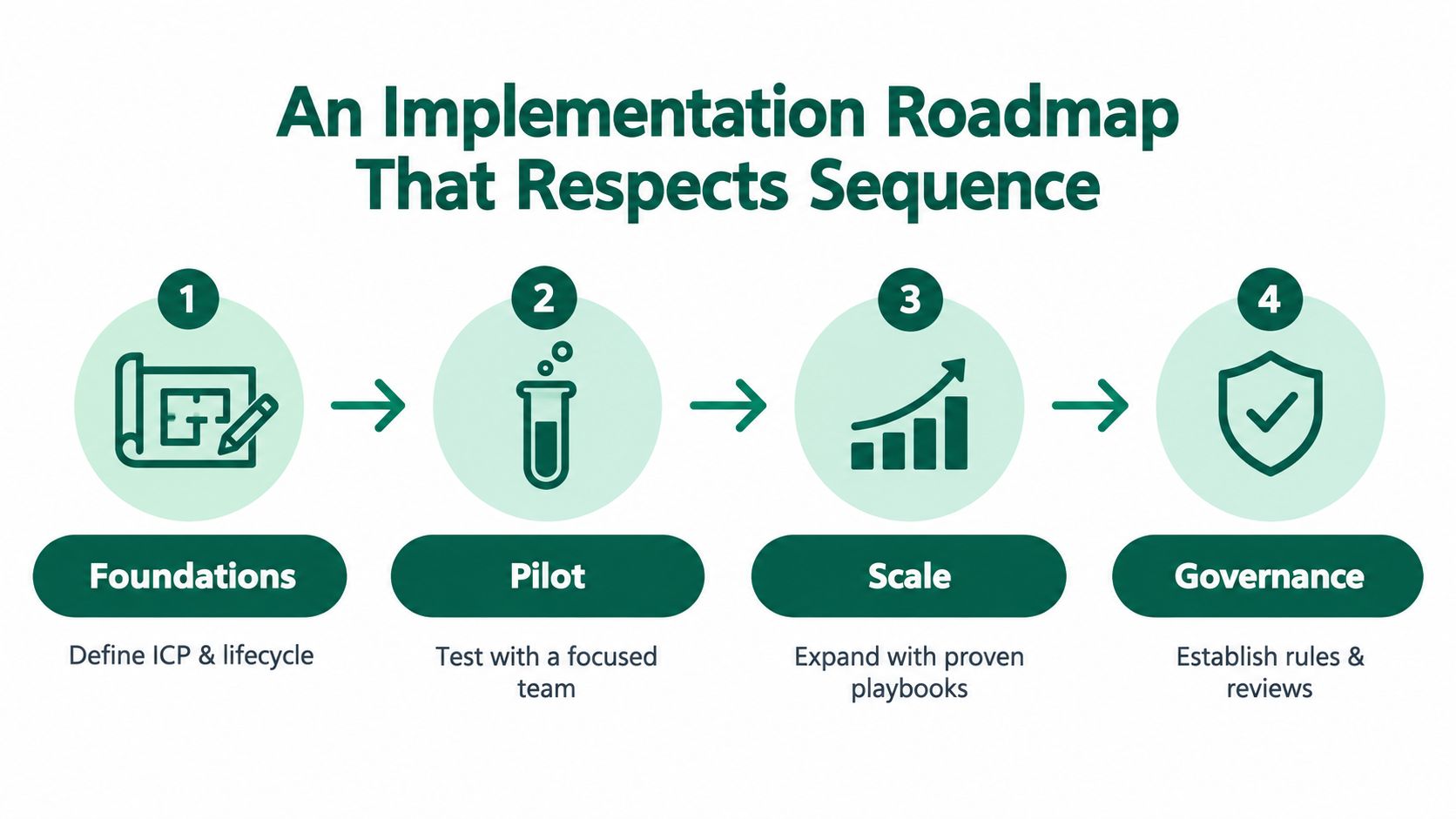
Governance needs operating rules, not a document in a shared drive. Set review dates, model owners, access controls, evaluation criteria, data residency requirements, consent controls, and a kill-switch for automation that misses its thresholds.
EU obligations apply to synthetic output. Under Article 50 of the EU AI Act, generative AI outputs containing synthetic audio, images, video, or text must carry a machine-readable mark and remain detectable as artificially generated. The transparency obligations apply on 2 August 2026. (EU AI Act transparency obligations)
For operating detail, use this 2026 AI implementation guide for B2B marketers.
The sequence protects the strategy. Foundations reduce false confidence, pilots create decision evidence, scale builds operating advantage, and governance keeps the system accountable.
The most useful case studies are the ones you can audit. They name the decision, the signal, the intervention, and the measurement method. They don't treat “AI adoption” as the outcome.
The examples below are patterns worth studying, not claims about named companies.
A mid-market developer tools company had an account list that looked healthy in aggregate but produced inconsistent sales conversations. The team rebuilt ICP scoring around AI-generated intent signals from product behavior, technical content engagement, and CRM history. It reduced sales cycle length by 28%.
The important change wasn't the model. The team changed routing and sales preparation around the score. A governance decision determined the outcome: sales managers reviewed false positives on a recurring basis and removed signals that correlated with activity but not buying intent.
A Series B data infrastructure startup had named accounts, but marketing treated them as a list rather than a set of buying situations. The company used AI to operationalize personalization across 120 target accounts, adapting campaign themes by account context, role, and stage. Opportunity creation from named accounts increased by 3.2x.
The governance decision was narrower than the campaign. Marketing required every personalized claim to map to approved positioning and account evidence. That stopped the system from producing impressive-looking messages that sales couldn't defend in a live conversation.
A vertical SaaS company had SDRs spending too much time researching accounts and too little time holding qualified conversations. It replaced the research workflow with a governed AI stack that assembled account context, identified relevant triggers, and prepared an outreach brief. Qualified meetings doubled without adding headcount.
The key control was human approval before outreach. The system could collect and organize evidence, but the SDR remained accountable for whether the trigger was real, the message was appropriate, and the account belonged in the motion.
These examples share a pattern. AI didn't create demand from nothing. It made existing signals more usable and moved information into a decision at the right time. Remove the governance decision, and each program becomes a faster way to distribute bad assumptions.
AI marketing programs rarely fail because a model cannot write a sentence. They fail because the company has not defined good marketing, assigned decision rights, or established how incremental revenue will be proved. Treat AI as a positioning and decision system, not a content factory.
More output does not create more differentiation. It creates a larger library of competent language that resembles every competitor. Test the position before increasing production. Ask whether the target segment recognizes the problem, believes the claim, and sees a credible reason to act.
AI-generated content is already commoditized. The advantage sits in sharper segmentation and message-market fit, where the system helps the team choose what to say, to whom, and when.
AI will optimize whatever the business measures, including activity that only looks valuable. Clean UTMs, lifecycle stages, opportunity definitions, and a shared pipeline source of truth must come first. Use control groups where possible, then separate correlation from incremental contribution.
The CMO Survey 2026 report notes that AI use has risen from 13.1% of marketing activities in 2024 to 24.2% in 2026, while many teams still struggle to measure impact beyond productivity gains.
Assign one person responsibility for model quality, prompt drift, data freshness, exceptions, and business performance. Set a review cadence and keep decision logs. The team needs to see why a workflow acted, not only what it produced.
A 2026 AI marketing benchmark summary reports that 84% of marketers still admit to running generic campaigns, even as 75% have adopted AI. Adoption has not solved differentiation because tools cannot know which distinctions matter until the team defines them.
The EU AI Act introduces transparency obligations for synthetic content, with applicability beginning on 2 August 2026. Build a workflow that can identify and label generated output before campaign review, rather than discovering the gap after publication.
The same discipline applies to AI search. Read why B2B marketers can't rely on LLMs alone for the AI search gap. Model output cannot replace first-party evidence, clear positioning, or attribution discipline.
| Failure Mode | What Goes Wrong | Countermeasure |
|---|---|---|
| Generic output | More assets repeat the same undifferentiated claims | Test positioning and audience specificity before scaling production |
| Weak attribution | Teams optimize clicks, opens, or influenced pipeline without proving incrementality | Instrument UTMs, CRM stages, holdouts, and revenue-linked dashboards |
| Unowned performance | No one monitors model accuracy, drift, or exceptions | Assign a named owner with a review cadence and kill criteria |
| Compliance exposure | Synthetic content lacks disclosure, provenance, or approval records | Document data sources, labeling rules, permissions, and human checkpoints |
The operating system around the model matters more than the novelty of the model.
The useful mental model is not “AI creates marketing.” It is AI improves the speed and quality of marketing decisions.
Five principles keep the work grounded:
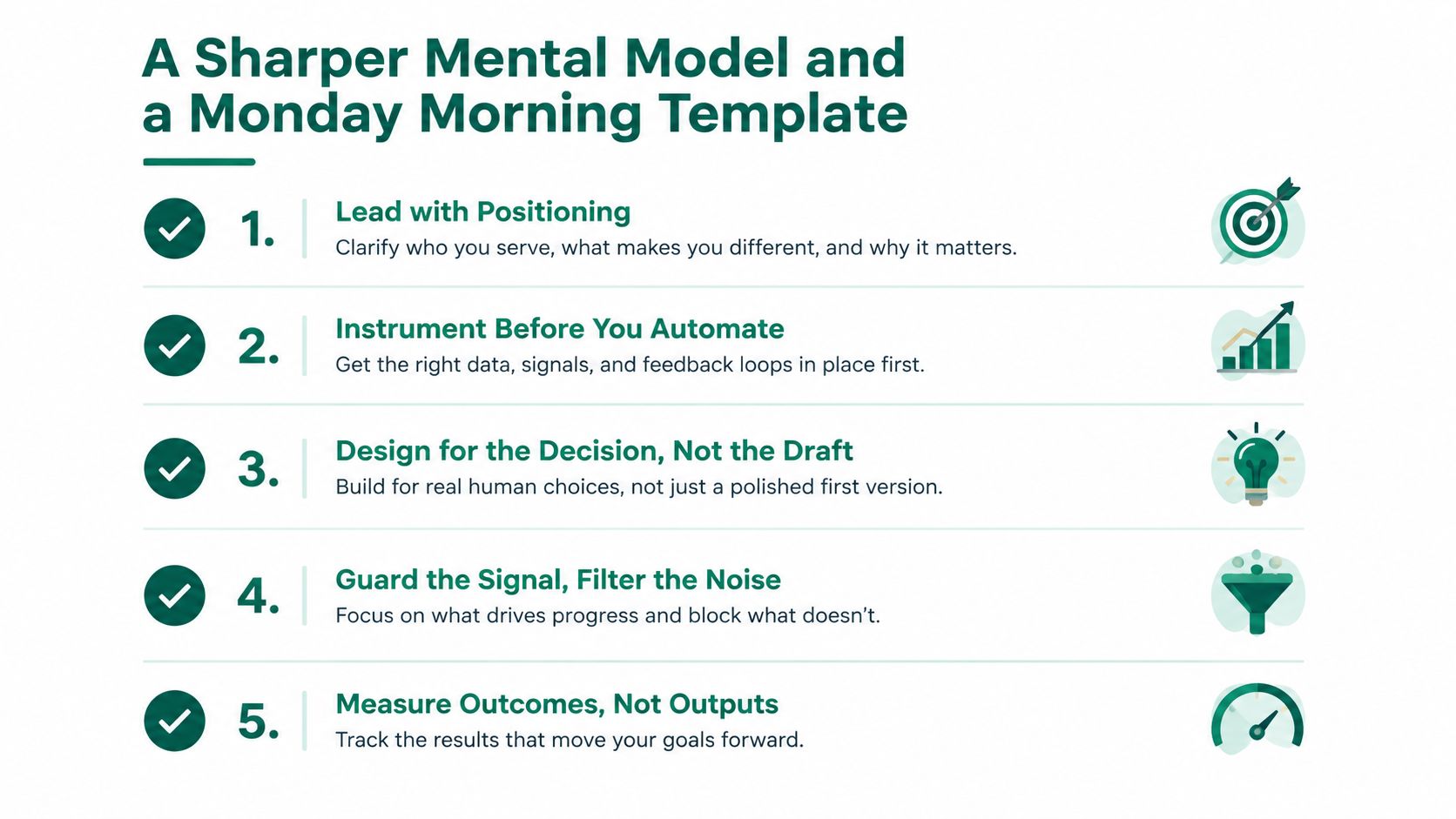
On Monday morning, ask the AI system to tighten the ICP using closed-won, closed-lost, product usage, sales call, and support evidence. Require it to return segment hypotheses, disqualifiers, trigger events, and the evidence supporting each recommendation.
Then run a message-market fit test. Give the team three positioning options and ask target buyers to react to problem recognition, urgency, differentiation, proof, and perceived risk. Don't ask which option sounds nicest. Ask which one changes the buyer's understanding of the problem.
Build an AI-assisted nurture sequence for one lifecycle stage. Define the trigger, desired next action, suppression rules, human escalation point, and measurement plan. Give sales a one-page enablement brief with the audience, message, proof, objections, discovery prompts, and disqualifiers.
For the first thirty days, track pipeline creation, opportunity conversion, win rate, sales cycle length, and the quality of the accounts entering the motion. Keep output metrics as diagnostics, not as the definition of success.
The teams winning with AI in 2026 won't necessarily produce more. They'll make better decisions sooner, communicate more clearly, and stop funding motions that can't prove their value.
Big Moves Marketing helps B2B SaaS leaders clarify positioning, design go-to-market systems, and connect marketing activity to pipeline and revenue attribution. If your team needs a sharper AI growth strategy rather than another content workflow, visit Big Moves Marketing to start a focused conversation.



%20-%20white.svg)