%20png%20copy.avif)
The most popular advice about digital marketing and AI is also the most expensive: buy more tools, automate more tasks, publish more content.
That advice is wrong.
AI doesn't fix a weak go-to-market system. It exposes it. If your ICP is fuzzy, your messaging is generic, and your funnel is stitched together with manual workarounds, AI will scale the mess faster than your team can clean it up. Founders who treat AI as a productivity add-on usually get more output and less signal. More drafts. More dashboards. More campaigns. Not more pipeline.
The useful way to think about digital marketing and AI is simpler. AI is a decision system. It helps teams process more behavioral data, spot patterns earlier, personalize more precisely, and adjust channels faster than a human-only workflow can. That changes more than content production. It changes how you structure the GTM team, where you put budget, what work you stop funding, and what kind of strategic discipline your company can maintain under pressure.
Most founders ask the wrong first question. They ask, "Which AI tool should we buy?" A better question is, "Where does our GTM engine still run on opinion, lagging reports, and manual guesswork?"
That's the shift.
AI isn't your new marketer. It isn't your replacement SDR. It isn't your content strategist. It's the operating system that sits under core marketing decisions and forces your team to work with cleaner inputs, tighter feedback loops, and less wasted motion.

A lot of B2B SaaS teams still treat marketing like a chain of disconnected tasks. Someone writes content. Someone launches paid campaigns. Someone exports CRM data. Someone updates attribution slides before the board meeting. Then leadership wonders why execution feels slow and why channel performance is hard to trust.
AI matters because it changes how those decisions get made.
Instead of waiting for a monthly review to realize lead quality dropped, systems can analyze behavioral signals in near real time. Instead of using static personas built six months ago, teams can work from dynamic profiles shaped by actual browsing, buying, and engagement data. Instead of manually checking ad accounts every few hours, systems can adjust bids, targeting, and budget allocation continuously.
Practical rule: If your team is using AI mainly to draft words, you're using the smallest part of the opportunity.
The strategic point is bigger than automation. Good AI integration reduces decision latency. It shrinks the distance between signal and action. That is what improves GTM execution.
In B2B SaaS, the problem usually isn't lack of activity. It's poor coordination between positioning, demand gen, sales follow-up, and measurement. AI can help, but only if you use it to tighten the system rather than decorate the edges.
That means leaders should stop evaluating AI based on novelty and start evaluating it based on operational friction. Where does your team repeat analysis by hand? Where does campaign optimization depend on one overworked specialist? Where does sales ignore marketing data because nobody trusts it?
If you want a sharper framing of that problem, this piece on why AI without strategic thinking is destroying B2B marketing results gets to the same issue from a different angle.
The companies that benefit from digital marketing and AI won't be the ones with the biggest tool stack. They'll be the ones that use AI to make their GTM system more coherent, measurable, and hard to out-execute.
A tool-first AI strategy usually starts with urgency and ends with clutter.
A founder sees a new writing tool, meeting summarizer, outbound assistant, ad optimizer, or research agent. The team buys access. Everyone gets told to "start using AI more." Output goes up for a few weeks. Then quality drops, workflows fragment, and nobody can explain what improved.
This is predictable. Not surprising.
When teams don't have clear positioning, defined buying stages, or a stable ICP, AI doesn't solve the problem. It scales the confusion. The model will still produce blog posts, ads, emails, landing page copy, and campaign ideas. They just won't be anchored to a useful market thesis.
That's why generic AI adoption feels productive but creates little business value. You get a lot of assets and very little advantage.
The financial context makes this worse. A 2025 industry roundup says 72% of overall marketing budgets are now allocated to digital channels, and the global digital advertising and marketing market is projected to reach $786.2 billion by 2026 according to Insivia's digital marketing statistics roundup. When digital is already the main budget center, sloppy AI adoption isn't a minor operational mistake. It's an expensive one.
If your sales team can't describe why one segment closes faster than another, your AI lead scoring won't be credible.
If your homepage still sounds like five competitors stitched together, your AI content workflow will publish polished sameness.
If your CRM data is incomplete, your campaign optimization layer will make confident decisions from weak inputs.
Here's the first-principles version:
| Problem | What teams do | What actually happens |
|---|---|---|
| ICP is vague | Generate more top-of-funnel content | More irrelevant traffic and weak fit leads |
| Messaging is soft | Use AI to scale copy production | Brand sounds faster, not clearer |
| Funnel data is messy | Add AI reporting and scoring tools | Noise gets formalized into dashboards |
| Channel strategy is unfocused | Launch AI-assisted campaigns everywhere | Spend fragments across low-conviction bets |
AI is an amplifier. It doesn't rescue weak strategy. It makes weak strategy harder to ignore.
Most founders need to get more disciplined.
A better sequence is boring and effective.
First, clarify the decision problem. Then identify the data required. Then define the workflow change. Only then does tooling matter.
That sounds slower. It isn't. It avoids six months of motion that never compounds.
Most discussions of digital marketing and AI collapse into one topic: content generation. That's a narrow view. The bigger shift is that AI changes four parts of the GTM engine at once. It changes how you identify demand, how you shape the message, how you activate channels, and how you decide what is working.
Here is the useful mental model.
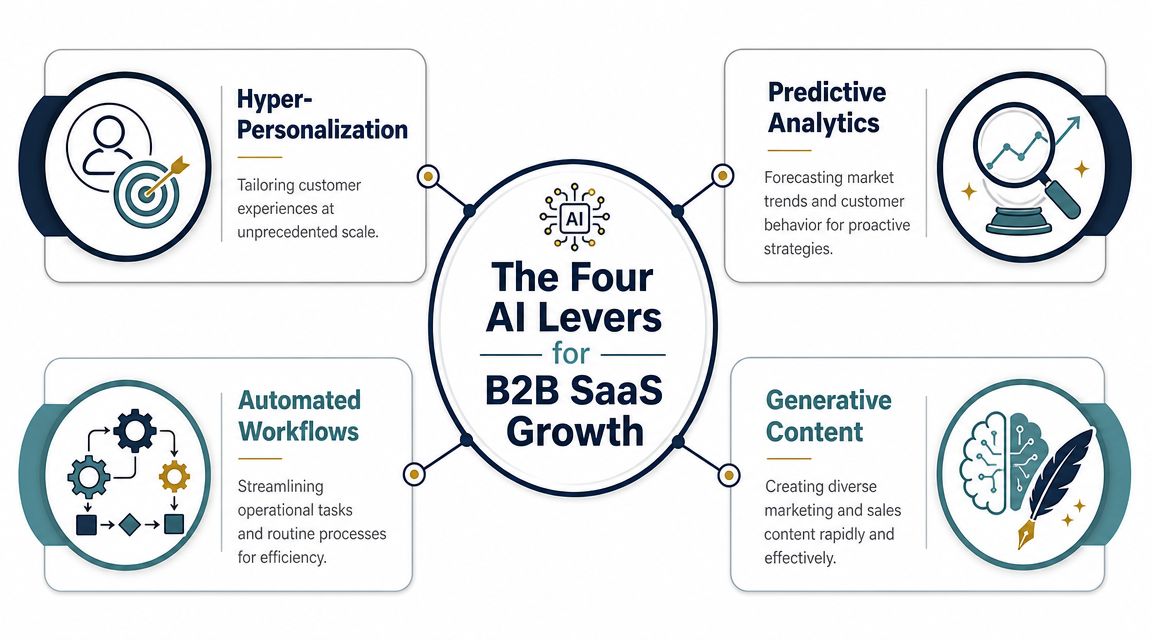
The old way was static segmentation. Teams grouped accounts by industry, company size, or role title. Then they pushed the same campaign to broad lists and hoped performance data would reveal intent later.
That approach is too blunt for serious B2B growth.
AI systems can ingest structured and unstructured data to build dynamic customer profiles, update cohorts continuously, and surface patterns that broad segmentation misses. They can work across demographics, browsing behavior, purchase patterns, social data, images, and videos to refine who should see what and when, as described in this analysis of AI-driven segmentation and personalization.
For a SaaS company, this means your notion of "best-fit account" shouldn't live in a static slide. It should evolve as you learn from product usage, sales conversations, campaign engagement, and closed-won patterns.
What changes in practice?
This is one place where AI can remove real friction between marketing and sales. Marketing stops sending flat lists. Sales gets a more defensible view of intent.
AI is already embedded in marketing workflows. In a 2026 HubSpot report, 80% of marketers said they use AI for content creation. The same source notes that AI is also used for media production, and that AI can support paid media optimization, predictive buying signals, and dynamic customer profiling in one-to-one messaging, as summarized in HubSpot's marketing statistics collection.
That does not mean content strategy got easier. It means mediocre content got cheaper.
The right use of AI in content is not "publish more." It's "compress low-value production work so your team can spend more time on point of view, customer specificity, and distribution."
Here is the practical split:
| Use AI for | Keep human-led |
|---|---|
| First drafts | Positioning choices |
| Variant generation | Core narrative and category framing |
| Repurposing by format | Customer insight synthesis |
| Basic research organization | Claims, proof, and editorial judgment |
| Personalization at scale | Final voice and differentiation |
If your team is still using expensive humans to rewrite webinar transcripts into bland blog posts, AI should replace that workflow. If you're using AI to define your category story, you're outsourcing the most important thinking in the company.
A more mature version of this approach is covered in this guide to using generative AI for B2B marketing and sales growth.
Later in the process, video matters too. This short overview is useful context for how leaders are thinking about AI inside modern marketing systems.
AI begins to alter team structure, not just task execution.
In paid media, optimization has always rewarded speed. Human teams can review performance on a schedule. AI systems can monitor and adjust continuously. In practical terms, that means budget shifts, bid changes, audience refinement, and campaign sequencing can happen much faster than a manually managed workflow.
For B2B SaaS, the second-order effect is important. You don't need a large team doing repetitive channel maintenance if the system can handle a meaningful share of in-flight optimization. You need stronger operators defining the right constraints, creative hypotheses, and business thresholds.
That creates a staffing shift.
Your paid team shouldn't spend its best hours tweaking knobs that software can already adjust. It should spend them deciding which demand pockets deserve budget in the first place.
This also changes budget allocation. When AI improves the speed of campaign response, weak channels become easier to spot. Teams can cut underperforming motion earlier instead of keeping it alive through optimism and spreadsheet storytelling.
This is the least discussed and most important lever.
A lot of B2B teams still measure marketing with deterministic habits in a probabilistic environment. They want clean attribution from messy journeys. They want a single source of truth from fragmented web, CRM, product, and ad data. They want certainty where there is only partial visibility.
AI is useful here because it helps teams make decisions under incomplete information.
Google Analytics 4 now exposes purchase and churn probability. That matters because it reflects a broader move toward probabilistic decisioning. It also lines up with how AI-driven systems increasingly handle optimization across audience discovery, creative testing, deployment, measurement, and budget movement. The practical question for leaders isn't whether AI can model these signals. It's whether the company knows how to trust the outputs, set guardrails, and tie them back to defensible ROI.
For B2B SaaS, that means shifting the measurement conversation away from vanity metrics and toward questions like:
This is the hardest lever because it exposes internal weaknesses. Messy campaign tagging, inconsistent lifecycle stages, poor CRM hygiene, and disconnected data sources all become obvious once you try to build predictive logic on top of them.
That discomfort is useful. It forces operational honesty.
Most AI rollouts fail for the same reason most GTM transformations fail. Leadership tries to redesign everything at once. That's usually a bad idea. You don't need an enterprise-wide AI strategy on day one. You need one painful problem, one clean pilot, and one clear definition of success.
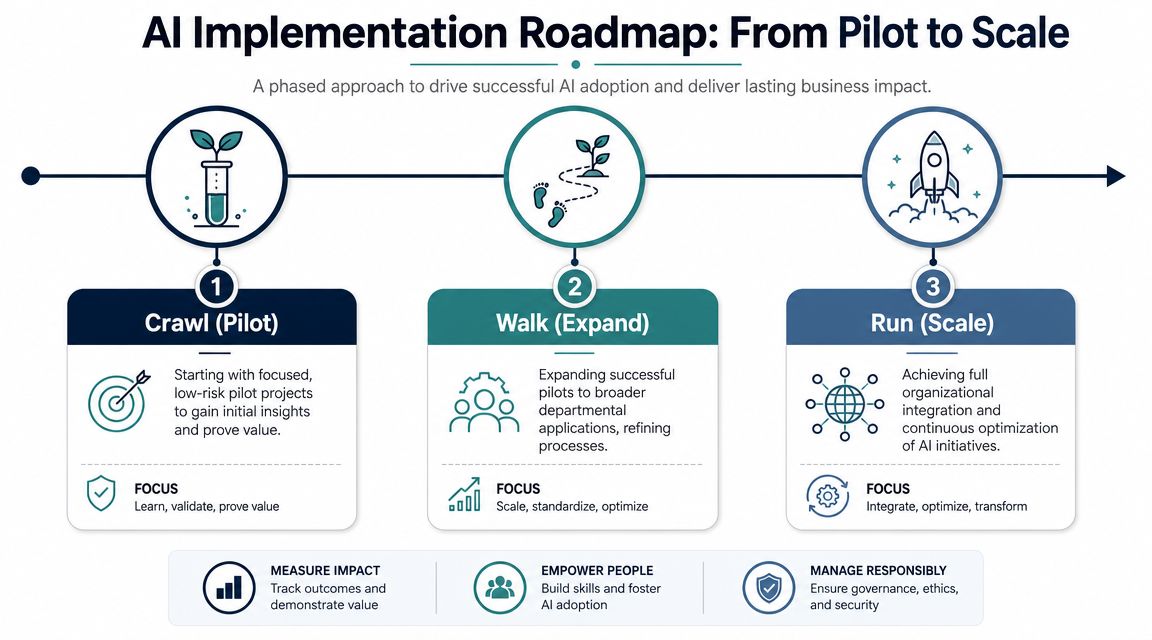
Start where the current process is slow, repetitive, and expensive to get wrong.
Good pilot candidates in B2B SaaS include lead scoring, demo follow-up prioritization, campaign budget reallocation, content brief generation, or churn-risk segmentation for expansion plays. Bad pilot candidates are broad mandates like "use AI in demand gen" or "make content production more efficient."
The standard should be simple. Pick one workflow where humans are making frequent decisions from noisy data.
A practical crawl phase usually includes:
If you're looking for a more tactical planning lens, this practical AI implementation guide for B2B marketers is a useful companion.
A pilot proves possibility. It doesn't create operational value until the workflow gets embedded.
Many companies frequently stall at this stage. They run a few successful tests in isolation, then never integrate the output into daily execution. The model works, but nobody changes behavior. Sales still follows old routing logic. Paid still relies on manual reviews. Content still gets approved the old way.
That's dead weight.
AI-powered digital marketing systems create value through real-time decisioning on large behavioral datasets, and the core effect is a closed feedback loop where more event-level data improves model calibration, which improves targeting precision and reduces wasted spend across channels, according to Salesforce's explanation of AI in digital marketing.
That means the walk phase should focus on process integration, not experimentation theater.
A useful operator checklist:
| Question | What you're checking |
|---|---|
| Is the output used inside the daily workflow? | Adoption through behavior, not enthusiasm |
| Are the inputs reliable enough to trust? | CRM fields, campaign data, lifecycle stages |
| Is there a feedback loop? | Outcomes return to improve the model |
| Are humans still making judgment calls where needed? | Guardrails against blind automation |
A pilot is a lesson. A system is a habit.
The run phase starts when separate AI-supported workflows begin reinforcing each other.
Lead scoring feeds paid retargeting decisions. Campaign engagement updates sales prioritization. Product usage helps shape expansion messaging. Predictive signals inform budget moves. Content personalization reflects actual account behavior rather than broad role assumptions.
That is when AI stops being a set of tools and becomes part of the operating model.
The company-level changes are not subtle.
You don't need to rush this. In fact, rushing it usually breaks trust.
What matters is sequence. Solve one constrained problem. Embed it. Improve the data. Expand only when the previous layer is credible. The companies that scale AI well aren't moving randomly. They're building compounding decision quality.
Founders waste time when they treat AI oversight like a tooling discussion. It is an operating model discussion.
Your job is to decide which decisions deserve automation, which ones require human judgment, and which metrics will change budget, headcount, or sales behavior. If you skip that layer, the team buys software, produces more output, and learns very little.
The common mistake is obvious. B2B SaaS teams buy an AI platform because a competitor mentioned it, then scramble to invent a use case after procurement. That is how you get shelfware, duplicate workflows, and a GTM stack nobody trusts.
Use a stricter sequence:
This order matters because AI changes more than execution. It changes who owns work, where analysis happens, and how quickly budget can move. If a model can improve lead prioritization, you may need fewer manual scoring exercises and more revenue operations oversight. If AI cuts content production time, the gain should not fund more content for its own sake. Shift that time and money into distribution, sales enablement, conversion analysis, and stronger category positioning.
Tool categories are still useful. Just don't mistake the category for the strategy.
Consultancies in this space often frame AI around measurable GTM use cases, which is the right standard. Buy tools to improve a specific business decision. Do not buy them to signal that your company is "doing AI."
Poor KPI design creates fake progress. Teams start reporting prompt volume, asset output, and workflow counts because those numbers are easy to produce. None of that tells you whether AI improved the business.
Track three layers.
That stack forces a better question set. Did AI improve targeting precision? Did it help sales spend time on better accounts? Did it reduce wasted spend? Did it improve conversion quality, not just top-of-funnel activity?
If your team needs a cleaner framework for tying AI work to revenue impact, use this guide on measuring marketing ROI and pipeline impact.
Deprioritize the metrics that create noise:
A useful rule is simple. If a KPI does not influence resource allocation, it belongs in an ops report, not an executive review.
AI failures rarely look dramatic at first. They look like small quality drops that spread. Sales works bad scores. Paid budget shifts for reasons nobody can explain. Personalized messaging sounds relevant on the surface but gets key account context wrong. Brand voice gets flattened. Legal risk creeps into published copy.
That is a governance problem, not a prompting problem.
Set explicit rules in four areas:
Review governance at the same level you review budget allocation. AI changes cost structure and team design. That means leaders should watch for second-order effects. Fewer production bottlenecks can expose weak strategy. Faster campaign launches can amplify bad segmentation. Better automation can reduce the need for repetitive execution work while increasing the need for operators who can judge quality, diagnose model failure, and connect marketing decisions to revenue.
Governance is how you keep those gains and avoid the downside.
Founders shouldn't stop at asking how AI can improve marketing execution. The harder question is what your use of AI signals about the quality of your company.
In a market where more teams can produce acceptable content, launch campaigns faster, and automate routine follow-up, operational competence becomes less of a differentiator. That means your advantage has to move upward. Better positioning. Better judgment. Better integration across the GTM system. Better proof that your company can convert information into action faster than peers.
Customers won't care that your team used AI to draft a nurture email. They will care that your outreach feels relevant, your buying journey is coherent, and your follow-up reflects real intent rather than automation spam.
Investors and acquirers read this too. A company that uses AI well usually shows it indirectly. Cleaner segmentation. More disciplined spend. Faster iteration. More consistent messaging across product, sales, and marketing. Better measurement logic. Fewer random acts of demand gen.
That is a positioning asset.
If your category story is still vague, start there. This guide on how to write a positioning statement is a useful place to tighten the strategic layer before you scale execution.
The AI era doesn't reward companies for using more software. It rewards companies that remove guesswork from the parts of GTM that should never have depended on guesswork in the first place.
That is the useful frame for digital marketing and AI.
Not replacement. Not novelty. Not more content for the sake of activity.
A better operating system. Better decisions. Better company signaling.
Ask one blunt question: is your GTM engine becoming a competitive advantage, or is it becoming a liability that AI is making easier to see?
If you need a sharper GTM operating model, Big Moves Marketing helps B2B SaaS founders and growth leaders tighten positioning, clarify messaging, and identify where AI improves decision quality instead of adding more noise.
Explore Big Moves Marketing services and resources:




%20-%20white.svg)