%20png%20copy.avif)
The promise of AI in B2B marketing was supposed to be transformative - faster content creation, deeper insights, and more personalized campaigns at scale. Instead, something troubling has emerged across marketing departments worldwide. According to research published in the journal Societies, frequent AI usage now shows a significant negative correlation with critical thinking abilities, mediated by what researchers call "cognitive offloading." This isn't a minor finding buried in academic literature—it has profound implications for every B2B marketing team relying on AI tools.
This isn't merely an academic concern relegated to university research papers. In B2B marketing, where complex buying decisions involve an average of 6 to 10 decision-makers according to McKinsey research and sales cycles exceed 120 days, the stakes are immense. When marketers offload their thinking to AI tools, they produce generic content that fails to resonate with sophisticated business buyers—and the data increasingly shows this pattern emerging across industries.
As Joel Zorrilla, Marketing Director at Wayfindr, puts it bluntly: "Most B2B marketers are using AI to make themselves dumber." He describes cognitive offloading as "asking ChatGPT to write a blog about B2B marketing, copy-pasting the result, and wondering why it tanks." The result is content riddled with mistakes, without supporting data, and obviously machine-generated—exactly what sophisticated B2B buyers have learned to ignore.
Zorrilla brings credibility to this assessment. His track record includes recovering from a disaster at InCorp, where traffic and leads plummeted 90% in one week after a Google algorithm update. With minimal budget, he rebuilt everything from scratch and recovered traffic within six months. At Wayfindr (then CBIP Logistics), he transformed their marketing approach and achieved 10x ROI, including landing Bloomberg journalist quotes for the founder. These results came from strategic thinking, not AI shortcuts.
This guide examines the science behind cognitive offloading, its measurable impact on B2B marketing performance, and provides a strategic framework for using AI that enhances rather than replaces human expertise. The goal isn't to discourage AI use—it's to help you use it intelligently.
Cognitive offloading isn't a new phenomenon, though AI has dramatically accelerated it. The concept describes how humans delegate cognitive tasks to external tools or systems. Historical precedents include the calculator's well-documented influence on arithmetic skills and the internet's reshaping of memory patterns—a phenomenon commonly called the "Google Effect" where people become adept at remembering where to find information rather than the information itself. However, AI represents something qualitatively different: it extends beyond mere assistance to actively replacing sophisticated cognitive functions such as analysis, reasoning, and creativity.
A comprehensive study by Michael Gerlich at SBS Swiss Business School, published in January 2025, surveyed 666 participants across diverse age groups and educational backgrounds using both quantitative surveys and in-depth interviews. The statistical methodology included ANOVA, correlation analysis, and random forest regression to ensure robust findings. The results were stark and consistent across multiple analytical approaches:
Negative correlation with critical thinking: Frequent AI users demonstrated significantly lower scores on critical reasoning assessments. The relationship wasn't subtle—it was statistically significant and mediated directly by cognitive offloading behaviors. The random forest regression model (R² = 0.37) accurately captured the relationship between AI tool usage, cognitive offloading, and critical thinking scores.
Age-related vulnerability: Younger participants (ages 17-25) showed both higher dependence on AI tools and lower critical thinking scores compared to older participants. This finding suggests that sustained early reliance on AI may impede cognitive development and adaptability—particularly concerning for B2B marketing teams hiring younger professionals.
Education as a protective buffer: Higher educational attainment correlated positively with maintained critical thinking skills, suggesting that deep domain expertise provides some protection against cognitive atrophy. Individuals with advanced educational backgrounds maintained robust critical thinking skills despite regular AI usage.
Non-linear relationship: Moderate AI usage did not significantly affect critical thinking, but excessive reliance led to diminishing cognitive returns—indicating a threshold beyond which cognitive engagement significantly declines. This suggests there's a "sweet spot" for AI usage that marketers should aim to identify.
As the researchers note, "While AI aids in various tasks, it has the potential to reduce cognitive engagement because users may passively accept information provided by AI without critical scrutiny." The study emphasizes the need for AI-powered tools that encourage source verification and independent thinking, ensuring users learn critically rather than passively.
The implications for B2B marketing are significant. Marketing requires the exact cognitive skills that AI overuse appears to erode: analytical reasoning, strategic thinking, creative problem-solving, and the ability to synthesize complex information into compelling narratives. If marketers are losing these capabilities through cognitive offloading, the quality of their output—and their value to organizations—diminishes accordingly.
AI adoption in B2B marketing has moved from experimental pilot programs to essential infrastructure. The numbers tell a compelling story about just how pervasive this technology has become—and the significant performance gaps it's creating between strategic users and those engaged in mindless cognitive offloading.
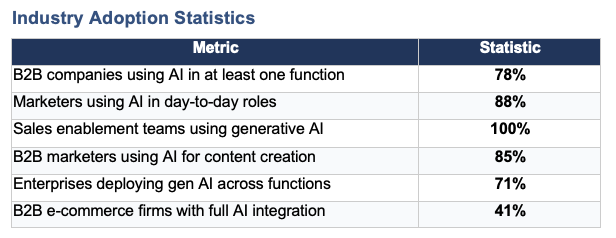
Sources: Allego 2025 Revenue Enablement Report, McKinsey B2B Pulse Survey, Content Marketing Institute
The Allego survey of 346 B2B revenue enablement leaders found that AI has crossed a critical threshold. What's particularly notable is the speed of change: adoption jumped from 62% to 100% in just one year. However, nearly half (48%) of these teams say adoption is still challenging. The biggest blocker isn't resistance—it's understanding how to use AI effectively. This gap between access and competence is where cognitive offloading thrives.
The real story isn't adoption rates—it's outcomes. Organizations that use AI strategically are pulling dramatically ahead of those engaged in cognitive offloading. McKinsey's research reveals consistent patterns:
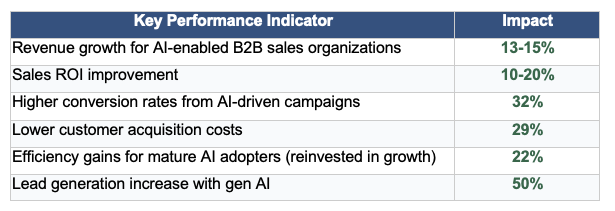
Source: McKinsey AI-Powered Marketing and Sales Research
A crucial finding from McKinsey's B2B Pulse Survey: companies that deploy both generative AI and personalization strategies together are 1.7 times more likely to increase market share than those not fully committed to either approach. Additionally, 57% of companies that reported market share growth of 10% or more were deploying gen AI—a correlation that suggests strategic AI use drives competitive advantage rather than merely improving efficiency.
Before addressing how to use AI correctly, it's worth understanding a fundamental problem that AI often exacerbates rather than solves: the inability to market complex B2B offerings effectively. Zorrilla identifies one critical error that plagues 90% of boutique and medium-sized agencies: they lack a systematic process for understanding complex business models.
"Complex means it's not easy to understand," Zorrilla explains. "If you're writing content or running ads, you have to become an expert in whatever that is. A lot of agencies don't have a way of learning and transmitting that knowledge to their stakeholders."
This matters profoundly because AI tools amplify existing competencies—or deficiencies. When a marketer who doesn't truly understand a 4PL logistics model, a SaaS pricing structure, or a manufacturing process uses AI to create content, the result is superficial material that sophisticated B2B buyers immediately recognize as lacking substance. The AI can only work with the understanding you bring to it.
For Wayfindr, Zorrilla and his writer spent considerable time becoming logistics experts—understanding the specific 4PL model, not just general shipping concepts. This depth of knowledge affects everything from Google Ads keyword selection to content priorities. "If you have a Google Ads expert running ads, they have to understand the high priority versus low priority products and keywords. They have to understand the nuances."
Zorrilla offers a practical metric for determining when you've learned enough about a complex B2B industry: client feedback. "In the beginning, the client's going to say 'no, that's wrong' constantly," he notes. "After two or three months, that feedback should be cut down by 80% at least. Otherwise, you're not learning."
This learning process cannot be shortcut with AI. The technology can accelerate research and help organize information, but it cannot replace the iterative process of developing genuine expertise. AI cannot provide the understanding that comes from conversations with customers, hands-on experience with products, or deep immersion in industry challenges. Cognitive offloading shortcuts this essential learning process, leaving marketers permanently stuck in the "'no, that's wrong'" phase.
When B2B companies struggle with lead generation despite having traffic, the problem typically lies in messaging. And cognitive offloading makes this worse, not better—it produces generic messaging that fails to connect with specific buyer pain points.
Zorrilla's approach starts with what he calls a "brand story audit"—examining how a company talks about itself across all touchpoints. "If I land on a website and if I immediately don't understand what they do, what their offering is, and what their unique value proposition is, I'm probably going to leave," he explains.
He applies what he calls the "five-second rule": "Within five seconds, I have to understand what you do, how you do it, what value it brings to me, how it works." This is a demanding standard that requires extreme clarity and specificity—qualities that AI-generated content typically lacks.
AI-generated content typically fails this test spectacularly. It produces generic language that could apply to any company in a sector, lacks specific value propositions grounded in real customer outcomes, and often buries the actual offering under walls of feature descriptions and buzzword-laden prose. Sophisticated B2B buyers have become expert at identifying and skipping this type of content.
The brand story audit functions as messaging guidelines—similar to visual brand guidelines, but focused on communication. "If people are having lead flow issues, look at your messaging," Zorrilla advises. "You're probably confusing your visitors. Make the customer the hero of the story, and write about your products or services in a super simple way that those potential customers understand."
Beyond messaging clarity, Zorrilla advocates for rigorous A/B testing—creating two versions of landing pages with different messaging and splitting traffic 50/50 to measure which converts better. This empirical approach helps identify when AI-generated content underperforms human-crafted alternatives, providing a crucial check against cognitive offloading. When you test AI-generated copy against human-crafted alternatives, the data often reveals significant performance differences that gut feeling alone would miss.
Instead of lazy copy-pasting, Zorrilla advocates strategic AI usage across four key areas. These approaches maintain human critical thinking while leveraging AI's genuine strengths. The distinction is crucial: these methods use AI to extend human capabilities rather than replace human judgment.
Use AI to create blog outlines and source supporting data. Claude excels at research and creating comparison tables that make dense information digestible. This application keeps you in the driver's seat—you're defining the structure, the argument, and the conclusions while AI handles information gathering and organization.
A B2B SaaS company demonstrated this approach by analyzing 2,000 sales calls using Claude. They discovered that their customers cared more about implementation time than features—an insight that would have remained buried in call transcripts without AI-assisted analysis. They shifted their entire content strategy accordingly and saw a 34% increase in qualified leads over six months. Notice that the strategic insight came from human interpretation of AI-surfaced data, not from asking AI to write content.
This is where AI truly shines without risking cognitive offloading. A 1,500-word blog can become a LinkedIn carousel, an audio podcast (using ElevenLabs), or an interactive podcast with two speakers (using Google's NotebookLM). "Don't just write a blog and publish it," Zorrilla emphasizes. "Turn that into a carousel. Turn that into audio. Turn that into a podcast. You can be sitting on a goldmine and you don't realize that."
This approach multiplies the value of human-created content rather than replacing human thought. The original thinking, expertise, and unique insights remain yours; AI simply transforms them into different formats for different channels and consumption preferences. Your strategic thinking is preserved and amplified rather than outsourced.
Different platforms excel at different tasks. Strategic AI users maintain subscriptions to multiple tools and match them to specific use cases rather than relying on a single tool for everything:
"I just discovered NanoBanana a week ago," Zorrilla notes. "It's really good at creating illustrations in line with your brand guidelines." This specialization approach means using the right tool for each specific need rather than forcing one tool to handle everything poorly.
Traditional PDFs are becoming obsolete in an era when every competitor can produce them with AI. Zorrilla is building interactive micro-SaaS tools embedded directly on websites. For Wayfindr, he's developing a shipping cost calculator—offering substantially more value than a static PDF guide could ever provide.
Tools like Lovable AI and Vibe Coding now enable non-developers to create functional micro-SaaS applications. "That's the future of lead magnets," Zorrilla says. This application requires significant strategic thinking about what would genuinely help your prospects—the opposite of cognitive offloading. You must deeply understand your prospects' problems to build tools that solve them.
The difference between cognitive offloading and strategic AI use becomes clear when examining specific B2B implementations. These companies demonstrate patterns that separate high-performers from those simply automating mediocrity.
HubSpot's integration of AI with CRM platforms demonstrates how to maintain human strategy while leveraging AI execution. Using ChatGPT to customize emails based on user behavior and website data, they achieved an 82% increase in conversions, a 30% improvement in open rates, and 50% more clicks. The key distinction: humans defined the strategy, segmentation logic, and value propositions; AI handled personalization execution at scale. The thinking remained with humans; only the execution was automated.
Jedox, a global provider of business intelligence software, faced scattered data and lengthy sales cycles—problems that pure AI automation couldn't solve. By implementing HubSpot marketing automation tools, they streamlined data, developed advanced workflows, and began segmenting their audience effectively. These efforts resulted in a 54% increase in marketing-qualified leads and a 12-20% reduction in sales cycle duration. Smart Forms helped gather information progressively without overwhelming prospects—a nuanced approach that required human understanding of the buyer journey and what questions to ask at each stage.
Vidyard integrated AI-powered personalized video messaging into sales workflows, creating a hybrid approach that amplified human connection rather than replacing it. The result: sales funnels improved performance by 85%, doubled sales-qualified opportunities, and boosted close rates by 25%. The technology amplified human salespeople's ability to connect personally with prospects rather than replacing that connection with generic automation.
ServiceMax, which makes field technology for infrastructure producers, faced a challenge: creating a website useful for different kinds of visitors across various manufacturing sectors. Rather than creating generic content with AI, they partnered with DemandBase to implement AI-driven content recommendations. The machine learning system first understood visitor positions so it could predict what they were attempting to do, then recommended relevant content. ServiceMax saw an increase in product demos and a 70% decrease in bounce rate, with time spent on pages doubling. The AI served existing high-quality content more intelligently rather than generating new mediocre content.
According to HubSpot's case studies, Aerotech boosted win rates by 66% using AI to prioritize the right deals faster. Rather than having AI create sales pitches, they used it to analyze which opportunities deserved human attention and resources. This kept strategic thinking with humans while letting AI handle data analysis at scale—a perfect example of using AI's strengths (processing large amounts of data quickly) while preserving human strengths (judgment about where to focus limited resources).
Based on both research findings and successful B2B implementations, here's a practical framework for maintaining critical thinking while leveraging AI's genuine strengths:
Effective content teams use a process that keeps human expertise central while leveraging AI appropriately at each stage:
Stage 1 - AI Research and Outlining: Use AI to analyze top-performing content in your niche, identify gaps, and create detailed outlines. Tools like Clearscope and MarketMuse excel here. The human role: define objectives, evaluate AI suggestions, and make strategic decisions about direction. The AI surfaces options; you decide which matter.
Stage 2 - Human-Led Drafting: Your subject matter experts write the sections requiring experience, original insights, or brand voice. This is where differentiation happens. AI cannot replicate your proprietary knowledge, customer conversations, or strategic perspective. This stage is non-negotiable.
Stage 3 - AI Enhancement: Use AI to optimize for SEO, improve readability, generate variations for A/B testing, and adapt content for different channels. The thinking is done; AI handles optimization execution at scale.
Create AI personas representing different stakeholder perspectives—CFO, CTO, end user, procurement—and run your content through this "expert panel" before publishing. Prompt each persona to review your content from their unique perspective:
This catches blind spots human editors miss because they're too close to the content. One B2B software company used this technique and discovered their case studies never addressed implementation costs—a major concern for CFOs that they had consistently overlooked. Adding that information increased case study-to-demo conversion by 41%.
Research shows that AI-assisted content carries slightly higher penalty risk: 3.8% of AI-assisted pages triggered manual Google reviews, compared to 2.7% for purely human-written content. Google's concern isn't AI per se but thin, repetitive, or regurgitated content—exactly what cognitive offloading produces. Build a review workflow—draft by AI, fact-checked by experts, polished by editors—to ensure every asset delivers fresh insights and unique value.
Set explicit quality criteria: Does this sound like our brand? Does the narrative flow naturally? Are there specific examples and concrete data? Does it add something unique that competitors can't easily replicate? Rewrite sections that feel formulaic or could apply to any company in your space. This editing phase is where good content becomes great—and it requires engaged human attention that cannot be delegated.
"We're living in the modern version of the Industrial Revolution," Zorrilla reflects. "AI is moving really fast. Marketing now is 10 times harder than it was four or five years ago."
The primary challenge is dramatically increased competition for attention. "Five years ago, we had a really good team of writers, and that was our advantage. But now everybody's a writer because everybody's pumping out content. The competition is 10, 20 times higher." This democratization of content creation through AI has made those old advantages less effective—but it's also created an opportunity for those who can produce genuinely differentiated work.
1. Focus relentlessly on quality: This remains a differentiator when AI makes basic content production universal. Quality requires deep industry knowledge, original insights, and genuine value creation—areas where AI assists but doesn't replace human expertise. According to the Content Marketing Institute, 71% of B2B marketers say creating content that stands out is harder than ever—making quality the key competitive lever.
2. Stay current with AI developments: Zorrilla discovers new capabilities weekly. Subscribe to newsletters, follow thought leaders on LinkedIn, and experiment with new tools as they emerge. "Every week, these things are changing. AI is moving so fast. It's really important to stay ahead of the curve." The tools you use today may be obsolete in six months.
3. Optimize for AI-powered search: Consider how ChatGPT, Perplexity, and Claude will surface and cite your content. B2B buyers show 90% click-through rates on AI Overview sources—dramatically higher than the 8% general user rate. AI overviews and natural language search are fundamentally changing SEO, and B2B marketers who optimize for these platforms will capture disproportionate visibility.
4. Prepare for micro-SaaS lead magnets: Traditional PDFs are becoming obsolete. Start learning to create interactive tools that provide genuine utility to prospects. This requires thinking deeply about what your prospects actually need—the opposite of cognitive offloading.
By 2026, AI won't be the differentiator—signal will be. In a world where everyone uses the same tools, competitive advantage comes from the unique expertise and insights you bring. As content generation becomes commoditized, value shifts to net-new insights grounded in real experience. Companies that master the human-AI signal cycle—injecting fresh perspective into AI workflows—will build marketing engines that outlearn and outperform. Noise is cheap. Signals are rare. And the most signal-rich brands will dominate every channel they touch.
The research is clear: cognitive offloading through lazy AI use correlates with diminished critical thinking abilities. For B2B marketers, whose success depends on understanding complex business models, crafting nuanced messages, and building relationships with sophisticated buyers, this isn't just an academic concern—it's an existential competitive threat.
The solution isn't avoiding AI—that's neither practical nor desirable given the competitive landscape. Instead, successful B2B marketers treat AI as a force multiplier for human expertise rather than a replacement for it. They use AI for research, repurposing, and execution while keeping strategic thinking, industry knowledge, and creative judgment firmly in human hands.
As Zorrilla notes: "You got to look at it holistically. You got to be much smarter about it. Marketing is constantly evolving. You really got to predict the future and always stay up to what's happening with the latest trends."
For university students considering marketing degrees, Zorrilla is blunt: "I think it's useless to study marketing in university, because by the time you graduate, everything you learned has been expired." The only viable path forward: continuous learning, strategic AI adoption, and unwavering focus on delivering genuine value in an increasingly noisy digital landscape.
For B2B leaders, the path forward requires intentional choices: developing deep industry expertise that AI cannot replicate, building systematic processes for learning complex business models, testing messaging rigorously rather than accepting AI outputs uncritically, and maintaining the critical thinking skills that sophisticated buyers expect and deserve.
The companies that win won't be those that use AI the most—they'll be those that use it the smartest, preserving human judgment while leveraging artificial intelligence to extend their reach and impact. In the age of cognitive offloading, the most valuable skill is knowing when to think for yourself.
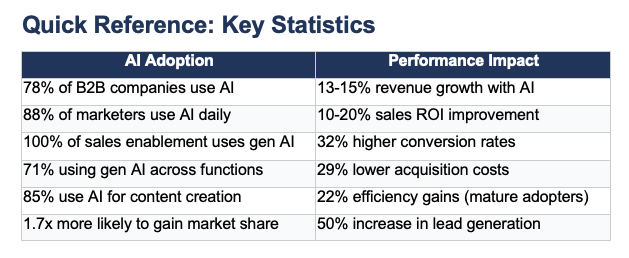
This article synthesizes research from McKinsey, Content Marketing Institute, Allego, and academic studies published in peer-reviewed journals. For the original interview that inspired this guide, visit the original article on ContentGrip.
Explore Big Moves Marketing services and resources:



%20-%20white.svg)