%20png%20copy.avif)
Most advice on artificial intelligence advertising is wrong in one important way. It treats AI like a growth engine. It isn't one. It's a force multiplier for a go-to-market system that already knows who it's selling to, why buyers should care, and what action should happen next.
That distinction matters more now because the top of funnel is changing underneath B2B teams. Google AI Overviews reached 1.5 billion monthly users by 2025 and appear in over 12% of searches by volume, which is reshaping discovery and cutting organic clicks by an estimated 34.5% according to Ahrefs' AI marketing statistics analysis. If your growth model assumes the old search journey still works, you're already behind.
Most SaaS teams still make the same mistake. They ask which AI ad tool to buy before they fix their positioning, funnel logic, and conversion path. That gives them faster content, more automated bids, and cleaner dashboards. It does not give them more qualified pipeline. It just speeds up confusion.
The popular pitch says AI will replace marketers, fix targeting, and generate pipeline on autopilot. Ignore it. AI does not create demand where there is no message clarity. It doesn't rescue a muddled category story. It doesn't make a weak offer compelling.
What it does is sharpen execution inside an already coherent system. It can help your team identify patterns faster, adapt creative faster, and allocate spend with more discipline. But if your ICP definition is sloppy or your sales story changes every two weeks, AI will optimize around noise.
That matters even more in a search environment where buyers increasingly get summarized answers instead of clicking through to your site. Teams that still think visibility starts and ends with blue links are operating on an expired model. If you want a clear primer on how AI-made assets now shape online distribution, this overview of digital media created by artificial intelligence is useful context.
Founders often ask the wrong first question. They ask, "Which AI ad platform should we test?" The better question is, "Which part of our current GTM system is strong enough that automation will improve it instead of distort it?"
If your paid search campaigns already map tightly to buying intent, AI can improve matching and iteration speed. If your LinkedIn campaigns already speak to distinct buyer roles, AI can help you scale variants without bloating the team. If none of that foundation exists, the output gets worse, not better.
Practical rule: Apply AI to a working motion first. Never use it to compensate for weak positioning, bad conversion paths, or unclear ownership.
A lot of leaders also confuse content velocity with market traction. More assets do not mean more demand. Faster asset production does not mean better persuasion. AI helps once the strategic choices are already made. That's why a grounded view of AI in marketing matters more than another list of prompts.
Most explanations of artificial intelligence advertising are written for ecommerce brands chasing impulse purchases. That's not your world. B2B SaaS deals usually involve a narrow ICP, long consideration cycles, multiple stakeholders, and a painful gap between click data and revenue reality.
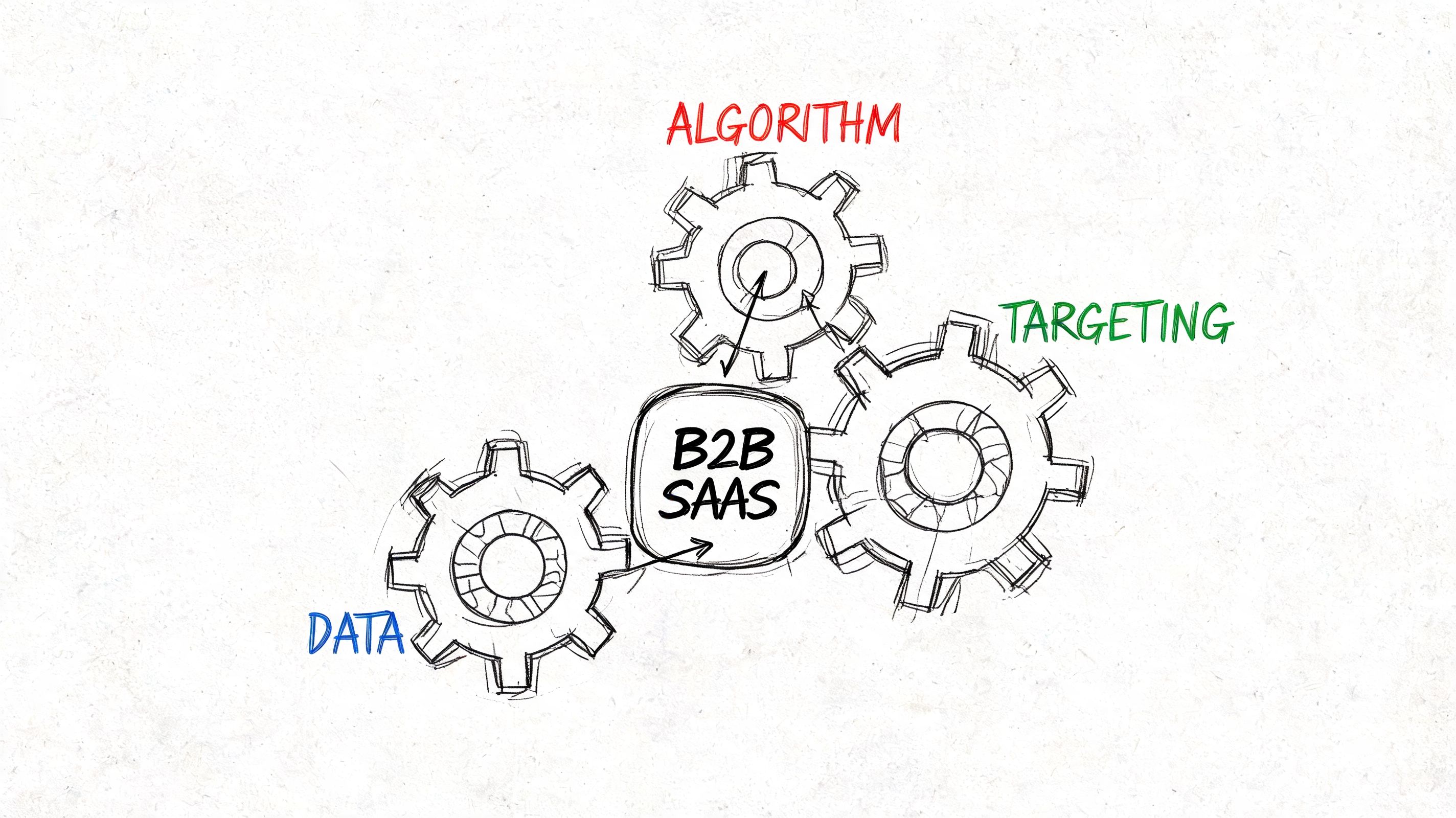
At a practical level, AI in ad platforms usually does four jobs.
That sounds simple. The consequences aren't. In B2B, each of those functions can help or hurt depending on what data you feed the system.
If your CRM is full of junk leads, predictive targeting learns from junk. If your ad library contains generic messages, dynamic assembly produces generic variants. If your conversion event is a low-intent ebook download, automated bidding optimizes for cheap form fills instead of pipeline quality.
A consumer brand can often tolerate broad targeting because purchase cycles are short and feedback loops are fast. A B2B SaaS company can't. Your ad system isn't trying to sell a low-consideration product. It's trying to start a conversation with the right account, at the right moment, with a message that survives internal scrutiny.
Think of AI ad systems less like a magician and more like a junior analyst with infinite stamina. It can process more combinations than your team. It cannot decide what your category narrative should be. It cannot tell you whether operations leaders care more about risk reduction or workflow visibility. Humans still own those calls.
A simple way to evaluate any vendor claim is this table:
| AI capability | Useful when | Dangerous when |
|---|---|---|
| Automated bidding | Your conversion event reflects real sales value | You're optimizing for low-quality lead volume |
| Audience modeling | Your win-loss and CRM data are clean | Your ICP is vague or over-broad |
| Creative generation | Your message hierarchy is stable | Your brand story is still unsettled |
| Dynamic creative assembly | You have modular assets for distinct buyers | You only have one generic campaign idea |
The right mental model is operational, not mystical. AI helps ad systems make more decisions, faster. It does not improve the quality of the decisions you failed to define.
This is why founders should stop asking whether AI is "worth it" in the abstract. The vital question is where machine speed improves a human strategy that already has teeth.
The lowest-value use of AI in advertising is also the most common. Teams use it to spit out ad copy variations nobody needed. That's cheap, easy, and mostly irrelevant.
The higher-return use cases sit closer to message matching, media efficiency, and buying-committee relevance.
One concrete example is dynamic creative optimization, or DCO. According to StackAdapt's write-up on AI advertising, campaigns using DCO achieved 32% higher CTR and 56% lower CPC than static creatives. That matters because DCO is not about writing more ads. It's about matching the right creative combination to user context in real time.
In B2B SaaS, that's useful when one campaign needs to speak differently to a finance lead, an operations owner, and a technical evaluator. The underlying product may be the same. The objections are not.
A good DCO setup lets you keep one strategic message architecture while changing the surface layer:
That's where AI helps. It doesn't invent the positioning. It improves message delivery across contexts.
There's a deeper discussion of this shift in using AI to power B2B enterprise SaaS growth in 2025, especially if you're trying to connect media choices to broader GTM motion.
The best AI advertising wins usually come from one of three places.
First, better segmentation inside a narrow market. B2B teams often treat their ICP as a static list. In reality, your highest-probability accounts change by trigger, role, timing, and problem intensity. AI is useful when it helps prioritize who deserves budget now, not when it just expands audiences indiscriminately.
Second, more relevant creative across the buying committee. Most SaaS ads still pretend a company buys software as one person. It doesn't. AI helps when it supports creative variation by role without turning your team into a copy factory.
Third, faster learning loops on spend allocation. A founder doesn't care that a platform found cheaper clicks. They care whether budget moves toward the channels and messages that produce revenue conversations faster.
Spend more time using AI to improve selection and sequencing. Spend less time using it to manufacture endless ad variants.
Later in the buying journey, video can help teams think about where AI belongs in the stack and where it doesn't.
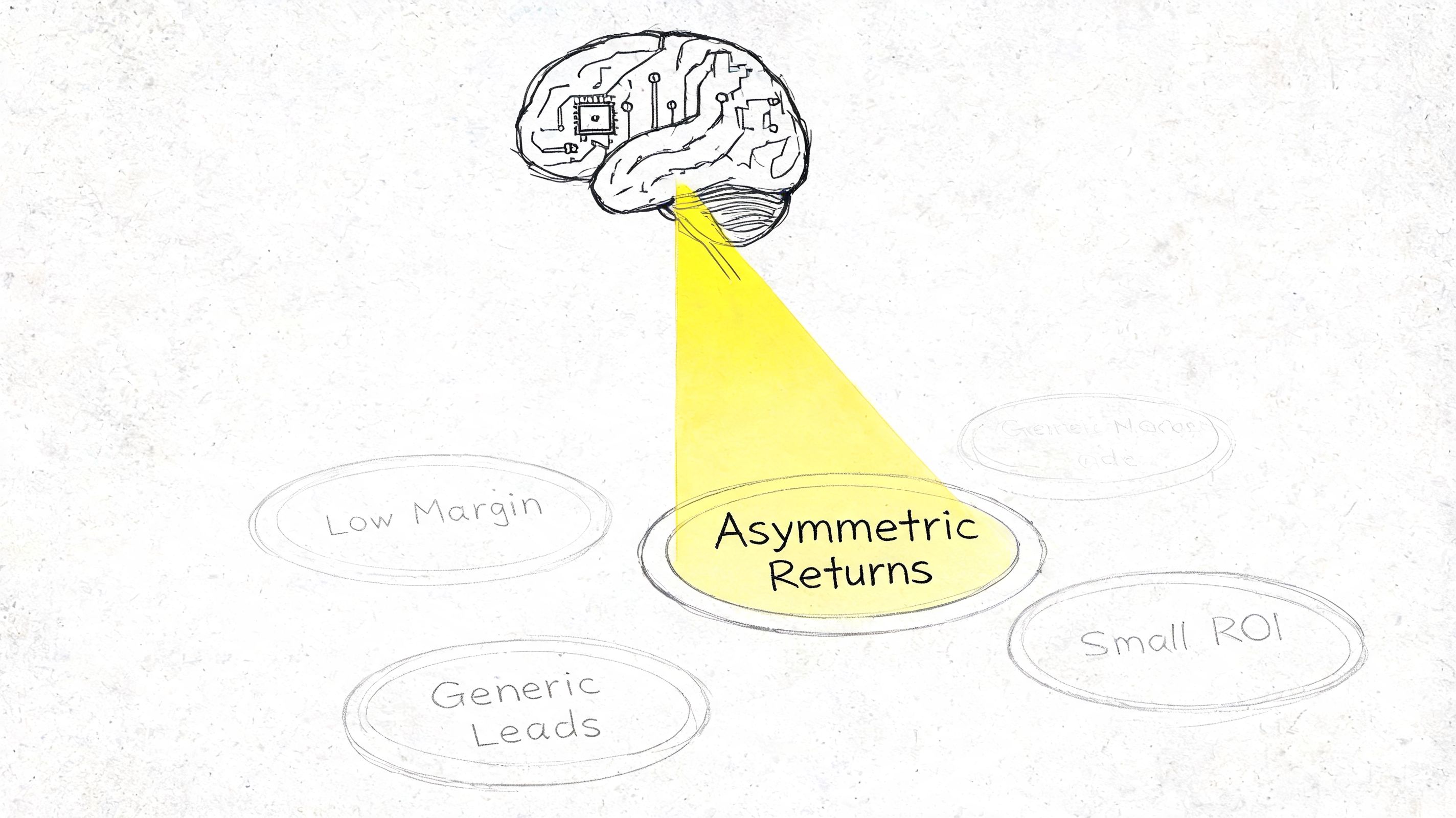
The pattern is consistent. AI creates outsized returns when it improves one of three things: who you target, what message each stakeholder sees, and how quickly you reallocate budget based on actual buyer response. Everything else is secondary.
A rushed AI plan usually looks like this. Someone on the team gets excited about a new platform. A pilot starts without clean data, without clear success criteria, and without a decision-maker who owns outcomes. Three months later, the company has more dashboards, more generated assets, and no stronger view of pipeline impact.
That isn't an adoption problem. It's a leadership problem.
The pressure is real. The IAB State of Data Report 2025 summary cites HubSpot data showing AI adoption in marketing rose from 21% in 2022 to 74% in 2023, and 57% of marketers feel they'll become irrelevant if they don't learn AI. That's exactly why leaders need a framework. Pressure produces bad decisions when there isn't one.
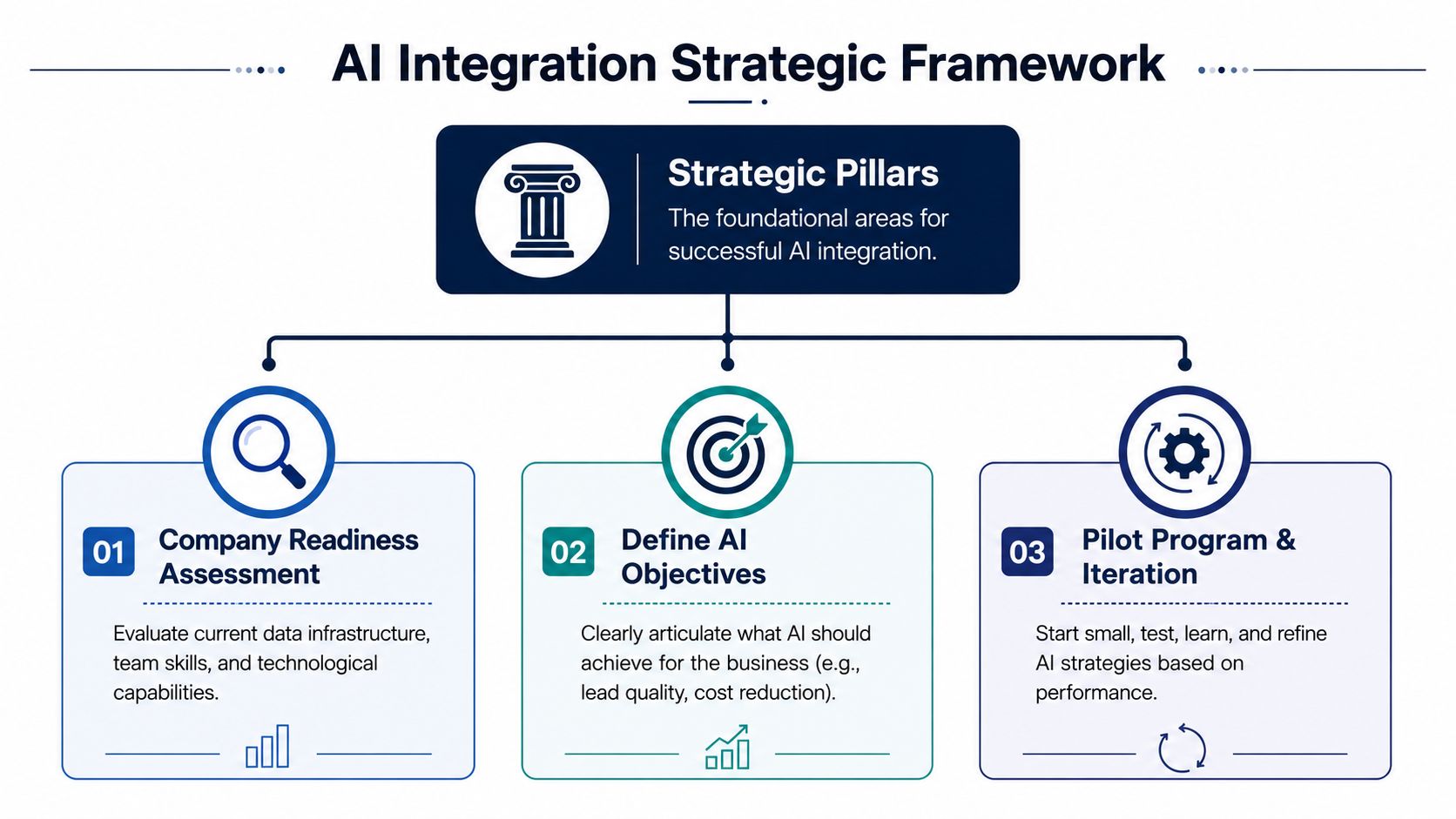
Most companies are not ready for advanced AI advertising even if they can afford the tools. Readiness comes down to three things:
If any of those are weak, stay basic. Use AI for narrow assistance, not broad automation.
A useful AI objective is specific about business impact. A useless one is "use AI to improve marketing."
Founders should decide which of these they are trying to change:
| Objective type | Good fit for AI | Bad fit for AI |
|---|---|---|
| Lead quality | Better audience filtering, tighter creative matching | Top-funnel volume campaigns with weak qualification |
| Cost control | Bid optimization against meaningful conversion events | Chasing cheap traffic |
| Sales cycle support | Role-based messaging and retargeting tied to funnel stages | One-size-fits-all nurture ads |
| Search visibility adaptation | Content and paid alignment for AI-shaped discovery | Old SEO assumptions without message updates |
If the objective isn't explicit, platform automation will pick one for you. Usually that's click efficiency. That's not what a SaaS founder is paying for.
A more durable planning lens sits inside a broader B2B marketing strategy framework. AI should fit the strategy. It should never become the strategy.
The right way to integrate AI is phased and boring. That's good.
Start with one motion that already works. Search. LinkedIn. Retargeting. Pick the one where your team understands baseline performance, buyer intent, and conversion quality. Then add one AI capability that changes a single part of the system.
Examples:
Operator note: If you can't explain why a pilot should work before you run it, you won't know what the result means after it ends.
Avoid bundled transformations. New targeting, new creative, new landing pages, and new measurement all at once creates attribution fog. Founders don't need more experiments. They need fewer experiments with sharper logic.
Strategy is only useful when it survives contact with execution. Most AI advertising efforts break at this point. Not because the tools are weak, but because the operating discipline is.
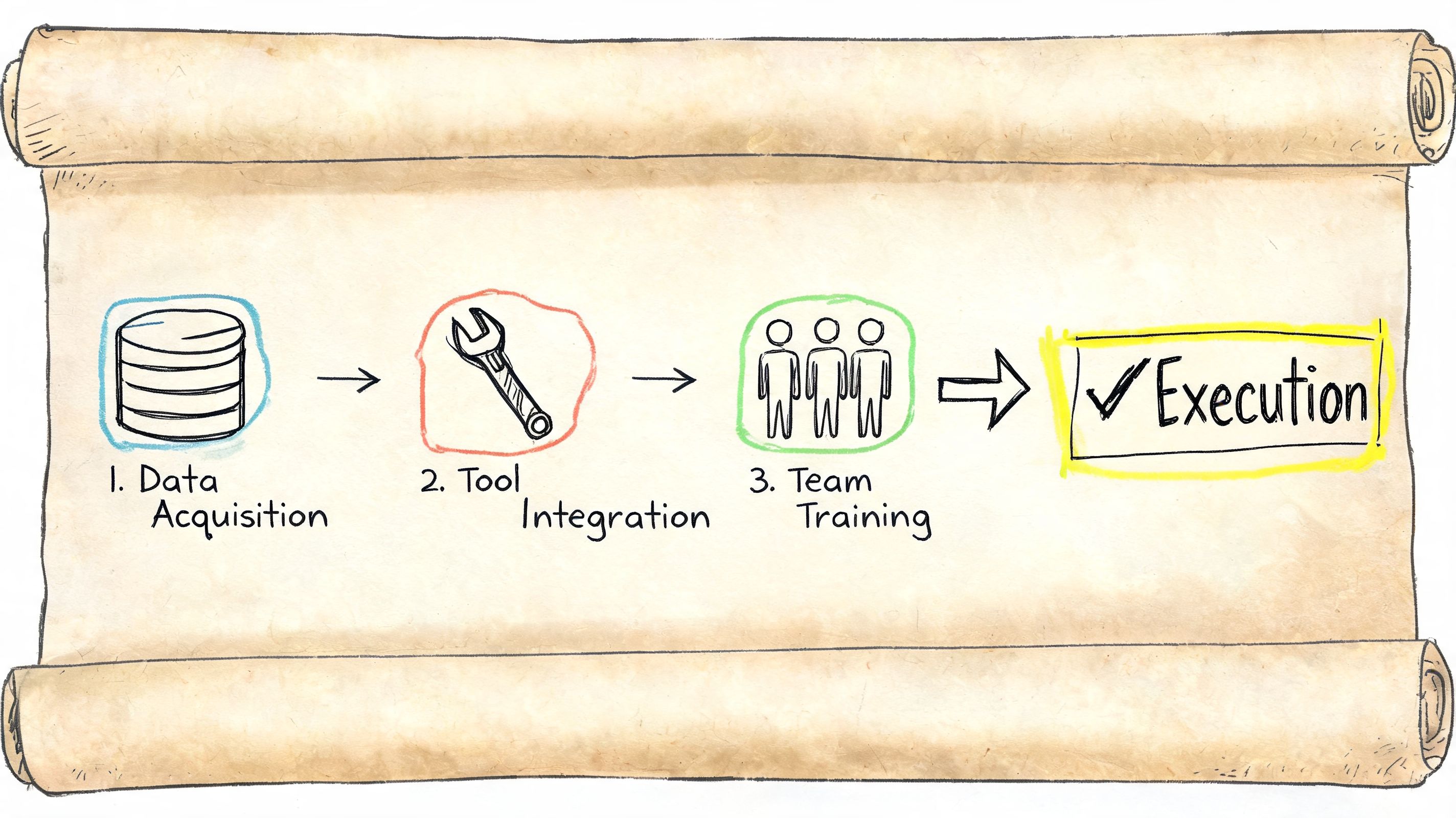
You do not need infinite data. You need usable data.
For many B2B SaaS teams, that means unifying a short list of signals that reflect commercial value. Pipeline stage progression. Opportunity source. Win-loss themes. Persona or buying role. Sales cycle notes. Expansion potential if relevant. That's enough to start making better ad decisions than others in the field.
Don't begin with data enrichment fantasies. Begin with data hygiene.
A practical filter:
Founders routinely overbuy. They purchase a complex AI stack before they have the internal process to use it well. That's backwards.
A pre-PMF or early growth team usually needs AI features inside existing systems, not another sprawling layer of software. A later-stage team with clear channel economics may justify specialized tooling for creative testing, audience modeling, or workflow automation. The sequence matters.
Use this lens when evaluating tools:
| Question | Why it matters |
|---|---|
| Does it improve a current bottleneck? | If not, it's novelty software |
| Can your team verify output quality? | Black-box recommendations without review are a risk |
| Does it connect to CRM and revenue data? | If it can't, you'll optimize for the wrong thing |
| Will it reduce decision time for operators? | Good tooling should simplify, not expand process overhead |
If your team is still figuring out prompt workflows, asset QA, and review logic, a practical guide on how to use generative AI tools for B2B SaaS growth is more useful than another platform demo.
You do not need a large AI team. You need clear human roles around it.
One person should own paid media decision-making. One person should own messaging coherence. One person should ensure CRM and sales feedback loop back into targeting and measurement. In smaller companies, that may be two people wearing three hats. That's fine. Unowned systems are the actual problem.
What you should hire for:
What you can train for:
AI reduces manual work. It does not reduce the need for adult supervision.
Most pilots fail because nobody defines what counts as success before launch.
Set the test scope narrowly. Decide what event matters. Decide what the team will do if results are mixed. Decide what gets rolled back if quality drops. Then run the pilot long enough to gather signal but not long enough to become a zombie project.
A clean pilot structure often looks like this:
This sounds obvious. It isn't common.
Most AI ad platforms report success in the language of ad platforms. Better CTR. Lower CPC. More impressions. More automated coverage. Those may be directionally useful. They are not a founder-level answer.
The hard truth is that reliable B2B benchmarks are thin. NIQ's research on attitudes toward AI-generated ads shows consumer studies can raise concerns such as AI ads being perceived as "annoying," but that doesn't solve the B2B problem. There is still a real benchmark gap for SaaS funnels. So stop waiting for generic market data to tell you whether your AI program works. Build your own proof system.
At the company level, AI advertising should answer four questions:
Those are business questions. Your measurement model should follow them.
A simple internal measurement stack might map like this:
| Funnel layer | What to inspect |
|---|---|
| Acquisition | Search terms, audience segments, role-level engagement patterns |
| Qualification | Sales acceptance, meeting quality, account fit |
| Pipeline | Opportunity creation, stage progression, disqualification reasons |
| Revenue influence | Closed-won contribution, cycle compression, expansion potential |
If your AI pilot improves top-of-funnel efficiency but lowers sales acceptance, it didn't work. If it creates more leads but from worse-fit accounts, it didn't work. If it helps sales engage the right committee members earlier, that can matter even if the platform dashboard looks less flashy.
You need a baseline period, a clear control, and agreement with sales on what quality means. Without that, every AI result becomes a debate about interpretation.
Use internal comparison questions such as:
The best ROI model in B2B is often embarrassingly simple. Tie campaign changes to account quality, opportunity creation, and sales progression. Ignore the rest until those are clear.
If your team needs a stronger operating view of this, use a more rigorous marketing ROI measurement approach instead of relying on channel screenshots and vendor decks.
Most founders underestimate AI advertising risk because the visible output looks harmless. A generated headline. An automated audience recommendation. A chat-based campaign assistant. None of that looks legally or reputationally dangerous on the surface.
The problem sits below the surface. Data use, disclosure, targeting logic, and output review are still far messier than the software demos suggest.
According to the University of Kansas summary of research on AI-generated ad labeling, only about 50% of AI-generated ads are properly labeled. That creates a transparency issue immediately. For B2B teams, the challenge is sharper because enterprise buyers care about trust, procurement, and compliance signals more than consumer brands sometimes do.
The main risk areas are straightforward:
Governance is the central issue. Platforms are moving faster than policy. Founders who assume the tools have handled the hard compliance questions for them are being careless.
You don't need a legal treatise. You need operating rules.
Start with these:
A short internal policy is better than vague good intentions. So is a clear escalation path when someone spots hallucinated copy, off-brand visuals, or questionable audience logic.
If your team can't explain how an ad was created, what data informed it, and who approved it, you don't have an AI advertising process. You have exposure.
B2B companies don't get paid for novelty. They get paid for trust, clarity, and repeatability. Your AI systems should operate on the same standard.
AI won't rescue a broken go-to-market model. It won't create product-market fit. It won't fix weak messaging or invent buyer conviction.
What it can do is make a disciplined B2B SaaS team faster and sharper. It can improve targeting precision, speed up creative adaptation, and reduce wasted motion in channels where message and intent already line up. That's the right mental model. Artificial intelligence advertising is an amplifier of strategic quality.
So don't chase every new tool. Don't hand critical judgment to opaque systems. Don't confuse automation with insight.
Use AI where the economics are clear and the operating logic is tight. Apply it to campaigns with defined buyers, stable messaging, reliable conversion signals, and a team that knows how to inspect results. That's where the primary advantage is. Not in volume. In better decisions.
If you're a B2B SaaS founder or GTM leader trying to make smarter bets on positioning, paid growth, and AI adoption without wasting quarters on noise, Big Moves Marketing helps teams clarify the strategy first, then build the execution model around what drives pipeline.
Explore Big Moves Marketing services and resources:

%20-%20white.svg)