%20png%20copy.avif)

Most advice on AI for digital marketing is aimed at the wrong problem.
It tells your team how to produce more. More blog posts. More ad variants. More email copy. More social content. That sounds efficient. It often isn't. In B2B SaaS, more low-grade output usually means more noise, more internal clutter, and more brand erosion dressed up as productivity.
It's not about how AI can help marketing teams move faster. It's where AI can improve judgment, targeting, and revenue decisions. If your category is crowded, your sales cycle is long, and your buyers are skeptical, speed without precision is expensive.
The dominant use case for AI in marketing is also the least defensible one.
SurveyMonkey's marketing AI research shows 88% of marketers now rely on AI in their current jobs, and among those already using it, 93% use it to generate content faster while 50% use it to create content. That tells you two things. First, AI adoption is already mainstream. Second, many marketing departments are aiming it at throughput, not advantage.
That's a strategic error in B2B SaaS.
When every competitor can generate passable blog posts, generic LinkedIn copy, and serviceable email drafts, content volume stops being an edge. It becomes table stakes at best and brand dilution at worst. Founders then look at the content calendar, see more assets shipping, and assume the engine is improving. Usually, the opposite is happening. The market gets noisier while differentiation gets weaker.
Output is often confused with genuine progress because it's easy to count. Articles published. campaigns launched. prompts run. But buyers don't care how fast your team can manufacture text. They care whether your company understands their problem better than the alternatives.
The useful question is simple. Did AI help you say something sharper, target someone better, or make a better revenue decision?
If the answer is no, then your team isn't using AI for digital marketing strategically. It's using it as a labor substitute.
That distinction matters most in categories where trust drives pipeline. If your product has a long implementation cycle, requires stakeholder buy-in, or competes against incumbents, generic AI output doesn't just fail to help. It weakens credibility. Buyers can feel when they're reading recycled market mush.
A better approach starts with a different mental model. Use AI first for synthesis, pattern detection, segmentation, decision support, and GTM precision. Use it later for production support. If you reverse that order, you get more assets built on weak thinking.
If you want the blunt version, AI without strategic thinking is destroying B2B marketing results. That's not because AI is bad. It's because teams are often pointing it at the shallowest work.
The failure pattern is predictable. A company decides it needs an AI strategy. Then it makes one of two moves. It scales content production without improving insight, or it buys tools before defining the problem. Both create activity. Neither reliably improves pipeline.
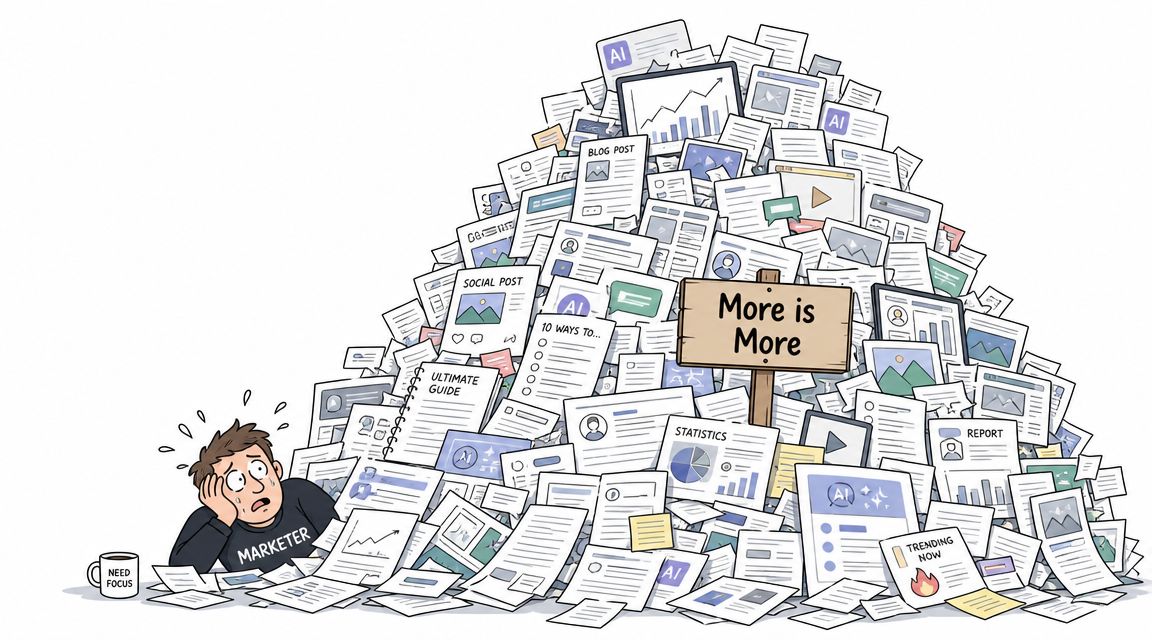
This is the easier trap to spot because it looks productive.
A head of marketing tells the team to use AI to publish faster. Blog output rises. Landing pages multiply. Sales asks for more nurture emails, and those get generated too. On paper, the function looks efficient. In the market, it starts sounding interchangeable.
The underlying mistake is assuming that search visibility and buyer attention are won by scale alone. That logic was already shaky before generative AI. It's worse now. CMSWire's write-up on the AI roadmap for marketers notes that Google rewards "helpful, reliable, people-first content" rather than content made for rankings. If you use AI to mass-produce generic material, you're not building an advantage. You're increasing the odds that buyers ignore you and search systems devalue the work.
Blog programs detached from sales reality
Marketing publishes high-volume educational content that never answers the objections enterprise buyers raise in calls.
SEO briefs built around category sameness
Teams optimize for the same phrases, same angles, and same structure as every rival. Rankings become harder. Distinction disappears.
Founders losing trust in marketing output
They see more assets and no corresponding change in qualified demand, conversion quality, or deal velocity.
Practical rule: If AI makes your company sound like the average vendor in your category, it is reducing value, not creating it.
The same issue shows up in AI search. Many teams assume large language models will somehow surface whatever they publish. That assumption is lazy. If you want a deeper critique of that mistake, the AI search gap in B2B marketing is the one to pay attention to.
The second trap is more expensive because it hides behind software procurement.
Leaders hear that AI is changing marketing. They buy writing tools, enrichment tools, personalization tools, and analytics overlays. Then they ask the team to "find use cases." This is backward. A tool-first approach creates fragmented experiments, duplicate workflows, and shelfware.
The main issue isn't adoption. It's problem selection.
A B2B SaaS company does not need "more AI." It needs answers to concrete questions:
| Question | Better use of AI | Bad use of AI |
|---|---|---|
| Why are deals stalling after demo? | Analyze call notes, objections, and ICP mismatch patterns | Generate another follow-up email sequence |
| Which leads deserve sales time now? | Build predictive scoring from historical behavior and CRM data | Add more top-of-funnel traffic with vague targeting |
| Why is paid spend inefficient? | Use behavioral signals to tighten audience and bidding decisions | Produce more ad copy variants with no segmentation change |
Tool-first teams rarely frame the work this way. They focus on feature lists instead of revenue constraints.
That creates second-order problems:
The hard truth is simple. AI doesn't rescue an undisciplined GTM org. It just lets that org move faster in the wrong direction.
If you're serious about AI for digital marketing, stop organizing the work around tools. Organize it around decision quality.
Organizations should think about AI in three layers. The order matters. If you skip the first layer, the rest gets shaky fast. If you over-invest in the third layer first, you get speed built on weak inputs.
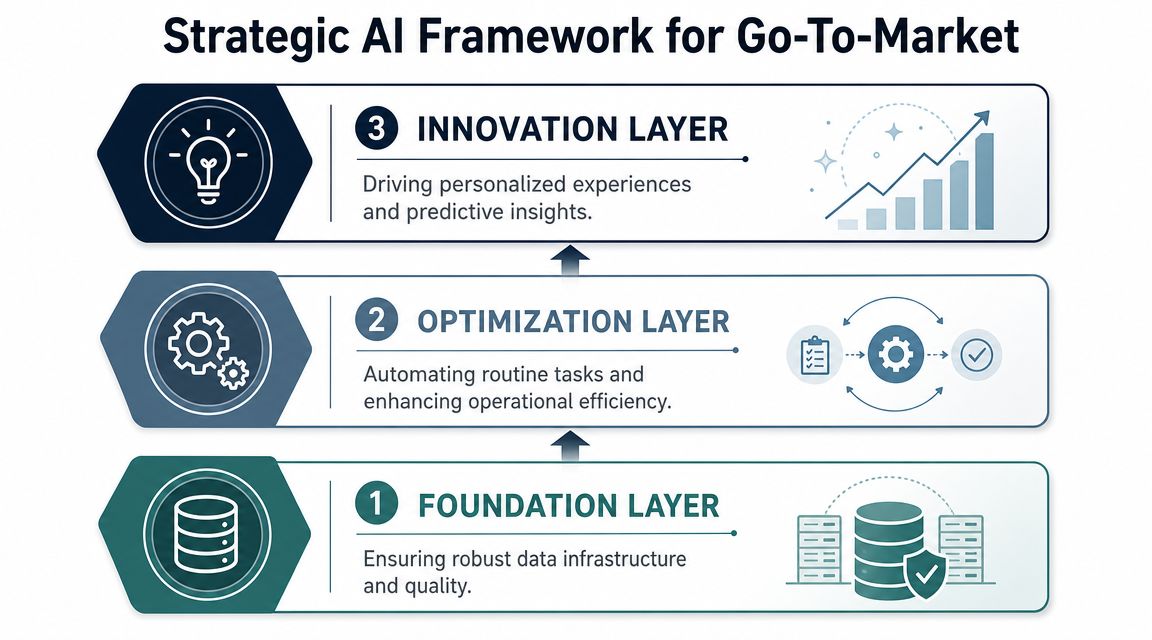
Value creation often begins here, but many groups typically devote minimal effort.
Use AI to synthesize customer interviews, support tickets, win-loss notes, CRM records, call transcripts, and market research into a clearer picture of your ICP, buying triggers, objections, and category language. This is not glamorous. It is also where strategic advantage starts.
For a founder-led sales company, this layer matters because the founder often holds the best customer insight in their head. AI can help codify that insight faster across the organization. For a post-PMF company, it helps reveal where messaging drift has started between product, marketing, sales, and customer success.
This is the layer where Big Moves Marketing's perspective on artificial intelligence and marketing fits best. The useful role of AI is not to replace strategic judgment. It's to help teams process more signal and make sharper positioning decisions.
Once your market understanding is stronger, AI becomes useful for targeting and routing.
This layer covers audience segmentation, lead prioritization, behavioral personalization, campaign decisioning, and predictive scoring. The point is not automation for its own sake. The point is directing time, spend, and sales attention toward the opportunities with the highest probability of movement.
To consider this practically:
Identify the signal
Look at behaviors that suggest intent, fit, or risk. Product usage, demo requests, content consumption, email engagement, account activity, and CRM history all matter if they're trustworthy.
Decide the action
Score leads, route accounts, personalize sequences, or change campaign targeting based on those signals.
Measure business effect
Watch conversion quality, sales acceptance, pipeline velocity, and wasted spend.
Better AI use means fewer bad handoffs, fewer low-fit leads pushed to sales, and fewer budget decisions made on stale reporting.
These applications include content generation, summarization, draft creation, workflow automation, and operational assistance.
These are useful capabilities. They just shouldn't sit at the center of your AI strategy. They should sit downstream from better thinking. If your positioning is weak, AI will generate weak assets faster. If your segmentation is messy, AI will scale the mess.
That doesn't mean this layer is unimportant. It means it is dependent.
Use AI here to:
The mistake is treating this layer as the strategy itself. It isn't. It's the finishing system, not the source of advantage.
Most AI examples in marketing are too shallow to matter. "Write posts faster" is not a serious GTM use case. Neither is "generate ten headlines." Useful applications sit closer to buyer understanding, funnel decisions, and sales execution.
Start with the funnel, not the tool list.

A common SaaS problem is false confidence in the ICP. The team thinks it knows who buys. Sales is chasing one segment, product is building for another, and marketing is publishing for a third. AI can help reconcile that faster if you feed it the right material.
Take customer interviews, sales calls, support conversations, and onboarding feedback. Then use AI to cluster recurring pains, decision criteria, objections, and desired outcomes. You're not asking it to invent insight. You're asking it to compress a messy qualitative dataset into patterns the team can act on.
That changes messaging quality. Suddenly, your homepage language can reflect the problem buyers describe. Your paid campaigns can target the pain that creates urgency. Your content can answer what procurement, finance, and technical stakeholders need to see before a deal moves.
A short explainer is useful here if your team is still thinking too tactically:
AI starts affecting pipeline quality directly.
Salesforce's overview of AI in digital marketing describes the highest-value technical use as real-time decisioning. Systems can ingest behavioral signals such as clicks, searches, conversions, and CRM context, then update audience segments and bidding logic continuously. In plain English, AI can help your team stop treating all traffic, leads, and accounts as if they deserve the same response.
Lead scoring
Instead of routing every hand-raiser the same way, score based on fit and behavior. A low-fit lead with high superficial engagement shouldn't crowd out a strong-fit account showing buying signals.
Nurture sequencing
Different prospects need different proof. Technical evaluators want architecture confidence. Economic buyers want risk reduction and ROI logic. AI can help route messaging by role and stage.
Expansion and churn signals
Existing accounts generate signals too. Product usage changes, support patterns, and stakeholder activity can help identify upsell potential or retention risk earlier.
Campaign prioritization
Marketing teams often spread budget too evenly. AI can help identify which segments, keywords, or account groups deserve more spend now.
This is also where many teams should review practical options, including AI tools for B2B marketing and sales in 2025, but only after the workflow and decision point are defined.
If your CRM routing logic is bad, AI won't save it. It will just automate the bad logic.
In B2B SaaS, marketing and sales often break alignment at the point where context should transfer. Marketing sends "qualified" leads. Sales receives thin records and generic nurture history. Reps then restart discovery from scratch.
AI can improve that handoff by packaging account context in a form sellers can use. That includes summarized engagement history, likely pain points based on consumed content, likely objections based on segment, and persona-specific talk tracks derived from prior successful conversations.
This matters more in complex sales than in simple transactional funnels. If your deals involve multiple stakeholders, the seller needs a compact map of what the account likely cares about. AI is useful here because it can turn fragmented activity into a coherent brief.
A practical output might include:
| Sales context need | AI-assisted output |
|---|---|
| What has this account shown interest in | Summarized topic and content engagement history |
| What pain is likely urgent | Pattern-based inference from role, segment, and behavior |
| What proof will matter | Relevant case material, objections, and supporting assets |
| What should happen next | Suggested follow-up path based on stage and activity |
The quality standard is simple. If the output helps a rep ask better questions, it has value. If it only helps them send faster generic emails, the value is limited.
This is one of the clearest operating use cases because the cause and effect are easier to observe.
In paid acquisition, AI is strongest when it improves in-flight decisions. That means changing bids, segment priorities, creative combinations, and spend allocation based on live performance signals, not monthly postmortems. For SaaS teams spending meaningful budget across search, social, or programmatic channels, this can be far more valuable than using AI to write another set of ad headlines.
The logic is straightforward:
This is especially useful when your market has mixed intent. Not every click means buying interest. Some traffic is educational. Some is competitive research. Some is student or job-seeker noise. AI can help separate useful demand from distraction if your tracking setup is credible.
Most AI reporting inside marketing teams is weak.
It focuses on content produced, hours saved, prompts run, or workflows automated. Those are implementation metrics. They are not business outcomes. A board does not care that your team generated more assets this quarter. It cares whether CAC got healthier, pipeline moved faster, and revenue efficiency improved.

A lot of executives accept bad AI reporting because the category is still noisy. Don't.
If your team says AI is working, the burden is to show business movement. Sopro's AI sales and marketing statistics roundup reports that businesses using AI-driven marketing see 20% to 30% higher ROI than traditional approaches, and that AI can cut campaign launch times by 75% and improve click-through rates by 47%. Useful. But those gains only matter if they translate into economics your company actually cares about.
A launch that happens faster is good. A click-through rate that improves is good. Neither is enough on its own.
The right scorecard depends on your growth model, but the structure is consistent. You want to know whether AI improved decision quality, sales efficiency, or spend efficiency.
Pipeline quality
Are sales accepted leads improving? Are more opportunities coming from the segments you actually want?
Speed through the funnel
Are qualified accounts moving from first touch to meeting, from meeting to opportunity, or from opportunity to close with less friction?
Paid media efficiency
Is budget getting concentrated in higher-converting audiences, offers, or channels?
Sales productivity
Are reps spending less time researching low-value accounts and more time working the right ones?
Content performance in context
Not "how much did we publish," but "did better insight improve conversion on the assets that matter?"
A simple executive view helps:
| Weak AI metric | Useful AI metric |
|---|---|
| Articles generated | Pipeline influenced by targeted assets |
| Hours saved | Campaign cycle time tied to launch quality |
| Prompt count | Better conversion across key funnel stages |
| Tool adoption | Higher sales acceptance of routed leads |
Board-level test: If the metric can't be connected to revenue quality, conversion quality, or spend efficiency, it probably belongs in an operations review, not the main AI story.
If your team needs a stronger operating baseline for this, how to measure marketing ROI is the right lens. AI should be evaluated the same way any serious GTM investment is evaluated. By contribution, not novelty.
The operational risk with AI isn't that your team won't use it. It's that they'll use it everywhere with no discipline.
That creates scattered prompts, inconsistent brand voice, unreliable workflows, and decision-making based on dirty data. If you're a founder or GTM leader, the job is not to encourage broad experimentation forever. The job is to narrow AI use to a few high-value workflows and make them reliable.
Pick one revenue-relevant bottleneck.
Not "improve marketing with AI." That's useless. Pick a specific problem such as poor lead prioritization, slow campaign setup, weak account research for outbound, or inconsistent message adaptation by segment. Then decide what input data exists, who owns the workflow, what action changes, and how you'll judge success.
A good pilot has three characteristics:
Clear workflow boundary
One team, one job, one decision point.
Observable business effect
You can tell whether conversion quality, speed, or spend allocation improved.
Human review built in
The team can catch bad outputs before they affect buyers or pipeline.
This is not optional.
IBM's perspective on AI in marketing is clear that predictive models depend on high-quality training data. If your CRM is full of junk stages, duplicate accounts, missing attribution, vague close-lost reasons, or inconsistent lifecycle definitions, your AI outputs will be unreliable. The model isn't the problem. Your operating data is.
Inconsistent CRM fields
Different reps log the same thing in different ways, which makes pattern detection weak.
Poor lifecycle discipline
If MQL, SQL, opportunity, and churn risk mean different things across teams, prediction becomes noise.
Thin historical context
Models need enough useful history to separate signal from randomness.
Disconnected systems
If product, marketing, and sales data don't reconcile, you won't trust the output.
Teams over-correct in one of two ways. Either they fear AI and avoid it, or they trust it too quickly and stop applying judgment. Both are bad.
For B2B SaaS, approval matters most in messaging, targeting, and revenue routing. Nobody should publish positioning-heavy copy, adjust account prioritization logic, or change customer-facing communications without human review. AI can synthesize and suggest. Leaders still need to decide.
A lightweight governance model usually works better than a heavy committee:
The standard should be simple. If an AI workflow doesn't improve a real decision, remove it.
AI is an amplifier.
If your positioning is vague, it will produce more vague messaging. If your ICP is muddy, it will help you target the wrong accounts more efficiently. If sales and marketing disagree on what a good opportunity looks like, it will scale that disagreement into dashboards and automations.
This is why so many AI programs disappoint smart teams. The disappointment doesn't come from the technology. It comes from the fantasy that better tools can compensate for weak strategy.
B2B SaaS leaders should treat AI as a multiplier on clarity. It works best when your company already knows who it serves, what pain it solves, how it wins, and which signals indicate buying intent. In that environment, AI can sharpen segmentation, improve routing, speed up experimentation, and reduce wasted spend.
If those basics are missing, slow down.
AI should sit on top of strategic clarity, not in place of it.
This is the playbook. Use AI for digital marketing where it improves judgment, precision, and capital allocation. Keep it away from the center of your strategy if all it does is inflate output. Founders don't need more marketing motion. They need better GTM decisions.
If your team is using AI heavily but pipeline still feels noisy, the issue usually isn't tool adoption. It's weak positioning, fuzzy ICP definition, poor routing logic, or disconnected execution. Big Moves Marketing works with B2B SaaS founders and GTM leaders on that layer first, so AI and the rest of the marketing system support clearer decisions instead of creating more clutter.
Explore Big Moves Marketing services and resources:


%20-%20white.svg)