%20png%20copy.avif)
Most advice about artificial intelligence and marketing is still trapped at the wrong altitude. It treats AI like a faster intern. Write more posts. draft more ads. summarize more calls. save a few hours. That thinking is cheap, and it produces cheap outcomes.
If you're a B2B SaaS founder or revenue leader, the central question isn't which tool can generate more assets. The key question is where AI changes your go-to-market decision quality. The market has already moved. The AI marketing market grew from $12.05 billion in 2020 to $47.32 billion by 2025, and it's projected to reach $107.5 billion by 2028 according to AI marketing adoption data. That growth isn't happening because teams wanted prettier blog drafts. It's happening because leaders see AI changing how targeting, personalization, prioritization, and execution function.
The mistake is simple. Many marketing organizations use AI at the edge of the system, usually content production, while leaving the core GTM engine untouched. They automate output, but they don't improve judgment. They move faster, but often in the wrong direction.
The popular advice says to start with tools. That's backwards.
Tools matter far less than deciding where intelligence changes the economics of your GTM motion. If your positioning is muddy, your funnel definitions are weak, and your CRM data is a mess, adding AI just helps you produce more noise. If your GTM foundation is clear, AI can sharpen targeting, compress feedback loops, and help your team make better calls faster.
That's why I don't care whether your team has tested ten writing tools. I care whether AI is improving how you choose accounts, shape offers, score intent, route follow-up, and refine messaging from live buyer signals. Those are strategic decisions. They affect pipeline quality, sales efficiency, and speed to learning.
A lot of founders still frame AI as a cost-cutting exercise. That's small-company thinking. The larger opportunity is using AI to build a GTM system that gets smarter every quarter. If you're running paid acquisition, for example, the useful question isn't whether AI can write another headline. It's whether it can help your team streamline Google Ads with Keywordme so search intent, keyword coverage, and account structure reflect actual buying patterns instead of guesswork.
AI should sit closest to your revenue decisions, not your content calendar.
Most B2B SaaS teams have over-automated content and under-instrumented buyer intent. That's the wrong split. Start where AI improves judgment under uncertainty. That's where it becomes a GTM weapon instead of a productivity toy.
If you want a sharper view of that shift, Big Moves Marketing has already framed the issue well in its thinking on AI in marketing for B2B growth teams.
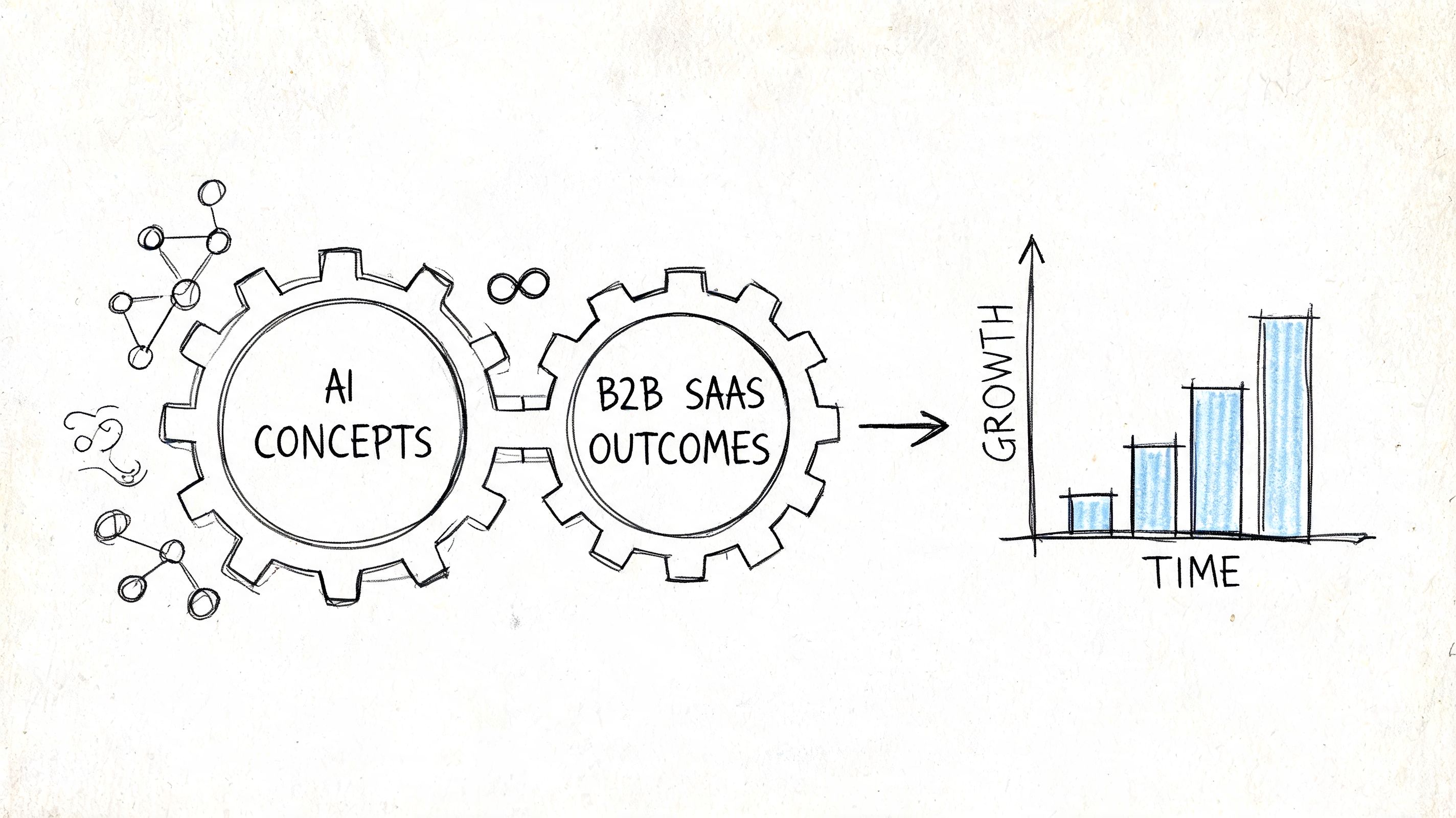
Founders don't need a seminar on model architectures. They need plain language that maps AI concepts to business consequences.
Generative AI is not "the blog post machine." In B2B SaaS, it's more useful as a drafting layer on top of strategy. It can help an AE build a first-pass outbound email based on an account's funding round, product stack, or annual report. It can help a marketer convert one positioning narrative into ad variants, landing page copy, webinar abstracts, and enablement snippets. It accelerates adaptation.
Predictive analytics matters more than most leaders realize. Think of it as a probability engine. Instead of asking your team to manually judge which demo requests look promising, predictive systems analyze patterns in behavior and account data to forecast which leads are more likely to progress. That changes routing, prioritization, and forecast confidence.
Machine learning is the pattern-detection layer behind many of these decisions. The practical value isn't technical elegance. It's finding combinations humans miss. A prospect who visited pricing twice, attended a webinar, used a specific product feature in trial, and came from a certain account profile may deserve immediate attention even if they don't fit your old manual scorecard.
Natural language processing is what turns messy buyer language into signal. Support tickets, call transcripts, reviews, and email replies contain objections, anxieties, and buying triggers. However, this valuable data often remains unused.
The dangerous part isn't that teams are using AI. It's that they're using it badly. While 68% of sales and marketing professionals now use AI at work, only 17% have received thorough, job-specific training, according to Demand Gen Report's coverage of AI use and training gaps. That gap creates exactly the kind of sloppy execution founders can't afford.
In practice, this looks like:
Practical rule: If your team can't explain where human judgment enters the workflow, you don't have an AI process. You have a risk surface.
The right mental model is simple. AI handles synthesis, prediction, and first-pass generation. Humans decide the market, the message, the priorities, and the trade-offs. If you want that distinction operationalized inside a B2B team, this CMO guide to integrating generative AI in B2B marketing is a useful reference point.
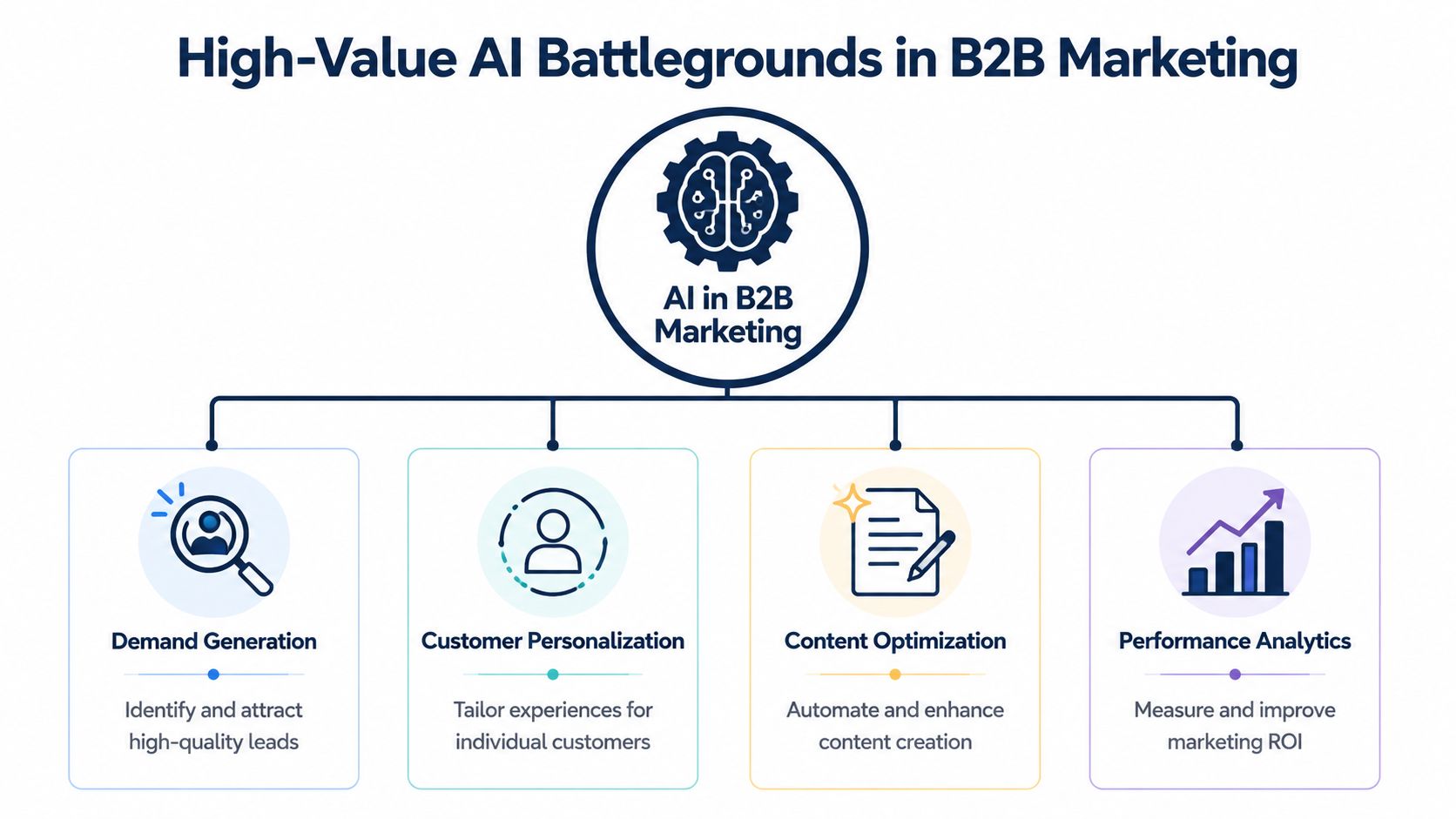
Founders waste time on AI in the wrong places. They automate low-value tasks, generate more content than the market wants, and call it progress. The smarter move is to apply AI where it changes pipeline decisions, message quality, and conversion paths.
These are the four battlegrounds that matter.
Demand generation improves when AI helps you decide which accounts deserve attention now. That means using behavioral data, product signals, CRM history, buying committee engagement, and channel interactions to rank opportunity. Firmographics still matter, but they are a blunt instrument on their own.
B2B teams that rely on broad targeting and vague ICP language usually create expensive noise. AI fixes that by tightening account selection, spotting intent earlier, and identifying which campaigns attract actual buying behavior instead of passive interest.
Use AI here to answer three questions: Which accounts are heating up, which channels produce pipeline instead of clicks, and which messages correlate with progression.
Personalization is not a first-name token. It is route design.
A CFO, an operations leader, and a technical evaluator should not hit the same page, see the same proof, or enter the same nurture path. AI helps teams adapt messaging, offers, CTAs, and follow-up sequences based on industry, use case, account maturity, product behavior, and funnel stage. That creates relevance buyers can feel.
Marketers surveyed by Twilio Segment in its State of Personalization report said personalization directly affects customer spend and loyalty. In B2B SaaS, the more important effect is simpler. Relevant journeys convert better because they reduce buyer effort.
AI belongs in content operations, but only if content has a job.
If your team uses AI to flood the blog, schedule generic social posts, and repurpose weak ideas into more weak ideas, you are scaling irrelevance. The better use is editorial intelligence. AI can surface content gaps by segment, identify pages that no longer match live objections, refresh positioning based on sales calls, and adapt strong assets into formats built for specific buying stages.
Analysts at Salesforce in its State of Marketing report found marketers are using generative AI heavily for content creation and optimization. The practical takeaway is straightforward. Speed matters less than fit. Content should help the right account move, not help your team publish more.
If you want a broader operating model for this part of the stack, these advanced marketing automation strategies are useful because they focus on orchestration across journeys, not isolated triggers.
This is the most underused battleground, and often the most valuable.
Every sales call contains market intelligence. Objections, stalled deals, pricing friction, competitor mentions, procurement concerns, and feature confusion all point to GTM problems that marketing should fix. AI can process transcripts, notes, and deal data at a scale no human team can match, then surface patterns that should change positioning, qualification, follow-up, and campaign messaging.
That is how AI stops being a productivity layer and becomes a GTM feedback engine.
A simple way to assess these battlegrounds is to compare weak usage with strategic usage:
BattlegroundWeak AI useStrong AI useDemand generationMore ad variantsBetter account prioritization and timingPersonalizationMerge fieldsDynamic journeys based on buyer contextContent operationsFaster publishingFaster message refinement and content adaptationRevenue intelligenceCall summariesObjection patterns that change GTM decisions
The companies that get outsized returns from AI will not be the ones with the most tools. They will be the ones that use AI to improve market selection, message accuracy, and revenue decisions.
If you're reviewing vendors across these categories, Big Moves Marketing has a practical overview of AI tools for B2B marketing and sales in 2025 that helps frame the options without confusing software selection with strategy.
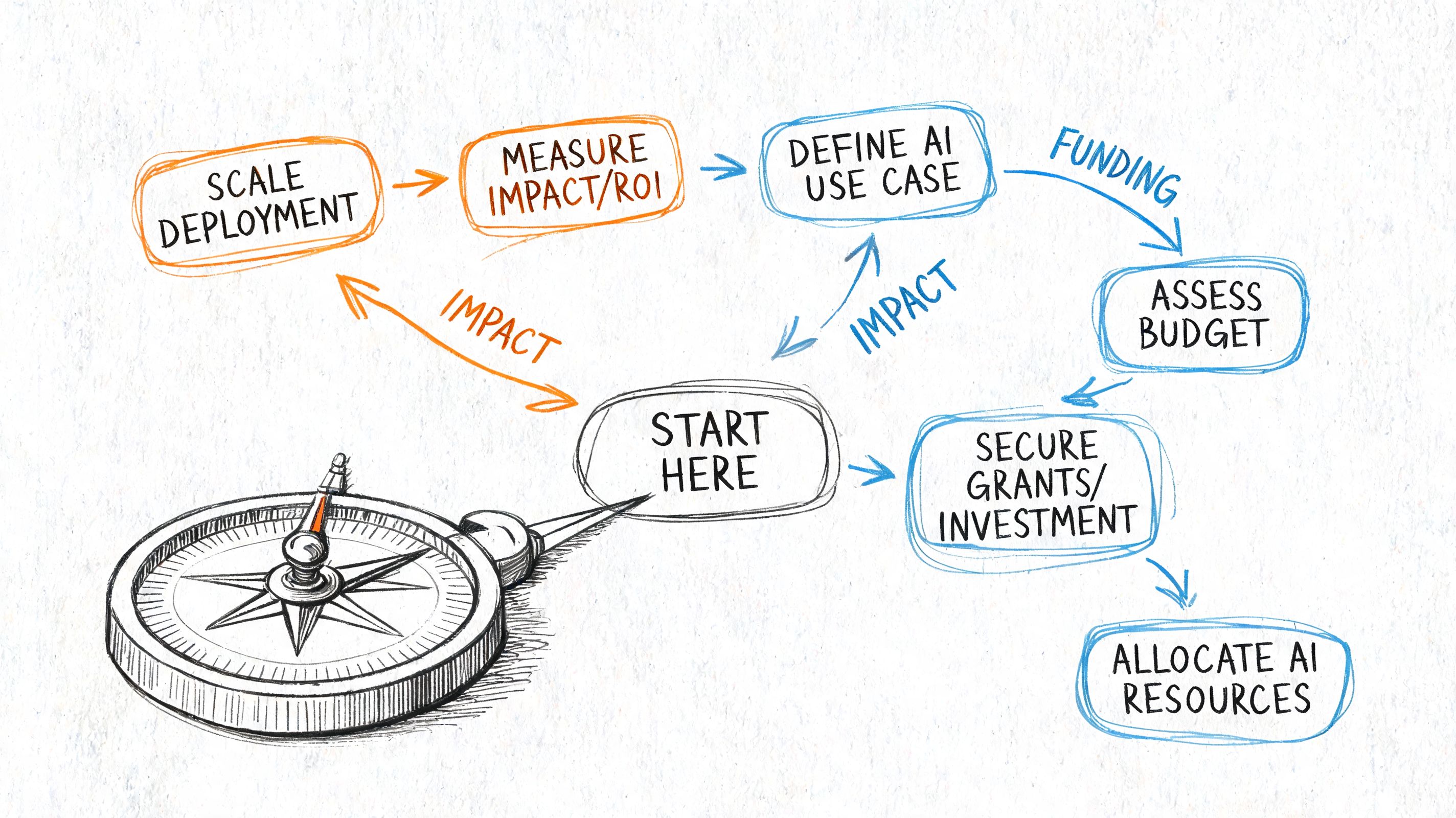
Most AI roadmaps fail because leaders choose based on novelty. They fund whatever sounds advanced, then discover the team can't support it, the data isn't ready, or the output doesn't affect revenue.
Use a simpler filter: evaluate each potential AI initiative on pipeline impact and implementation complexity. If a project won't plausibly change pipeline quality, conversion speed, deal progression, or retention behavior, it belongs lower on the list. If it requires messy integrations, major change management, and unclear ownership, be honest about the cost.
Think in four quadrants:
Founders often want to begin with the most ambitious project because it feels ground-breaking. That's usually a mistake. The first win should be boring enough to ship and important enough to matter.
A rough decision guide helps.
QuadrantTypical exampleDecisionHigh impact, low complexityAnalyze sales calls and support tickets to refine messagingStart nowHigh impact, high complexityPredictive lead scoring across CRM and product dataPlan after a smaller winLow impact, low complexitySocial post generationUse sparinglyLow impact, high complexityFull AI content factory with weak editorial controlAvoid
The right first project usually has four traits:
A pilot should create evidence, not internal excitement.
One more point. Don't outsource the prioritization itself to vendors. Their incentive is to expand scope. Yours is to reduce wasted motion. If you need outside support, choose a strategic partner that can tie AI to positioning, pipeline, and operating discipline. Big Moves Marketing is one example in that category because its work sits at the intersection of messaging, GTM pilots, and revenue systems rather than generic campaign production.
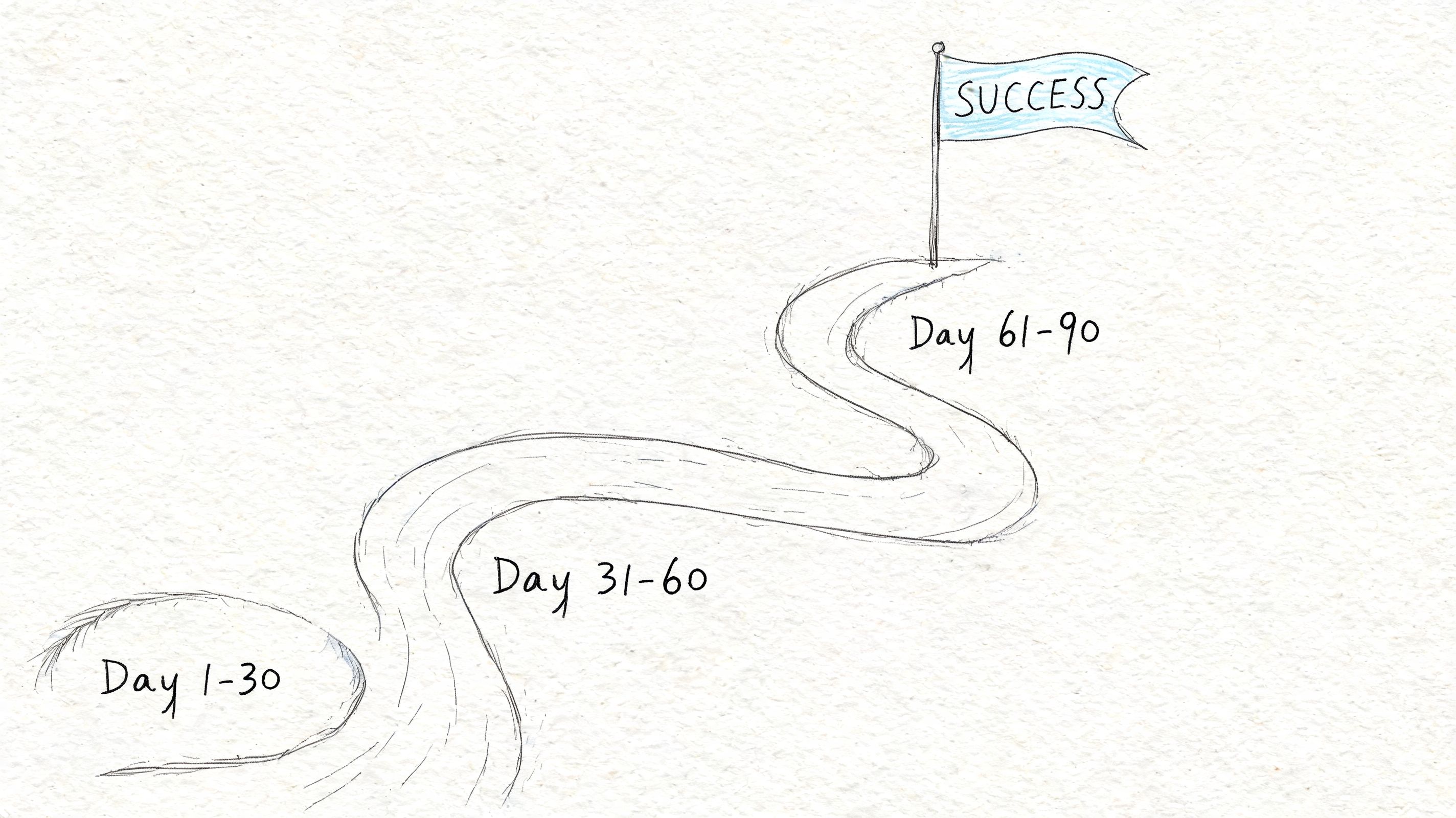
The first ninety days should produce one thing above all else. Proof.
Not proof that AI can generate things. Proof that one workflow in your GTM engine now performs better because the team is making better decisions. A clean starting point for many B2B SaaS companies is lead prioritization. According to Improvado's overview of AI marketing analytics, advanced AI lead scoring systems analyze historical conversion patterns across engagement signals, account attributes, and product usage to predict close probability. In practice, that helps teams focus attention on accounts showing measurable intent.
Choose one use case only. Not three.
Good first options are lead scoring, call transcript analysis, lifecycle email prioritization, or paid search optimization tied to pipeline stages. Then audit the inputs. If lifecycle stages are inconsistent, attribution fields are broken, or product usage events are missing, fix that before you ask AI to infer anything.
Use this checklist in the first month:
A simple operating rule matters here. Run the first model or workflow in shadow mode before changing process. Let it score, flag, or summarize without altering routing yet.
Now test it against reality.
If you're piloting lead scoring, compare AI-informed prioritization against the team's current manual process. If you're piloting messaging analysis, compare revised talk tracks against prior sales calls. Keep the control condition alive. Without it, everyone will interpret noise as progress.
Here's a useful mid-pilot learning aid:
The second month isn't about scale. It's about friction discovery. Expect bad fields, edge cases, false positives, and rep skepticism. Good. That's where the process gets real.
Treat pilot friction as signal. It usually reveals the operating problem you should have fixed years ago.
By month three, make a decision. Expand, refine, or stop.
If the pilot improved prioritization quality, message relevance, or speed of action, document the workflow. Define owner, review cadence, escalation path, and feedback loop. If it didn't materially improve decisions, shut it down. Don't keep zombie AI projects alive because leadership wants to appear modern.
A practical month-three review should answer:
This is also the stage where many firms realize AI should support broader GTM design, not just isolated tasks. If you're thinking that way, this perspective on how winning companies use AI for B2B growth is worth reading because it ties implementation to commercial outcomes rather than tool novelty.
Most AI reporting is still activity theater. Articles produced. Prompts run. Workflows automated. None of that matters to a board unless it changes revenue outcomes.
The right question is whether AI improved the quality and speed of your revenue engine. That means your KPI set should tilt toward conversion progression, sales efficiency, and retention behavior. IBM notes that companies using AI-enabled predictive analytics achieve 72% success rates in personalizing customer experiences at scale, and that capability is a driver of the market's projected growth to $82.23 billion by 2030 in its analysis of AI in marketing. The implication is straightforward. Personalization matters when it changes commercial performance, not when it makes a dashboard look advanced.
If your team reports "content generated" as a primary AI metric, you've already lost the plot.
Focus instead on whether AI changed:
Retention is often where AI measurement gets more serious, because weak-fit acquisition and weak-fit onboarding tend to show up later as churn. If that's on your radar, these AI churn analysis strategies are useful because they connect predictive signals to actual customer outcomes.
Use a simple scorecard that compares pre-AI and post-AI operating reality.
KPIBefore AIAfter AILead routingManual and delayedPrioritized by intent signals with human reviewSales follow-upSame for every leadFaster for higher-probability accountsPersonalizationStatic by segmentAdaptive by behavior and account contextMessaging refinementQuarterly guessworkOngoing updates from live buyer languageRetention insightReactiveEarlier pattern detection
You don't need a huge measurement stack to do this well. You need discipline. Every AI initiative should tie to one primary KPI, one secondary KPI, and one review rhythm. If the relationship between the workflow and the metric is vague, the initiative is probably vanity dressed as innovation.
AI risk in marketing rarely starts with a lawsuit. It starts with bad strategic judgment disguised as efficiency.
Founders should worry about three things first. Brand dilution, careless data exposure, and weak vendor selection. Those failures hurt pipeline long before legal teams get involved, because they distort positioning, pollute buyer interactions, and push teams into workflows they no longer control.
Generative AI can make a company sound polished while stripping out the sharp edges that make buyers remember it. That is a serious GTM problem. If your category point of view gets flattened into generic language, your campaigns may still ship faster, but they lose the tension and specificity that create demand.
The damage is operational too. Website copy drifts toward commodity phrasing. Sales decks start sounding interchangeable. Product marketing loses the language that separates your company from the safer, louder competitor.
A second problem sits under that one. AI is absorbing work that used to train junior marketers to spot weak claims, bad assumptions, and shallow research. As Martech's analysis of how AI is changing entry-level marketing work explains, teams can end up with fewer people who know how to challenge the machine. That leaves senior operators reviewing more output with less context behind it.
The real failure is not just incorrect output. It is a team that no longer knows how to recognize weak reasoning.
If a model touches customer data, pipeline data, call transcripts, pricing notes, or account research, you need clear policy before rollout. Do not treat privacy as a procurement checkbox. Treat it as a GTM control system.
Set rules at the workflow level. Define which data can enter external tools. Define which prompts are prohibited. Define who approves customer-facing output. Define where human review is mandatory. If those rules are fuzzy, adoption will sprawl and your team will start pasting sensitive information into systems they do not understand.
This matters even more in research-heavy work. Large language models can speed up synthesis, but they are weak substitutes for direct evidence in category analysis, competitive positioning, and buyer insight development. The Big Moves Marketing article on why B2B marketers can't rely on LLMs alone for search and research makes that limitation clear.
An AI label tells you almost nothing. Buy based on decision quality, control, and failure handling.
Ask vendors questions that expose whether the product improves your GTM system or just adds another noisy layer:
Run an internal checklist too:
This section is where founders usually get lazy. They buy the shiny layer, skip governance, and assume the team will figure it out. That is how AI turns from a GTM multiplier into a source of hidden drag.
Artificial intelligence won't rescue a weak market position. It won't fix muddled messaging. It won't compensate for poor sales discipline or bad data hygiene. It will only help your company execute those weaknesses faster.
That's why the right frame for artificial intelligence and marketing is not automation. It's amplification. AI amplifies the quality of your underlying GTM system. If that system is clear, focused, and instrumented, AI improves judgment, timing, relevance, and learning speed. If that system is confused, AI spreads confusion at scale.
The founders who get this right will make a few disciplined choices. They won't start with tool accumulation. They'll start with one revenue question that matters. They won't measure content volume. They'll measure pipeline movement. They won't remove humans from the loop. They'll place humans exactly where strategic judgment, verification, and trade-off decisions still matter most.
That's the working model for the next phase of B2B growth.
Let AI process more signal than your team can handle manually. Let it surface patterns, prioritize work, and accelerate adaptation. Then use the time and clarity it creates to do the part only leadership can do. Define the market sharply. Choose the message deliberately. Decide which buyers matter most. Build the operating discipline to keep learning faster than your competitors.
That is where the edge sits.
If you're a founder or GTM leader who wants to apply AI to positioning, demand generation, and pipeline design without getting lost in tool chatter, Big Moves Marketing helps B2B SaaS teams make those decisions with more clarity and less wasted motion.
Explore Big Moves Marketing services and resources:




%20-%20white.svg)