%20png%20copy.avif)

Let's cut through the noise. Most founders hear "what is revenue enablement" and mentally file it as a synonym for sales enablement. This is not a harmless mix-up; it's a strategic error that quietly strangles growth.
Revenue enablement is not a rebrand. It’s a different operating system for your entire go-to-market motion. It is a cross-functional discipline designed to maximize revenue across the entire customer lifecycle, not just the initial sale. Get this wrong, and you're building your company on a foundation of misaligned teams and leaky revenue buckets.
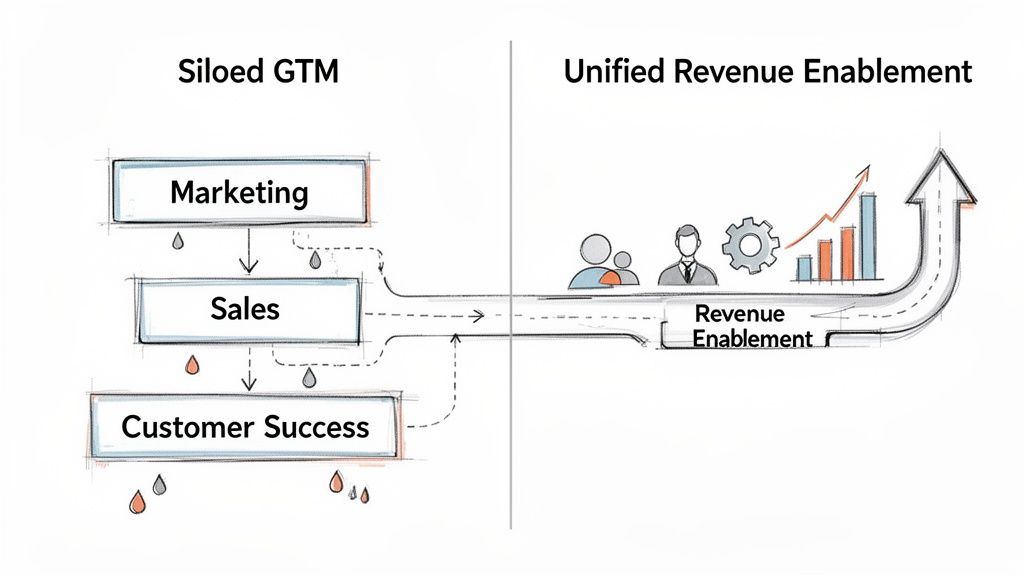
The confusion is understandable. For years, go-to-market teams have operated in functional silos. Marketing generates leads and throws them over the wall. Sales works to close them. Customer Success is left to manage the aftermath and secure the renewal. Each team has its own tools, KPIs, and version of "enablement."
In a modern SaaS business, this model is fundamentally broken. It’s an assembly line designed for a world that no longer exists, creating friction, message dilution, and significant revenue leaks at every handoff.
The root of the problem is misaligned incentives. When each team optimizes for its own local metric—MQLs for marketing, new logos for sales, renewal rates for CS—the customer experiences whiplash.
This is a recipe for a fractured customer experience. In a SaaS world where over 70% of revenue can come from existing customers, this broken journey is a direct threat to your profitability and valuation.
The siloed GTM structure isn't just inefficient; it's a liability. It forces customers to re-educate themselves at every stage, destroying trust and manufacturing churn risk before your team even onboards them.
Revenue enablement corrects this by reframing the objective. The goal is no longer just closing the deal; it's maximizing the lifetime value of every customer. It achieves this by forcing a fundamental operational shift—from separate, competing efforts to a single, unified revenue engine.
This isn't a theoretical exercise. It’s a practical framework for aligning Marketing, Sales, and Customer Success on shared goals and resources. While the core practices of sales enablement are critical, they only address one leg of the customer journey. You can dive deeper into that in our guide on the essentials of a modern sales enablement definition.
Revenue enablement extends those principles across the entire customer journey. It ensures the value proposition remains consistent from the first ad a prospect sees to the quarterly business review a customer has in their third year. It treats the customer journey as one continuous conversation, not a series of disconnected handoffs. This strategic alignment is the defining difference—and it's why this model drives predictable growth where the siloed approach fails.
Let's move past definitions. What does revenue enablement actually look like in practice?
In operational terms, revenue enablement is the engine you build to get all your customer-facing teams—Marketing, Sales, and Customer Success—executing a single, unified go-to-market motion. It's not a project or a slide deck. It's a permanent function designed to create predictable revenue.
This engine’s remit starts the moment a prospect encounters your brand and continues through their entire life as a customer, including every renewal, upsell, and cross-sell. We're not talking about giving reps a few more battlecards. We're talking about systematically engineering a "continuity of value" where every person on your revenue team is aligned on messaging and working from the same playbook.
This holistic approach is a direct response to a fundamental shift in B2B SaaS. The old model of focusing exclusively on new logos is obsolete. Durable growth comes from retaining and expanding the customers you already have. As industry leaders are discovering, modern enablement must support the entire customer journey, ensuring every team is strategically aligned around shared revenue goals. You can read more about how this is shaping the future of revenue enablement on Flowla.com.
Founders often ask, "That sounds good, but what does it actually do?" The answer lies in your core SaaS metrics. A well-executed revenue enablement function directly impacts the KPIs that determine your company's health and valuation.
Revenue enablement is, at its core, a change management discipline. Its purpose is to drive strategic outcomes, not just complete training tasks. The goal is to move the needle on hard business metrics.
By aligning your teams and standardizing their processes, you systematically attack the friction that kills efficiency and erodes margin. Consider the direct line between enablement activities and your most important KPIs:
Without a revenue enablement function, every department fends for itself. Marketing creates content it believes is valuable. Sales builds one-off pitch decks. Customer Success develops onboarding materials in a vacuum. The result is wasted effort, mixed messages, and a confusing customer experience.
Revenue enablement centralizes this work. It installs a system to create, deploy, and measure the impact of the tools, content, and training your teams use daily. Strong revenue enablement drives continuous improvement in your sales team's execution. You can learn more about how to achieve impactful sales process optimization.
This isn't just about efficiency; it's about intelligence. When all your revenue teams operate within a single framework, you gain an unprecedented view into what’s working and what isn’t. You can finally connect a blog post to closed-won revenue. You can see which onboarding playbooks correlate with the highest NRR.
This is the strategic advantage a siloed, department-by-department approach can never provide. If you're looking to build this kind of advantage, exploring a cohesive B2B go-to-market strategy is the necessary next step.
A high-performing revenue function doesn’t materialize by accident. It’s engineered. Most founders I advise understand this, yet they attempt to build it on a shaky foundation, over-investing in one area while others lag.
Predictable growth is built on four interdependent pillars. If one is weak, the entire structure is unstable. Let's break them down from an operator's perspective—this isn't theory, it's the blueprint for a machine that drives growth.
This is where most early-stage companies fail. They hire a single "enablement person" and expect miracles. The truth is that revenue enablement is a team sport, and it requires executive sponsorship to have any real impact.
Without clear governance, your enablement hire becomes a glorified order-taker, drowning in requests for "a quick slide deck" or "an updated battlecard." This pillar isn't about one person; it's about a cross-functional team with representation from Marketing, Sales, and Customer Success.
This group needs a clear charter, defined ownership over initiatives, and a direct line to leadership. Their job is to tackle the biggest points of friction in your revenue engine, not just react to the loudest voice in the room.
Your go-to-market teams need a shared playbook. Without it, you have chaos. One rep uses a homegrown qualification method, another wings it, and your win rates become a black box. You cannot scale what you do not standardize.
This pillar is about defining and documenting how you sell, renew, and expand.
Defining these processes isn't about creating rigid scripts. It's about codifying the best practices of your top performers into a repeatable methodology that can be taught, measured, and improved. It’s the only way to scale excellence beyond your A-players.
Most B2B SaaS companies are drowning in content but starving for insight. They have thousands of assets—case studies, one-pagers, whitepapers—scattered across disparate systems, and most of it goes unused. This isn't a content problem; it's a strategy problem.
A strategic content library is not a digital dumping ground. It's a curated arsenal where every asset—from a top-of-funnel blog post to a late-stage security doc—is mapped to a specific stage in the customer journey and a specific job to be done.
This is where revenue enablement brings order to chaos, connecting siloed teams under a unified strategy.

As the diagram shows, a central enablement function serves the entire go-to-market organization. Instead of Marketing, Sales, and Success creating content in vacuums, a revenue enablement mindset ensures you're building a single, coherent set of assets—playbooks, battlecards, and talk tracks—that serves the whole revenue engine.
When you get this right, you achieve a level of message discipline that is otherwise impossible. To see how this starts, check out our guide on the critical first step of aligning sales and marketing.
Technology is the final pillar for a reason. Too many companies buy an expensive enablement platform hoping it will fix their people and process problems. It won't. Technology is an accelerator, not a savior.
Your tech stack’s primary job is to be the single source of truth for your content and your team's performance. It must provide clear, data-driven answers to critical questions:
The right technology, implemented after your people, process, and content strategy are solid, allows you to stop guessing and start engineering revenue outcomes. It closes the loop, turning anecdotal feedback into actionable intelligence.
Each of these four pillars is non-negotiable. Neglect People, and your efforts lack direction. Ignore Process, and you cannot scale. Fail on Content, and your teams are flying blind. Underinvest in Tech, and you will never know what's working.
Let's discuss a crippling handicap in B2B SaaS. Marketing celebrates MQLs. Sales chases new logos. Customer Success focuses on renewals, often disconnected from the customer's buying experience.
Each team operates in its own world with its own goals and informal "enablement." This doesn't just create departmental friction—it manufactures blind spots across your entire go-to-market motion.
When teams are siloed, leadership gets disconnected KPIs but no real picture of revenue health. You can't see the bottlenecks at handoffs, and you can’t diagnose why your revenue engine is sputtering.
This is where a unified revenue function becomes a strategic necessity. It's about moving from fragmented efforts to a cohesive, data-driven system built for predictable growth.
The old model of separate enablement for each team is obsolete. It creates a dangerous illusion of success.
The core problem with siloed GTM teams is that everyone can hit their individual targets while the company leaks revenue. Revenue enablement forces accountability to shared outcomes, making it impossible to hide behind departmental KPIs.
To truly align your teams, you need a shared operational language and a single source of truth. A well-structured Revops Content Playbook can provide the essential framework for creating this shared reality.
This transition demands a centralized Revenue Operations (RevOps) function to act as the control room for your revenue engine. RevOps is tasked with integrating data from disparate systems—your CRM, marketing automation, and customer success software—into one reliable picture.
Without this technical backbone, your enablement efforts are flying blind, lacking the data to prove impact or guide decisions. Getting this foundation right is non-negotiable, which is why choosing the right B2B CRM is a crucial early decision.
What is the real difference between sales enablement and revenue enablement? It’s not a buzzword; it’s a fundamental expansion in scope and strategic importance.
Traditional sales enablement supports one team: Sales. Its focus is narrow, equipping reps with content and training to win new deals. Revenue enablement takes a holistic view of the entire customer lifecycle, from the first touchpoint to renewal and expansion. As leading firms now understand, this strategic shift on Bigtincan.com isn't just a training function; it’s a strategic discipline that drives business results.
This table breaks down the fundamental differences.
| Dimension | Sales Enablement (The Old Model) | Revenue Enablement (The New Reality) |
|---|---|---|
| Primary Scope | Supports the Sales team exclusively. | Supports all customer-facing teams: Marketing, Sales, and Customer Success. |
| Core Focus | Top-of-funnel activities: content creation, sales training, and rep onboarding. | The entire customer lifecycle, from initial awareness to renewal and expansion. |
| Key Metrics | Content usage, call scores, quota attainment, time-to-ramp. | Deal velocity, win rates, process adoption, ACV, CAC, and NRR. |
| Team Alignment | Optimizes individual sales performance. | Optimizes the entire revenue process and aligns teams to shared outcomes. |
Ultimately, revenue enablement forces a move from department-specific vanity metrics to a shared scorecard reflecting the health of the entire business.
To make this operational shift work, you must adopt shared goals and metrics. A true revenue enablement model requires a formal governance structure—not just more meetings, but cross-functional working groups with the authority to solve systemic problems.
It’s time to change how you measure success.
This unified approach gives leadership a clear, end-to-end view of the revenue process. It exposes weak points that were previously invisible, like a drop-off in engagement after the sales-to-success handoff or a long ramp time for new AEs that’s inflating your CAC.
By breaking down silos and aligning teams around shared data and goals, you transform your go-to-market motion from disconnected sprints into a single, coordinated marathon. This is how you build a durable, scalable revenue engine.
For a founder at a growing SaaS company, building a full-blown revenue enablement function feels daunting. It sounds expensive, complicated, and slow.
The reality is, you don’t need to boil the ocean.
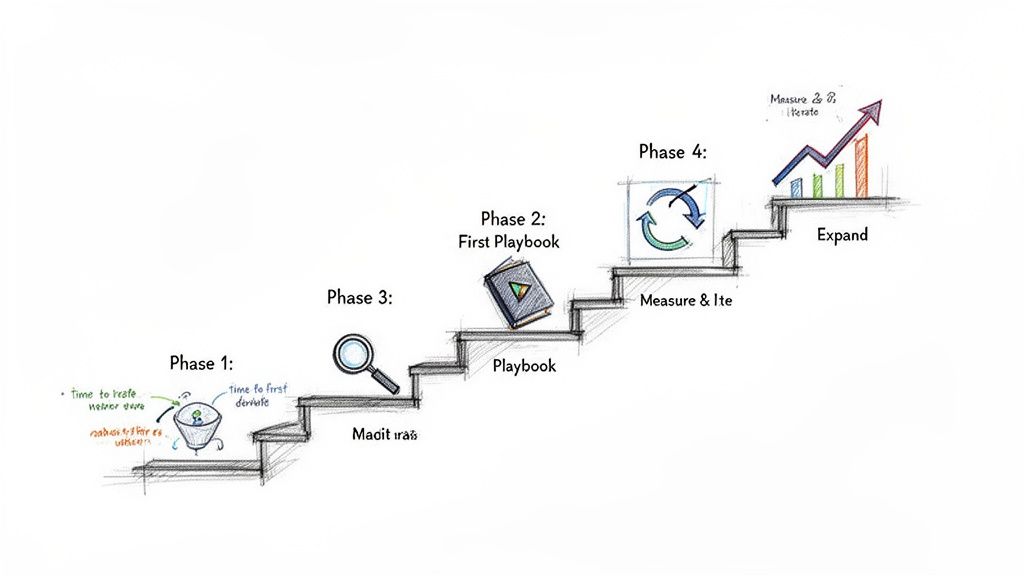
The most effective revenue enablement programs I’ve seen didn't start with a massive budget or a dedicated team. They started by solving one painful, expensive problem. A pragmatic, phased approach is the only way to build momentum, prove value, and earn the right to expand.
First, become a detective. Uncover the single biggest point of friction in your revenue process. Don't guess. Dig into your CRM data and have candid conversations with your customer-facing teams.
You are hunting for a systemic bottleneck, not a one-off complaint.
Pinpoint the one problem that, if solved, would have the most significant and immediate impact on a core revenue metric. That becomes your entire focus.
An effective enablement function is built on a foundation of proven ROI. Starting with a small, measurable win isn't a shortcut; it's a strategic necessity to gain credibility and executive buy-in for future investment.
This deliberate focus on solving a single, high-impact problem is the core principle behind any successful growth roadmap. If you're looking for a framework to prioritize your efforts, our guide on using a Now, Next, Later roadmap can accelerate your B2B growth by applying this same disciplined thinking.
Once you’ve identified the problem, build a targeted playbook to solve it. This is your Minimum Viable Enablement. You're creating the smallest possible set of tools and processes required to fix the specific issue you diagnosed.
If the problem is inconsistent messaging, your playbook might simply include:
Clearly document the ideal process and create only the essential assets needed to support it. Resist the temptation to build a massive content library. Your goal here is surgical precision, not brute force.
This is where most enablement efforts fail. You must tie your playbook directly to the metric you set out to fix. If your goal was to reduce new hire ramp time, then you must track Time to First Deal for every new AE who uses the playbook.
Set a baseline before you launch. After a set period—say, 90 days—measure the result.
Did the metric move? By how much? Get direct feedback from the team. What parts of the playbook were effective? What was useless? This feedback loop is non-negotiable. Use it to refine the process and assets.
Once you have a measurable win, you have political capital. You've proven that a structured, data-driven approach to improving team performance works. You've demonstrated tangible ROI, transforming enablement from a "cost center" into a growth driver.
Now, and only now, do you go back to Phase 1.
With the credibility you've earned, you can tackle the next biggest point of friction in the revenue engine. This iterative cycle—Audit, Build, Measure, Expand—is how you build a world-class revenue enablement function from the ground up. It ensures every initiative is grounded in real business problems and delivers demonstrable value, creating a flywheel of continuous improvement across your entire GTM organization.
When leaders begin to think about a unified go-to-market strategy, the same practical questions always surface. Having worked in the trenches with B2B SaaS companies on this for years, here are some direct answers.
Do not rush this hire. The function should begin organically, with a founder or GTM leader tackling a specific, costly problem. A formal hire isn't triggered by a revenue milestone; it’s a response to systemic friction that appears after you have product-market fit and are trying to scale the team.
The signals that it’s time for a dedicated role are when:
Even then, the first move isn't a job posting. It's assigning enablement responsibilities to a sharp operator you already have. This ensures the function is built on a foundation of solving documented problems, not just checking a box on an org chart. A formal title should follow proven value.
They are essential partners, but they are not the same thing. Confusing them dilutes the impact of both.
RevOps builds and maintains the infrastructure of your revenue engine—the systems, tools, and data flows. Revenue Enablement focuses on the people and processes using that engine—the skills, knowledge, and playbooks that make your GTM teams effective.
Another way to think about it: RevOps provides the diagnostic data showing where the funnel is broken. Revenue Enablement takes that data, diagnoses the underlying human or process issue, and deploys the fix—a new training program, a refined sales playbook, or better competitive intel. They are the "how" and the "who/what" of your revenue machine.
You have to move past vanity metrics. "Content views" or "training sessions completed" are meaningless. You must measure the direct line between your activities and business outcomes. A mature enablement function can draw a straight line from its initiatives to core financial metrics.
Start by tracking leading indicators that predict revenue:
As the function matures, your focus must shift to lagging indicators that prove full-funnel impact. These are the metrics your board and investors care about, like Net Revenue Retention (NRR) and Customer Lifetime Value (LTV). They show your strategy isn't just about winning deals—it's about creating valuable, long-term customer relationships.
At Big Moves Marketing, I help B2B SaaS founders build the strategic clarity needed to drive this kind of unified growth. If your go-to-market motion feels fragmented and you're ready to align your teams around a single revenue engine, let's talk. Visit https://www.bigmoves.marketing to learn more.
Explore Big Moves Marketing services and resources:




%20-%20white.svg)