A go-to-market plan is a coordinated operating plan that turns a product or service into measurable market demand and revenue. More than 50% of product launches fail to hit their business targets, which is why a GTM plan should be treated as a risk-management and resource-allocation system, not a promotional calendar.
The popular advice to “build a launch plan” gets the problem backward. A calendar can tell a team when to publish, email, and run a demo. It can't tell them whether they've chosen a market that cares, built a case the buying committee can support, or created a way to tell what's working. Those are the decisions a real plan has to make.
Many teams call a launch calendar a go-to-market plan, then wonder why the launch underperforms. The calendar records activity. The plan explains how those activities are supposed to create demand and revenue, and what the company will change if the hypothesis proves wrong.
A go-to-market plan is the operating system that connects a chosen market, a relevant offer, a route to buyers, and evidence of commercial progress.
That definition matters because launches are risky business decisions. McKinsey's analysis of product and service launches found that more than 50% fail to hit their business targets, while average failure rates across industries exceed 40%. Those figures make a GTM plan more than a marketing deliverable. It's how leadership decides where to put people, budget, and attention, and how it will detect when the underlying commercial bet isn't holding up.
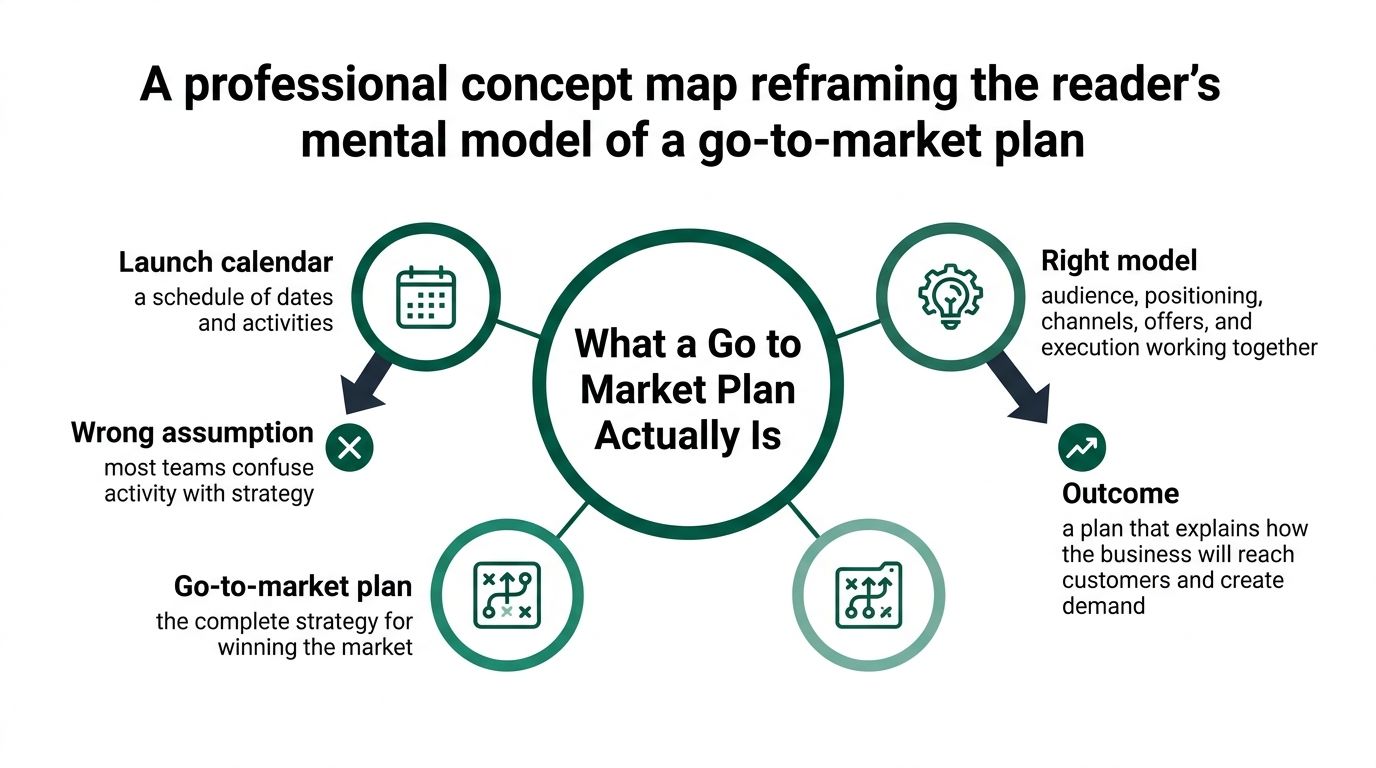
A working plan links decisions through cause and effect. Segmentation determines where the team expects demand to concentrate. Positioning determines which problem and proof points the company brings forward. Channel and sales-motion choices determine how buyers discover, evaluate, and purchase. Measurement shows whether attention is moving toward qualified opportunities, pipeline, and revenue.
That's the difference between a promotional calendar and a commercial hypothesis. A calendar says, “We'll run a campaign.” A GTM plan says, “This segment has an urgent problem, this message should make the value clear, these routes fit how its buying group evaluates software, and these signals will tell us whether to continue or revise the approach.” It also assigns owners and resources so the strategy can be executed, not just presented.
A usable GTM plan makes a sequence of decisions. Each one narrows the next. If the early choices stay vague, later work can look polished while solving the wrong problem.
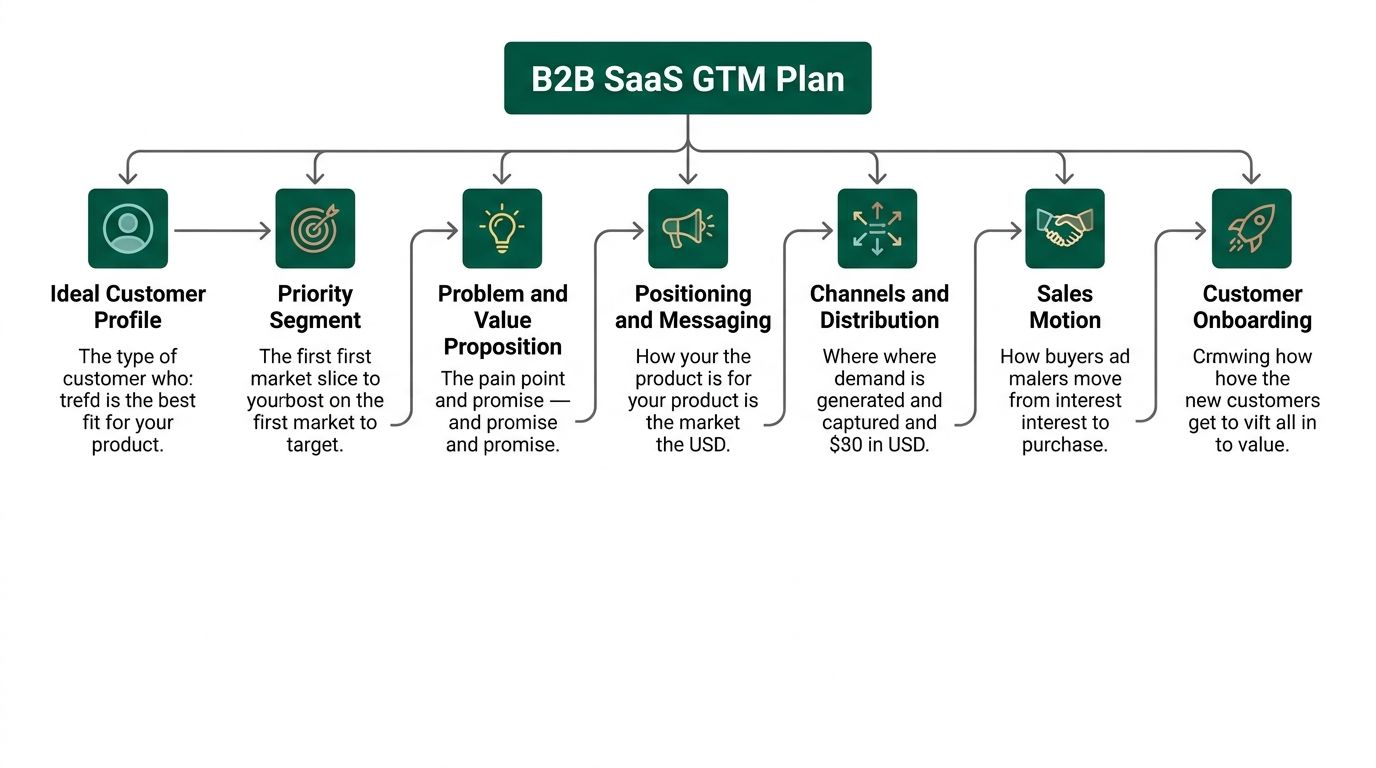
Start with the ideal customer profile and priority segment. Decide which kinds of organizations are most likely to have the problem, the ability to act, and the conditions for successful adoption. An ideal customer profile template can help structure that decision, but the template isn't the strategy. A useful ICP points to a specific market slice and buying process. “Mid-market technology companies” isn't enough if the team can't explain who owns the problem or what makes it urgent.
Then define the unmet problem and value proposition. What workflow is broken, what does that failure cost the buyer, and why is this product a credible alternative? Positioning has to survive comparisons with existing tools, internal workarounds, and doing nothing. If the answer only lists features, buyers have to do the work of connecting those features to business value.
Pricing and packaging force the company to decide how buyers can purchase and what they receive. Route to market and sales motion determine whether the product needs a guided sales process, a self-serve experience, partners, or a mix. A go-to-market strategy framework likewise treats market definition, positioning, pricing, channel and motion choice, handoffs, and launch planning as connected decisions.
The plan should state its assumptions plainly. For example: “This segment should convert more readily because its workflow is urgent and the current workaround is costly.” That's a hypothesis, not a forecast. The measurement design should show what evidence would support or challenge it.
A practical scorecard can include conversion rate, customer-acquisition cost, sales-cycle duration, average contract value, win rate, retention, and payback. These measures help leaders distinguish a weak message from a poor channel fit or a product that doesn't meet the segment's needs. The point isn't to track everything. It's to connect the team's major decisions to evidence.
A team planning how to find clients for your SaaS business can use that question to pressure-test its segment and route-to-market assumptions. Outbound activity won't rescue a plan that hasn't decided who should buy and why.
A B2B purchase isn't a sequence of independent leads. It's a group decision, often made through research that happens before a seller gets involved. A plan that targets only one “ideal customer persona” can generate an enthusiastic champion while leaving the rest of the committee unconvinced.
6sense's B2B buyer research found an average buying group of 10 members. Buying-group size was positively correlated with deal size (r=0.620, p<0.001), and average selling price explained nearly 40% of the variation in team size. As contract value and organizational risk rise, the plan has to move from individual persona targeting to account and buying-group orchestration.
That means mapping the economic buyer, operational champion, technical evaluator, procurement, security, legal, and likely blockers. Each role needs relevant proof, but the proof must contribute to one coherent business case. Finance may need evidence of business impact; technical evaluators need architecture and integration detail; security and legal need risk documentation; users need to understand the workflow.

A second failure is treating each form fill as a separate opportunity. If several people from one account engage with a campaign, they may be different members of the same committee, not separate prospects. Counting them independently can make demand look larger than it is. Measure engagement and progression at the account level, with visibility into which stakeholders are involved and what concerns remain.
Gartner's 2025 research on B2B buying teams found that 74% experience unhealthy conflict during the decision process, while buying groups that reach consensus are 2.5 times more likely to report a high-quality deal. Gartner also reported that individual-level relevance had a 59% negative impact on group consensus, while messaging designed for group relevance improved consensus by 20%.
That's a warning against giving every stakeholder a separate story that conflicts with the others. Organize the narrative around a shared business problem, then provide role-specific detail that helps each person evaluate the same decision. Strong B2B messaging examples can help teams think through how to align audience needs with a consistent value proposition.
The right channel mix depends on the buying situation, not on the team's favorite channel or last year's budget split. A new-category product with technical risk may need expert guidance and proof of value. A familiar, repeatable purchase may suit online buying or product-led conversion.
McKinsey's research on when B2B buyers want digital or salesperson support found that 76% of surveyed buyers considered speaking with a salesperson helpful when researching a new product or service. That preference fell to approximately 50% for repeat purchases with new or different specifications, and 15% when repurchasing the same product or service. The same research found that 46% were willing to buy from a supplier's website if it were available and efficient, compared with 10% who were doing so at the time.
| Purchase Situation | Prefer Salesperson Help | Willing to Buy on Website |
|---|---|---|
| Researching a new product or service | 76% | 46% |
| Repeat purchase with new or different specifications | Approximately 50% | 46% |
| Repurchasing the same product or service | 15% | 46% |
The website figure reflects willingness across the surveyed buyers, not a separate preference measured for each row. Treat the table as a decision prompt, not a rule that every SaaS product should adopt the same motion.
Digital channels can educate, qualify, and support transactional conversion. Sales can validate technical fit, reduce perceived risk, negotiate, and coordinate internal agreement. The plan should state which segments, use cases, and deal situations get human support, and where buyers can move independently.
Channel integration matters as much as channel selection. McKinsey's 2024 B2B Pulse research found that buyers use an average of 10 interaction channels during the purchasing journey, up from five in 2016, and 42% used more than 11 touchpoints. A B2B channel-mix strategy should assign each route a job and define the handoffs between them. Splitting budget across isolated channels doesn't explain how buyers move from discovery to evaluation, consensus, and purchase.
A plan becomes executable when it assigns people to decisions and deliverables. A launch doesn't need every team to own everything. It does need clear ownership for positioning, buyer enablement, handoffs, and measurement.
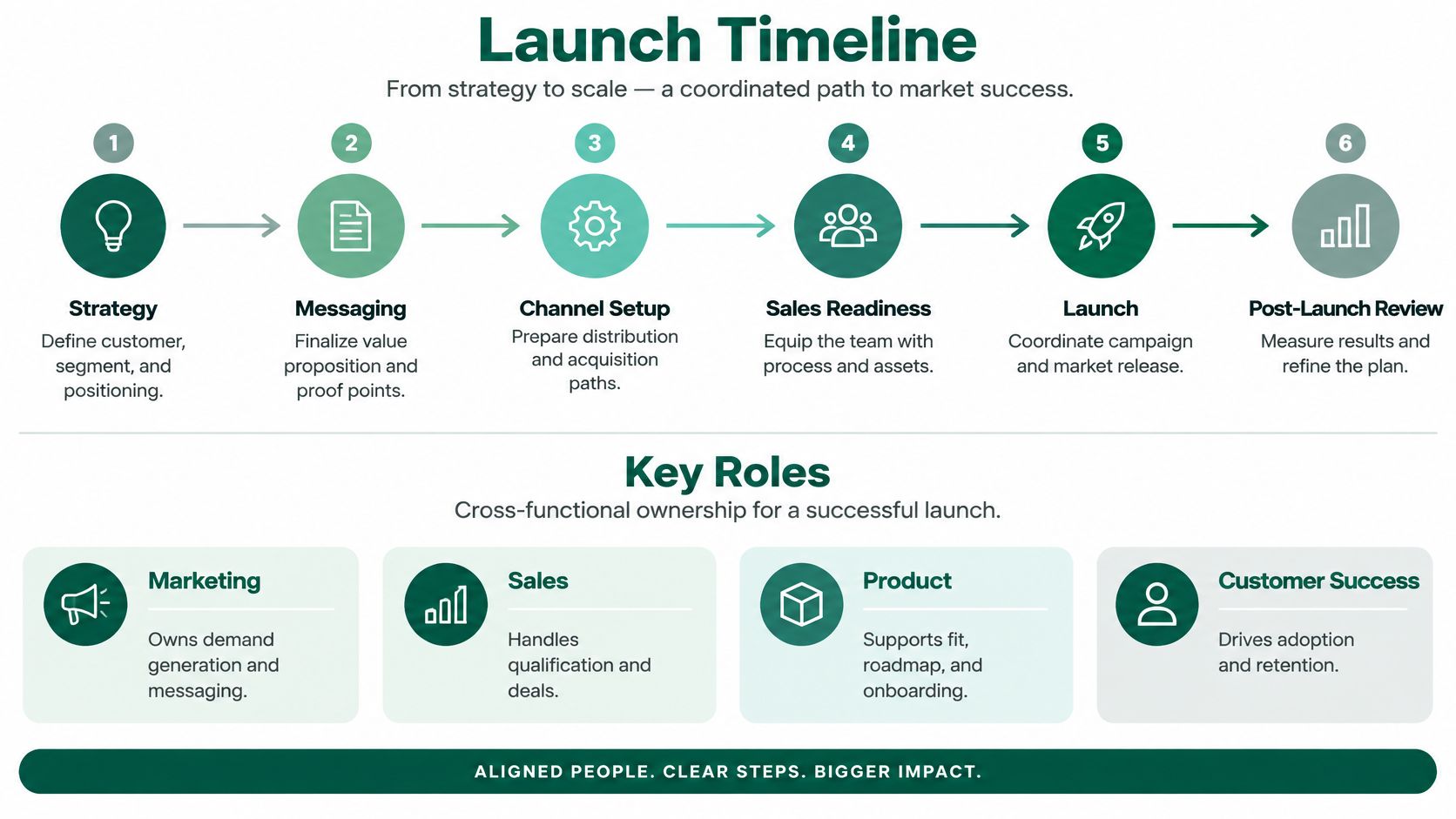
Start with the commercial hypothesis and segment choice. Product brings evidence about product capability and fit; marketing clarifies the audience, positioning, and demand path; sales tests the message against actual buyer objections; customer success identifies adoption requirements; leadership resolves trade-offs and commits resources. Name one accountable owner who keeps those inputs aligned.
Sequence work by readiness, not by arbitrary dates. Validate the message before building the website around it. Prepare sales materials and lead-routing rules before campaign pilots generate interest. Set up dashboards and stage definitions before launch activity makes the data harder to interpret.
Before launch, the team should have validated messaging, a conversion-ready website, sales materials, campaign pilots, lead-routing rules, and performance dashboards. Each deliverable should pass a practical test. Can a buyer understand the value? Can a seller answer predictable objections? Can the right person follow up when an account signals interest? Can leadership see whether the plan is progressing?
A product launch timeline template can help organize the sequence, but dates alone don't demonstrate readiness. Define the handoffs too. Teams should agree on what qualifies as an inquiry, a marketing-qualified account, a sales-accepted opportunity, and closed revenue.
Operating rule: If a milestone has no owner and no acceptance criteria, it's a task list item, not a launch gate.
Perfect attribution isn't a credible launch assumption. Buyers research anonymously, move between channels, and may use AI to summarize reviews or analyze information before speaking with sales. A GTM plan should treat those interactions as signals, not pretend every touch can be tied neatly to a closed deal.
The 2025 State of Marketing Attribution report reported that only 6 in 10 marketers track generated pipeline, about half measure opportunities created, and only 1 in 3 report new ARR. The same research described MQLs as the dominant metric, while only 22% of surveyed ABM teams tracked pipeline from target accounts and even fewer measured revenue impact. Separate buyer research cited in the report found that 94% of buying groups ranked preferred vendors before contacting a seller, and buyers used AI to summarize reviews or analyze data.
The recommendation isn't to abandon measurement. It's to stop promising precision the data can't support. Build a minimum viable system that connects target accounts, buying-group progression, opportunity stages, pipeline, revenue, and sales-cycle velocity. Use anonymous engagement and offline activity as directional evidence, not as conclusive attribution.
If account engagement is weak, examine whether the team is reaching the intended segment. If accounts engage but don't create opportunities, review the message, buyer problem, and sales handoff. If opportunities advance but don't close, investigate product fit, competitive alternatives, stakeholder coverage, and commercial terms. Those are different problems, so they need different responses.
Combine account-level journey signals, CRM opportunity stages, controlled channel tests, consistent campaign taxonomy, and periodic revenue reconciliation. Don't make one attribution model the referee for the whole business. A practical guide to measuring marketing ROI can help connect activity to business outcomes without pretending every touch is equally observable.
Consider a B2B SaaS company launching a tool that helps revenue teams coordinate account research and buyer activity. The broad market might include many technology companies, but the team shouldn't target all of them at once. It should choose a segment where disconnected workflows create an urgent operational problem and where the relevant buyer group can be identified.
The company's first hypothesis could be that revenue teams with fragmented account information will value a shared workflow enough to consider a new system. That hypothesis shapes the positioning. Marketing must explain the operational problem; finance needs a credible business case; technical evaluators need integration and implementation detail; security and procurement need evidence that risk has been addressed.
The message should not imply different outcomes to different stakeholders. A sales champion may care about coordination, but an executive still needs to understand how that coordination supports a business priority. The plan should connect those concerns to one decision narrative, then let each role examine the details that matter to them.
Channel choices follow the purchase. Content and the website support independent research. Sales helps evaluate fit, answer complex questions, and coordinate the committee. Campaign pilots test whether the selected segment responds to the problem framing. The company builds the message, website, sales materials, routing, and measurement before asking the pilots to generate demand.
The team then reviews account progression rather than counting each engaged contact as a separate opportunity. If target accounts show interest but don't advance, it tests whether the problem, proof, or handoff is weak. If the evidence points to a different segment or objection, the team changes that assumption deliberately. It doesn't label the launch successful or unsuccessful based on activity alone.
A GTM plan is a learning system, not a document to file after launch. Its value comes from making trade-offs explicit: which segment, which problem, which message, which channels, which sales motion, and which measures will guide the next decision.
Buying-group consensus and account-level measurement are parts of the same discipline. The first helps the team understand how a purchase advances; the second helps it see whether that progress is real. If either is missing, leaders can mistake one engaged contact or a busy campaign for commercial traction.
This week, write down the plan's first testable hypothesis and name the person accountable for reviewing the evidence. Include the segment, the buyer problem, the expected response, and the signal that would make you revise the plan. That's more useful than polishing another launch calendar.
If your team needs senior marketing leadership to connect positioning, buying-group needs, channel choices, and measurement, Big Moves Marketing provides B2B go-to-market planning and hands-on growth support for technology companies. Visit Big Moves Marketing to discuss the commercial hypothesis behind your launch and the decisions your team needs to make before spending on demand generation.