%20png%20copy.avif)
Most "strategic marketing plans" are activity lists in disguise. They are academic exercises filled with SWOT analyses and content calendars, disconnected from the only metric that matters: revenue. This is precisely why they fail B2B SaaS founders.
What you end up with is a to-do list, detached from product, sales, and your company's actual revenue model.
The fatal flaw in most marketing plans isn't the template—it’s the underlying assumption that marketing operates in a vacuum. Founders and marketing leaders fill in the blanks, mistaking activity for progress.
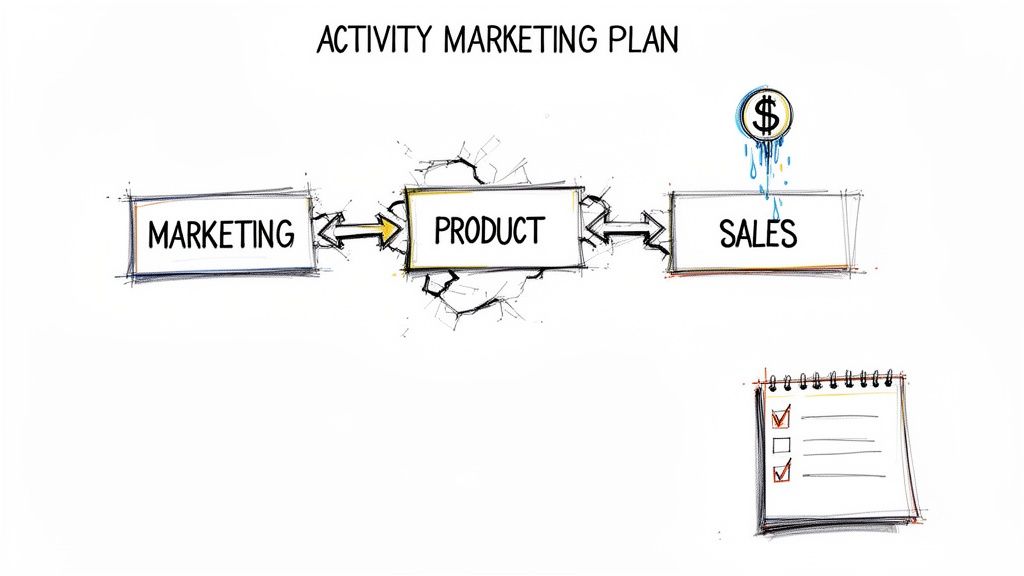
This flawed approach is the root of the most common and costly growth pains I’ve seen across more than 70 B2B SaaS companies. It’s why marketing budgets are burned on channels that don’t generate qualified pipeline. It’s why messaging fails to connect with your Ideal Customer Profile (ICP), and it creates a chasm between marketing’s output and what your sales team can actually close.
The purpose of a strategic marketing plan is not to document activity. It is a decision-making tool for allocating finite resources—time, money, and focus—to the highest-leverage initiatives that directly impact revenue.
An activity-based plan focuses on outputs: blog posts published, ads launched, events attended. A revenue-focused plan is built backward from the business's financial targets. It forces uncomfortable but critical conversations.
This isn't a semantic difference. It's a fundamental reframing of marketing’s role from a cost center to a revenue engine. Without this shift, any template is just a prettier way to organize wasted motion. You can learn more about aligning these efforts by understanding the modern B2B marketing funnel.
The template we’re about to build isn't about filling sections. It's about making a series of strategic commitments.
It forces hard choices about who you serve, what you will be the best in the world at, and how you will prove it. It connects every single marketing action directly to a sales outcome. This is the only way to build a marketing function that earns the respect of the board, the trust of the sales team, and a defensible market position.
Stop planning activities. Start engineering revenue.
Most marketing plans are dead on arrival. They get bogged down in tactical debates: Should we pour money into LinkedIn ads? Or is SEO the answer? Maybe another webinar? This tactical chaos is where budgets and good intentions go to die. It’s what happens when you build a strategy on sand.
A plan that drives revenue doesn't start with channels. It's built on three non-negotiable pillars that dictate every subsequent decision. Get these pillars right, and the tactical choices become obvious. Get them wrong, and you're just burning cash faster.
These pillars are Positioning, Pipeline, and Proof.
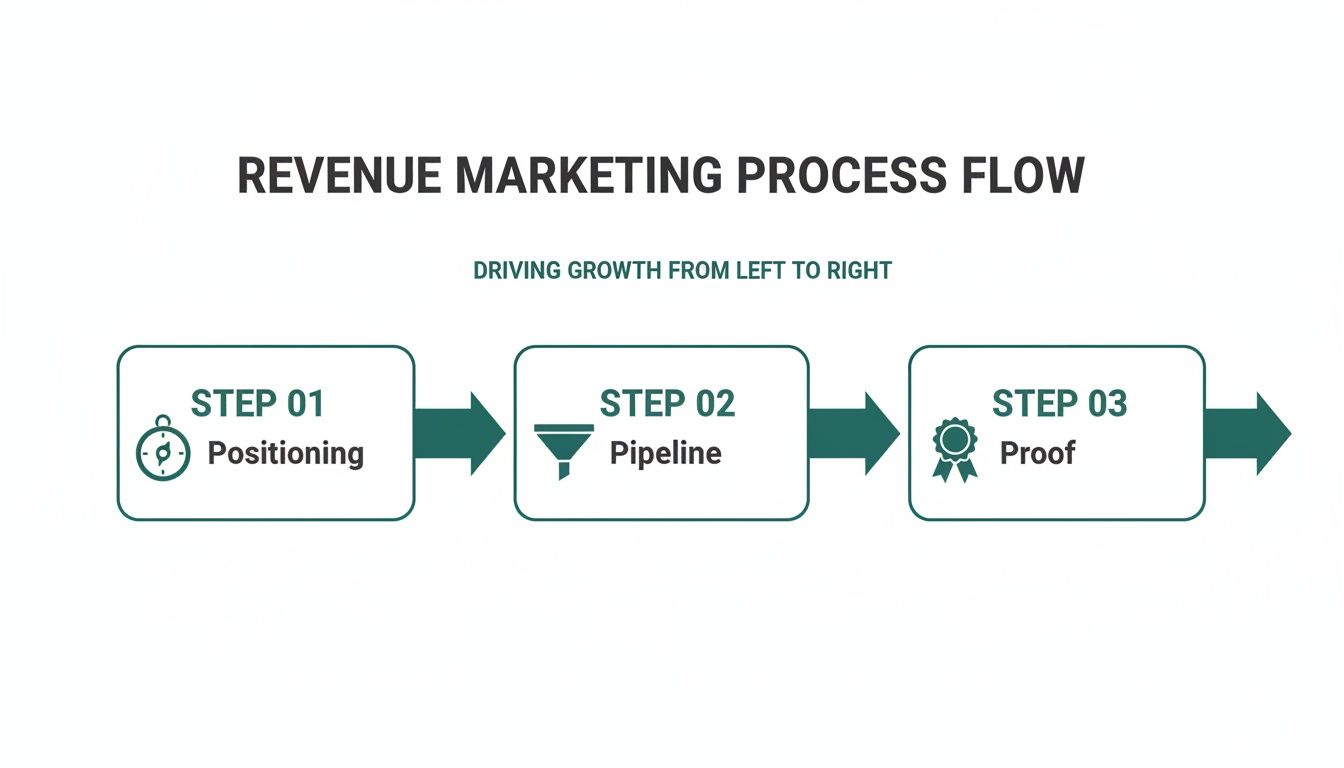
Positioning isn't a mission statement or a feature list. It’s the specific, painful market problem you solve for a very specific Ideal Customer Profile (ICP). It’s the argument for why your solution is the only logical choice.
Most B2B SaaS teams get this wrong. Their positioning is weak because they describe what their product is, not what it does for a buyer. This forces prospects to do the exhausting mental work of connecting your features to their business pain—work they almost never do.
Strong positioning is an exercise in strategic exclusion. It’s about having the discipline to say who your product is not for. That clarity is the single most powerful engine for efficient growth.
"Pipeline" is a precise term in a revenue-focused plan. It defines the complete, measurable journey from an anonymous prospect to a closed-won deal, with clear accountability at every stage.
This forces you and your sales counterpart to answer the tough questions that prevent finger-pointing later:
A marketing plan without a mathematically sound pipeline model is a list of expensive hopes. You have to show how $1 of marketing investment turns into a sales conversation and, eventually, a multiple of that in revenue. This isn't about hitting a vanity MQL target; it's about engineering a predictable system for creating qualified opportunities. Getting this right is so critical, which is why a deeper understanding of the foundational elements in the 3 pillars of B2B marketing can provide the clarity needed to build a revenue machine.
Your product claims are worthless without proof. The Proof pillar is your system for building overwhelming credibility and de-risking the purchase for your buyer. It’s the strategic collection and deployment of evidence that validates your positioning and makes your claims believable.
This is more than a logo wall. It’s about systematically creating assets that dismantle buyer skepticism at every stage.
| Common Template Section (Fluff) | Strategic Pillar (Revenue Focus) |
|---|---|
| "Our Mission Statement" | Positioning: The specific problem we solve for a defined ICP that makes us the only logical choice. |
| "Lead Generation Tactics" | Pipeline: The measurable model showing exactly how we convert anonymous prospects into closed-won deals. |
| "Testimonials Section" | Proof: The system for creating and deploying case studies, data, and social proof that validate our claims. |
Effective proof isn't accidental. It requires a deliberate process. Identify successful customers, document their outcomes in quantifiable terms (e.g., "reduced support tickets by 35%," "accelerated reporting from 4 hours to 5 minutes"), and package those results into formats your sales team can use to close deals.
Without this three-pillar foundation, your marketing plan is just a document. With it, your plan becomes a tool for engineering growth.
A plan is only valuable if it forces hard decisions. This is where we distill Positioning, Pipeline, and Proof into an actionable document. Think of this less as a fill-in-the-blanks exercise and more as a series of strategic commitments.
Most templates create the illusion of strategy while avoiding the hard questions. We're tossing those out. Instead, we’ll use sections that demand clarity and tie every activity back to revenue. As you start mapping things out, it's also helpful to have a broader framework in mind; a comprehensive founder's guide to a modern startup marketing strategy can provide excellent context.
Do not call this an "Executive Summary." A summary is passive; a mandate is a directive. It's an active commitment. This section, written last but placed first, is your one-page memo to the CEO and board. It must be brutally direct.
In no uncertain terms, it should state:
This section frames marketing not as a cost center but as a team accountable for a specific, measurable contribution to the company’s primary objective.
Here's where you show your math. You connect the business goal to your team's daily activities by working backward from the revenue target.
If the company needs $5M in new ARR and historical data shows a 25% close rate from a qualified opportunity, you know you need to generate $20M in qualified pipeline. If your average sales cycle is six months, that pipeline needs to be in the door by the start of Q3 at the latest.
This section forces a data-driven conversation with sales and finance. Get aligned on the critical numbers:
Without these numbers, your plan is a wish. With them, it becomes a revenue model.
This section requires ruthless focus. Define exactly who you are selling to and what burning problem you solve for them. This is not the place for broad personas.
A truly unassailable Ideal Customer Profile (ICP) includes:
Most importantly, define the problem from their perspective. A great problem statement sounds like something your buyer would say: "I'm spending 40 hours a month manually reconciling data between our CRM and our billing system, and I'm terrified something will break."
For a more detailed walkthrough on nailing this, check out our resource on building an ideal customer profile template.
With the ICP and problem locked down, this section answers: "Why us?" What’s our unique point of view on solving their problem? This is not a feature list; it's the core argument for your existence.
Your messaging should flow from a central theme in a clear hierarchy:
This structure becomes the source code for all communication from marketing and sales, ensuring you tell one coherent story.
This is the engine of your marketing plan. It details how you will create and capture demand. It’s a cohesive model with two interconnected motions.
For each motion, define the channels, the primary call to action, and the KPIs you'll track.
Now, attach dollars to your pipeline model. Allocate your budget based on your strategy, not a generic percentage split. If your focus is capturing existing intent, your budget should lean heavily into channels like Google Ads, not broad awareness plays.
Budgeting Rule of Thumb: Allocate 70% of your demand budget to proven, scalable channels (demand capture). Pour the other 30% into experiments (demand creation). This balances predictability and innovation.
Marketing’s job doesn’t stop at lead handoff. A great plan formalizes the handshake between marketing and sales. This section defines the assets and training marketing will deliver to help sales close deals faster.
This should include practical tools like:
This turns marketing from a "lead gen factory" into a strategic partner in driving revenue.
The final section is about accountability. It defines success and how you'll report on it, moving beyond vanity metrics to focus on what the CEO and board care about.
Your core marketing dashboard should track:
This framework closes the loop, connecting daily execution back to the Executive Mandate. It's how you prove ROI and earn the trust to ask for more budget. For a deeper dive, review our guide on how to measure marketing ROI.
A brilliant marketing plan sitting in a shared drive is worthless. I've seen it repeatedly: founders excel at strategy but stumble on operationalizing it. Turning strategy into growth requires a disciplined, repeatable system.
Your plan is not a cage; it's a compass. It keeps you pointed true north, helping you navigate the chaos of new ideas and urgent requests without getting knocked off course.
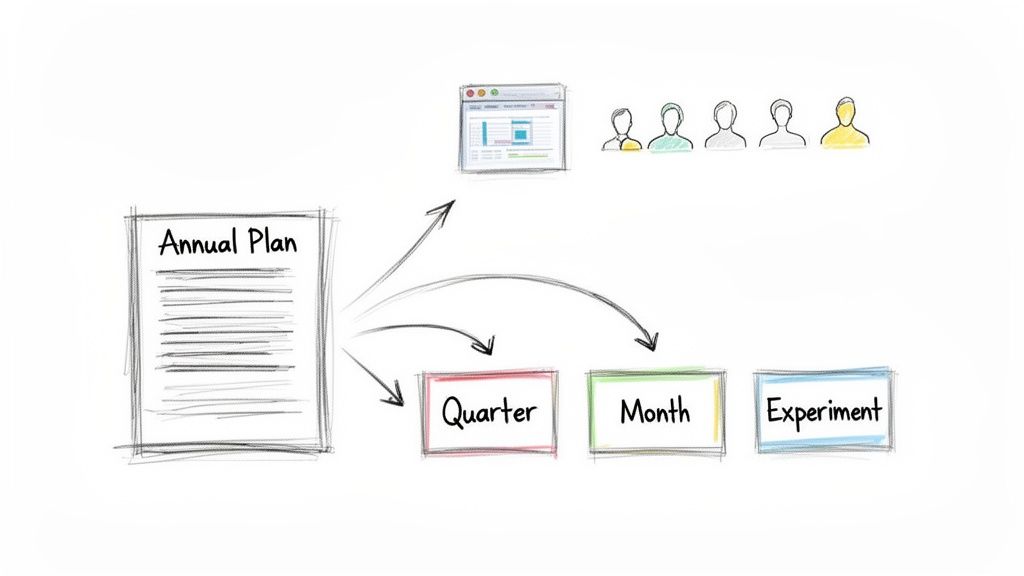
Break down your annual plan. The market moves too fast for a 12-month execution cycle. The real work happens in 90-day sprints. This forces focus and injects urgency.
Your annual plan sets the destination (e.g., $5M in new ARR). Your quarterly priorities are the critical moves you'll make in the next 90 days to get there. For every quarter, marketing, sales, and product leads must lock in on no more than 2-3 primary objectives that directly feed the annual goal. These are not wishes; they are measurable outcomes.
For example:
These specific objectives become your filter. When a new idea appears, ask: "Does this directly help us hit our quarterly objectives?" If the answer isn't a clear "yes," the default response is "not now."
This ruthless prioritization is your best defense against shiny object syndrome. It empowers your team to say no, protecting their focus from the constant distractions that derail startups.
With quarterly priorities set, translate them into action with a non-negotiable weekly growth meeting. This is not a status update. It’s a high-tempo, problem-solving session built around a handful of core questions.
The CEO-level dashboard is the centerpiece. It provides a clear, immediate view of pipeline health.
| Metric | This Week | WoW Change | Target | Status |
|---|---|---|---|---|
| New MQLs | 45 | +10% | 40 | Green |
| SQLs Accepted | 15 | -5% | 18 | Yellow |
| New Demos Booked | 12 | -15% | 15 | Red |
| Pipeline Generated | $180k | -20% | $225k | Red |
| Pipeline Coverage | 3.2x | -0.3x | 4.0x | Yellow |
This simple table instantly directs the conversation. If demos are down 15%, the discussion isn't about blog traffic. It’s about conversion rates, lead quality, and sales follow-up speed. The "red" numbers tell you exactly where to focus. This cadence—review, adjust, repeat—transforms your strategic plan from a static document into a dynamic tool and builds a culture of accountability. To effectively translate your plan into execution, leveraging a detailed product launch checklist can guide your efforts and ensure no critical steps are missed.
When you implement this disciplined process, the impact on sales is profound. Marketing operates with strategic focus, arming the sales team with higher-quality leads, better enablement assets, and a consistent story. This alignment is how you turn strategy into closed deals.
After advising over 70 B2B SaaS companies, I’ve seen the same handful of fatal errors sink marketing plans before they even get off the ground. These aren't minor missteps; they're fundamental misunderstandings of what a strategic plan is supposed to do. Recognizing these failure patterns is your best defense.
This is the most common mistake. A document lists activities: "run Google ads," "post on LinkedIn," "start a podcast." This isn't a strategy; it's a wish list of tactics disconnected from any business objective. A real strategy starts with the revenue target and works backward, identifying a specific market segment and carving out a differentiated point of view. Only then are tactics chosen.
Another critical error is delegating the thinking. Founders, feeling "too busy," offload strategy to a junior marketer or a low-cost agency. This is a catastrophic abdication of leadership.
You cannot outsource your company's strategic thinking. A junior employee or a cheap agency lacks the context, authority, and business-level understanding to make critical decisions about market positioning and resource allocation. They can execute tactics, but you must own the plan.
Early-stage founders often fall for metrics that feel good but mean nothing for revenue: website traffic, social media followers, email open rates. Your plan must be anchored to pipeline and revenue.
Track metrics that matter:
If your plan doesn't track these, it's a hobby, not a revenue engine. When building your own framework, referencing a comprehensive business development plan template can be a great way to ensure all revenue-driving bases are covered.
Many founders invest heavily in product and engineering but get sticker shock when it comes to marketing. They create an ambitious revenue goal but attach a shoestring budget to the engine meant to power it. I recall an early client, a US-based AI startup, stuck at 5% month-over-month growth because their efforts were scattered. By implementing a structured plan with clear goals, we redirected their spend and drove that growth to 35% within six months. You can explore more about how structured templates drive success by reviewing some data on monday.com.
A plan is doomed when built in an echo chamber. Marketing creates a document and "presents" it to sales and product, guaranteeing misalignment. Sales will say the leads are low quality, and the product team will be disconnected from market feedback. The strategic marketing plan must be a cross-functional pact, co-created and signed off on by sales, product, and marketing leadership.
A great strategic marketing plan template gets you to the starting line. Winning the race comes down to how you handle the tough questions that arise the moment you try to execute.
Think of your core strategy—your ICP, positioning, and revenue model—as your company's constitution. It’s built to last. Re-evaluate it semi-annually, or if a massive market event occurs. Your tactical plan, however, is a living document.
A plan that isn’t reviewed weekly and adjusted quarterly is already obsolete. The goal is disciplined adaptation, not rigid adherence.
Check performance against KPIs weekly. That data fuels quarterly priority planning. Be quick to adapt the "how," but be deliberate about changing the "why" and the "who."
There is no magic percentage. The right number depends on your growth stage, funding, and revenue targets.
The better question isn't "what percentage?" It's "what pipeline do we need to generate?" Work backward from your revenue goal. If you need $5M in new ARR and your model shows you need a 4x pipeline, your marketing team's job is to generate $20M in qualified pipeline. Your budget is the investment required to build that machine.
You, the founder or leader, own the strategy. Period. Do not delegate strategic thinking. Once the core plan is locked, then hire for execution.
An agency can be excellent for specific, channel-based execution—like performance marketing or SEO. They bring specialized expertise you may not need full-time. However, a strong in-house marketing leader is non-negotiable for owning the big picture. They ensure alignment with sales and product and translate business goals into marketing objectives. My advice is almost always: hire a great marketing leader first. Empower them to use agencies to fill tactical gaps.
The classic symptom of a broken plan. This is a strategy and alignment problem, plain and simple. This plan forces you to fix the problem at its foundation.
This process changes the conversation from finger-pointing to collaborative problem-solving. It forces both teams to look at the same data and work toward the one goal that matters: qualified pipeline.
Ready to move from tactical chaos to a revenue-focused strategy? Big Moves Marketing partners with B2B SaaS founders to build the positioning, messaging, and go-to-market plans that drive predictable growth. Let's build your plan.
Explore Big Moves Marketing services and resources:




%20-%20white.svg)