%20png%20copy.avif)
Most B2B SaaS founders download a business development plan template, fill in the blanks, and file it away. This isn't strategic planning. It’s a box-checking exercise that creates a false sense of security while actively misleading your growth efforts.
The standard template is an artifact from a different era, designed for a 1990s manufacturing business, not a modern SaaS company navigating complex GTM motions. For founders and revenue leaders today, it’s fundamentally broken.
I've seen this exact pattern play out across dozens of early-stage and growth-stage SaaS companies. A leadership team burns weeks building a document that becomes irrelevant the moment the market shifts—which is constantly.
The failure of most templates is that they force you to invent five-year revenue projections while completely ignoring the actual drivers of B2B SaaS growth: market positioning, ideal customer profile (ICP) clarity, and the unit economics of your sales motion.
This outdated approach creates a static document, not a living strategic tool. It promotes dangerous habits:
The result is a plan that gives you zero decision-making advantage. It won't help you decide whether to hire a sales rep or invest in content. It doesn't clarify which customer segment to prioritize. It just sits in a folder, a testament to wasted strategic cycles. A related concept, the sales playbook, suffers the same fate when it's treated as a static document instead of a dynamic guide for execution.
The traditional business plan is a relic obsessed with outputs—the plan itself—rather than outcomes, which are the smarter, faster decisions you make every day.
For a B2B SaaS founder, a business development plan template is only useful if it becomes a living framework for testing your assumptions. It’s not about predicting the future; it's about systematically de-risking it.
This requires a shift in thinking. The goal is to build a plan that drives action, not one that gathers dust. A modern, SaaS-native approach doesn't waste weeks on abstract market analysis or five-year revenue fantasies. Instead, it maps the specific go-to-market activities, sales motions, and partnership channels that will land your first 10, then 50, then 100 high-value customers.
The lifecycle of a static business plan is painfully predictable. It starts with excitement and ends in irrelevance.
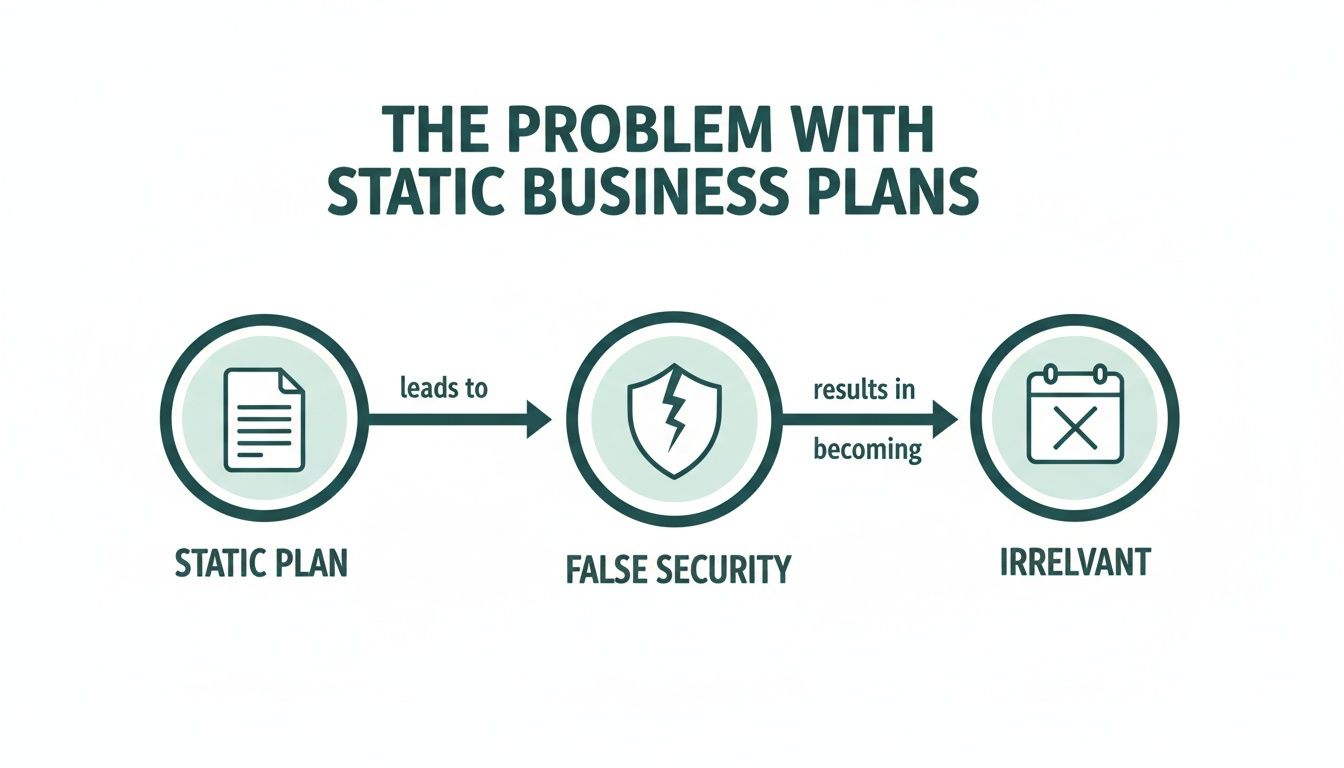
This document-centric process gives you a false sense of security. But that feeling quickly fades as the plan becomes completely disconnected from the day-to-day reality of running the business.
The difference between a document and a decision-making system is stark. Most templates guide you toward creating a historical artifact. We help leadership teams build an operating system for growth.
Here’s how the two approaches stack up.
This shift forces operational clarity. Your plan stops being a static map and transforms into a compass, guiding your next move based on real-time feedback from the market. It’s less about having all the answers upfront and more about building a system to find them quickly. A well-structured product launch plan should be built on these exact same dynamic principles.
The purpose of a SaaS business development plan isn't to be right; it's to get less wrong, faster. It’s a tool for structured learning, where every action generates data that refines your model of how the business actually grows.
Embracing this mindset means moving beyond a static Word doc. To build a dynamic OS for growth, you must inform your execution with proven tactics. Exploring these 10 Proven SaaS Growth Strategies is a solid starting point. Ultimately, this framework becomes the central source of truth for your entire go-to-market team, aligning sales, marketing, and product around a unified set of assumptions and goals.
A generic business development plan template is a waste of time. The hollow sections like "Market Analysis" or "Sales Strategy" invite vague, unactionable fluff. To build a plan that drives growth, you must discard those old categories and use a framework built for SaaS—one based on assumptions you can test.
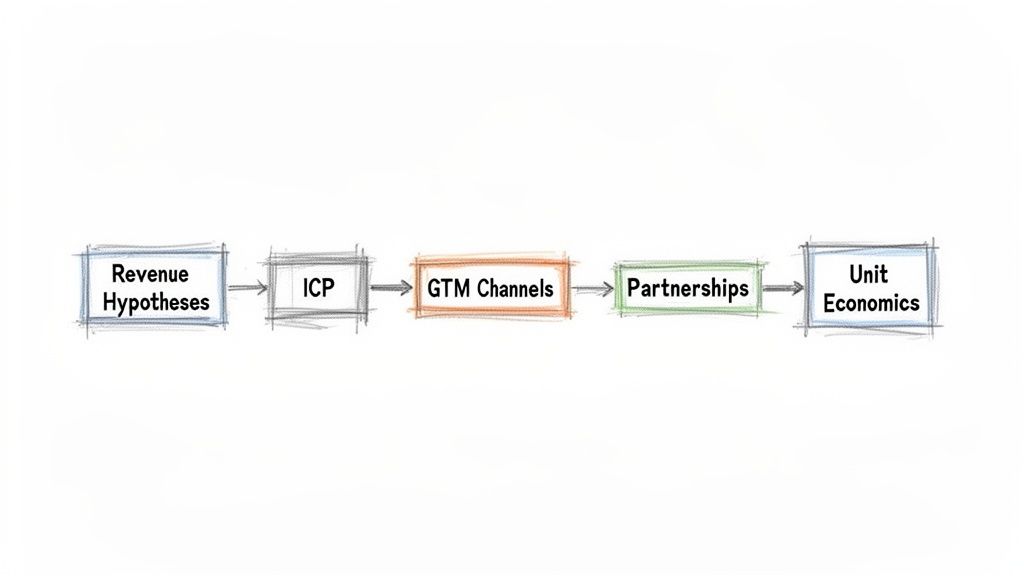
This isn't about filling in blanks. It's about codifying how you think your business will grow and maintaining the discipline to stick to that model.
Most business plans start with a top-down revenue target pulled from thin air. This is backward. A plan that works starts with a bottom-up growth hypothesis.
The format is simple but forces strategic thought:
If we target [Specific ICP] on [Specific Channel] with a message about [Specific Pain Point], then we will achieve [Quantifiable Outcome] because of [Underlying Reason].
This reframes the entire exercise from wishful thinking into a series of structured experiments. "Achieve $1M ARR" is a weak goal. A strong hypothesis is: "If we target VPs of Revenue at Series B marketing tech companies with content on sales cycle compression, we can book 20 demos per month, because our data shows they are struggling with deal velocity in the current economy."
This approach turns your plan into a set of testable "if-then" statements—the only intellectually honest way for an early-stage company to operate.
"Ideal Customer Profile" has been watered down to a firmographic checklist. This is insufficient and dangerous. A real business development plan defines your ICP across three critical dimensions:
If you don't understand the trigger, you're just noise. An ICP definition that lacks this depth guarantees your go-to-market motion will be unfocused and expensive.
Founders make one of two mistakes: they either try to be everywhere at once, or they default to popular channels like LinkedIn ads or outbound SDRs. Both are excellent ways to burn cash.
A strategic plan doesn't list channels; it prioritizes them based on a single criterion: Where does our hyper-specific ICP already go to find solutions for the pain we solve?
If you sell to developers, they aren't responding to cold emails. They live on GitHub, Stack Overflow, and in niche communities. If you're selling to CFOs, they're moved by peer recommendations and data-backed ROI cases, not flashy social media campaigns.
Your plan must pinpoint one primary and one secondary channel for initial tests. Master those before considering a third. Channel selection is a core strategic decision, not a tactical to-do list.
Business development and sales enablement are two halves of the same engine. Your business development plan is worthless if your sales team lacks the messaging and tools to execute it.
This means your plan must explicitly connect strategy to the assets your sales team will use on the ground.
For each growth hypothesis, you must answer:
When sales enablement is an afterthought, the plan grinds to a halt. When it's baked in, you create a flywheel where market feedback from sales calls directly refines your overarching strategy. Data backs this: studies show that 71% of high-growth companies have a formal business plan. For SaaS startups, this effect is amplified when go-to-market strategies and sales enablement are tightly integrated. More business planning statistics show that founders who combine their plans with detailed financial projections see 15-20% better capital efficiency.
A growth plan without financial guardrails is a fantasy. Before you spend a dollar on a campaign, you must define what "good" looks like from a unit economic perspective. This isn't a complex financial model; it's a set of non-negotiable rules.
Your plan must define your absolute maximum allowable Customer Acquisition Cost (CAC), your minimum required Lifetime Value (LTV), and your maximum payback period.
These aren't goals; they are hard constraints. For example: "We will not pursue any channel where CAC exceeds $5,000," or "Our business model only works if the LTV:CAC ratio is at least 3:1 and the payback period is under 12 months."
These guardrails become an instant filter for every decision. If a proposed marketing campaign can't plausibly hit your CAC target, you don't run it. This discipline prevents you from scaling an unprofitable business—the most common and fatal mistake in venture-backed SaaS.
A plan without the right metrics is a wish list. The biggest mistake in business development plans is an obsession with vanity metrics—top-line revenue, MQLs, user growth. They look impressive in a boardroom but can hide fatal flaws in your business model.
A real growth plan for a B2B SaaS company is built on a foundation of unit economics and pipeline metrics. Think of these not as numbers to track, but as diagnostic tools.
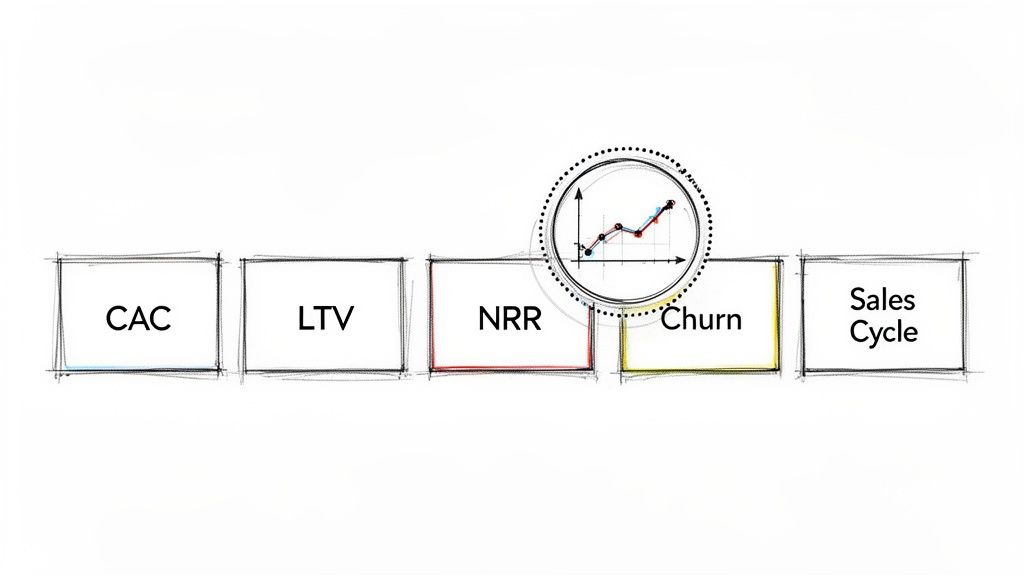
They tell you exactly where your growth engine is sputtering. If you're not measuring what truly matters, you're flying blind.
Forget sprawling dashboards. Most founders can diagnose the health of their GTM motion with just a handful of numbers. Your business development plan must set clear targets for these core indicators.
Customer Acquisition Cost (CAC) to Lifetime Value (LTV) Ratio: The master metric of SaaS viability. An LTV:CAC ratio below 3:1 is a red light, suggesting you're buying unprofitable growth. A healthy ratio proves your acquisition strategy is sound.
CAC Payback Period: How many months of revenue does it take to recoup the cost of acquiring a customer? In venture-backed SaaS, a payback period under 12 months is the gold standard. Stretching past 18 months signals a critical flaw in your pricing or acquisition channels.
Net Revenue Retention (NRR): This measures revenue growth from your existing customer base (upsells, cross-sells, churn). An NRR over 100% means your business grows even if you don’t add a single new customer. It’s the clearest sign of product stickiness.
Pipeline Coverage: Your sales forecast's reality check. To hit your quarterly revenue target, you need a pipeline of qualified opportunities worth at least 3-4x that number. Anything less and you're setting your sales team up to fail.
These aren't just numbers for a report; they are strategic guardrails. A long payback period can invalidate an acquisition channel. Low NRR tells you to fix retention before chasing new logos. It’s critical to get a firm grip on understanding KPI vs metrics to ensure you’re focused on indicators that lead to action.
KPIs are useless unless they connect directly back to your strategic initiatives. Each metric should answer a hard question about your plan.
For example, a service company I advised documented a $340 CAC with a $4,200 LTV—a stunning 12.4x ratio that validated their entire growth model. That data-driven planning proved demand before scaling investment, dramatically reducing execution risk.
A declining win rate isn't just a sales problem; it's a strategy problem. It might signal a messaging disconnect, a shift in the competitive landscape, or that you're targeting the wrong ICP. Your plan must be a living document that uses this data to trigger a strategic review, not just a sales performance review.
This is how you turn a simple plan into a powerful diagnostic tool.
Example Scenarios:
Building your plan around these feedback loops creates a self-correcting growth engine. To nail this, you need to learn more about how to measure marketing ROI effectively. The goal isn't a perfect plan from day one. It's to create a system that forces you to confront reality, adapt quickly, and make decisions based on data, not hope.
I’ve seen dozens of business development plans fail. The patterns are predictable. They almost never implode because of a bad idea. They fail because of flawed assumptions and a lack of executional rigor. These are the common traps.
This is the most common way SaaS growth plans die. A team builds a product and drafts a plan assuming customers will simply recognize its brilliance. Then… nothing. They believe, "If you build it, they will come."
This is a catastrophic misreading of how B2B markets work. Your plan can't just assume demand exists. It must lay out explicit, testable hypotheses for how you will create it. The warning sign is a plan heavy on product features but light on the GTM motion. The fix is to become obsessed with distribution.
Early on, it's tempting to chase any prospect who shows interest. This is a siren song that leads straight to ICP drift. Your definition of an "ideal customer" changes weekly, often based on the last sales call.
This scrambles your messaging, confuses your product roadmap, and makes it impossible for marketing to build momentum. You can't build an effective lead generation for SaaS engine when the target is always moving. The solution is discipline. Your plan has to lock in a primary ICP for at least one full quarter. You must commit to testing that hypothesis thoroughly before considering a pivot.
This is the strategic equivalent of ADHD. A founder tries outbound for three weeks, sees no immediate results, and declares it a failure. Then they jump to LinkedIn ads for a month with a tiny budget and abandon that, too.
Most GTM channels take 6-9 months to yield meaningful, repeatable data. Abandoning a channel before it has time to mature is one of the most expensive mistakes a startup can make.
A strong plan commits to one or two channels aligned with your ICP. It allocates enough time and resources to run a proper test. The goal isn't instant results; it's validated learning.
This failure is so common it's a cliché, yet it plays out constantly. Marketing is measured on generating MQLs and runs campaigns for one persona. Sales, measured on closed revenue, ignores those leads and pursues a different customer type.
They are running two different playbooks for two different companies. This is a direct path to burning cash and creating internal friction. Your business development plan must be the single source of truth that forces alignment. It must define the ICP, value proposition, and success metrics for both teams. If marketing and sales don't sign off on the same plan, it’s dead on arrival.
The most insidious failure is scaling a business that loses money on every customer. Leaders get seduced by top-line revenue growth while ignoring a disastrous LTV:CAC ratio or a payback period stretching beyond 24 months.
A modern business development strategy must be anchored in unit economics. This means obsessively tracking KPIs like net revenue retention and maintaining a healthy 3–4× pipeline coverage relative to revenue targets. For example, companies that implement structured upsell and cross-sell initiatives often increase revenue from existing customers by 15-25%, proving the power of a metrics-driven approach.
Your plan absolutely must have non-negotiable economic guardrails. If a channel can't produce customers within your target CAC, you kill it. If your payback period creeps up, you halt expansion and fix the model. Ignoring broken unit economics isn't optimism; it's a slow-motion suicide mission.
A business development plan template is a starting point. The real value comes from the hard questions it forces your leadership team to confront. The document itself is secondary to the clarity and alignment that rigorous planning creates.
Forget the annual review. For an early-stage B2B SaaS company, your business development plan is a dynamic tool.
Conduct a formal, deep-dive review quarterly to assess progress against your core hypotheses and KPIs. But the plan's key assumptions—around ICP, messaging, and channels—should be stress-tested monthly.
If your win rate drops, your sales cycle lengthens, or a new competitor emerges, that’s a trigger. Revisit the relevant section of your plan immediately. Think of the plan as your strategic dashboard, not a static artifact.
The single biggest mistake is confusing activity with progress. Founders create a plan packed with tactics—"post on LinkedIn," "run ads," "attend events"—without a clear strategic through-line connecting that activity to a business outcome.
They end up with a to-do list, not a strategic framework. A strong plan doesn't just list what you will do; it articulates the hypothesis behind each action.
A weak plan says, "We will post on LinkedIn."
A strong plan says, "We will target VPs of Engineering at Series B fintechs (ICP) on LinkedIn (Channel) with content about reducing CI/CD pipeline costs (Pain Point), because we believe they have the budget and urgency to solve this now." That is a testable strategy, not just a task. To get this right, you must develop a deep understanding of your ideal customer profile.
Yes, but with a critical distinction. Do not create a five-year revenue fantasy pulled from thin air.
Your financial model must be a direct output of your GTM and unit economic assumptions. Instead of starting with "we'll hit $5M in ARR in year three," start from the bottom up.
Your financial projections should be the mathematical result of your strategic plan. This makes them a tool for testing the viability of your strategy—not an arbitrary number for an investor deck. When the numbers don't add up, it forces you to confront flawed assumptions in your plan before you waste a dollar in the market.
At Big Moves Marketing, we help B2B SaaS founders and revenue leaders move beyond generic templates. We work with you to build a dynamic growth operating system—a plan grounded in market reality that provides the clarity needed to make faster, smarter decisions and avoid wasted growth motion.
If you’re ready to build a plan that actually drives results, learn more at https://www.bigmoves.marketing.
Explore Big Moves Marketing services and resources:



%20-%20white.svg)